
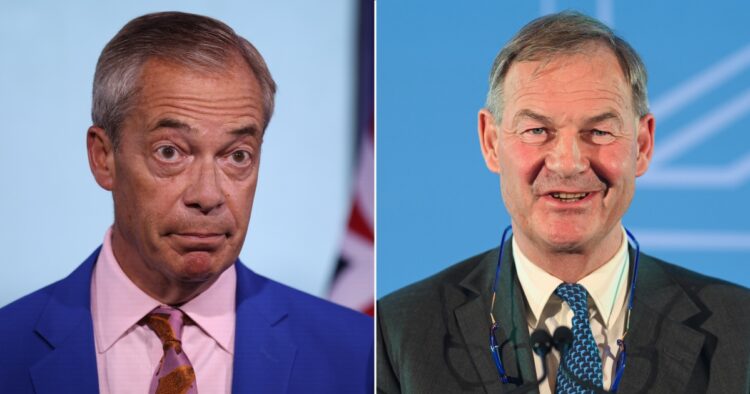
Reform UK are once again furious at Restore Britain after the party lost a council by-election to Labour by a margin of just two votes.
It’s becoming quite the regular occurrence for Nigel Farage’s party as once again Rupert Lowe’s Restore Britain has split the hard-right vote in a tight by-election, allowing Labour to swoop in and win.
Of course, this is simply called democracy, and Labour could make a similar argument about Green candidates standing and splitting the left-wing vote.
But that doesn’t matter to Reform, who are fuming with Restore after events in Dudley.
On Thursday, a by-election took place for the St James ward on Dudley, after the incumbent Reform councillor stood down for personal reasons in September.
in a dramatic vote, Labour’s Caroline Reid regained the ward she lost in May’s elections. Reid won 874 votes, just two more than Reform candidate Chris Chivers’ 872, BirminghamLive reports.
Sam Firmstone for the Conservative Party finished in third place with 317 votes while Restore Britain – who hadn’t stood in the seat back in May – received 159 votes for their candidate.
The result does little to affect the makeup of Dudley council, where the Tories are still the largest single group with 27 councillors and Reform UK are the largest opposition group with 22 elected members.
Labour now have 16 councillors, whilst the Lib Dems have four.
Reacting to the result, Reform’s deputy leader Richard Tice wrote on X: “Vote Restore, get Labour.”
It was only last week that a very similar thing happened in Leicestershire, where Restore carved out enough of the hard-right vote to torpedo Reform’s chances of holding onto a seat.
And at the start of October, there were two more races in which Restore split the vote to open the door Labour.
It spells bad news for Reform, who now seem to be haemorrhaging support to all sides. For weeks, Labour have been pulling clear of Reform in the polls, and now the Tories seem to be winning back voters as they return to second place.
REFORM FURY AT RESTORE BRITAIN AFTER LOSING BY-ELECTION TO LABOUR BY JUST TWO VOTES – FARAGE’S PARTY LEFT FACING A POLITICAL NIGHTMARE!
Nigel Farage’s Reform UK has suffered a humiliating electoral setback after losing a crucial council by-election to Labour by just TWO votes, triggering fresh anger over the growing influence of Rupert Lowe’s Restore Britain.
The extraordinary result in Dudley’s St James’s ward has reignited the bitter rivalry between the two right-wing political movements, with Reform supporters accusing Restore Britain of splitting the vote and allowing Labour to snatch victory.
For Farage, the defeat could hardly have come at a worse time.
Reform has spent months attempting to establish itself as Britain’s dominant alternative to Labour and the Conservatives. Yet the latest result has exposed a potentially serious weakness in its electoral strategy: the emergence of another political movement competing for many of the same voters.
Labour’s Caroline Reid secured 874 votes, narrowly defeating Reform candidate Chris Chivers, who received 872.
That is a difference of just two votes.
Meanwhile, Restore Britain’s candidate, Tristian Owens, collected 159 votes, a figure that immediately became the centre of a furious political argument.
Reform deputy leader Richard Tice responded to the result with a blunt message on social media: “Vote Restore, get Labour.”
The statement perfectly captured the frustration within Farage’s party.
But was Restore Britain really responsible for Labour’s victory, or is Reform simply struggling to accept the consequences of an increasingly divided political right?
A TWO-VOTE DEFEAT THAT HAS SHOCKED REFORM
The result in St James’s ward is particularly significant because Reform had previously enjoyed a comfortable victory there.
During the May 2026 local elections, Reform secured the ward with 1,630 votes, defeating Labour by a majority of 903.
At that point, the result appeared to demonstrate the strength of Farage’s political movement in an area where dissatisfaction with the established parties had created opportunities for Reform.
However, just a few months later, the political situation changed dramatically.
The by-election was triggered after Reform councillor Ivor Robinson resigned for personal health-related reasons.
With the seat becoming vacant, Labour saw an opportunity to recover territory it had lost earlier in the year.
Caroline Reid ultimately succeeded, receiving 874 votes against Chivers’s 872.
The Conservatives finished third with 317 votes, while Restore Britain secured 159.
The Green Party received 79 votes.
The turnout was approximately 22.45 per cent.
For Labour, the victory was a remarkable result in a ward that Reform had previously won comfortably.
For Reform, it was a deeply frustrating reminder that even a small movement in voting behaviour can completely change the outcome of an election.
RUPERT LOWE’S RESTORE BRITAIN BECOMES A PROBLEM FOR FARAGE
At the heart of the controversy is Rupert Lowe, the former Reform MP who established Restore Britain as a separate political movement.
Lowe has increasingly positioned his organisation as an alternative for voters who believe Reform is not going far enough on immigration, national identity and other political issues.
That strategy creates an obvious problem for Farage.
Both organisations are competing for sections of the electorate that are dissatisfied with mainstream British politics.
They may disagree about leadership, political strategy and the direction of the country, but there is considerable potential overlap between their target audiences.
The Dudley result has therefore become another example of the difficulties that can emerge when two parties appeal to similar groups of voters.
Restore Britain’s candidate received 159 votes.
That is 157 more than the difference between Labour and Reform.
The mathematics are undeniably striking.
However, it would be inaccurate to claim that all 159 Restore voters would otherwise have supported Reform.
Some might have voted Conservative, stayed at home or chosen another candidate.
Others may have supported Restore precisely because they rejected Reform’s political approach.
There is no reliable evidence establishing how those voters would have behaved if Restore Britain had not contested the election.
Nevertheless, the result demonstrates why Reform is increasingly concerned about competition from Lowe’s movement.
FARAGE AND TICE SEND A CLEAR MESSAGE
The reaction from Reform’s senior leadership was immediate.
Richard Tice took to X and wrote: “Vote Restore, get Labour.”
The message was short, direct and clearly designed to place responsibility for the defeat on Restore Britain.
Nigel Farage also criticised the outcome, highlighting the tiny difference between the two leading candidates and the number of votes received by Lowe’s party.
His argument was straightforward: a divided right-wing electorate makes it easier for Labour to win constituencies that might otherwise be competitive.
The Reform leader also used the result to reinforce his wider political message that the next general election could be decisive for Britain’s future.
Farage has repeatedly argued that voters must unite behind his party if they want to remove Labour from power.
However, Lowe’s supporters are unlikely to accept that argument without a fight.
Restore Britain exists because its supporters believe they deserve a separate political alternative.
Expecting those voters to abandon their preferred party simply to help Reform is unlikely to resolve the underlying disagreement.
The political conflict is therefore becoming increasingly difficult to contain.
LABOUR CELEBRATES AN UNEXPECTED VICTORY
While Reform and Restore Britain argued over the consequences of the result, Labour had every reason to celebrate.
Caroline Reid’s victory represented a significant turnaround from the May election.
The party had previously lost the ward to Reform by a substantial margin, making its recovery particularly noteworthy.
Winning by just two votes may not sound impressive, but electoral politics is ultimately about securing more votes than your opponents.
Reid achieved exactly that.
The result also provides Labour with an opportunity to argue that Reform’s growing problems with competing right-wing movements could benefit the government.
If Reform and Restore Britain continue fighting over the same electorate, Labour may find opportunities to win otherwise difficult contests.
However, Labour should not assume that the result guarantees a broader political recovery.
A local by-election involving a relatively small electorate cannot automatically predict what will happen in a general election.
Nevertheless, the psychological impact of the result could be significant.
For Labour activists, it provides evidence that Reform is not unbeatable.
For Reform, it is an uncomfortable warning that political momentum can disappear remarkably quickly.
THIS IS NOT THE FIRST TIME RESTORE HAS CAUSED PROBLEMS FOR REFORM
The Dudley defeat is particularly embarrassing because it follows similar results elsewhere.
Earlier in October, two council by-elections produced narrow Labour victories in which Restore Britain also attracted votes from an electorate that included potential Reform supporters.
In Shepshed, Leicestershire, Labour defeated Reform by 53 votes after a recount.
Restore Britain secured approximately 6.4 per cent of the vote.
Other contests have also raised questions about whether the emergence of Lowe’s movement could complicate Reform’s efforts to win marginal seats.
This is becoming a recurring problem for Farage.
Reform may be performing strongly in some national opinion polls, but national popularity does not automatically translate into victories in individual constituencies.
Under Britain’s first-past-the-post electoral system, the distribution of votes matters enormously.
A party can receive substantial support across the country while still losing crucial constituencies because its opponents are better positioned locally.
The danger for Reform is that even relatively small numbers of voters choosing Restore Britain could influence the outcome of closely contested elections.
That does not mean Restore voters are responsible for Labour victories.
It means the political right is facing a serious question about fragmentation.
WHY RUPERT LOWE IS UNLIKELY TO BACK DOWN
For Rupert Lowe, the controversy may actually represent an opportunity.
Restore Britain has demonstrated that it can attract voters in areas where Reform previously enjoyed strong support.
Rather than treating this as a reason to withdraw, Lowe may view the result as evidence that his movement has a political future.
His supporters are unlikely to be impressed by demands that they should simply vote for Farage.
Indeed, the more aggressively Reform attacks Restore Britain, the more difficult it could become for the two movements to find common ground.
There is also a wider strategic disagreement.
Farage wants Reform to become a major national political force capable of challenging Labour and the Conservatives.
Lowe’s movement wants to establish its own identity and attract voters who are dissatisfied with the existing political choices.
Those ambitions may prove difficult to reconcile.
Unless one side changes its approach, competition between the two organisations could become a recurring feature of British elections.
THE BIGGER PROBLEM FOR BRITAIN’S POLITICAL RIGHT
The Dudley result highlights a fundamental weakness in the assumption that voters who support different right-wing parties will automatically unite behind a single candidate.
Political allegiances are more complicated than that.
Some voters may prioritise immigration, others may focus on economic policy, and others may simply dislike particular political personalities.
A voter who supports Restore Britain is not necessarily a Reform voter waiting to return to Farage.
Likewise, someone who chooses the Conservatives cannot automatically be expected to support Reform.
The British right is therefore facing a challenge that goes beyond the rivalry between two political leaders.
It must decide whether it can accommodate different political movements or whether internal competition will continue creating opportunities for Labour.
The Conservatives are also part of this equation.
Kemi Badenoch’s party is attempting to rebuild its support, meaning Farage cannot assume that every dissatisfied Conservative voter will move towards Reform.
The political landscape is becoming more complicated, not less.
FINAL VERDICT: TWO VOTES, ONE HUGE POLITICAL WARNING FOR FARAGE
The defeat in Dudley’s St James’s ward may have involved only two votes, but its political consequences could extend much further.
Labour’s Caroline Reid has regained a seat that Reform won comfortably in May.
Restore Britain’s Tristian Owens received 159 votes, prompting angry accusations that Rupert Lowe’s movement had divided the right-wing electorate.
Richard Tice’s response, “Vote Restore, get Labour”, demonstrated the frustration within Reform.
Yet the result also exposes a difficult reality for Farage.
He cannot simply demand that voters support his party while assuming that competing political movements will disappear.
If Reform wants to become a credible governing alternative, it must find a way to attract voters beyond its existing support base.
For Labour, the result offers encouragement and an opportunity to exploit divisions among its opponents.
For Lowe, it demonstrates that Restore Britain can influence closely contested political battles.
And for Farage, it is a warning that the biggest threat to Reform’s electoral ambitions may not always come from Labour.
Sometimes, the most damaging political battles are the ones taking place on your own side.
Two votes separated Labour and Reform in Dudley. But 159 votes for Restore Britain have created a much bigger question for Nigel Farage: how can he unite Britain’s right when another movement is determined to compete against him?