
Reports say that more than 20 Labour councils covering four million people are expected to have elections cancelled this year after telling ministers that they do not have the “capacity” to hold a vote.
Reform UK’s Zia Yusuf told GB News on Wednesday that the party was ready to mount a judicial review in the High Court to try to force the Government to over-rule the councils’ requests.
Yusuf said: “Reform’s lawyers are coming at them with everything we’ve got.”
Zia Yusuf told GB News: ‘Reform’s lawyers are coming at them with everything we’ve got’
| PA
Last month ministers asked 63 councils in England if they wanted to delay their elections until 2027 so they could bed in a local government shake up, prompting howls of protest from Reform.
They were given until midnight on Thursday this week to say if they wanted a delay. Ministers said they would be “minded” to agree to any postponement.
Sources have tonight told The Times newspaper that 27 local authorities covering more than 5.2million people and 3.7million registered voters will ask the minister for a delay.
Last month Local Government minister Alison McGovern said: “We have listened to councils who’ve told us of the challenges they face reorganising while preparing for resource-intensive elections for areas which may shortly be abolished.
Last month ministers asked 63 councils in England if they wanted to delay their elections until 2027
“Several have submitted requests to postpone elections so it is therefore right we let them have their say so they can focus their time and energy on providing vital services while planning for re-organisation.”
Sir Keir Starmer has been handed a “50-50 chance” of keeping his job by the end of the year by one of his own ministers.
On Tuesday – ahead of Labour’s 13th U-turn in scrapping mandatory Digital IDs – ministers were said to be frequently discussing how long Sir Keir had left.
“What’s happening at the moment is extraordinarily bad,” one admitted. “We can’t just pretend otherwise.”
Another Cabinet colleague was asked whether he would still be in No10 by December – and replied: “50-50.”
1American history could be rewritten after ‘ancient civilisation older than the pyramids’ emerges …
2Petrol and diesel drivers dealt blow as Labour hikes charges next month in major emissions push
3Evri delivers empty box to pensioner, 78, before sending her picture of ‘completed order’
4Iranian shopkeeper, just 26, to be hanged after spending final minutes with family
Labour’s big hitters were also said to be furious at Sir Keir’s reshuffle after Angela Rayner resigned in disgrace in November.
“We’ve gone through a catastrophic series of missteps,” yet another minister told the Financial Times.
And another still added: “I’m not convinced any of the options are better than Keir, but we are so unpopular at the moment I’ve come to the conclusion it’s worth rolling the dice.”
The harsh words came just as it emerged Labour was considering making the planned digital ID Right to Work checks voluntary rather than compulsory in 2029 – its 13th U-turn.
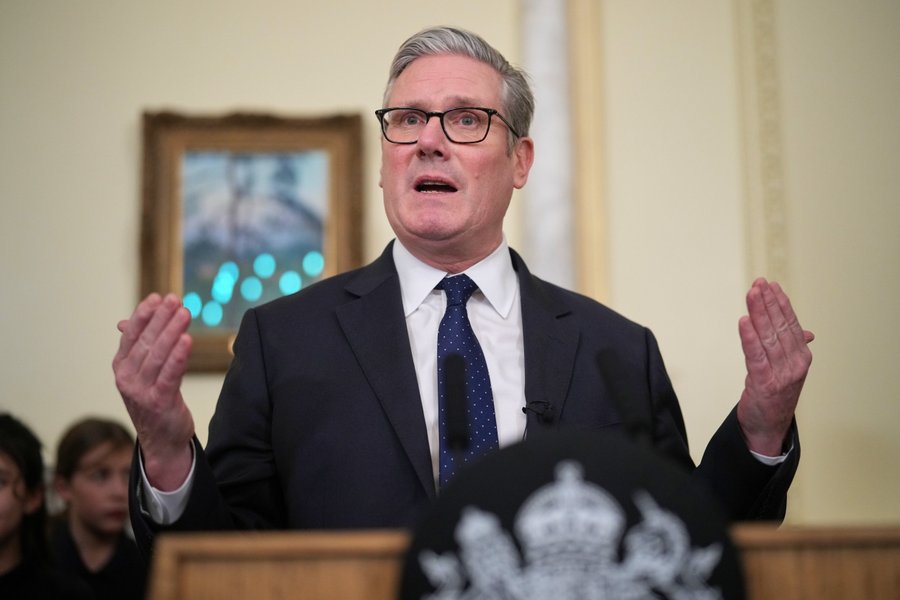
Sir Keir Starmer has been handed a ’50-50 chance’ of keeping his job by the end of the year by one of his own ministers
| PA
In fewer than two years in charge, the party has changed tack on tax rises, slashing winter fuel payments, welfare reforms, holding a grooming gangs inquiry and many more.
One minister who has publicly criticised the party is Health Secretary Wes Streeting.
Mr Streeting, who has been touted for a potential leadership challenge, said: “This excuses culture does the centre-left no favours.
“If we tell the public that we can’t make anything work, then why on Earth would they vote to keep us in charge?”
Health Secretary Wes Streeting said tat an excuses culture ‘does the centre-left no favours’
| PA
But, speaking to GB News on Wednesday morning, Transport Secretary Heidi Alexander denied that the Government had made any such U-turns.
“I just don’t accept that all of the things that you read out have been U-turns,” she told the People’s Channel.
“I think it’s right that a government course corrects if new information becomes available; it’s right that if we can make a policy better, we will.”
She added: “I don’t know exactly what Wes has said in the last couple of days. You’re quoting something to me that I haven’t actually heard. I know that this government is totally united on delivering against the priorities that we set out in our manifesto, which was to bring stability back to the economy.”
The Prime Minister also appeared to have maintained some support around the Cabinet table.
“There’s no way he’s going to go of his own accord,” one minister added – and argued that Sir Keir sees May’s crunch local elections as unrepresentative of how Britain may vote in a General Election.
REFORM UK SET TO SUE LABOUR OVER LOCAL ELECTION CANCELLATIONS: “WE ARE COMING FOR YOU!”
A major political confrontation erupted in Britain when Reform UK launched legal action against the Labour government over plans to postpone local elections in several parts of England.
The dispute quickly became one of the most controversial political battles of 2026, raising serious questions about democratic accountability, the government’s powers and the rights of millions of voters.
Reform UK, led by Nigel Farage, accused Labour of attempting to prevent people from having their say at the ballot box.
The party’s message was uncompromising: it would challenge the government through the courts rather than accept a decision that could leave communities without their scheduled elections.
The confrontation was not simply about council timetables. It became a wider argument about whether political leaders should be able to change election dates while undertaking major reforms to local government.
At the centre of the controversy was Labour’s programme to reorganise local authorities in England.
The government argued that some councils were facing considerable administrative pressure as they prepared for structural changes. In areas where existing councils were expected to be replaced by new authorities, ministers said postponing elections could help avoid unnecessary costs and organisational difficulties.
However, Reform UK saw the proposal very differently.
For Farage’s party, the possibility that millions of people could lose the opportunity to vote in elections scheduled for May represented an unacceptable interference with local democracy.
The party argued that residents should not be expected to wait another year simply because the government was reorganising the structure of local councils.
Reform’s legal challenge therefore became a test of the government’s authority and the limits of its ability to alter the electoral timetable.
The scale of the dispute was significant.
According to contemporary reporting, the government had considered postponing elections in around 30 council areas, potentially affecting more than 4.5 million people.
The controversy attracted attention across the political spectrum because the proposed changes affected councils controlled by different parties.
Reform accused Labour of weakening democratic accountability at a moment when opposition parties were preparing to challenge the governing party in local contests.
Labour rejected the suggestion that it was attempting to avoid an electoral defeat.
Ministers maintained that local government reorganisation created exceptional practical difficulties and that postponements could be justified where councils were struggling to organise elections during the transition.
But that explanation did little to calm the political storm.
For Reform UK, the issue offered an opportunity to present itself as a party prepared to confront the government over democratic rights.
Farage’s supporters argued that elections should not become optional whenever they create administrative inconvenience for politicians.
The party’s aggressive language reflected the seriousness with which it viewed the dispute.
Its message to Labour was effectively that the government would face legal and political consequences if it attempted to prevent voters from participating in scheduled elections.
The case also placed pressure on other opposition parties.
The Conservatives and Liberal Democrats had expressed concerns about the proposed postponements, although their wider positions on local government reform were not identical to Reform’s.
The dispute therefore created an unusual situation in which parties competing against one another electorally found themselves raising similar questions about the importance of allowing voters to choose their local representatives.
For Labour, the challenge was particularly uncomfortable.
The government had presented local government reorganisation as a major administrative reform intended to simplify structures and improve the delivery of public services.
Yet the controversy threatened to shift attention away from those objectives and towards the question of why residents should lose an election opportunity during the process.
Local elections are important because councils make decisions affecting everyday life.
They influence planning applications, housing policy, rubbish collection, roads, public spaces, social care and numerous other services.
Councillors are directly accountable to the communities they represent.
When elections are postponed, residents may have to wait longer before they can replace representatives with whom they are dissatisfied.
That is why the dispute attracted attention beyond Westminster.
For many voters, the argument was straightforward: if a council is facing major changes, that does not automatically mean residents should lose their right to elect representatives on schedule.
Others, however, questioned whether holding expensive elections for councils that might soon disappear was an effective use of public money.
This disagreement exposed a difficult balance between administrative efficiency and democratic accountability.
The government insisted that it had to consider the practical demands facing councils.
Reform insisted that those demands could not be used as a reason to restrict the electoral choices available to residents.
The legal proceedings became the decisive battleground.
In January 2026, Reform secured an expedited timetable for its challenge, with a full High Court hearing initially scheduled for February.
The government was required to explain the reasoning behind its approach, while the party prepared to argue that the proposed postponements should not go ahead.
The legal action also forced ministers to defend their position under increased scrutiny.
Rather than allowing the controversy to fade away, Reform had brought the dispute directly before the courts.
That decision carried political risks as well as potential rewards.
If Reform had failed, Labour could have argued that its approach was legally justified and that the opposition had exaggerated the issue.
But if the government reversed its decision, Farage would have an opportunity to claim that his party had forced ministers to retreat.
That second outcome eventually materialised.
On 16 February 2026, the government abandoned its original plan to postpone the elections in 30 council areas following new legal advice.
The Ministry of Housing, Communities and Local Government confirmed that the elections would go ahead in May.
The government also agreed to pay Reform UK’s legal costs associated with the challenge.
Farage immediately presented the decision as a major victory.
He argued that Reform had taken Labour to court and forced the government to restore the opportunity for millions of people to vote.
The party’s supporters celebrated the reversal as evidence that legal action could make a difference when opposition parties believed democratic rights were at risk.
For Labour, the announcement represented an embarrassing climbdown.
The government had initially defended the postponement proposals on administrative grounds, only to abandon them after the legal challenge and further legal advice.
The reversal also created practical problems for councils and election administrators.
Some had already spent months preparing for the possibility that elections would not take place as originally scheduled.
Once the government changed course, local authorities faced renewed pressure to organise the polls within the remaining timeframe.
Election administrators warned that the lost preparation time could create considerable difficulties.
This highlighted another consequence of the controversy: uncertainty over election dates can affect not only politicians and voters but also the officials responsible for delivering the democratic process.
The episode also strengthened Reform UK’s political narrative.
Farage has repeatedly attempted to portray his party as an outsider challenging what he describes as an established political system.
The local election dispute fitted neatly into that message.
Reform could argue that it had taken direct action rather than simply criticising Labour from the opposition benches.
However, the wider significance of the dispute should not be overlooked.
The question of when elections can be postponed is not exclusively a party-political issue.
Governments of different political backgrounds may face situations in which local authority restructuring, emergencies or administrative difficulties create pressure to change electoral arrangements.
The challenge is ensuring that any postponement is legally justified, proportionate and transparent.
Voters must be able to trust that decisions affecting their democratic rights are being made for genuine public reasons rather than short-term political advantage.
That trust is particularly important during periods of political instability.
Britain’s political landscape has become increasingly competitive, with established parties facing pressure from challengers promising a different approach to government.
Local elections provide an important opportunity for voters to express their dissatisfaction and influence the direction of their communities.
Preventing or delaying those elections can therefore become an explosive political issue, even when ministers believe they have practical reasons for doing so.
The Reform-Labour confrontation demonstrated just how quickly an administrative decision can develop into a national political crisis.
It also showed that opposition parties can use the courts to challenge government decisions when they believe established procedures or democratic principles are being threatened.
For Farage, the outcome offered a valuable political victory.
For Labour, it was a reminder that major reforms require more than convincing arguments about efficiency. They also require public confidence, legal certainty and careful consideration of democratic consequences.
Ultimately, the local election dispute became about something much bigger than council boundaries or administrative costs.
It was about who gets to decide when voters can have their say.
Reform UK made its position clear: it would not quietly accept a postponement that it believed denied communities their democratic opportunity.
And when the government eventually reversed its decision, the party gained exactly the kind of confrontation it had been seeking.
The message behind its challenge was unmistakable: political power does not place a government beyond legal scrutiny, and decisions affecting millions of voters must be capable of standing up to public and judicial examination.
Time to go Qw -eer