

Britain’s Asylum Seeker Hotspots MAPPED: See the Areas Housing 1,000+ Migrants
Britain has experienced significant changes in immigration and asylum patterns in recent years. The increasing number of people arriving in the country to seek protection has become one of the most controversial political and social issues in the United Kingdom. According to government statistics and recent reports, thousands of asylum seekers are currently being accommodated in different towns and cities across the country, with some local authorities supporting more than 1,000 individuals. This situation has raised important questions about housing, public services, community relations and the government’s ability to manage the asylum system effectively.
The Areas Housing the Largest Numbers of Asylum Seekers
Asylum seekers are distributed across different regions of the United Kingdom, although some areas accommodate significantly larger populations than others. According to Home Office statistics published in June 2026, Glasgow City had the highest number of supported asylum seekers, with approximately 3,938 people. Other areas with substantial populations included Birmingham, with 2,136 people; Liverpool, with 1,961; Coventry, with 1,700; and Belfast, with 1,540.
These figures demonstrate that asylum accommodation is not limited to London or the south of England. Major cities in Scotland, Northern Ireland and the Midlands also play an important role in supporting people who are waiting for decisions on their asylum applications.
London has also experienced considerable pressure. Boroughs such as Hillingdon and Hounslow have accommodated substantial numbers of asylum seekers, partly because of their proximity to Heathrow Airport and the availability of temporary hotel accommodation.
The geographical distribution of asylum seekers has changed over time. According to research by the University of Oxford’s Migration Observatory, the North West of England once again became the region accommodating the largest share of supported asylum seekers by 2025. This highlights how accommodation policies and housing availability influence where people are placed.
Why Are Certain Areas Becoming Asylum Hotspots?
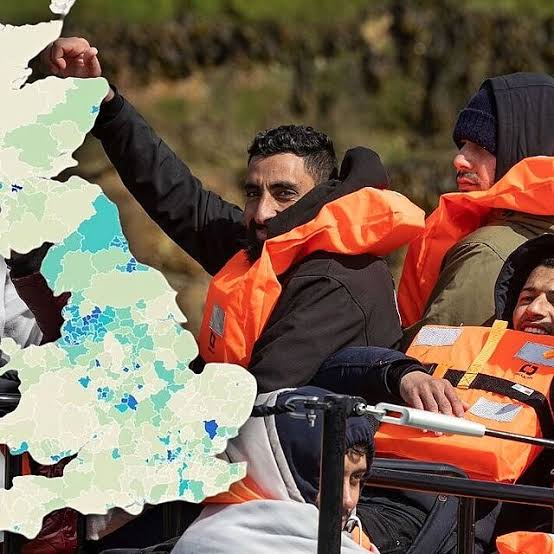
There are several reasons why particular towns and cities have become major centres for asylum accommodation.
One important factor is the availability and cost of housing. The government relies on accommodation providers to find suitable properties for people who require support while their asylum applications are being processed. Areas with relatively inexpensive housing may therefore attract more asylum accommodation arrangements than expensive locations.
Another important factor is the government’s dispersal policy. Under this approach, asylum seekers receiving financial and housing assistance are allocated accommodation in different parts of the country rather than being concentrated in a small number of major cities. The objective is to distribute responsibility more evenly among local authorities.
However, the policy does not always produce equal outcomes. Some councils have significantly higher numbers of asylum seekers than others, creating concerns about whether local resources are sufficient to support additional residents.
The use of hotels has also contributed to the concentration of asylum seekers in certain locations. Hotels have frequently been used as temporary accommodation when the government cannot find enough suitable housing. Although this arrangement provides immediate shelter, it can be expensive and may create difficulties for both residents and local communities.
Pressure on Local Communities and Public Services
The growing number of asylum seekers in certain areas has generated considerable debate about the impact on local communities.
Housing is one of the main concerns. Many British residents already face difficulties finding affordable accommodation, particularly in areas where rental prices are high. Some people therefore question whether the government should prioritise improving housing availability for existing residents before increasing the number of properties used for asylum accommodation.
Public services are another important issue. Local councils may need additional resources to provide healthcare, education, translation services and social support. Children seeking asylum may require access to schools, while adults may need medical assistance, legal advice and help understanding the British system.
When local authorities receive additional responsibilities without sufficient financial support, pressure on public services can increase. This is particularly challenging for smaller communities that have limited infrastructure and fewer available facilities.
Nevertheless, it is important to recognise that asylum seekers are not responsible for the structural problems affecting Britain’s housing market or public services. These challenges existed before many recent arrivals and are also influenced by wider economic and political factors.
The Human Side of the Asylum Crisis
Behind the statistics are individuals and families who have often experienced extremely difficult circumstances. Many asylum seekers leave their home countries because of armed conflict, political persecution, religious discrimination or serious threats to their personal safety.
For these individuals, arriving in Britain does not necessarily mean that their problems are over. They may spend months or even years waiting for a decision on their applications. During this period, restrictions on employment and uncertainty about their future can make everyday life extremely difficult.
Living in temporary accommodation can also affect mental health and social integration. Some people experience isolation, anxiety and difficulties adapting to a new language and culture.
At the same time, local residents may feel concerned if major accommodation projects are introduced without proper consultation. Communities need clear information about proposed developments, the number of people expected to arrive and the support arrangements available.
A successful asylum policy must therefore consider the interests and concerns of both asylum seekers and existing residents.
Political Debate and Government Challenges
The issue of asylum accommodation has become an important political challenge for successive British governments. Political parties have faced pressure to reduce irregular migration, control public spending and demonstrate that the immigration system is functioning effectively.
One of the most controversial issues is the arrival of migrants across the English Channel in small boats. These crossings have attracted significant media attention and have increased public debate about border security and the government’s responsibilities.
The government has attempted to reduce its dependence on hotels by expanding other accommodation arrangements, including properties and former military facilities. However, these measures have also faced opposition from some local communities.
The parliamentary Home Affairs Committee has highlighted significant regional differences in asylum accommodation. Its research has shown that the North West has experienced a much higher concentration of supported asylum seekers relative to its population than the South East.
This raises an important question: how can the government distribute responsibility fairly without placing excessive pressure on individual communities?
Effective management requires cooperation between central government, local councils, housing providers and community organisations. Financial support must also reflect the actual needs of each area rather than simply the number of people accommodated.
Possible Solutions for the Future
There are several measures that could help Britain improve its asylum system.
First, the government should accelerate the processing of asylum applications. Long waiting periods increase accommodation costs and leave applicants uncertain about their future. Faster and fairer decisions would allow successful applicants to begin rebuilding their lives while ensuring that those who do not qualify for protection are dealt with according to the law.
Second, accommodation should be distributed more fairly. Local authorities with already high numbers of asylum seekers should not be expected to accept unlimited additional responsibilities. Decisions should consider population size, housing availability and the capacity of local public services.
Third, the government should provide sufficient funding to communities receiving asylum seekers. Additional resources for schools, healthcare, housing and local infrastructure could reduce pressure and improve relationships between newcomers and existing residents.
Finally, better communication is essential. Local people should be consulted about major accommodation developments, while asylum seekers should receive appropriate guidance and opportunities to participate in community life.
Conclusion
Britain’s asylum seeker hotspots reveal the complexity of managing migration in a modern society. Cities such as Glasgow, Birmingham, Liverpool, Coventry and Belfast have become important centres of asylum accommodation, while several London boroughs continue to experience pressure from temporary housing arrangements.
Although the growing concentration of asylum seekers presents genuine challenges for local authorities, it should not be viewed solely as a question of numbers. The issue also involves human rights, public spending, housing policy, border management and social responsibility.
The British government must find a balance between protecting vulnerable individuals and addressing the legitimate concerns of local communities. A fair, transparent and efficient asylum system would benefit both newcomers and existing residents. Ultimately, Britain’s ability to manage this challenge will depend not only on controlling migration but also on building a society in which resources are distributed fairly and everyone is treated with dignity and respect.