


Advertisement
The record number of small boat arrivals this year comes in the same week Border Force missed two dinghies.
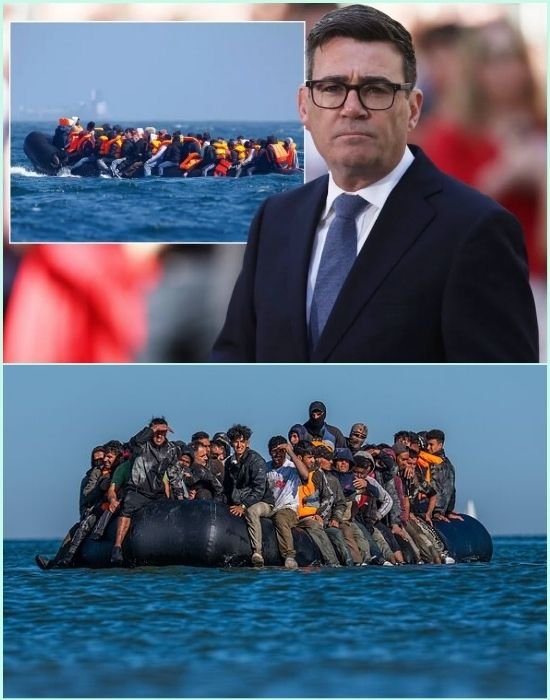
ANDY BURNHAM FACES FRESH MIGRATION PRESSURE AS 781 CROSS THE CHANNEL IN ONE DAY! RECORD-BREAKING ARRIVALS SPARK NEW QUESTIONS OVER BRITAIN’S BORDER SECURITY!
Britain’s immigration debate has entered another intense chapter after 781 people crossed the English Channel in small boats in a single day, putting renewed pressure on Prime Minister Andy Burnham and his government’s approach to border security. The figures, recorded on Wednesday, 23 September 2026, represent the highest number of small-boat arrivals recorded on a single day so far this year. The developments have reignited political arguments over immigration enforcement, the asylum system, people-smuggling networks, and the government’s ability to prevent dangerous crossings. According to provisional Home Office figures, the 781 arrivals travelled in ten separate boats. The announcement immediately attracted attention from opposition politicians, immigration campaigners, and members of the public who have been following the government’s attempts to reduce Channel crossings. For Burnham, the figures present another significant political challenge. His government has promised to tackle people-smuggling operations, strengthen border enforcement, and reduce the number of dangerous journeys across the Channel. However, the latest figures demonstrate that the problem remains unresolved.
A RECORD-BREAKING DAY IN THE ENGLISH CHANNEL The scale of Wednesday’s arrivals is particularly striking because it exceeded the previous daily record for 2026. On 29 July, 752 people arrived in nine small boats. The latest figure pushed that record higher, with 781 people reaching British territory in just ten vessels. The average number of people aboard each boat was approximately 78, although individual vessels carried different numbers of passengers. The arrivals also brought the provisional total for 2026 to 18,565 people. That figure is significant, but the wider statistics reveal another important part of the story. At the same point in 2025, approximately 32,188 people had arrived through the same route. This means that overall small-boat arrivals were approximately 42% lower than during the corresponding period last year. The figures therefore present a complicated picture for the government. While the latest single-day total represents a new annual record, the cumulative number of arrivals remains considerably lower than in 2025. This distinction has become central to the political debate.
ANDY BURNHAM UNDER PRESSURE TO EXPLAIN HIS STRATEGY The latest arrivals have placed renewed attention on Andy Burnham’s immigration policies. The Prime Minister has insisted that tackling people-smuggling networks remains a priority for his administration. His government argues that reducing dangerous crossings requires more than simply increasing patrols along the coastline. It involves international cooperation, intelligence-sharing, disrupting criminal networks, and improving the effectiveness of the asylum system. Burnham has also defended the importance of examining longer-term trends rather than focusing exclusively on individual days. Speaking about the overall figures, he has pointed to the reduction in crossings compared with the previous year. He has argued that cooperation with international partners and action against organised smuggling networks are necessary to achieve lasting results. Nevertheless, opposition politicians argue that a government cannot ignore a daily figure approaching 800 arrivals. They want clearer explanations about how the latest crossings occurred and what additional measures will be introduced to prevent similar situations. T
WO UNDETECTED BOAT ARRIVALS ADD TO THE CONTROVERSY The controversy has become more serious following reports that two migrant boats reached the Kent coastline without being intercepted on separate days. One vessel reportedly came ashore near Folkestone on Monday, while another arrived near Dover on Tuesday. These incidents prompted Home Secretary Shabana Mahmood to order an urgent review of border-security arrangements. The government acknowledged that the incidents raised questions about the effectiveness of existing monitoring and interception procedures. Mahmood said that even one uncontrolled landing was unacceptable and that the review would examine what needed to change. The issue is particularly important because preventing uncontrolled arrivals is one of the central objectives of Britain’s border-security operations. Most small boats are detected and intercepted, with passengers subsequently transferred to Border Force vessels for identification and processing. However, the two reported landings demonstrated that the system can still experience failures. The government now faces questions about surveillance capabilities, operational resources, and cooperation with French authorities. NIGEL FARAGE SEIZES THE OPPORTUNITY TO ATTACK THE GOVERNMENT Nigel Farage was quick to respond to the latest figures, using the 781 arrivals to criticize Burnham’s leadership and immigration strategy. The Reform UK leader accused the government of failing to maintain control of Britain’s borders. He also argued that the country needed a much tougher approach to preventing small-boat crossings. Farage has repeatedly called for the Royal Navy to play a greater role in stopping migrant boats and has presented Reform UK’s border proposals as an alternative to the government’s current strategy. His comments have added another political dimension to the controversy. Supporters of Reform argue that the latest arrivals demonstrate the need for more decisive enforcement. Critics, however, question whether deploying naval vessels to stop small boats would be operationally practical, legally straightforward, or compatible with the UK’s maritime rescue responsibilities. The disagreement reflects a fundamental division over how Britain should balance border enforcement, international law, and the protection of human life.
THE HUMAN DANGER BEHIND THE NUMBERS While political arguments dominate the headlines, the dangerous conditions surrounding Channel crossings remain an important part of the story. The English Channel is a busy international shipping route, with unpredictable weather, strong currents, and commercial vessels operating throughout the area. Inflatable dinghies carrying large numbers of passengers can become extremely vulnerable when conditions deteriorate. The latest arrivals included a particularly concerning journey involving a vessel carrying 51 people that reportedly spent more than 33 hours at sea after departing from Normandy. Such journeys demonstrate the risks associated with relying on overcrowded and unsuitable boats. The people undertaking these crossings may include adults and children fleeing conflict, persecution, or difficult circumstances. Others may be attempting to reach Britain for different reasons. Each asylum application must be assessed individually under the relevant legal framework. At the same time, the criminal networks organising dangerous crossings remain a major concern for British and French authorities.
WHY THE MIGRATION DEBATE IS BECOMING MORE POLITICAL Immigration has become one of the defining political issues in Britain because it touches several areas of public life. Local communities have raised concerns about accommodation, housing availability, healthcare, public services, and the impact of large asylum facilities. Rural areas have also become increasingly involved in the discussion, particularly where former military sites are being considered for asylum accommodation. The government insists that it must meet its legal responsibilities while reducing the costs associated with hotel accommodation. Opposition parties argue that stronger border enforcement and faster asylum decisions are essential. These disagreements have created a difficult political environment for Burnham. If the government cannot demonstrate measurable progress, it risks facing continued criticism from opponents who argue that its strategy is insufficient. However, the reduction in overall crossings compared with 2025 is also relevant and should not be overlooked when assessing the government’s record. WHAT HAPPENS NEXT? The urgent review ordered by the Home Secretary will be closely watched. Authorities must examine how two vessels managed to reach the British coastline without interception and whether existing surveillance arrangements require further improvements. Cooperation with France will also remain essential. The two countries have previously worked together to disrupt smuggling networks, strengthen coastal monitoring, and prevent dangerous departures. However, people-smuggling operations can adapt quickly when enforcement measures change. The government must therefore consider a combination of intelligence, policing, international cooperation, effective asylum processing, and maritime safety measures. It will also need to explain how it intends to ensure that local communities have sufficient information and resources when asylum accommodation is proposed. CONCLUSION: 781 ARRIVALS PUT BRITAIN’S MIGRATION POLICY UNDER THE SPOTLIGHT The arrival of 781 people in ten small boats has created a fresh political challenge for Andy Burnham and his government. Although the figure represents the highest single-day total of 2026, the wider annual statistics show that arrivals remain approximately 42% lower than at the same point in 2025. Both figures matter when evaluating the government’s immigration strategy. For Burnham, the challenge is to demonstrate that the reduction in overall crossings can be maintained while addressing the continued activity of people-smuggling networks. For Nigel Farage and other opposition politicians, the latest figures provide another opportunity to question whether the government’s approach is delivering sufficient results. Meanwhile, the Home Secretary must address the security failures that allowed two boats to reach the coastline without interception. Ultimately, the debate is about more than one record-breaking day. It concerns the effectiveness of Britain’s borders, the responsibilities of government, the safety of people attempting dangerous journeys, and the confidence of communities affected by immigration policy. The coming months will be important in determining whether the government’s measures can deliver sustained reductions in crossings. One question will continue to dominate Westminster: how can Britain regain public confidence in its border system while protecting lives and upholding its legal responsibilities?