


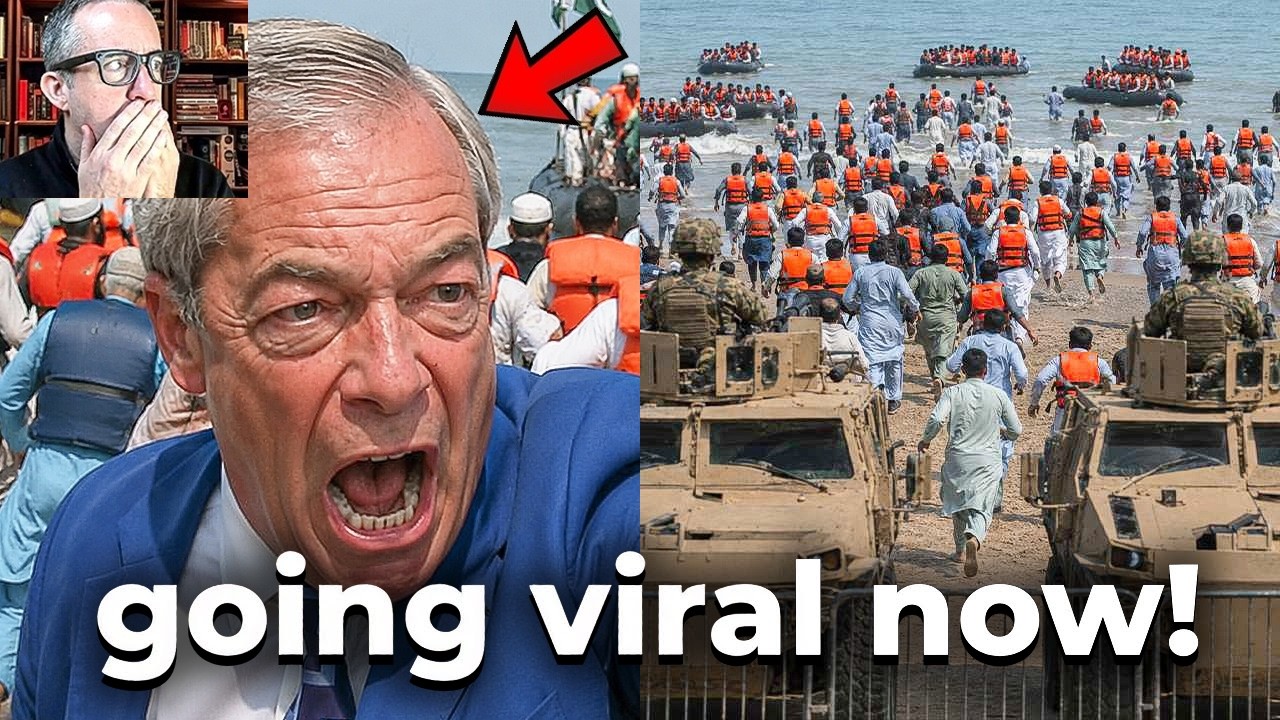
Migration and border security returned to the political spotlight after several commentators, including Reform UK leader Nigel Farage, argued that Europe and the United Kingdom are facing increasing pressure from illegal migration and called for tougher enforcement measures.
A widely shared video showed a British politician questioning French officers on a beach about why migrants were being allowed to enter the water and continue their journey toward the English Channel. According to the footage, one officer said their instructions were to prioritize safety rather than physically stop people from entering the water. The exchange has fueled renewed debate over the role of French authorities in preventing small boat crossings.
Farage also highlighted reports of large numbers of migrants attempting to enter Ceuta, the Spanish territory in North Africa. He argued that Spain’s previous decision to grant legal status to hundreds of thousands of undocumented migrants could encourage further migration toward Europe. Farage claimed that if current policies continue, more migrants could eventually make their way to northern France before attempting to cross into the UK.
The video’s narrator agreed that irregular migration remains a significant challenge but questioned whether a future Reform UK government alone could quickly resolve the issue. He suggested that wider European cooperation and broader policy changes would likely be required to reduce migration flows over the longer term.
The discussion also focused on Reform UK’s proposed immigration policies. Farage reiterated his position that migrants whose asylum claims are rejected should be returned to their countries of origin whenever possible. He argued that the UK should adopt stricter deportation policies and cited government spending on migrant accommodation as evidence that the current system requires reform. Some statistics mentioned during the discussion were presented by the speakers but were not independently verified within the video.
The commentators further argued that migration has become one of the defining political issues facing Britain and claimed that concerns over public services, crime, housing, and community cohesion have contributed to growing public frustration. They maintained that stronger border controls and immigration enforcement should become central priorities for future governments.
The video concluded by referencing footage of a Muslim speaker discussing religious identity and loyalty. The narrator argued that such statements illustrate wider concerns about integration and social cohesion, while acknowledging that the comments reflected the views of the individual speaking rather than those of the broader Muslim community.
Overall, the discussion presented migration as one of the UK’s most pressing political challenges, with Farage and other commentators urging voters to support tougher border policies. Critics, however, continue to argue that the issue requires balanced solutions that address humanitarian responsibilities alongside border security and international cooperation.
Britain’s immigration debate has entered another turbulent period as Nigel Farage and influential political commentators warn that increasing migration pressures could create serious challenges for the country’s borders, public services and national identity. The Labour government, led by Prime Minister Andy Burnham, is facing renewed scrutiny over its immigration strategy, with opposition parties demanding stronger enforcement and clearer evidence that existing policies are delivering results.
Immigration has become one of the most important political issues in Britain. The arrival of migrants in small boats across the English Channel continues to attract considerable public attention, while wider concerns about asylum accommodation, housing shortages, employment and pressure on public services have intensified political disagreements.
Nigel Farage, leader of Reform UK, has repeatedly argued that successive governments have failed to establish effective control over Britain’s borders. He believes the current asylum system allows too many people to enter the country through irregular routes and remain for extended periods while their immigration claims are considered.
Farage has called for a fundamental change in the government’s approach. His proposals include tougher border enforcement, expanded detention facilities, faster deportations and a more restrictive asylum system. He argues that people who have no legal right to remain in Britain should be removed quickly rather than allowed to remain in temporary accommodation at public expense.
His position has attracted support from voters who believe that immigration enforcement has been inadequate. However, refugee organisations and political opponents argue that some of his proposals could undermine Britain’s international obligations and place vulnerable people at risk.
The latest figures demonstrate why immigration remains such a sensitive issue. According to the House of Commons Library, approximately 33,000 people arrived in Britain through small-boat crossings during the year ending June 2026. This represented around 88 per cent of all detected unauthorised arrivals during that period.
Although the number was lower than the approximately 41,000 recorded during 2025, the crossings remain a significant challenge for border authorities.
The government has used the figures to defend its enforcement strategy, arguing that cooperation with France and stronger action against criminal smuggling organisations are beginning to produce results.
One of the most important elements of Labour’s strategy involves improving cooperation with French authorities. British funding supports patrols, surveillance operations and intelligence-sharing arrangements designed to prevent migrants from reaching the English Channel.
The government has committed approximately £662 million to support French operations between 2026/27 and 2028/29. Ministers believe that preventing departures is generally more effective than dealing with migrants after they arrive on British shores.
However, critics question whether the financial contribution represents good value for taxpayers. They argue that Britain should demand measurable results, including fewer successful crossings, more arrests of smuggling organisers and an increase in the number of people returned when they have no right to remain.
The disagreement has become a major political issue between Labour and Reform UK. Farage claims that additional patrols and financial agreements cannot solve the problem unless the government establishes a credible deterrent.
Reform has also announced proposals to suspend the asylum system for up to five years if it enters government. The plan includes rejecting new asylum applications, invalidating approximately 90,000 outstanding cases and expanding deportation operations.
These proposals have generated significant controversy. Supporters argue that Britain needs a radical response to what they regard as a long-standing failure of border enforcement. Critics warn that automatically rejecting applications would put genuine refugees at risk and create serious legal difficulties.
The Refugee Convention establishes important protections for people fleeing persecution, including the principle that individuals should not be returned to countries where they face a genuine risk of serious harm.
Consequently, any future government seeking to change the asylum system would need to address its international legal responsibilities as well as the practical difficulties involved in deportation.
The Labour government has defended a different approach. Its immigration reforms focus on faster asylum decisions, stronger action against organised immigration crime and increased removals of people who have no legal right to remain.
The Immigration and Asylum Bill 2026 is an important part of this programme. It proposes establishing an independent immigration appeals authority, reforming certain legal procedures and creating a revised protection framework for refugees and people requiring humanitarian protection.
Ministers argue that these changes will reduce delays and improve the efficiency of the immigration system while maintaining appropriate legal safeguards.
Nevertheless, commentators have questioned whether administrative reforms alone will be sufficient to restore public confidence. They argue that the government must demonstrate that its policies can reduce irregular arrivals and prevent the asylum system from becoming overwhelmed.
Another major concern is the pressure immigration can place on housing and public services. In some communities, the use of hotels and other buildings to accommodate asylum seekers has generated local opposition.
Residents have questioned whether local authorities have sufficient resources to manage additional demand for healthcare, transport and other public services. They have also expressed frustration when accommodation decisions are made without adequate consultation.
The government argues that replacing expensive hotels with more suitable and cost-effective accommodation will reduce public expenditure. It also maintains that local authorities should receive appropriate support when hosting asylum accommodation.
However, the wider housing crisis cannot be attributed solely to immigration. Britain has experienced years of insufficient housebuilding, rising rents and significant regional differences in housing availability. These problems require long-term planning and investment.
Employment is another important dimension of the debate. Britain depends on overseas workers in several essential sectors, including healthcare, social care, construction and hospitality.
Farage argues that excessive reliance on migrant labour can discourage employers from investing in domestic training and workforce development. He wants stricter migration rules and stronger incentives for businesses to recruit British workers.
Labour has also promised to reduce reliance on overseas recruitment, particularly in sectors where employers could train domestic workers. However, ministers recognise that some industries continue to experience serious labour shortages.
This creates a difficult balancing act. Restricting migration too quickly could create recruitment problems, while allowing employers to depend excessively on overseas labour could weaken incentives to develop the domestic workforce.
Political commentators have also highlighted the importance of distinguishing between different forms of migration. Legal workers, international students, family migrants, asylum seekers and people who enter without permission have different legal circumstances and economic contributions.
Treating every migrant as part of the same problem risks creating confusion and undermining constructive discussion. An effective immigration system must apply clear rules while recognising the different reasons people come to Britain.
The political consequences of the debate could be considerable. Reform UK is attempting to attract voters who believe that Labour and the Conservatives have failed to deliver effective immigration control.
The Conservatives are also seeking to strengthen their position by advocating tougher border enforcement and faster removals. Labour, meanwhile, must demonstrate that its policies can deliver measurable improvements without abandoning humanitarian responsibilities.
The pressure is therefore not limited to the government. All major political parties face questions about how they would manage immigration, protect public services and maintain economic growth.
Another important consideration is the role of the media. Dramatic headlines about migration can influence public perceptions, but individual incidents should not be treated as representative of every migrant or asylum seeker. Reliable statistics and careful reporting are essential if the public is to understand the scale and causes of migration accurately.
Ultimately, Britain’s immigration system needs to balance several competing responsibilities. The government must maintain secure borders, disrupt criminal networks, process asylum claims efficiently and remove people who have no legal right to remain. At the same time, it must protect genuine refugees, support economic development and ensure that local communities are not left without adequate resources.
In conclusion, Nigel Farage’s warnings about migration pressures have intensified scrutiny of the Labour government’s border policies and placed immigration firmly at the centre of Britain’s political debate. While official figures show that small-boat arrivals have recently declined from their 2025 level, tens of thousands of people continue to make dangerous crossings, demonstrating that the problem remains unresolved. Reform UK is demanding a much tougher approach, including major changes to asylum procedures and large-scale deportations, while Labour argues that stronger enforcement, international cooperation and administrative reforms offer a more sustainable solution. The challenge for Andy Burnham’s government is to demonstrate that its policies can deliver secure borders, reduce illegal migration and maintain public confidence. Britain needs an immigration system that is firm but fair, economically responsible and consistent with its legal obligations. Political promises alone will not resolve the problem; lasting progress will require effective enforcement, international cooperation and a clear long-term strategy that addresses both the causes and consequences of migration.