
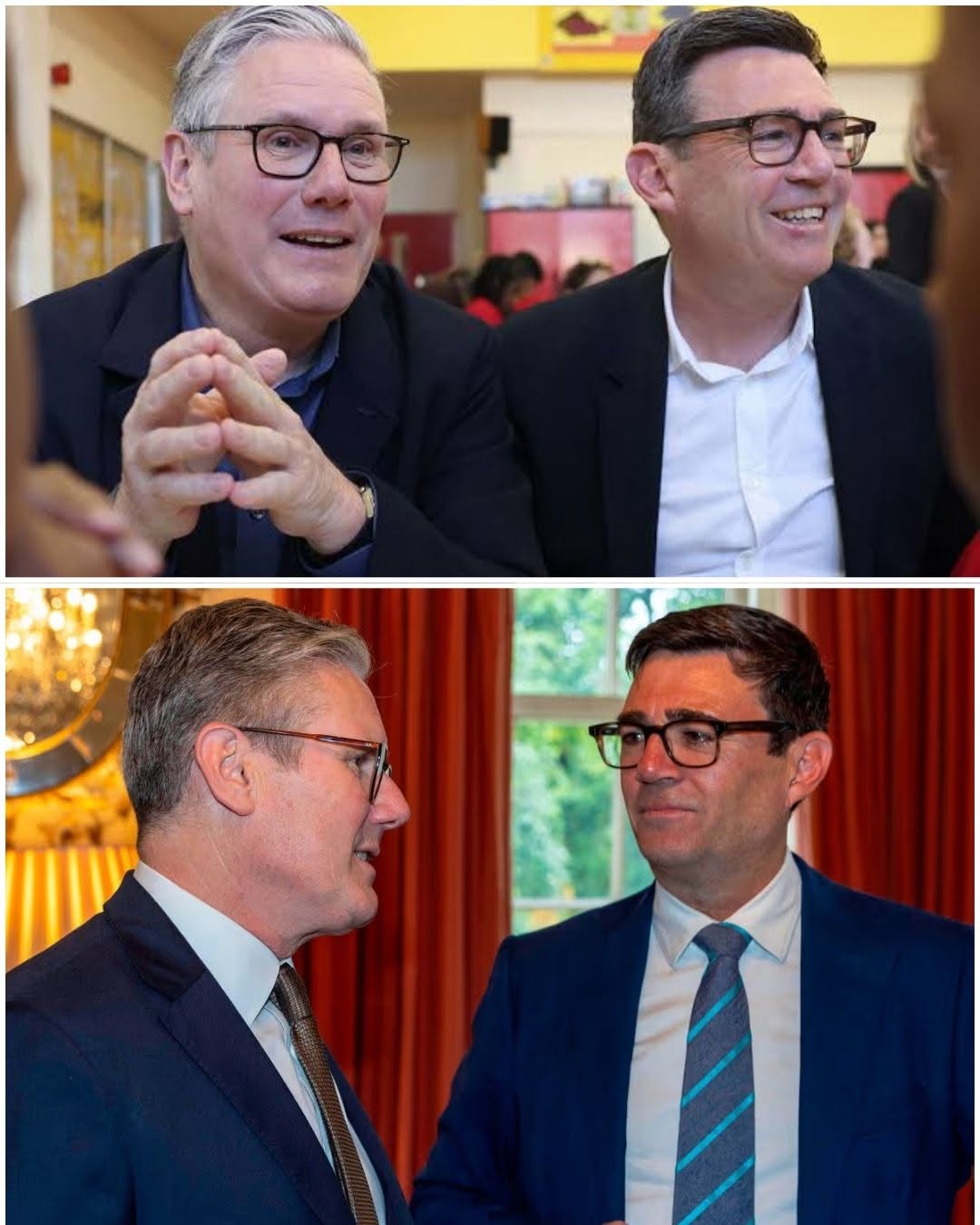
Alleged Downing Street Leak Raises Questions About Labour Leadership, Policy Continuity and Andy Burnham’s Political Future
UK POLITICS | GOVERNMENT ACCOUNTABILITY & LABOUR PARTY | 8 October 2026
Claims of a major Downing Street document leak have sparked fresh political speculation about Andy Burnham, Keir Starmer and the direction of the Labour Party, following online allegations that a supposedly confidential 50-point policy document could undermine promises of a new political beginning.
The circulating account alleges that Burnham, described in the claims as prime minister, has been following a hidden policy programme inherited from Starmer rather than developing an independent governing agenda.
It further suggests that political rivals have given Burnham an unflattering nickname and that individuals within his own political circle deliberately disclosed the alleged document to damage his reputation.
However, the accusations have not been independently substantiated by the information provided.
No authenticated government document, verified whistleblower testimony or official confirmation has been supplied establishing the existence of the alleged 50-point programme.
The account also does not provide reliable evidence confirming its central premise that Burnham is serving as prime minister.
Burnham is best known for his role as Mayor of Greater Manchester and his previous service as a senior Labour politician. His precise political status at the time of any alleged incident must be established through authoritative records rather than inferred from a sensational headline.
As a result, the claims should be treated as unverified political allegations, not as evidence of an established government scandal.
Nevertheless, the story raises broader questions about political leadership, policy continuity, internal party divisions and the importance of transparency in government.
The Alleged 50-Point Policy Document
At the centre of the controversy is the claim that a confidential document containing 50 policy commitments has been circulating within Labour’s senior political ranks.
According to the online description, the document supposedly originated during Keir Starmer’s leadership and was later retained as a guiding framework for Burnham.
The allegation implies that Burnham’s political direction is being shaped by decisions made before any supposed change in leadership.
However, the document itself has not been made available for independent examination.
Its title, authorship, date, classification and intended purpose remain unknown.
These details would be essential to determining whether it represented an official government strategy, an internal discussion paper, a campaign planning document or something else entirely.
Political organisations routinely produce policy proposals, briefing papers and strategic plans.
The existence of such material would not automatically demonstrate deception or misconduct.
To establish that voters had been deliberately misled, evidence would need to show that specific commitments were concealed and that public statements knowingly contradicted them.
Without that evidence, the alleged document cannot reasonably be described as proof of a political betrayal.
Andy Burnham and the Question of Political Independence
Andy Burnham has long been regarded as an influential figure within the Labour Party.
His political career includes senior ministerial positions and leadership of Greater Manchester, where he has developed a distinct public profile through his positions on transport, regional investment, public services and local government.
His political reputation has often been associated with a willingness to challenge central government when he believes regional interests are being overlooked.
That background helps explain why claims about his political independence could attract attention.
Supporters may regard him as a figure capable of offering a different approach to Labour leadership.
Critics, meanwhile, may question whether differences in political presentation necessarily translate into substantive changes in policy.
However, disagreement about a politician’s independence is fundamentally different from proof that the politician is secretly controlled by a predecessor.
Such a conclusion would require credible documentary evidence and a clear account of the decisions allegedly being directed.
Policy Continuity Is Not Necessarily a Cover-Up
One of the central assumptions behind the allegations is that retaining policies associated with a previous leader would amount to deception.
In practice, continuity is a normal feature of democratic government.
New leaders frequently inherit existing legislation, spending commitments, administrative structures and policy programmes.
Some policies may continue because they retain broad political support or because abandoning them would create significant financial or operational disruption.
Others may be reviewed, modified or replaced.
A change in leadership does not automatically require every existing policy to be discarded.
The more important question is whether political leaders communicate their priorities accurately and explain significant decisions to the public.
If a leader promises a substantial departure from previous policies while privately planning to retain them unchanged, that could create legitimate questions about political honesty.
However, establishing such a contradiction requires authenticated evidence of both the private intentions and the public commitments involved.
The Mystery Surrounding the Final 16 Policies
The circulating headline places particular emphasis on the final 16 measures in the alleged 50-point document.
It suggests that these policies contain especially damaging information capable of undermining Burnham’s credibility.
Yet the content of those measures has not been provided.
There is no verified information establishing whether they concern taxation, immigration, public spending, constitutional reform or any other policy area.
Consequently, it would be irresponsible to invent their contents or suggest that they contain evidence of wrongdoing.
If an authentic document emerges, each proposal should be assessed individually.
A policy might be controversial without being unlawful.
Likewise, a politically unpopular decision is not necessarily evidence of corruption or deliberate concealment.
Meaningful scrutiny requires understanding what a proposal says, why it was developed and whether it conflicts with public commitments.
Until the alleged measures are independently verified, claims about their supposedly devastating significance remain speculative.
Allegations of an Internal Labour Betrayal
Another prominent element of the story is the suggestion that Burnham’s own allies deliberately leaked confidential material to weaken his political position.
Internal disagreements are not unusual within major political parties.
Labour, like other parties, contains politicians with differing views about economic policy, public services, electoral strategy and leadership.
Such differences can create tensions, particularly during periods of political uncertainty.
However, the existence of disagreement does not establish that a coordinated effort to sabotage a political leader has occurred.
Claims of an organised internal leak would require evidence identifying the material disclosed, how it was obtained and whether those responsible acted with the alleged intention.
Anonymous accusations about political motives should be treated cautiously.
Without independent corroboration, describing unnamed colleagues as traitors risks turning speculation into apparent fact.
The Role of Political Nicknames and Personal Attacks
The circulating account also refers to a supposedly damaging nickname used by Burnham’s political rivals.
Political nicknames are a familiar feature of British public debate.
They can be used to criticise a leader’s perceived weaknesses, question political credibility or create memorable campaign messages.
However, no authenticated quotation or reliable attribution has been provided identifying the alleged nickname in this case.
Inventing one would risk misrepresenting the individuals involved.
More broadly, personal labels can distract from substantive questions about government performance.
Whether a politician is independent, effective or trustworthy should ultimately be assessed through public statements, policy decisions and measurable outcomes rather than insults.
What Would Make a Government Leak Credible?
Authenticating an alleged government leak involves more than publishing screenshots or anonymous claims online.
Journalists and investigators would normally seek to establish the document’s origin, date, authorship and relationship to official decision-making.
They would also examine whether the document had been altered or presented without important context.
Where possible, claims should be corroborated through independent sources and responses from the people or institutions involved.
A genuine internal policy document may provide valuable insight into government planning.
However, its significance depends on what it actually demonstrates.
An early proposal, for example, should not automatically be treated as a final government decision.
Similarly, the circulation of a document within a political organisation does not prove that every person who received it endorsed its contents.
What the Controversy Reveals About Public Trust
Even when dramatic allegations remain unverified, they can influence public perceptions of political institutions.
Voters increasingly expect leaders to explain policy decisions clearly and demonstrate that campaign promises are reflected in government action.
Concerns about transparency can become especially intense when politicians present themselves as offering a fresh political direction.
However, public confidence is not strengthened by treating unsupported accusations as established truths.
Accountability requires scrutiny, but scrutiny must be grounded in verifiable evidence.
Political opponents are entitled to challenge one another’s records and proposals.
They also have a responsibility to distinguish factual claims from speculation.
Conclusion: Questions Remain, but the Alleged Betrayal Is Unproven
The reported Downing Street leak presents a dramatic narrative involving Andy Burnham, Keir Starmer, a confidential 50-point policy programme and an alleged attempt at internal political sabotage.
Yet the available information does not establish that the document exists, that its final 16 policies contain concealed wrongdoing or that Labour figures deliberately leaked it to destroy Burnham’s political standing.
Nor does it independently confirm the headline’s description of Burnham as prime minister.
The central issue is whether credible evidence emerges demonstrating that voters were deliberately misled about Labour’s leadership or policy direction.
If authenticated documents become available, they should be examined carefully and fairly, with relevant political figures given an opportunity to respond.
Until then, allegations of a secret governing playbook and an ultimate political betrayal should remain clearly identified as unverified.
British voters deserve transparency about the decisions made in their name.
They also deserve reporting that separates genuine revelations from political speculation.
Ultimately, the credibility of this story will depend not on the dramatic language surrounding the alleged leak, but on whether its central claims can be independently established.
HUGE DOWNING STREET LEAK EXPOSED! Andy Burnham’s “Fresh Start” Faces Serious Questions
A major political controversy has emerged after leaked Downing Street documents raised questions about how much of Prime Minister Andy Burnham’s agenda was inherited from his predecessor, Keir Starmer.
The documents, reported by Sky News on 17 September 2026, contained around 50 pages of presentations, policy submissions and strategic proposals originally prepared in April as part of an effort to keep Starmer in power. Although that plan ultimately failed, several of its ideas appear to have survived the change of leadership.
For Burnham, who entered Downing Street in July promising a different approach, the revelations have created an uncomfortable political question: how much has genuinely changed, and how much is a continuation of the previous administration?
The Leak That Put Downing Street Under Pressure
The leaked material reportedly outlined a range of ideas covering the economy, energy, national security and the government’s political strategy.
According to Sky News’s analysis, around 20 of the proposals had been announced by Starmer before his departure. Six had subsequently been announced by Burnham, while another eight were expected to emerge in the following weeks.
The figures do not automatically prove that Burnham simply copied his predecessor. Governments routinely inherit policy proposals, and some ideas remain in development across changes in leadership.
Nevertheless, the overlap has given political opponents an opportunity to challenge the prime minister’s promise of a fresh start.
The central issue is not merely whether two administrations have similar policies. It is whether Burnham can demonstrate that his government has a different direction, different priorities and a clearer explanation of how its decisions will improve people’s lives.
“Fresh Start” or Continuity?
Every new prime minister faces pressure to establish an identity.
Burnham’s challenge is particularly complicated because he inherited an administration with existing spending commitments, policy proposals and difficult economic decisions already in progress.
Abandoning every initiative associated with Starmer would risk wasting work that could still be useful. Continuing those policies, however, leaves Burnham vulnerable to accusations that the change in leadership has altered the presentation more than the substance.
The distinction matters to voters who expect a new prime minister to address problems that remained unresolved under the previous government.
If the government continues with similar policies, ministers must explain why those policies remain necessary, what has changed in their implementation and how the public should judge their results.
Without that explanation, even sensible continuity can become a communications problem.
Opposition Parties Seize the Opportunity
The leak quickly provided ammunition for opposition politicians seeking to portray Burnham as a continuation of the Starmer administration.
Reform UK’s Robert Jenrick reportedly described Burnham as “Keir Starmer with a TikTok account”, while Conservative criticism focused on the suggestion that Labour was recycling proposals rather than introducing sufficiently new ideas.
These attacks reflect a wider political struggle over credibility. A government can announce new initiatives, change its communication style and appoint different advisers, but opponents will continue to examine whether its decisions represent a meaningful departure from what came before.
The leaked documents also raised questions about energy policy. Conservative criticism highlighted proposals concerning North Sea oil and gas developments, including Jackdaw and Rosebank, arguing that delays could undermine energy security.
The government faces competing considerations in this area: the need for reliable and affordable energy, the economic importance of domestic production, environmental commitments and the long-term transition to lower-carbon sources.
The existence of proposals in an internal document does not establish that every option was approved or that the government was obliged to implement it. But the leak has made the decision-making process another subject of political scrutiny.
The Economy Remains the Biggest Test
The controversy comes as Burnham’s government faces difficult economic choices.
Households continue to worry about the cost of living, while businesses are concerned about expenses, taxation and the uncertainty surrounding future policy. Public services also require funding, placing pressure on ministers to balance competing demands.
Chancellor John Healey’s Budget on 28 October represents an important test of the government’s economic approach. Before the announcement, reporting indicated that the Treasury was considering a relatively cautious package, with targeted support for households and difficult decisions deferred to a later spending review.
That approach illustrates the limits facing any new administration. A prime minister may promise a fresh direction, but economic conditions, public finances and existing commitments restrict how quickly policies can change.
Supporters of a cautious strategy argue that governments must avoid making promises they cannot afford. Critics counter that modest measures may leave households wondering what has actually improved.
The leaked documents add another dimension to this debate. If the government relies on proposals developed under Starmer, it must demonstrate that those measures are now being implemented with a clear purpose and measurable outcomes.
Can Burnham Establish His Own Political Identity?
Burnham’s public image has placed emphasis on accessibility, practical solutions and a closer connection with ordinary people. That approach can help a prime minister communicate complicated decisions in more direct language.
However, communication alone cannot settle questions about policy.
Voters will ultimately judge the government on matters such as household bills, wages, employment, the National Health Service, housing and the quality of public services. A polished announcement will carry limited weight if people see little improvement in their daily lives.
The prime minister must therefore distinguish between policies inherited from his predecessor and the decisions that genuinely reflect his own priorities.
That does not necessarily mean rejecting everything associated with Starmer. Some proposals may be worth retaining. The important question is whether Burnham can explain why they are being continued, what changes have been made and what results the public can reasonably expect.
The leaked papers also highlight the importance of transparency. Internal government documents are often designed to explore options rather than establish final policy. Their contents should be assessed in context, rather than treated as proof that every proposal represents a settled decision.
At the same time, the public has a legitimate interest in understanding how major political choices are developed and why certain policies survive a change of prime minister.
A Political Problem That Will Not Disappear Overnight
The Downing Street leak does not, by itself, establish that Burnham’s entire programme is a failure. Nor does it prove that every policy carried over from Starmer is misguided.
It does, however, create a test of credibility for a prime minister who wants to demonstrate that his administration represents a distinct phase of Labour government.
The coming months will provide opportunities for Burnham to make that distinction clearer through decisions on public spending, energy, immigration, relations with Europe and the economy.
Each decision will give voters more evidence with which to assess whether the government’s direction has genuinely changed.
For the opposition, the leak offers a simple line of attack: the new prime minister may have inherited more of the old agenda than he admits. For Burnham, the answer cannot rest solely on dismissing that criticism. He will need to show how his policies work and why they deserve public confidence.
Ultimately, the most important question is not who first wrote an idea in a confidential presentation. It is whether the government can turn its proposals into effective policy and deliver results that people can see.
The Downing Street leak has put Burnham’s promise of a fresh start under scrutiny. Whether the controversy becomes a lasting political problem will depend on what his government does next—and whether its actions prove more persuasive than its slogans.