

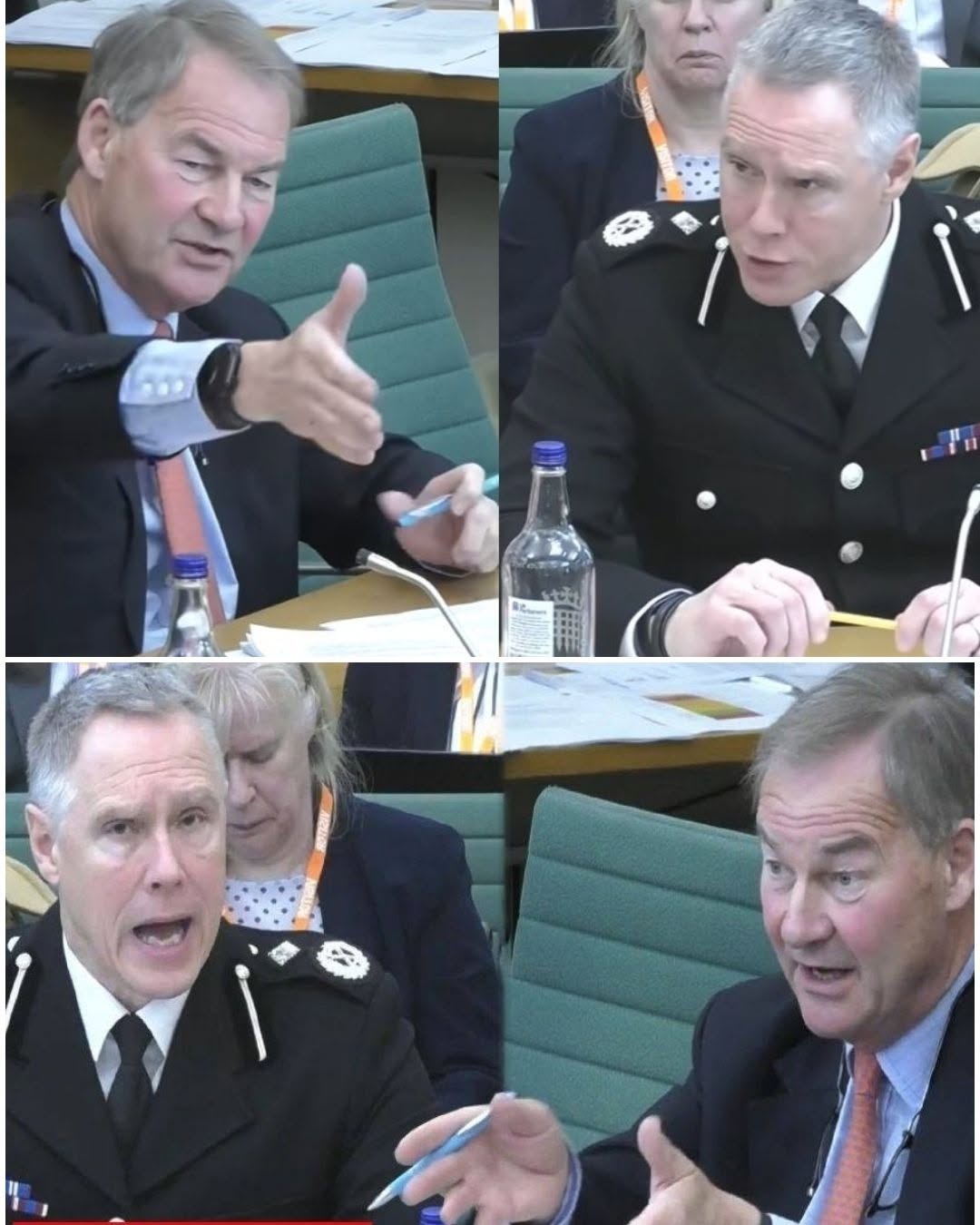
Rupert Lowe Challenges Ministry of Defence Over Fraud Concerns as Parliamentary Accountability Debate Intensifies
UK POLITICS | DEFENCE SPENDING & PUBLIC ACCOUNTABILITY | 8 October 2026
Questions surrounding financial oversight at Britain’s Ministry of Defence have returned to the political spotlight following claims that MP Rupert Lowe confronted senior defence officials over alleged systemic fraud, bureaucratic explanations and the accountability of individuals responsible for managing public money.
According to descriptions circulating online, Lowe delivered a forceful challenge during a parliamentary committee exchange, questioning whether the Ministry of Defence (MoD) was doing enough to identify financial misconduct and ensure that those responsible faced appropriate consequences.
The account alleges that a particular word used in an official report became the focus of a heated disagreement, with Lowe reportedly demanding stronger action against individuals involved in fraud.
However, the precise exchange has not been independently verified from the material supplied. No authenticated committee transcript, complete video recording or identified departmental report has been provided to establish exactly what was said.
Claims that Lowe lost his temper, that the committee chair attempted to silence him or that officials were left speechless should therefore be treated as unconfirmed descriptions rather than established facts.
Nevertheless, the controversy raises important questions about defence expenditure, financial transparency and the effectiveness of parliamentary scrutiny.
Why Defence Spending Faces Growing Script
The Ministry of Defence manages one of the British government’s most significant areas of public expenditure.
Its responsibilities include maintaining the armed forces, purchasing military equipment, supporting personnel, managing infrastructure and ensuring that Britain can respond to national security threats.
These activities involve complex procurement arrangements, long-term contracts and relationships with private-sector suppliers.
Because defence projects can involve substantial sums and highly specialised equipment, financial oversight is particularly important.
The National Audit Office and parliamentary committees have repeatedly examined problems associated with defence procurement, including cost overruns, delays, weaknesses in financial planning and difficulties delivering major programmes.
However, poor financial management and criminal fraud are not interchangeable terms.
A project exceeding its original budget may indicate forecasting failures, changing requirements or inadequate management. It does not automatically demonstrate deliberate dishonesty.
Fraud requires evidence of conduct meeting the relevant legal definition, including dishonest behaviour where applicable.
This distinction is essential when political criticism involves allegations of systemic wrongdoing.
The Alleged Committee Confrontation
The central claim surrounding Lowe concerns a reportedly tense exchange with defence officials about how suspected financial misconduct is described and addressed.
According to the circulating account, Lowe challenged the language used in an official report and questioned whether departmental terminology understated the seriousness of potential fraud.
The description suggests that he objected to a particular word, arguing that bureaucratic language should not obscure the consequences of financial wrongdoing.
However, without the relevant transcript or report, it is impossible to establish which word prompted the disagreement or whether the exchange occurred exactly as described.
The allegation that Lowe demanded imprisonment for corrupt officials also requires context.
Politicians may legitimately argue that serious financial crimes should attract criminal penalties.
However, decisions about prosecution and sentencing belong to the appropriate legal authorities and courts, not individual MPs.
Any person accused of fraud is entitled to due process, and criminal responsibility must be established through evidence.
What Does Systemic Fraud Actually Mean?
The phrase “systemic fraud” carries significant implications.
It suggests that fraudulent activity is not confined to isolated incidents but may be facilitated by broader weaknesses within an organisation’s procedures, controls or institutional culture.
Such a conclusion requires substantial evidence.
Investigators would ordinarily examine financial records, procurement decisions, internal controls, suspicious transactions and any evidence of deliberate deception.
They would also need to distinguish between errors, negligence, waste, contractual disputes and intentional criminal activity.
While weaknesses in financial systems can create opportunities for fraud, those weaknesses do not prove that fraud has occurred.
If credible evidence identifies recurring misconduct, the appropriate response may include criminal investigation, recovery of public funds, disciplinary action and improvements to oversight procedures.
However, describing an entire department as systemically corrupt without supporting findings risks unfairly implicating employees who have committed no wrongdoing.
Rupert Lowe’s Approach to Public Accountability
Rupert Lowe has developed a political profile through outspoken criticism of government spending, public administration and institutional accountability.
The former Reform UK MP has frequently presented himself as an advocate of greater scrutiny over how taxpayers’ money is managed.
His political approach has attracted supporters who believe that public officials should face more direct questioning about financial performance.
Critics of confrontational parliamentary exchanges, however, argue that effective scrutiny requires detailed evidence and careful distinctions between administrative failure and criminal conduct.
Both concerns are relevant.
Strong questioning can expose weaknesses that might otherwise receive insufficient attention.
At the same time, accusations must be supported by documentation if they are to lead to credible conclusions or meaningful reform.
Why the Ministry of Defence Must Explain Its Spending
Defence expenditure presents particular accountability challenges because some operational information cannot be made public for national security reasons.
Sensitive military capabilities, intelligence arrangements and certain procurement details may require confidentiality.
However, national security considerations do not eliminate the need for financial accountability.
Independent auditors, parliamentary committees and authorised oversight bodies play important roles in examining spending decisions.
Their work can identify weaknesses without necessarily disclosing operationally sensitive information.
When concerns about financial irregularities arise, the public should be able to understand whether those concerns have been investigated and what corrective measures have been taken.
Transparency also helps distinguish genuine wrongdoing from politically exaggerated allegations.
Should Fraud Lead to Prison Sentences?
The suggestion that individuals responsible for serious fraud should face imprisonment reflects a broader debate about penalties for financial crime.
Under British law, fraud offences can carry substantial criminal penalties, including imprisonment, depending on the offence and circumstances.
However, punishment must follow lawful investigation, prosecution and conviction.
Not every financial irregularity constitutes fraud, and not every case of poor management warrants criminal proceedings.
Administrative errors may require disciplinary measures or changes to procedures, while deliberate dishonesty may justify criminal investigation.
The principle of accountability applies to all levels of public administration, but so does the presumption of innocence.
Demanding stronger enforcement is a legitimate political position. Declaring unidentified officials guilty before an investigation is not.
The Role of Parliamentary Committees
Parliamentary committees are central to the scrutiny of government departments.
They can question ministers, senior officials and external experts, request documents and publish reports containing findings and recommendations.
Committee chairs also have responsibilities for managing proceedings and ensuring that witnesses and members can participate appropriately.
If a chair intervenes during a heated exchange, that intervention does not automatically demonstrate an attempt to suppress criticism.
It may reflect normal procedural responsibilities.
Equally, committee members are entitled to challenge witnesses robustly, particularly where public money and institutional performance are concerned.
The effectiveness of parliamentary scrutiny should be judged by the quality of the questions, the evidence obtained and the action that follows.
What Happens Next?
If the reported exchange concerns documented weaknesses in the Ministry of Defence’s financial controls, further scrutiny could involve requests for additional records, departmental explanations or examination by independent oversight bodies.
Any substantiated allegations of criminal fraud would require referral to the appropriate investigative authorities.
However, no specific prosecution, newly established fraud scheme or confirmed departmental cover-up can be inferred from the supplied account.
The most important next step would be to identify the original committee proceedings and relevant report.
Those records would allow the public to distinguish what Lowe actually said from interpretations circulating on social media.
They would also establish how defence officials responded and whether the committee identified grounds for further investigation.
Conclusion: Tough Questions Deserve Clear Answers
The allegations surrounding Rupert Lowe’s reported confrontation with Ministry of Defence officials reflect growing public interest in financial accountability and the responsible management of defence expenditure.
Taxpayers have a legitimate expectation that public money will be spent efficiently, that suspected fraud will be investigated and that serious wrongdoing will carry appropriate consequences.
Parliamentary representatives also have a responsibility to question government departments when credible concerns arise.
However, the available information does not establish that systemic criminal fraud has been proven within the Ministry of Defence, that officials deliberately concealed wrongdoing or that the alleged committee exchange unfolded exactly as sensational headlines suggest.
The central question is whether defence authorities have effective systems to prevent, detect and respond to financial misconduct—and whether those systems are subject to meaningful independent scrutiny.
Answering that question requires documentary evidence, transparent investigations and a clear distinction between waste, mismanagement and criminal fraud.
Strong political language may attract public attention, but lasting accountability depends on verifiable findings and practical reforms.
Ultimately, the public interest is best served not by dramatic claims that politicians have humiliated officials, but by ensuring that concerns about defence spending are investigated fairly, that wrongdoing is addressed where proven and that Britain’s defence resources are managed responsibly.
ENRAGED MP DESTROYS DEFENCE BOSSES IN FIERY SHOWDOWN
A fierce political confrontation over Britain’s military readiness has intensified the debate surrounding defence spending, military equipment and the country’s ability to respond to growing international threats.
As concerns mount over the Royal Navy’s capabilities and the readiness of the armed forces, MPs are demanding clearer answers from defence leaders. The questions are becoming increasingly urgent: does Britain have the ships, equipment and personnel it needs, and are ministers providing the resources required to protect the country?
The controversy comes amid mounting scrutiny of the government’s defence commitments and its plans to increase military spending in the years ahead.
MPs Demand Answers From Defence Leaders
Parliamentary scrutiny of Britain’s defence establishment has become more intense as lawmakers examine whether existing military resources match the country’s responsibilities.
The debate is not simply about how much money the government spends. It is also about whether that money produces the capabilities the armed forces urgently require.
MPs want to know why some military programmes take so long to deliver, why equipment shortages persist and whether procurement decisions are being made quickly enough to address emerging threats.
These questions have placed defence officials under pressure to explain how their plans translate into practical improvements.
For lawmakers, announcements about future investment are not enough. They want evidence that the armed forces can carry out their missions today, rather than relying on promises that may take years to fulfil.
A heated exchange between an MP and defence officials would capture this wider frustration. However, without a verified record of a particular confrontation, it would be misleading to attribute specific insults or dramatic statements to an unnamed politician.
The underlying dispute is nevertheless real: Britain’s defence capabilities and the timetable for strengthening them are subjects of sustained parliamentary concern.
Royal Navy Shortages Raise Serious Questions
One of the most prominent issues is the condition of the Royal Navy and its ability to monitor potential threats in the North Atlantic and Arctic regions.
On 22 October 2026, Labour MP Tanmanjeet Singh Dhesi, chair of the Commons Defence Committee, warned that Britain needed to address significant gaps in its naval capabilities. He told LBC that the country risked regretting a failure to provide adequate funding for its armed forces.
Dhesi highlighted the shortage of frigates equipped with specialist towed sonar used to detect submarines. According to his account, Britain had five such frigates against a requirement for at least eight. He also pointed to the wider reduction in the fleet of frigates and destroyers.
The concern extends beyond the number of ships available.
Undersea cables carry enormous quantities of international data, while underwater pipelines support vital energy infrastructure. Damage to these systems could disrupt communications, economic activity and essential services.
Military planners therefore regard the protection of Britain’s surrounding waters as an important part of national security.
The challenge is ensuring that enough suitable vessels are available to monitor suspicious activity, investigate potential threats and respond when necessary.
If ships spend extended periods undergoing maintenance, the number available for operations can fall sharply. Even a technologically advanced navy can struggle when too few vessels are ready for deployment.
Defence Spending Becomes a Political Flashpoint
The arguments over military readiness have intensified alongside the government’s latest defence spending commitments.
On 28 October, Chancellor John Healey committed the government to a pathway towards spending three per cent of gross domestic product on defence by 2030, with a further target of 3.5 per cent for core defence spending by 2035.
The government has said it intends to meet these commitments while addressing existing funding pressures. However, critics have questioned how the increases will be financed and whether the timetable will provide sufficient certainty for the armed forces and defence companies.
The dispute highlights a fundamental problem facing ministers.
Military equipment is expensive, and major projects often require years of planning, construction, testing and training. Increasing a budget does not immediately produce additional ships, aircraft, missiles or trained personnel.
Defence companies also need confidence that orders will remain in place long enough to justify investment in factories, specialist skills and supply chains.
Without predictable funding, projects can face delays and costs can rise. Yet governments must also balance military requirements against public services, taxation and other spending commitments.
That makes the defence budget a political question as well as a military one.
Procurement Delays Under the Spotlight
Another source of frustration is the process through which Britain purchases military equipment.
Large defence programmes involve complex contracts, technical requirements and long-term financial commitments. Changes in specifications or delays in decision-making can affect delivery schedules and increase costs.
Parliamentary committees have repeatedly examined whether the Ministry of Defence can improve its procurement process and make better use of the money allocated to it.
The House of Lords Industry and Regulators Committee has also examined the relationship between government and the defence industry. Its inquiry has covered military readiness, supply-chain security, support for smaller businesses and efforts to accelerate procurement.
Defence Secretary Wes Streeting and National Armaments Director Rupert Pearce were among the officials involved in discussions about these issues in October.
The questions are significant because Britain’s defence industry cannot expand production overnight. Manufacturers need a sufficiently stable pipeline of orders to recruit skilled workers, invest in facilities and develop reliable supply networks.
At the same time, ministers must ensure that contracts deliver value for taxpayers and that companies are held accountable for delays or underperformance.
The challenge is to improve speed without abandoning proper oversight.
The Threat From Russia Adds Urgency
Britain’s defence debate is taking place against a deteriorating international security environment.
Concerns about Russian activity around undersea infrastructure have increased pressure on the Royal Navy and its NATO partners to improve their ability to monitor the North Atlantic.
Dhesi’s warnings followed parliamentary scrutiny of Britain’s ability to counter submarines and other potential threats in the High North.
The issue has implications for the country’s wider military strategy. The North Atlantic is an important route for communications, trade and the movement of allied forces between North America and Europe.
If Britain cannot adequately monitor the surrounding waters, it could face greater difficulties protecting critical infrastructure and supporting NATO operations during a crisis.
MPs have also questioned whether European allies should prepare for greater uncertainty about the level of military support they might receive from the United States.
That does not mean a conflict is inevitable. It means defence planners must consider a range of possible scenarios and ensure that Britain can respond effectively if circumstances deteriorate.
Preparedness depends on more than headline spending figures. It requires trained personnel, available equipment, secure supply chains, intelligence capabilities and effective coordination with allies.
What Do Defence Officials Need to Explain?
The most important question is whether the government’s plans can produce measurable improvements within the promised timeframe.
Defence officials must explain how funding decisions will affect equipment availability, procurement schedules and the operational readiness of the armed forces.
They must also identify the capabilities that require immediate attention and distinguish them from projects whose benefits will emerge over a longer period.
For MPs, transparency is essential. Parliament cannot properly assess the government’s strategy without reliable information about costs, delivery schedules and the risks associated with delays.
However, some operational details must remain confidential to protect national security. The challenge is to provide enough information for democratic scrutiny without disclosing information that could assist potential adversaries.
A productive confrontation between politicians and defence leaders should therefore focus on evidence, accountability and practical solutions rather than personal attacks.
A Test for the Government
The dispute over defence readiness presents a difficult test for Andy Burnham’s government.
Ministers have promised higher military spending, but they must demonstrate that those commitments can be translated into stronger capabilities. They also need to explain how the government will address existing gaps while managing competing demands on public finances.
For the armed forces, the outcome matters more than the political language surrounding the announcements.
Personnel need reliable equipment, sufficient training and confidence that the systems they depend on will be available when required. Defence manufacturers need clear priorities and dependable contracts. Parliament needs evidence that public money is being spent effectively.
The pressure on defence officials is unlikely to disappear as long as these questions remain unresolved.
The real significance of any fiery parliamentary showdown would therefore lie not in the volume of the argument, but in the answers it produces.
Britain’s security depends on decisions made long before a crisis begins. MPs are demanding clarity about those decisions, and the government will need to show that its promises are supported by a credible plan, realistic funding and tangible improvements to military readiness.