

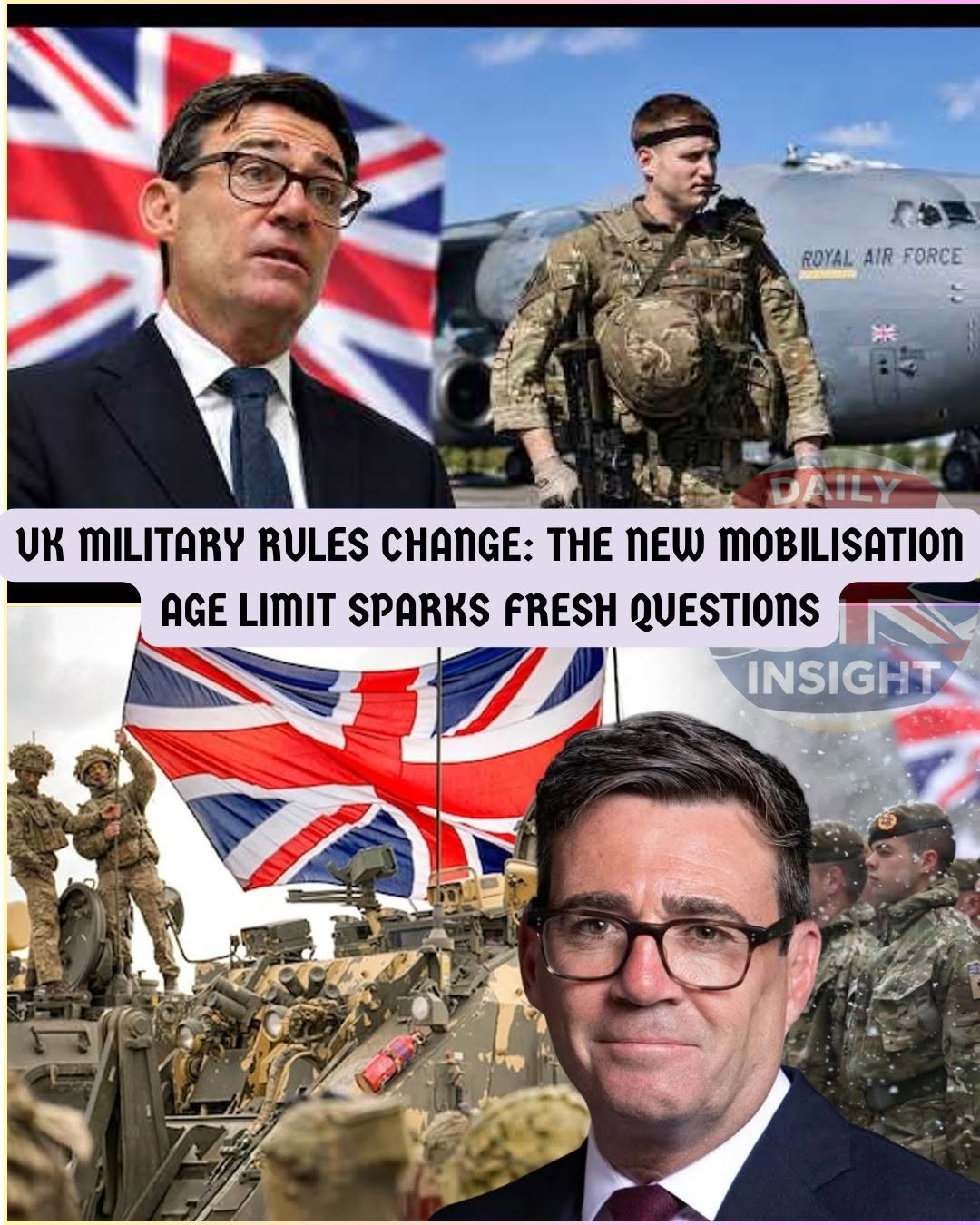
UK Military Recall Rules Could Extend to Age 65 — But Who Could Actually Be Mobilised?
Britain is preparing to make one of the most significant changes to its military reserve system in years, potentially allowing some former service personnel to remain liable for recall until the age of 65.
The proposals have prompted striking headlines about veterans in their 50s and 60s being brought back into uniform as the UK reassesses its military readiness amid a more uncertain international security environment.
But what is actually changing?
The answer is more complicated than suggestions that Britain is preparing to “call up everyone under 65”.
The reforms are contained in the Armed Forces Bill 2026–27, which is progressing through Parliament. They are intended to expand and standardise the Strategic Reserve — a pool that includes former members of the regular Armed Forces who retain a legal liability for recall after leaving full-time service.
Under the proposed legislation, that liability would be extended in several important ways.
However, it is not a general military draft, and the new rules would not automatically make every British veteran — let alone every civilian — liable for mobilisation.
The biggest change: the age limit
Under existing arrangements, recall liability differs according to service and rank.
House of Commons Library analysis explains that regular personnel can currently retain a recall liability for six years after leaving the Royal Navy or Royal Marines and 18 years after leaving the Army or RAF, generally subject to an upper age of 55. Officers can already remain liable until 65.
The Armed Forces Bill would make the system more consistent.
The maximum recall age would become 65 across all three services, while the liability period would generally be harmonised at 18 years.
That means some former personnel could remain part of the Strategic Reserve for considerably longer than under the current system.
The Bill would also extend recall liability to other ranks leaving the Volunteer Reserve, bringing them closer to arrangements already applying to officers.
Defence ministers argue that the reforms would give Britain access to a much larger pool of people with military experience during a serious crisis.
Does this mean 65-year-olds will be sent to the front line?
No.
Being legally liable for recall and actually being recalled are two different things.
Even if someone falls within the Strategic Reserve, it does not mean the Ministry of Defence intends to mobilise that individual routinely.
The Government has said any recall would be considered on a case-by-case basis.
Medical fitness, previous military experience and the role for which an individual was required would all matter.
During parliamentary debate, ministers specifically acknowledged that someone who was medically fit when leaving the Armed Forces might have developed health problems in subsequent years and therefore no longer be suitable for particular military duties.
The Ministry of Defence has also said recalled personnel would undergo routine medical checks and could be employed according to role-based medical standards.
That is especially significant because modern military requirements extend far beyond infantry combat.
Cyber security, intelligence, communications, engineering, logistics and medicine are among the specialist areas in which experienced former personnel could potentially be valuable during a national crisis.
A former military cyber specialist in their late 50s, for example, could possess skills that remain highly relevant even if they would not meet the physical requirements associated with a combat role.
Who would actually be affected?
This is where some of the more alarming interpretations of the policy become misleading.
The Government has stated that the extended rules would apply to relevant personnel leaving the Regular Armed Forces or Volunteer Reserves after the legislation comes into force, unless they exercise the applicable right to opt out.
People who have already left the military would not suddenly have a new recall obligation imposed retrospectively if their existing liability has expired.
Existing former personnel who are not covered could instead choose to opt into the expanded arrangements.
That distinction is crucial.
A 62-year-old who served in the Armed Forces decades ago is not automatically becoming eligible for compulsory recall simply because Parliament raises the maximum age to 65.
The legislation contains transitional provisions precisely because ministers acknowledged concerns about changing the terms under which people originally served.
Veterans therefore need to consider their individual service history and reserve status rather than assuming that the headline age limit applies universally.
What circumstances could trigger a recall?
The Bill also proposes a significant change to the circumstances in which members of the Strategic Reserve can be recalled.
The Government wants the Defence Secretary to be able to authorise recall for “warlike operations” that are being prepared or conducted.
That provides greater flexibility than waiting for the most extreme circumstances before drawing upon former personnel.
The Ministry of Defence says this is intended to improve Britain’s ability to transition rapidly from peacetime towards a major military operation or crisis.
Again, however, this does not mean the Defence Secretary could simply order millions of ordinary civilians into military service.
The provisions concern people with the relevant Reserve liability.
Is Britain introducing conscription?
No.
Nothing in these reforms creates general compulsory military service for the British population.
A civilian who has never served in the Armed Forces does not become liable for military service simply because they are under 65.
Cadets are not members of the Reserve Forces either and have no liability to serve, according to the House of Commons Library.
The distinction between a Strategic Reserve and conscription is fundamental.
The Strategic Reserve consists primarily of people who already have military experience and who retain specified obligations after leaving service.
Conscription would involve compelling a much wider section of the civilian population to enter military service and would require a substantially different political and legal decision.
That is not what the current Armed Forces Bill does.
Why is Britain changing the rules now?
The reforms form part of a much wider reassessment of Britain’s defence readiness.
The Ministry of Defence says it needs to be capable of rapidly expanding the available military workforce during periods of heightened threat.
When the proposals were announced in January, the Government said strengthening the Strategic Reserve would allow Defence to draw on the experience of former personnel during a crisis.
The Strategic Reserve is already substantial.
During evidence to Parliament in March, Veterans Minister Al Carns estimated its size at approximately 95,000 people. He also told MPs that roughly 14,900 personnel leave the Armed Forces each year.
Extending and standardising recall liability could therefore significantly enlarge the pool over time.
The emphasis is increasingly on whether Britain could expand military capacity quickly if the international security situation deteriorated.
Would everyone recalled become a soldier again?
Technically, recalled personnel would return to military service for the relevant period, but the practical roles could vary enormously.
A modern military relies on far more than personnel carrying weapons.
It needs doctors, nurses, engineers, mechanics, intelligence analysts, communications specialists, cyber experts, logisticians and administrators.
This helps explain why extending recall liability into people’s 60s could still have military value.
The Government has specifically highlighted critical skills including cyber, intelligence, medicine and communications when explaining the purpose of the reforms.
Fitness and suitability would also be assessed.
So the image of thousands of 60-year-old veterans automatically being dispatched into frontline combat does not accurately describe what the legislation provides.
Could someone challenge mobilisation?
Existing mobilisation rules already recognise circumstances in which reservists may seek to have mobilisation delayed or cancelled.
Government guidance says reservists can apply when mobilisation occurs at a particularly difficult time, including circumstances involving caring responsibilities or full-time education. Employers also have rights and responsibilities when a reservist is mobilised.
The precise application of the new Strategic Reserve arrangements will depend on the legislation and accompanying regulations as they come into force.
That is another reason headlines suggesting an unconditional power to recall anyone up to 65 should be treated cautiously.
What happens next?
The Armed Forces Bill has passed its Commons stages and is currently before the House of Lords.
The reforms are expected to come into force in spring 2027, subject to the legislation completing the parliamentary process.
There has already been debate over whether the Government should go even further.
An amendment proposed raising the maximum reserve age from 65 to 67, but MPs rejected it.
For now, 65 remains the Government’s proposed upper limit.
The bottom line
The UK is preparing to significantly strengthen its ability to recall experienced former military personnel during a serious crisis.
The proposed changes would raise the maximum recall age to 65, standardise the length of liability across the services and expand the circumstances in which the Strategic Reserve could be activated.
That is a meaningful change in Britain’s military readiness policy.
But it is not a nationwide call-up.
It does not mean every veteran under 65 will suddenly be ordered back into uniform, and it does not impose military obligations on ordinary civilians who have never served.
For veterans and serving personnel, however, the reforms are important because they reshape the relationship between leaving active service and remaining available to Defence.
The real question is therefore not whether Britain is secretly introducing conscription.
It is how large and effective a Strategic Reserve the country needs if a future crisis demands that its Armed Forces expand — and how far the obligations of military service should continue after someone has returned to civilian life.
UK Military Rule Change — Fresh Questions Over Who Could Be Mobilised
Fresh questions about Britain’s military rules have brought renewed attention to an issue that many people would prefer not to consider: who could be required to serve if the United Kingdom faced a major national emergency?
The prospect of military mobilisation raises difficult questions about national security, personal freedom and the responsibilities citizens may have towards their country. Any suggestion that existing rules could change is likely to attract considerable public interest, particularly at a time when European security and Britain’s defence capabilities remain important political issues.
However, a distinction must be made between changes to military policy, preparations for a potential emergency and the introduction of compulsory military service. These are not the same thing. Claims about a new rule must be assessed against official announcements and legislation rather than assumptions or speculation.
The debate nevertheless highlights an important question for the British government: how should the country prepare for serious security threats while making clear what is expected of its citizens?
Why Military Mobilisation Has Returned to the Debate
For many years, compulsory military service has seemed like a distant historical issue to much of the British public.
The United Kingdom ended peacetime national service decades ago and has relied on a professional volunteer armed forces model. People join the Army, Royal Navy and Royal Air Force through established recruitment systems, while reservists provide additional capacity and can be called upon under the relevant legal arrangements.
But the international security environment has changed considerably since the end of the Cold War.
Russia’s war against Ukraine, growing tensions between major powers, concerns about cyberattacks and the vulnerability of critical infrastructure have encouraged European governments to reconsider their defence planning.
Military leaders must think not only about equipment and technology, but also about personnel, logistics, training and the ability to sustain operations over time.
These considerations naturally lead to questions about how many people the armed forces might need during a serious crisis.
Yet the existence of defence planning does not automatically mean that compulsory service is being introduced. Governments can strengthen recruitment, improve reserve forces, increase training and expand industrial capacity without requiring the general population to enter military service.
Understanding these differences is essential to interpreting reports about a possible change in Britain’s military rules.
Who Could Be Called Upon to Serve?
The question of eligibility is central to any discussion of mobilisation.
Under Britain’s current professional military model, people who voluntarily join the armed forces agree to serve under the applicable terms and conditions. Reservists have separate obligations determined by their status and the relevant legal framework.
The circumstances in which reservists may be mobilised depend on the rules governing their service and the powers available to the authorities.
A wider system of compulsory military service would be a different matter. It would raise questions about who could be included, what age groups might be affected, whether exemptions would apply and what legal process would be needed to implement such a policy.
It would also require careful consideration of training capacity, medical fitness, military requirements and the practical consequences for employers, families and public services.
There is no reason to assume that every adult would automatically be eligible for military service simply because the government reviewed its defence arrangements.
Nor should a discussion about military readiness be interpreted as evidence that a new national conscription system has already been approved.
The precise answer depends on the actual rule being discussed and whether it has been formally adopted.
The Difference Between Reservists and Conscription
Public discussion often uses the words mobilisation, reserve service and conscription as though they mean the same thing. In practice, they describe different arrangements.
Mobilisation generally refers to preparing and activating personnel or resources for a particular operational requirement. It can involve existing service members, reservists and other resources, depending on the legal framework and the circumstances.
Reserve service involves people who have a recognised relationship with the armed forces but may not serve full-time. Their responsibilities can include training and, where legally authorised, periods of active service.
Conscription means compulsory military service imposed on people who would not otherwise have volunteered.
The distinction matters because each arrangement has different implications for individual rights and government responsibilities.
A government can increase the readiness of existing forces without introducing conscription. It can also review the role of reservists without creating an obligation for every citizen to enlist.
For that reason, any report describing a military rule change should identify the specific measure involved. Without that information, it is impossible to determine accurately who might be affected.
What Would Happen if Britain Faced a Major War?
A large-scale conflict would place enormous demands on a country’s armed forces and wider economy.
The government would need to assess the number of personnel required, the equipment available, the condition of supply chains and the ability to support military operations over an extended period.
Britain’s response would also depend on the nature of the threat. A limited operation, a prolonged regional conflict and a direct attack on the United Kingdom would create very different requirements.
Existing personnel and trained reserves would be important components of any response. The government would also need to consider whether specialist skills could be supplied through current