

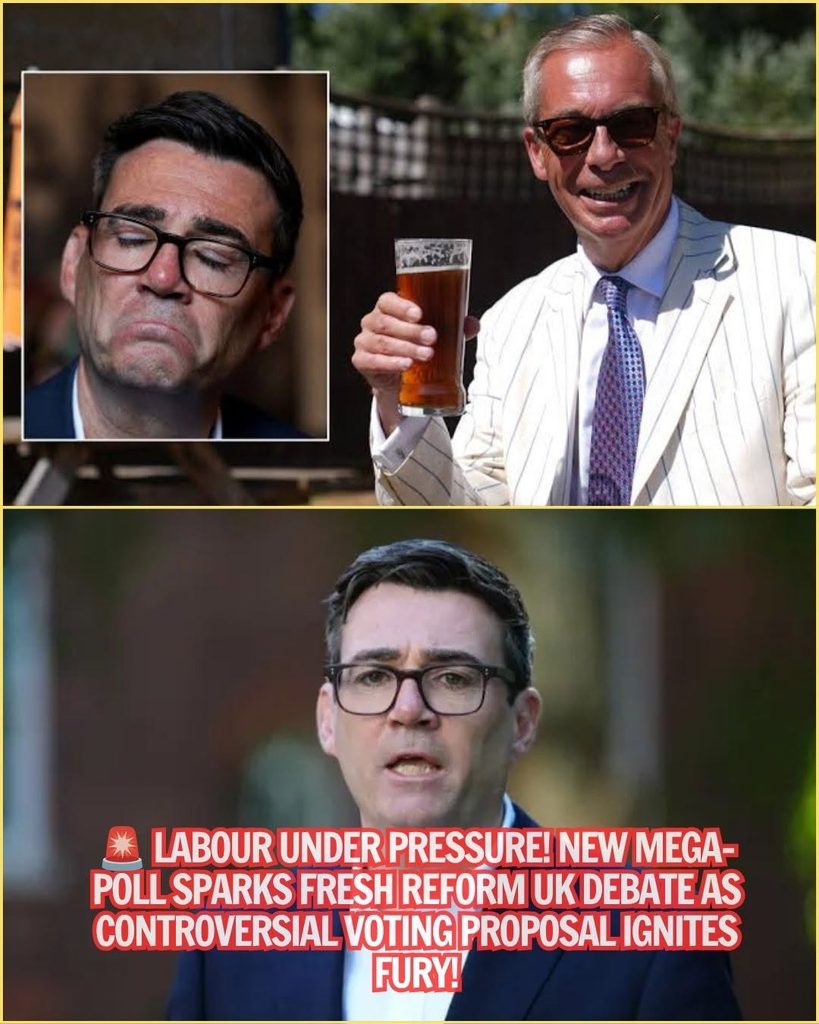
A massive new public opinion survey released today reveals a significant shift in the UK political landscape, with Nigel Farage’s Reform UK surging ahead of the governing Labour Party.
According to the Survation mega-poll, which surveyed more than 10,000 respondents, Reform UK would win the most seats if a general election were held today. The data projects that Reform would secure 227 seats, displacing Labour, which the poll places second with a projected 197 seats. The dramatic shift underscores growing public discontent with the new administration, just weeks into Burnham’s tenure.

Political analysts suggest the drop in Labour’s support is tied to increasing public frustration over the government’s communication strategy and policy execution. While Burnham initially won praise for a less scripted, more “human” communication style compared to his predecessor Keir Starmer, critics argue he has struggled to provide definitive answers on critical issues during recent, unscripted media appearances.
Detractors point to evasive responses regarding the UK’s preparedness against alleged Russian threats and the handling of the ongoing cross-channel migrant crisis.
Furthermore, the administration is facing intense scrutiny over impending fiscal decisions ahead of the highly anticipated October budget. Controversy is brewing over reports that Chancellor John Healey—who prominently resigned as Defense Secretary just months ago in protest of inadequate military funding—is now abandoning his previous demand to increase defense spending to 3% of GDP, opting instead to maintain the prior target of 2.7%. This perceived flip-flop, coupled with commitments to increase foreign and climate aid while domestic energy bills soar, has fueled opposition attacks arguing that Labour is neglecting the financial realities of British households.
Against this backdrop of government criticism, Reform UK continues to dominate political discourse by introducing hardline policy proposals that generate intense national debate.
Adding to their recent controversial pledge to prioritize British-born citizens for social housing, the party announced a new policy intending to “block voters who cannot speak English” from participating in UK elections.
The proposal immediately sparked outrage among left-leaning politicians and civil rights advocates, who condemned it as discriminatory and undemocratic. However, right-wing commentators have defended the policy, arguing that basic English proficiency is a necessary requirement for democratic participation and societal integration. Supporters of the measure contend that individuals who cannot speak the national language are likely economic migrants who burden the welfare system and, therefore, should not influence national elections.
As the October budget approaches, the pressure on Prime Minister Burnham is expected to intensify. With Reform UK seizing the momentum in the polls, Labour faces the daunting task of implementing necessary, and likely unpopular, fiscal measures while attempting to regain the public trust lost during the swift evaporation of the Burnham bounce.
Labour Under Pressure! New Mega-Poll Sparks Fresh Reform UK Debate as Controversial Voting Proposal Ignites Fury
Britain’s political debate has entered another unsettled period, with renewed attention on Labour’s position in the polls, Reform UK’s challenge to the established parties and growing disagreement over proposals to change the voting system. As politicians compete to convince voters that they have the answers to the country’s problems, questions about public confidence, democratic representation and the future direction of Westminster are once again taking centre stage.
A new large-scale poll, often described as a mega-poll, can attract considerable attention because it may attempt to estimate voting intentions across a wide range of constituencies rather than simply measuring national support. However, the significance of any particular survey depends on its methodology, sample, fieldwork dates and assumptions. Without the specific poll details, its figures and implications cannot be independently confirmed.
The wider debate is nevertheless important. Labour faces scrutiny over its record in government, Reform UK continues to challenge traditional political loyalties, and proposals concerning how elections are conducted can generate strong disagreements about fairness and democratic accountability.
Labour Faces Questions Over Public Confidence
For any governing party, opinion polls provide a snapshot of public attitudes and an opportunity to identify areas where voters are becoming dissatisfied. They do not determine election results, but sustained changes in voting intentions can influence political strategy and the way parties communicate their policies.
Labour entered government with expectations that it would improve public services, support economic stability and address the cost-of-living pressures affecting households. Delivering those objectives involves difficult choices over taxation, spending, public-sector reform and economic growth.
When voters feel that progress is too slow, frustration can grow. Families may judge the government by the cost of everyday essentials, workers by their take-home pay and patients by their ability to access healthcare. These immediate experiences can shape political attitudes as strongly as national policy announcements.
Labour must therefore demonstrate what its policies have achieved, explain where difficulties remain and provide credible plans for the future.
At the same time, a poll showing a decline in support would not necessarily mean that every voter had rejected the government’s entire programme. People can be dissatisfied with one policy while supporting another, and voting intentions may change as circumstances develop.
The most useful assessment comes from examining trends across several surveys and comparing them with the issues voters identify as their main concerns.
Reform UK Challenges the Established Parties
Reform UK has sought to position itself as an alternative to the traditional political establishment, campaigning on issues including immigration, taxation, public spending and government accountability.
Its appeal reflects frustration among some voters who believe that successive governments have failed to address longstanding problems. The party has attempted to turn that dissatisfaction into support by arguing that a different political approach is needed.
However, national polling figures require careful interpretation. A party’s share of the vote does not translate directly into the same share of parliamentary seats. Under Britain’s first-past-the-post system, the geographical distribution of support can be just as important as the national percentage.
A party with concentrated support in particular constituencies may win seats efficiently, while another with votes spread across the country may struggle to convert a similar national share into representation.
This is one reason large-scale constituency modelling attracts attention. Such studies attempt to estimate how national voting intentions could translate into individual constituency outcomes. Their conclusions, however, depend on assumptions about turnout, local campaigning, tactical voting and changes in support.
A mega-poll is therefore best treated as an analytical estimate rather than a definitive forecast of what would happen at the next general election.
Why a Controversial Voting Proposal Can Ignite Debate
The reported controversy surrounding a voting proposal raises a separate question: should Britain change the way its elections work?
The current Westminster system generally awards each constituency’s parliamentary seat to the candidate who receives the most votes. Supporters argue that it provides a direct link between representatives and local communities and can make it easier to identify which party has formed a government.
Critics argue that the system can produce a substantial difference between a party’s national vote share and its share of parliamentary seats. They contend that votes cast for unsuccessful candidates may have limited influence on the overall distribution of representation.
Alternative electoral systems attempt to address different aspects of this problem. Proportional representation, for example, is designed to make the distribution of seats more closely reflect the distribution of votes, although different models operate in different ways.
Such changes involve trade-offs. A more proportional system may give smaller parties greater representation, but some versions can make it harder for a single party to secure a parliamentary majority. Different arrangements may also change the relationship between voters, local representatives and party leaderships.
The practical consequences depend on the specific system being proposed. Without knowing the details of the reported proposal, it would be premature to claim that it would benefit one party or disadvantage another.
The Argument Over Democratic Fairness
Electoral reform often produces intense disagreement because political parties have different views about what makes a system fair.
One interpretation of fairness focuses on proportionality: the idea that a party’s representation should broadly reflect the number of votes it receives. Another emphasises constituency accountability, allowing voters to identify and remove a local representative directly.
Others focus on stability and the ability to form a government capable of implementing its programme. These objectives can sometimes conflict, meaning that no electoral system can maximise every goal simultaneously.
The debate also concerns public trust. Voters are more likely to accept election outcomes when they understand the rules and believe those rules are applied consistently.
Any proposal to alter the voting system should therefore explain how votes would be counted, how representatives would be selected and what changes voters could expect. It should also address the transition from the existing arrangements and the safeguards needed to maintain confidence in the process.
Claims that a proposed reform is a deliberate attempt to manipulate an election require evidence. A proposal should be assessed on its actual provisions and likely effects, rather than assumptions about the motives of those supporting it.
Could Electoral Reform Change the Political Landscape?
Changes to the voting system can influence how parties campaign, where they concentrate their resources and how voters decide between candidates.
Under first-past-the-post, parties often focus on constituencies where they believe they can win or defend a seat. Voters may also consider tactical voting if they believe their preferred candidate has little chance of winning locally.
Under some proportional systems, parties have stronger incentives to secure support across a wider area because votes can contribute to representation even when a candidate does not finish first in an individual constituency.
However, the effect on Labour, Reform UK and other parties would depend on the precise system introduced and the distribution of votes at the election concerned. It would be misleading to assume that one party would automatically benefit from every form of reform.
Political outcomes would also depend on campaign strategies, leadership, policy priorities and the issues dominating the public debate at the time.
That is why claims about the electoral consequences of a proposal should be supported by transparent modelling rather than broad predictions.
What the Mega-Poll Can—and Cannot—Tell Us
Large-scale polling can help identify changes in political support and explore how votes might translate into parliamentary representation. But its reliability depends on the quality of the underlying data and the assumptions used to model constituency results.
Important questions include how respondents were selected, when the survey took place, how undecided voters were treated and whether the model accounts for regional and constituency differences.
Even a technically sophisticated poll cannot predict every development between the survey and an election. Campaign events, economic changes, candidate selection and tactical voting can all influence the final result.
Readers should also distinguish between a poll measuring current voting intentions and a model projecting hypothetical parliamentary seats. The first records stated preferences at a particular time; the second adds assumptions about how those preferences might be distributed.
Both can provide useful information, but neither should be presented as a guaranteed outcome.
What Labour and Reform UK Must Address
For Labour, the challenge is to show that its decisions are improving the issues voters care about, while explaining the financial and practical constraints it faces.
For Reform UK, the challenge is to demonstrate that its criticisms are accompanied by policies that can be implemented, funded and assessed against measurable objectives.
For parties advocating electoral reform, the task is to explain why the proposed system would improve representation and how it would preserve accountability and public confidence.
The wider political debate would benefit from greater clarity about the evidence behind polling claims and the practical implications of proposed changes.
A Debate About More Than Poll Numbers
The reported mega-poll and controversy over voting reform point towards a broader question about how Britain’s political system should respond to changing public attitudes.
Polling can reveal dissatisfaction, but it cannot explain every reason behind it. Electoral reform can alter how votes translate into seats, but it cannot by itself resolve disagreements over public services, immigration, economic policy or trust in government.
Ultimately, the significance of the latest debate depends on the verified polling figures and the exact voting proposal being discussed. Those details are essential before drawing conclusions about which parties might benefit or how the system could change.
What remains clear is that political representation and public confidence will continue to be central issues as Britain considers its democratic future. The strongest arguments will be those that explain the evidence, acknowledge the trade-offs and show voters precisely what different choices would mean.