

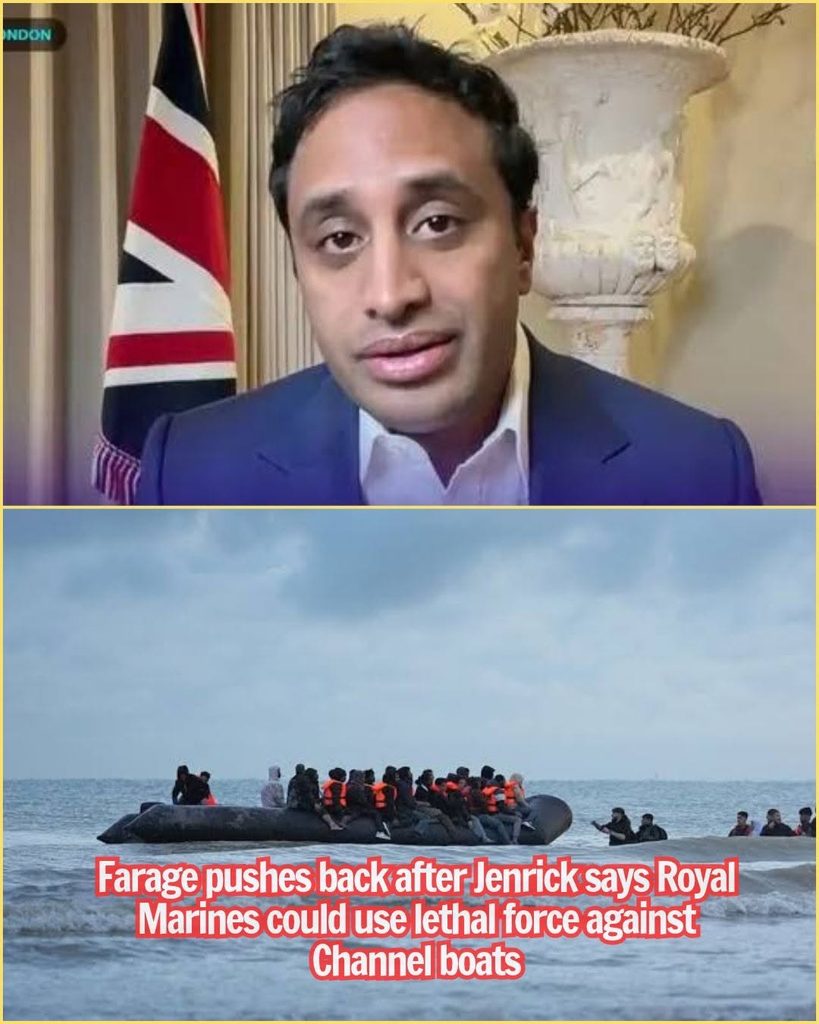
Nigel Farage has moved to deny that a Reform UK government would authorise the use of lethal force against small boat crossings in the Channel, intervening just hours after one of his MPs argued that troops should be allowed to open fire.
The Reform UK leader overruled Robert Jenrick, a prominent MP who defected from the Conservatives, after Jenrick suggested during a broadcast interview that the party would deploy the military to turn vessels back towards France. The public disagreement comes amid visible strain inside the party, on the same day an opinion poll suggested Reform had slipped into third place behind the Conservatives.

Speaking on LBC, Farage insisted that a Reform administration would not authorise any routine use of force against crossing boats, asserting that Jenrick was being “utterly misconstrued”.
Farage maintained that British forces would be permitted to use force only if they were fired at first, describing such action as a defensive response rather than a general policy of shooting at dinghies.
“Anybody wearing British military uniform who gets fired at has the right to respond. That’s what he was saying,” Farage told the station. Farage linked the situation to criminal operations operating around northern French camps, saying: “Remember, in these camps, every week there are shootings, there are stabbings. We are dealing here with very, very serious international criminal organisations, and what we’re saying is, we will, if we win the next election, pick these people up and take them back to France.”
Farage conceded that such interceptions could provoke confrontation, but predicted that robust action would quickly halt crossings altogether. “There is a possibility that initially that might be met with some force.
If it is, force will be met with force. But I tell you something: within two weeks of boats being taken back to France, the boats will stop coming,” he said.

The controversy was ignited when Jenrick claimed during an appearance on TalkTV that Reform was the only political party willing to use force against people making the crossing. “What we are going to do, and we’re the only political party that has the courage to say this, is deploy the Royal Marines into the Channel. If they need to use lethal force, then they’ll be able to do so,” Jenrick said.
Jenrick suggested that authorising the use of force would bring the crossings to an end “in just a few days”.
While he stated that using force was “obviously not what we want to see happen”, he added: “We want to see these individuals picked up off the boats in a sensible and reasonable way, and taken straight back to France.”
The remarks prompted sharp condemnation from the government. Defence minister Luke Pollard described the comments as “disgusting and illegal”, warning that members of the British armed forces are barred under military rules from following an unlawful command.

“We do not shoot unarmed civilians. We do not take military action against civilians,” Pollard told Times Radio. “The idea of this is a soundbite designed by Reform to distract from their sleaze and their scandal … it’s abhorrent to military values, it’s abhorrent to British values. I don’t think anyone should give this any truck.
We can all see what this is: an attempt to distract from Reform’s internal woes.”
The party’s position was further complicated when Reform UK chair Zia Yusuf also walked back earlier hardline rhetoric. Yusuf, who had previously promised that lethal force would be deployed to stop migrant boats reaching Britain, told BBC Breakfast that such measures would apply only “in extremely limited circumstances where it is necessary to protect innocent life.” Yusuf argued that personnel had to be prepared to act if they encountered individuals carrying weapons or threatening the lives of passengers on board.
Yusuf also highlighted internal divisions with former Conservative figures who joined Reform, including Jenrick and former home secretary Suella Braverman.
Asked on Sky News about a past social media post where he had referred to them as “quislings” for their roles in the previous government, Yusuf insisted that ministers in that administration bore collective responsibility for failing to deliver promised reductions in immigration numbers.
Yusuf additionally diverged from Braverman over controversial comments she had made suggesting her South Asian heritage prevented her from being considered English. Yusuf rejected that stance, referencing celebrated sporting figures such as Ashley Cole, Bukayo Saka, Rio Ferdinand and Nasser Hussain to illustrate that such an argument did not hold water with him. The widening public debate arrives alongside a Times poll indicating Reform had dropped to third place behind Labour and the Conservatives, giving Kemi Badenoch’s party its strongest showing since she became Tory leader.
Farage Pushes Back After Jenrick Says Royal Marines Could Use Lethal Force Against Channel Boats
Britain’s debate over illegal migration across the English Channel has taken another contentious turn after comments attributed to Robert Jenrick about the possible use of lethal force by Royal Marines against migrant boats prompted renewed scrutiny of how far the UK should go to secure its borders. Nigel Farage’s reported response highlights a wider disagreement over enforcement, public safety and the legal limits of government action.
The issue is particularly sensitive because small-boat crossings involve both border security and the safety of people travelling in often dangerous conditions. While politicians face pressure to demonstrate that irregular migration can be controlled, any proposal involving military personnel and potentially deadly force raises serious questions about legality, operational practicality and accountability.
The exact context of Jenrick’s reported remarks and Farage’s response is important. Without a verified transcript or full statement, their precise positions should not be overstated. Nevertheless, the controversy exposes a fundamental question for British policymakers: how can the country deter dangerous Channel crossings without creating further risks to human life?
A Harder Line on Channel Crossings
Small-boat migration has become one of the most visible issues in British politics. Images of overcrowded inflatables arriving on the south coast have fuelled public concern about border control, the asylum system and the government’s ability to prevent dangerous journeys.
Politicians advocating tougher enforcement argue that existing measures have not sufficiently discouraged people from attempting the crossing. They often call for stronger action against smuggling networks, faster processing of asylum claims and more effective removal procedures for people who have no legal right to remain in the UK.
However, proposals involving military force represent a different category of intervention from routine border enforcement.
The Royal Marines are highly trained military personnel, but deploying them in a border operation involving civilian vessels would require a clear legal basis, defined operational responsibilities and appropriate safeguards. Military capability alone does not determine whether a particular use of force is lawful or effective.
The distinction between stopping a boat, redirecting it, intercepting suspected smugglers and using potentially lethal force is fundamental. Each action presents different legal and practical considerations.
Why the Lethal-Force Question Matters
Any suggestion that military personnel could use lethal force against boats carrying migrants would require close examination of the circumstances in which such force might be authorised.
Under general principles governing the use of force by state authorities, deliberately using potentially lethal force is subject to strict constraints. The precise rules depend on the legal context, but protecting human life and demonstrating that force was necessary are central considerations.
A vessel carrying migrants cannot simply be treated as a military target because it is attempting to enter British waters irregularly. People aboard may include children, families and individuals who have paid smugglers to arrange their journey. Their presence does not automatically establish that they pose a threat warranting deadly force.
There may be exceptional circumstances in which authorities face an immediate threat to life. Such situations must be assessed on their specific facts and under the applicable law. They cannot justify a general assumption that lethal force is an acceptable means of preventing irregular migration.
Operational planning would also have to account for the danger of capsizing an inflatable boat, the possibility of people falling into the water and the difficulty of distinguishing suspected criminals from passengers who have little control over the journey.
These are not secondary concerns. They go to the heart of whether an enforcement strategy could achieve its stated objective without causing avoidable deaths.
Farage and the Politics of Border Control
Nigel Farage has made immigration control a central part of Reform UK’s political agenda. The party has argued for stronger measures to prevent irregular arrivals and remove people who do not have permission to remain in Britain.
That position reflects the concerns of voters who believe the government has struggled to manage migration effectively. For those voters, the Channel crossings have become a visible measure of whether political promises on border security are being fulfilled.
Yet disagreement can emerge even among politicians who support tougher enforcement. There is a difference between advocating more effective border controls and endorsing every proposed method of achieving them.
Farage’s reported pushback following Jenrick’s comments would therefore need to be understood in its full context. The key questions are whether he challenged the proposed use of lethal force itself, disputed the practicality of the approach or argued for a different enforcement strategy.
Without his verified statement, it would be inaccurate to assign him a particular argument.
More broadly, the debate illustrates why political positions on immigration should be examined in detail rather than reduced to a simple division between those who favour strict controls and those who oppose them. Politicians may agree on the objective of reducing irregular crossings while disagreeing sharply about the means.
The Role of the Royal Marines
The Royal Marines are part of the UK’s armed forces, trained for demanding military and specialist operations. Their potential involvement in a domestic border operation would raise questions about the division of responsibilities between military personnel and civilian authorities.
Border enforcement ordinarily involves law enforcement agencies, immigration officials and other public bodies operating under established legal powers. A military deployment would need a clearly defined purpose and an appropriate framework governing command, conduct and accountability.
It would also be necessary to explain what military personnel would contribute that existing agencies could not provide through properly resourced and coordinated operations.
If the objective were to identify and intercept smuggling operations, authorities would need reliable intelligence, coordination with maritime services and procedures for dealing with suspected offenders. If the objective were to prevent boats from reaching the UK, officials would still have to consider the safety of passengers and the legal consequences of any interception.
A deployment that appeared forceful in political messaging might not necessarily be the most effective operational solution. Its success would depend on measurable outcomes, lawful procedures and whether it reduced crossings without transferring the danger to people at sea.
The Government’s Wider Challenge
The dispute also places the government under pressure to explain how it intends to manage Channel crossings.
Effective policy involves more than preventing boats from reaching the coast. It includes action against criminal smuggling networks, efficient asylum decisions, cooperation with international partners and lawful removal procedures where individuals have no right to remain.
Each part of the system affects the others. Delays in processing claims can increase accommodation costs and prolong uncertainty. Difficulties arranging returns can weaken the practical impact of enforcement decisions. Meanwhile, criminal networks may adapt their methods when authorities introduce new restrictions.
A comprehensive strategy must therefore address both the immediate crossing and the wider system that follows an arrival.
Ministers also need to explain what results their policies are achieving. Relevant measures include the number of crossings, the outcomes of asylum applications, the disruption of smuggling operations, the time taken to process cases and the number of completed removals where legally appropriate.
Transparent reporting would allow Parliament and the public to distinguish between announcements, operational activity and demonstrated results.
Public Safety Must Remain Central
The strongest arguments for border enforcement and the strongest arguments for protecting life at sea need not be treated as mutually exclusive.
The government has a responsibility to enforce immigration law and protect the public. It also has responsibilities concerning the safety of people encountered by state authorities, including those who have entered the country irregularly.
A policy that increases the risk of boats capsizing could create a humanitarian emergency while doing little to address the criminal networks organising crossings. Conversely, an approach that combines intelligence, lawful interception, effective prosecution of smugglers and efficient asylum procedures can address several aspects of the problem without relying on indiscriminate force.
Public debate should therefore focus on what works, what is lawful and what risks each proposal creates.
Politicians advocating a tougher approach should explain how their measures would operate in practice. Those opposing a proposal should likewise address the problems it seeks to solve and offer credible alternatives.
A Debate That Requires Clear Answers
The reported disagreement between Farage and Jenrick highlights a wider contest over the future of Britain’s border policy. It raises questions about the role of the armed forces, the limits of state power and the practical measures needed to reduce dangerous Channel crossings.
Before drawing firm conclusions, the full remarks from both politicians need to be established. The distinction between discussing exceptional circumstances and proposing a general policy of lethal force is particularly important.
Ultimately, the UK faces a difficult but unavoidable task: maintaining effective border controls while ensuring that enforcement remains lawful, proportionate and accountable.
The public deserves policies that produce measurable results, protect those at risk and address the criminal networks exploiting vulnerable people. Strong language may dominate political headlines, but the real test will be whether any proposed approach can meet those responsibilities without creating greater dangers in the Channel.