

Reform UK pledges to deport 400,000 asylum seekers and ‘reverse the invasion of Britain’
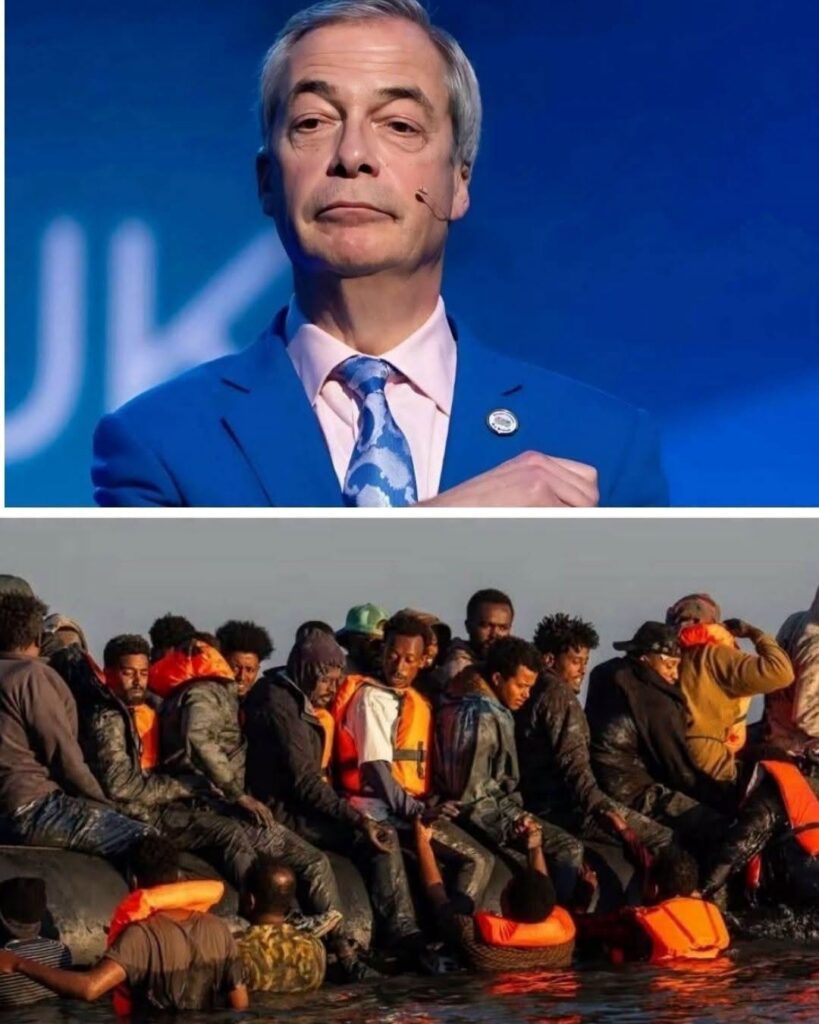
Nigel Farage is set to announce that a Reform UK Government would deport as many as 400,000 asylum seekers who broke into Britain illegally.
The Reform chief is set to commit to an immediate examination of all asylum decisions made over the past five years.
Home Office staff under a Reform Government would be tasked with investigating three key factors under the proposed scheme.
Officials would determine whether asylum seekers crossed the Channel on small boats, arrived hidden in lorries or aircraft, or overstayed their visas before lodging their claims.
Those affected would be allocated an unspecified timeframe to depart voluntarily.
Mr Farage will commit to an immediate examination of all asylum decisions made over the past five years
The overwhelming majority of those seeking asylum reached Britain via small boat, vehicle, or by switching to refugee claims after entering on work, study or tourist visas.
Anyone refusing to leave of their own accord would face detention and forced removal through Reform’s proposed Deportation Command.
The party estimates that over 400,000 people would fall within the scope of this retrospective policy.
Reform UK estimates that over 400,000 migrants would fall within the scope of the policy
Stripping status from those who have already had their asylum granted marks a radical doubling-down on the party’s earlier position of simply blocking illegal arrivals from making claims.

Is the UK border hiding a deadly secret? Nigel Farage just went on GB News with a claim that has Tep
Mr Yusuf said: “For years, Tory and Labour governments have presided over an invasion of Britain.
“They have effectively operated an open borders policy. Instead of upholding the law, they have rewarded those who broke it by entering Britain illegally.”
Zia Yusuf accused successive governments of overseeing ‘an invasion of Britain’
But the party is bracing for backlash, with the proposals expected to draw fury from NGOs and refugee organisations.
In the face of potential court challenges, Reform UK is also pledging to change the law and exit international refugee agreements.
The party has committed to leaving the controversial European Convention on Human Rights (ECHR) and abandoning the 1951 Refugee Convention.
A proposed Illegal Migration (Mass Deportation) Act would legally compel the Home Secretary to expel any migrant lacking residence rights.
Farage Deportation Bombshell Sparks Fury Across Britain
Nigel Farage has once again placed immigration at the centre of Britain’s political debate, with renewed attention on Reform UK’s proposals for deportation and tighter border controls. The prospect of a tougher approach has prompted strong reactions, raising questions about national sovereignty, public spending, human rights and the future direction of Britain’s immigration system.
For supporters of Reform UK, the issue is closely connected to promises to reduce irregular migration, strengthen border enforcement and restore public confidence in the government’s ability to control who enters and remains in the country. Critics, however, warn that sweeping deportation proposals could face substantial legal, administrative and diplomatic obstacles, while creating uncertainty for families and communities.
The latest controversy illustrates how immigration continues to divide political opinion across Britain. Yet behind the heated rhetoric lies a complex policy challenge: how can the government enforce immigration law effectively while respecting legal obligations and ensuring that decisions are fair?
Farage’s Tough Message on Immigration
Nigel Farage has built much of his political profile around opposition to high levels of immigration and criticism of successive governments’ border policies. Through Reform UK, he has argued for a more restrictive system and stronger action against people who have no legal right to remain in the country.
The party’s proposals have attracted voters who believe that the existing system has failed to deliver adequate control. For these supporters, deportation is not simply an administrative question. It represents a test of whether political leaders can implement the rules they promise during election campaigns.
However, a political commitment to remove people without lawful permission to stay does not automatically translate into a straightforward policy. Each case can involve questions about identity, nationality, legal appeals, family circumstances and whether the receiving country will accept the individual.
The precise proposals behind the latest reported deportation controversy should be distinguished from general statements about Reform UK’s immigration position. Specific deadlines, targets and policy details require confirmation before they can be treated as settled plans.
Why the Issue Has Sparked Such Strong Reactions
Immigration has become one of Britain’s most contentious political issues, particularly amid public concern about small-boat crossings, asylum accommodation and pressure on local services.
People who favour a tougher approach argue that immigration rules lose credibility if individuals whose applications have been rejected can remain in Britain for extended periods. They also point to the financial cost of processing claims, providing accommodation and pursuing removal cases.
For these voters, faster decisions and more effective enforcement are essential. They want the government to explain how it will prevent dangerous journeys, disrupt people-smuggling networks and ensure that unsuccessful asylum claims lead to lawful outcomes.
Opponents of large-scale deportation proposals raise different concerns. They question whether ambitious targets can be achieved within existing legal frameworks and warn against policies that could separate families or return people to countries where they face persecution or serious harm.
Human rights organisations and immigration specialists have also highlighted the importance of individual assessments. A person’s immigration status does not remove the need to consider applicable legal protections, including the prohibition on returning someone to a place where they face a real risk of torture or other serious harm.
These competing perspectives help explain why the debate generates such intense reactions. It involves not only border enforcement, but also legal responsibilities, economic considerations and fundamental questions about how Britain should treat people within its jurisdiction.
The Practical Challenges of Deportation
Removing people from the United Kingdom can involve a complicated process. Authorities must establish identities, obtain travel documents, arrange transport and secure cooperation from the relevant foreign governments.
Some countries may be reluctant to accept people whose nationality has not been established or where documentation is incomplete. Others may require lengthy verification procedures. Legal appeals and requests for further consideration can also delay removal.
A substantial increase in deportations would therefore require administrative capacity, trained staff, secure transport arrangements and effective agreements with receiving countries.
The government would also need to consider the cost of enforcement. Although supporters of stricter policies argue that reducing irregular migration could lower some public expenditure over time, removals themselves can be expensive. The overall financial impact would depend on the scale of the programme, the complexity of cases and the extent to which it prevented future costs.
Any serious proposal should explain how these operational challenges would be addressed rather than relying on a headline target alone.
The Small Boats Question
Small-boat crossings across the English Channel remain a prominent part of Britain’s immigration debate. The dangerous journeys have become a symbol of the wider disagreement over border control, asylum processing and the effectiveness of government policy.
Supporters of tougher enforcement argue that the system must discourage people from making the crossing and reduce the financial incentives for smugglers. They believe that clear consequences for unlawful entry, combined with faster asylum decisions, could help undermine criminal networks.
Others argue that enforcement alone cannot resolve the problem. They point to the role of international cooperation, intelligence-sharing and action against trafficking organisations. They also stress that people seeking asylum may have legitimate protection claims that must be considered individually.
A workable approach would need to distinguish between people who qualify for protection, people whose applications are refused after a lawful process, and those involved in facilitating dangerous crossings. Treating every case as identical could create legal problems and make effective enforcement more difficult.
Could the Proposals Transform Britain’s Immigration System?
A major change in deportation policy would require more than political announcements. It would need clear legislation where necessary, adequate funding, administrative planning and cooperation with other countries.
There would also be questions about the role of courts and the appeals process. Any government seeking faster removals would have to determine how to reduce avoidable delays while preserving meaningful opportunities to challenge decisions that may be unlawful.
Another consideration is the effect on people who are already living and working in Britain. Immigration policy covers a wide range of circumstances, from asylum claims to work visas, family reunification and long-term residence. A change aimed at people without permission to remain would need to define its scope carefully.
Employers, local authorities and public services would also want clarity about how any new rules would operate. Uncertainty can complicate decisions for businesses and families, particularly where immigration status affects employment, accommodation or access to services.
For Reform UK, the challenge is to show how its stated objectives could be converted into a legally workable and financially credible programme. For its political opponents, the challenge is to explain how existing arrangements can be improved and how the government intends to enforce decisions more effectively.
Britain’s Political Divide Deepens
The deportation debate is also a test of the major political parties’ credibility. Reform UK has sought to make immigration a defining issue, putting pressure on its rivals to explain what they would do differently.
Some voters believe established parties have repeatedly promised stronger border control without delivering results quickly enough. Others fear that increasingly confrontational political language risks oversimplifying a complex issue and encouraging hostility towards migrants as a group.
The debate is unlikely to be resolved by slogans alone. Voters will need information about actual policy proposals, legal constraints, expected costs and measurable outcomes. Claims about how many people could be removed, how quickly the process could operate and how much it would cost should be assessed against published evidence.
There is also an important distinction between criticising an immigration system and blaming entire communities. Public debate can address unlawful entry and the enforcement of immigration decisions without assuming that migrants share the same circumstances or intentions.
What Happens Next?
The reaction to Farage’s deportation agenda highlights the pressure on Britain’s political leaders to provide credible answers on immigration. The public wants to know whether the system can operate efficiently, whether public money is being used effectively and whether the rules are being applied consistently.
Any future plan will need to address the practical realities of identifying people, securing travel documents, negotiating with other governments and resolving legal challenges. It will also need to explain how people with valid protection claims will be treated and how enforcement will comply with British and international law.
Until the exact details of the latest reported announcement are confirmed, claims about its scope and consequences should be treated cautiously. Nevertheless, the wider argument is clear: immigration policy remains a major dividing line in British politics.
For Farage and Reform UK, tougher deportation measures are part of a broader promise to change the direction of the country’s border policy. For critics, the central questions concern feasibility, cost and legal safeguards.
Ultimately, the measure of any policy will not be the strength of the headline announcing it. It will be whether the government can implement clear and lawful rules, reduce dangerous journeys, make timely decisions and maintain public confidence without abandoning its legal responsibilities. That is the challenge at the heart of Britain’s continuing immigration debate.