
A Charged Demonstration in One of Britain’s Most Diverse Cities
Manchester became the focal point of a heated national debate this week after a large demonstration calling for “remigration” drew thousands of participants and ignited tense confrontations in the city center.
The march, organized by nationalist activist networks and promoted heavily on social media, brought together protesters carrying Union Jack flags and chanting slogans about border control, national identity, and immigration policy.
Supporters of the march described it as a protest against what they view as decades of failed immigration policies and what they call the erosion of British sovereignty.
Critics, including community leaders and civil rights groups, said the rally amplified inflammatory rhetoric targeting immigrant communities and risked worsening divisions in an already polarized political climate.
As the crowd moved through central Manchester streets, the demonstration quickly grew into one of the largest nationalist gatherings the city has witnessed in recent years. Organizers framed the event as a response to growing frustration among some Britons over immigration levels, housing shortages, and the perception that political leaders have ignored public concerns.
Tensions Rise as Counter-Protests Confront the March
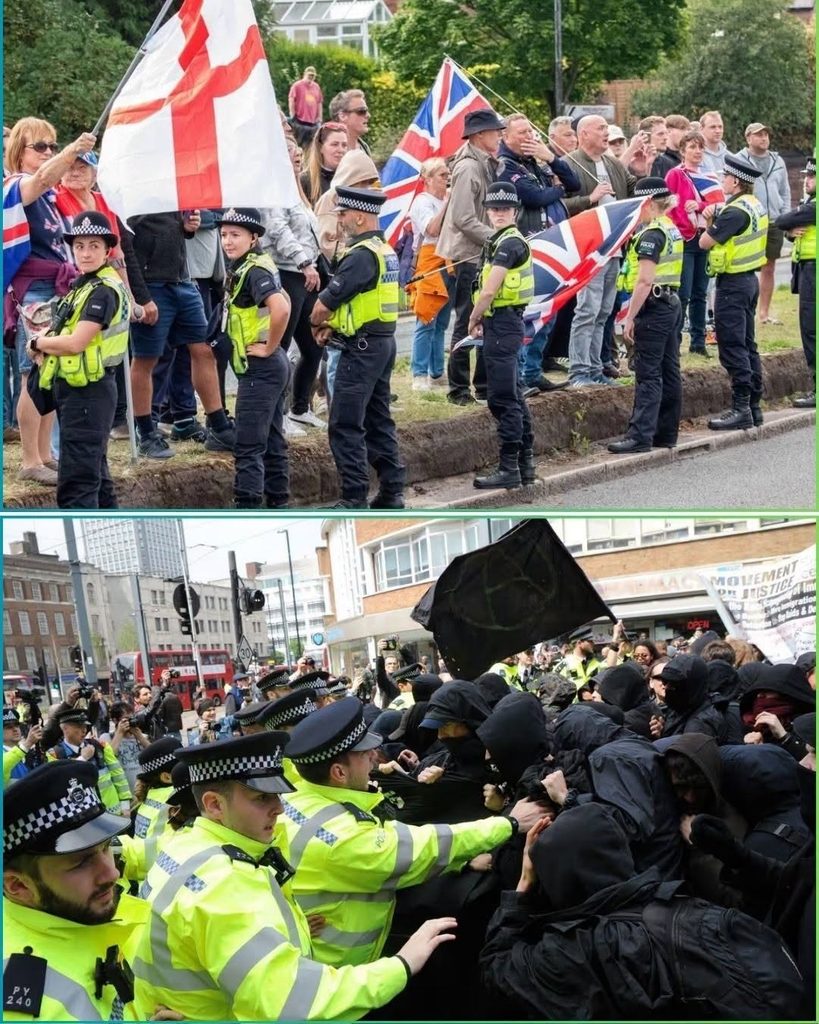
The demonstration did not unfold without resistance. Groups of counter-protesters gathered along parts of the march route, holding signs condemning racism and warning against what they described as extremist political messaging.
Police had anticipated the possibility of confrontation and deployed a substantial security presence, including mounted officers and riot units positioned near key intersections.
Despite those precautions, tensions escalated when small groups from both sides began exchanging chants and insults. Videos circulating online appeared to show brief physical altercations, with bottles thrown and individuals being restrained by other demonstrators before police intervened.
Authorities later confirmed that several incidents required intervention, though officials emphasized that the majority of participants remained within the boundaries of peaceful protest. Officers moved quickly to separate opposing groups and prevent the clashes from spreading further into surrounding neighborhoods.
The scenes nevertheless underscored the intensity of the moment. For many observers, Manchester—long known for its multicultural character—had suddenly become the stage for a broader national argument about identity, immigration, and the direction of the United Kingdom.
Claims of Policing Bias Fuel Further Controversy
In the aftermath of the march, accusations about police conduct quickly emerged from multiple sides. Some participants in the remigration demonstration alleged that officers had treated their group more aggressively than counter-protesters, arguing that law enforcement had been overly protective of individuals confronting the march.
Police representatives rejected those claims, stating that their priority had been to prevent violence and ensure public safety for all participants. In official statements, authorities said officers responded proportionally to incidents as they developed and made decisions based on crowd safety rather than political affiliation.

Still, the perception of uneven enforcement spread widely on social media, where clips from the protest circulated rapidly. Commentators sympathetic to the march argued that the images illustrated what they described as “two-tier policing,” a phrase increasingly used in online political discourse. Others countered that such narratives misrepresented isolated incidents and risked undermining trust in public institutions.
The controversy added another layer to an already volatile political environment.
Immigration Debate Returns to the Center of British Politics
The Manchester demonstration reflects a broader shift in public discourse surrounding immigration in the United Kingdom. Over the past decade, the issue has remained central to political debate, particularly following the Brexit referendum, when concerns about border control and national sovereignty dominated national campaigns.
Advocates of stricter immigration policies argue that the country’s infrastructure, housing market, and public services are struggling under demographic pressures. Opponents of the remigration movement warn that such rhetoric oversimplifies complex social challenges and can stigmatize entire communities.
Political analysts note that the language used during the march—particularly calls for mass deportations—signals a more radical tone than typical immigration policy debates in mainstream British politics. That shift, some experts say, mirrors trends seen across Europe, where nationalist movements have increasingly framed immigration as a defining issue of national survival.
A Symbolic Moment for a Divided Public Conversation
For residents of Manchester, the events left a mixed impression. Some local business owners reported disruptions and early closures as police diverted traffic and crowds moved through the city. Community leaders urged calm and emphasized the importance of dialogue rather than confrontation.
At the same time, the scale of the demonstration revealed the depth of frustration felt by segments of the population who believe their concerns about immigration have been ignored. Whether the march represents a growing national movement or a temporary surge of activism remains uncertain.
What is clear is that the images from Manchester—crowds waving flags, counter-protesters lining the streets, and police attempting to keep order—have intensified an already heated national conversation.
As Britain continues to grapple with questions of identity, immigration policy, and social cohesion, the events in Manchester may come to be seen not simply as a protest, but as a snapshot of a country wrestling with its future.
Manchester Remigration March Sparks Fierce Debate Over Immigration, National Identity and Community Relations
Manchester has once again become a focal point in Britain’s heated debate over immigration, national identity and border control. A demonstration promoted as a “remigration” march has drawn attention to growing divisions over how the United Kingdom should manage immigration, protect its borders and maintain social cohesion.
The confrontational headline surrounding the march claims that Muslims believed they could “take over Britain” but were “dead wrong.” However, such language is a political slogan, not an established description of the views or intentions of British Muslims. The central issue is the demonstration itself: why supporters are demanding tougher immigration policies, why opponents fear the consequences, and what the debate reveals about the country’s political climate.
A report published by UK News Forum on August 21, 2026, described a large nationalist demonstration in Manchester, with participants carrying Union Jack flags and calling for stricter border controls. It also described counter-protests, tense exchanges and a substantial police presence. These details should be treated as reported claims rather than independent confirmation of every incident. <Link url=”https://uknewsforum.com/muslms-thought-they-could-take-over-britain-they-were-dead-wrong-manchester-explodes-in-massive-remigration-march/” title=”Read the original report”/>.
Why the Remigration Message Is Gaining Attention
The word “remigration” has become increasingly prominent in nationalist and anti-immigration politics across parts of Europe. Its meaning varies depending on the group using it. Some campaigners use it to describe the removal of people who have no legal right to remain in a country. Others advocate much broader deportation policies, sometimes extending their rhetoric to people who have lived in a country for years.
That distinction matters. Enforcing immigration law, removing people whose asylum claims have been rejected after due process, and changing the rules governing future arrivals are different policy questions from attempting to remove people because of their religion, ethnicity or cultural background.
Supporters of tougher immigration controls argue that the government must demonstrate that the rules are meaningful. They raise concerns about pressure on housing, public services, local infrastructure and the ability of authorities to process asylum applications efficiently. They also argue that public confidence suffers when people believe political leaders are unwilling to discuss the scale or consequences of immigration openly.
Those concerns deserve examination through evidence, clear policy proposals and accountable government. But they do not establish that Muslims as a group are seeking to take control of Britain. British Muslims are not a single political movement: they have different backgrounds, opinions and views about immigration, religion and national identity.
Manchester’s Previous Demonstrations
The latest headlines also sit within a broader pattern of protest activity in the city during 2026.
ITV News reported that Britain First held a “march for remigration and mass deportations” in Manchester on February 21, followed by a counter-demonstration involving anti-racism groups. Police introduced additional measures to manage the crowds and reduce the risk of disorder. <Link url=”https://www.itv.com/news/granada/2026-02-21/britain-first-march-and-counter-protests-take-place-in-manchester” title=”ITV News report on the February march”/>.
A second Britain First demonstration took place on April 18. According to ITV News, police reported three arrests after counter-protesters attempted to breach police lines and officers intervened. The force said there were no reports of members of the public being injured during the incidents described in its update. <Link url=”https://www.itv.com/news/granada/2026-04-18/britain-first-march-far-right-group-gathers-in-manchester-amid-counter-protests” title=”ITV News report on the April march”/>.
These earlier events help explain why another demonstration calling for remigration would attract intense attention. They also show that the dispute involves not only immigration policy but competing views about public protest, racism, free expression and the safety of minority communities.
Manchester City Council has publicly raised concerns about organised far-right activity and rhetoric directed at migrants and Muslims. Meanwhile, supporters of the demonstrations argue that their right to assemble and advocate changes to immigration law must be respected. In a democratic society, peaceful protest is a protected part of political life, although that protection does not extend to violence, threats or harassment.