
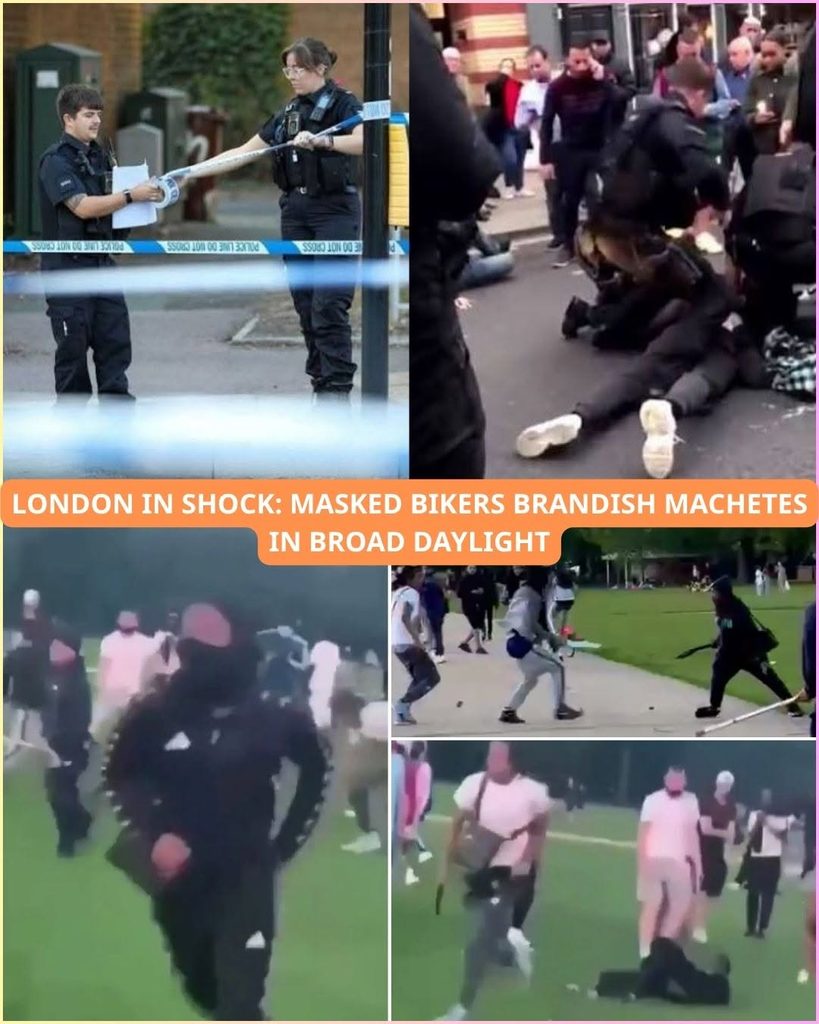
A brutal machete duel at Sunday lunchtime, another scene from Khan’s ‘safe’ London: Video captures masked teens attacking each other with machetes in broad daylight in family park – as it emerges bystander jumped in to separate them

This is the moment a gang of masked teenagers attacked each other with machetes in a south London park.
The violence unfolded at Burgess Park in Camberwell on Sunday at lunchtime, with the thugs seen trying to stab and slash one another in broad daylight.
In the video snapped by a local, bystanders can be seen trying to break up the brawl.
The scene is yet another display of shocking violence in London, despite Sir Sadiq Khan repeatedly insisting the city as ‘safe’.
Earlier this year, the Mayor of London leapt on new statistics showing homicides at the lowest level on record to boast about his record on policing.
However, a closer look at the data reveals a range of other crimes, including violent assaults, have dramatically increased since he came to power in 2016.
Reports of violence against the person have soared by nearly a third between 2016/17 and 2025/26 to hit 242,777 in total.
Theft from the person has increased by 140 per cent over the same period while sexual and drug offences are up by 55 per cent and 34 per cent consecutively.

Video shared on social media showed three teens carrying machetes fighting in Burgess Park, Camberwell

One of the teens can be seen restraining a boy while a friend tries to stab him in broad daylight
Sunday’s footage shows four armed men fighting as an onlooker shouts ‘stab him’.
One of the men holds one of his rivals on the ground as his associate rushes in and starts trying to knife him.
Bystanders are heard shouting at the thugs to stop and they eventually run away.
The Metropolitan Police said four teenagers have been arrested over the incident in Camberwell, one of whom had taken himself to hospital for treatment for his injuries.
A spokesman said: ‘Police were called at around 12.30pm on Sunday, May 17 to reports of an altercation in Burgess Park, Camberwell.
‘Officers attended and searched the area with the assistance of the police helicopter. Four boys, aged 16 and 17, were arrested on suspicion of offences including affray, causing grievous bodily harm and possession of an offensive weapon.
‘Three boys were arrested near the scene, while a fourth was arrested later on Sunday evening. All four boys remain in police custody.
‘Two of the boys who were arrested were reported to have suffered injuries in the incident, which were not life-threatening or life-changing.
‘One, a 17-year-old boy, self-presented at hospital for treatment to wounds and was discharged later that afternoon, following which he was arrested at a property in Southwark.
‘The second boy, a 16-year-old, was taken to hospital by police and was later discharged.
‘The investigation continues. Anyone with information is asked to contact police on 101, quoting CAD 3298/17MAY or Crimestoppers, anonymously, on 0800 555 111.’
ir Sadiq used new figures showing there were 97 homicides in London last year to justify an attack on those who ‘talk down our capital for their own political gain’ – but the Tories accused him of ‘gaslighting’ Londoners about the true extent of crime.

US President Trump, a frequent critic of Sir Sadiq whom he has called a ‘terrible mayor’, has made a series of claims about London, including saying crime is ‘through the roof’ and that the city wants to ‘go to sharia law’.
Sir Sadiq responded by saying: ‘A lot of this misinformation, disinformation and lies comes from the United States of America. It’s really important to counter the propaganda coming from President Trump.’
The mayor launched another staunch defence of London in March – at the same time mobs of youngsters were attacking emergency workers and looting shops in Clapham.
Shopkeepers were forced to barricade their doors after nearly 100 teenagers stormed shops, including a Marks & Spencer store on Clapham High Street.
M&S retail director Thinus Keeve has blamed the London mayor for failing to tackle crime as he demanded answers after his staff and customers came under attack from by mobs of youths.
‘I keep hearing crime is falling, especially in London – something none of us believes, and very few people working in retail would see,’ Mr Keeve said.
‘In fact, we see the absolute opposite in our high streets and in our stores.’
Meanwhile crime on Transport for London (TfL services) has also increased under Sir Sadiq – with more incidents of violence, public disorder and a huge rise in vandalism.
The London Assembly’s Police and Crime Committee said that 48,000 crimes were reported in 2025 – up 46 per cent against a pre-pandemic average of 16,544 amid ‘unacceptable’ levels of violence against women and girls.
Some 12,951 offences on the Tube were recorded between July and December 2025 – an increase of 2.7 per cent from 12,606 in the same period in 2024.
This included a 152 per cent rise in offences of criminal damage, up from 947 to 2,390 incidents amid an ongoing graffiti epidemic on the Underground.
In March, a group of foul-mouthed teenagers sparked a terrifying brawl inside an Elizabeth line train carriage after a middle-aged passenger asked them to stop vaping, before the melee spilled out onto the platform at Stratford in east London.
SHOCK IN LONDON: Panic Erupted After Masked Bikers Were Reportedly Seen Carrying Machetes in Broad Daylight
Reports of masked motorcyclists allegedly carrying machetes in broad daylight have sparked concern and renewed debate about public safety in London. The reported incident, which has circulated amid wider anxieties about knife crime and antisocial behaviour, has raised questions about how authorities respond when people believe they are witnessing a potentially dangerous situation in public.
Details surrounding the alleged sighting remain important to establishing exactly what happened, including where the incident occurred, how many individuals were involved and whether police received reports or made any arrests. Until those details are confirmed, the account should be treated cautiously rather than as proof of a wider organised threat.
Nevertheless, the possibility of people openly carrying large blades on busy streets is enough to alarm residents and passers-by. For many Londoners, the concern extends beyond one reported encounter to a broader question: how can public spaces remain safe when people fear that weapons may be carried openly in their neighbourhoods?
A Disturbing Report Raises Questions
London’s streets are used every day by commuters, shoppers, tourists, families and workers. An apparent sighting of masked individuals carrying machetes can therefore generate immediate concern, particularly if it takes place in a crowded area or near public transport.
Masks and face coverings are not, by themselves, evidence of criminal activity. People may wear them for a variety of legitimate reasons. However, when witnesses believe that individuals are carrying potentially dangerous weapons, the circumstances can understandably appear threatening.
The distinction between a confirmed offence and an unverified report is essential. Witness accounts can provide valuable information, but early descriptions may be incomplete, and details can change as more evidence becomes available. Images shared online may also lack information about when or where they were recorded.
Police investigations typically seek to establish the sequence of events, identify those involved and determine whether any laws have been broken. Evidence may include CCTV footage, witness statements, vehicle registration details and material recorded by members of the public.
If the reported sighting is confirmed, the next questions will concern the circumstances in which the blades were carried, whether anyone was threatened and whether the individuals were connected to any other incident.
For residents, however, uncertainty can be unsettling. People want to know whether there is an immediate danger and what steps are being taken to address it.
Why Reports of Bladed Weapons Cause Alarm
Weapons such as machetes can cause severe injuries, making reports of their presence in public spaces particularly concerning. Even when no assault takes place, the apparent display or possession of a blade in threatening circumstances may prompt fear among those who witness it.
In England and Wales, carrying a bladed article in public without a lawful reason or authority can constitute an offence, subject to the specific circumstances and statutory exceptions. Threatening someone with a blade can lead to further criminal consequences.
The law does not treat every object or situation identically, and the precise offence depends on the evidence. Investigators must establish what was carried, where it was carried, the circumstances and whether a lawful defence applies.
These distinctions matter because public concern should lead to accurate reporting and appropriate enforcement rather than assumptions about guilt.
The presence of weapons can also have effects beyond the immediate incident. Witnesses may feel anxious about using a particular street, parents may worry about children travelling independently, and local businesses may become concerned about the safety of customers and employees.
Such reactions can spread quickly when short videos or dramatic claims circulate through social media. A report that initially concerns one location may become a much wider discussion about crime across the capital, even when there is insufficient evidence to establish that the incident reflects a broader trend.
Reliable information is therefore crucial. Authorities need to communicate confirmed facts clearly, while news reports should distinguish between what witnesses allege and what investigators have established.
London’s Wider Debate About Knife Crime
The reported sighting has the potential to feed into London’s continuing debate about knife crime, youth violence and the effectiveness of policing. These issues have remained prominent in public discussion, with residents and community organisations calling for measures that prevent violence before it occurs.
However, one reported incident cannot establish whether knife crime across London is rising or falling. That question requires verified police records, consistent definitions and comparisons across relevant periods.
The nature of the offence also matters. Possession of a weapon, threats, robbery and an actual stabbing are distinct events, even though they may all contribute to public concern about bladed weapons.
For people living in areas affected by violence, the distinction does not necessarily make their concerns less serious. A visible weapon can create a sense of insecurity even if nobody is injured. At the same time, effective policy depends on understanding the difference between isolated incidents and sustained patterns of offending.
London’s size and diversity also mean that experiences can vary significantly between neighbourhoods. A disturbing event in one district should not automatically be interpreted as evidence that the entire capital is unsafe.
The challenge for public officials is to acknowledge residents’ concerns without exaggerating the scale of a problem or making claims that the available evidence cannot support.
What Should Witnesses Do?
When people believe they have seen individuals carrying dangerous weapons, personal safety should come first.
Witnesses should avoid approaching the individuals, attempting to confront them or following their vehicles. A confrontation can escalate rapidly, particularly when the circumstances are unclear and weapons may be involved.
Anyone who believes there is an immediate threat should contact emergency services on 999 in the UK. If there is no immediate danger but information may assist an investigation, non-emergency reporting through 101 or the Metropolitan Police’s official reporting channels may be appropriate.
Useful details can include the location, time, direction of travel, descriptions of the individuals and any vehicle registration information that can be observed safely. People should not put themselves at risk to obtain photographs or video footage.
Footage already recorded may help investigators, but it should be handled responsibly. Publishing identifying accusations online without reliable evidence can misidentify innocent people, interfere with an investigation or expose individuals to harassment.
Members of the public should also be wary of reposted videos that claim to show a particular London incident without providing a verifiable date or location. Online material can be old, miscaptioned or taken from an entirely different event.
Responsible reporting helps ensure that genuine threats receive attention without creating unnecessary panic.
The Role of Police and Local Communities
If authorities receive credible reports of people carrying machetes in public, their response may involve assessing the immediate risk, checking available CCTV footage, gathering witness accounts and determining whether an offence has occurred.
Visible police patrols can reassure residents in areas where a specific concern has been reported. But the longer-term response to weapon-related crime requires more than a temporary increase in officers.
Community policing can help residents share information, identify recurring problems and build relationships with local officers. When people trust that reports will be taken seriously and handled professionally, they may be more willing to provide evidence that helps prevent further incidents.
Prevention also requires attention to the circumstances that contribute to violence. Youth services, education, employment opportunities, targeted intervention and support for people at risk of becoming involved in criminal activity can all form part of a broader strategy.
These measures are not substitutes for enforcing the law. Rather, they address different aspects of the same problem: responding to dangerous behaviour when it occurs while reducing the likelihood of further violence.
Local authorities, police, schools, community organisations and residents each have a role to play, although their responsibilities and powers differ. Effective cooperation depends on clear information, realistic expectations and an understanding of which interventions have evidence behind them.
Social Media and the Spread of Fear
In modern urban life, an alarming report can travel across social media long before all the circumstances are known. A short clip showing masked riders, for example, may attract thousands of views and generate claims about weapons, motives or intended targets that have not been independently verified.
This speed can be useful when authorities need to identify witnesses or warn the public about an immediate danger. It can also make it difficult to separate reliable information from speculation.
Dramatic headlines may encourage people to share material before checking its origin. Repeated posts can then create the impression that an event has been independently confirmed by multiple sources when they all rely on the same original claim.
There is also a risk that unverified reports become attached to particular ethnic, religious or social groups. Such speculation can inflame tensions and divert attention from the evidence needed to identify those responsible for actual offences.
A responsible approach requires a simple distinction: concern about potentially dangerous conduct is legitimate, but conclusions about the people involved must be based on verified information.
Authorities should provide updates when possible, while journalists and social media users should avoid presenting unconfirmed allegations as established facts.
Public Safety Without Unnecessary Panic
The reported appearance of masked bikers allegedly carrying machetes in London highlights the tension between the public’s need for reassurance and the importance of accurate information.
Residents are entitled to expect that potentially dangerous conduct will be investigated and that the law will be enforced. They also deserve clear communication about what is known, what remains uncertain and whether any immediate safety advice is necessary.
At present, the key questions concern verification: where the alleged incident occurred, whether police confirmed the sighting, whether weapons were recovered and whether any arrests or charges followed. Without reliable confirmation, it would be premature to draw firm conclusions about the individuals involved or the scale of the threat.
The broader debate about knife crime deserves serious attention, but it should be informed by evidence rather than by the emotional impact of a single headline.
For Londoners, the priority is straightforward. Public spaces should be safe, dangerous behaviour should be addressed promptly, and people who witness possible threats should know how to report them without placing themselves in danger.