

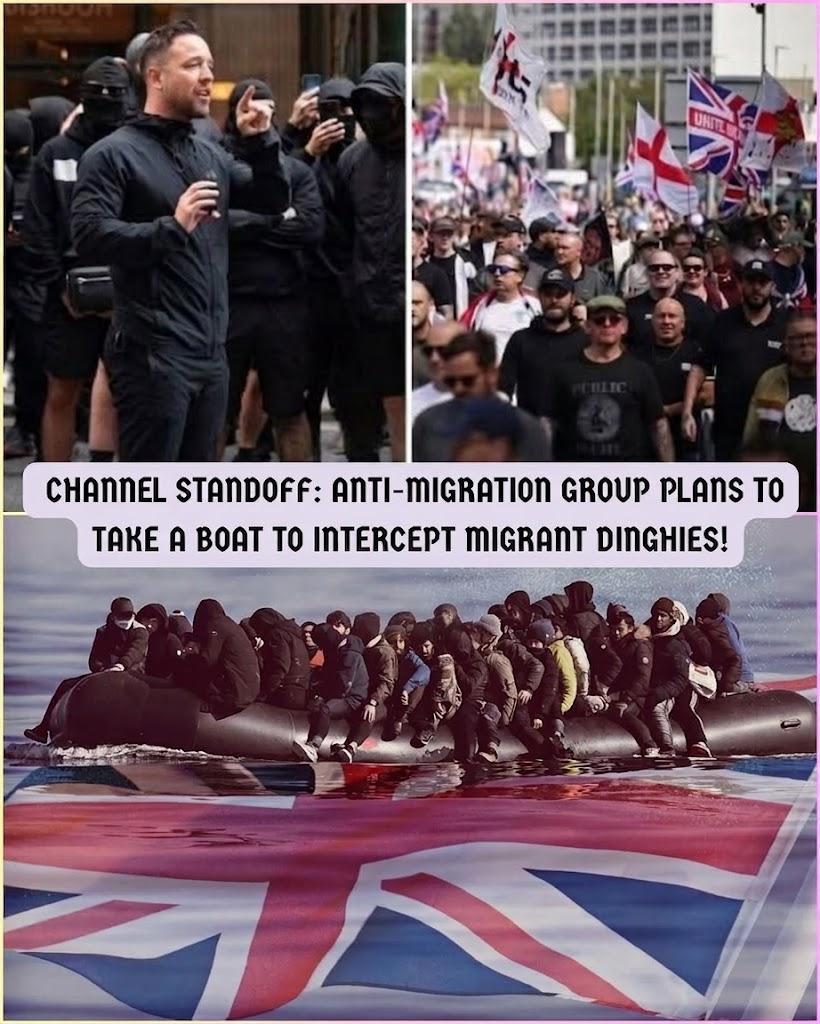

Fears of a dangerous confrontation in the English Channel are growing following reports that anti-immigration activists are considering taking their own vessel to sea in an attempt to disrupt or confront migrant dinghies travelling toward Britain.
The reported plan has immediately intensified an already bitter national debate over irregular migration, border enforcement and the limits of political protest.
Supporters of tougher immigration controls may see the proposal as a dramatic response to years of frustration over small-boat crossings. Critics, however, warn that civilian attempts to intervene in one of the world’s busiest shipping routes could put migrants, protesters and professional rescue crews in serious danger.
Important details remain unclear, including precisely which individuals would participate, what vessel they would use and what they mean by “stopping” migrant boats.
Those uncertainties matter.
There is a significant difference between sailing into the Channel to stage a symbolic protest, observing migrant boats from a safe distance, and physically attempting to block, board, tow or redirect a crowded dinghy.
The latter possibilities would raise much more serious legal and safety questions.
From Street Protest to Action at Sea
Anti-immigration demonstrations have become increasingly visible as the number of people attempting to reach Britain in small boats remains a major political issue.
Until now, most protest activity has taken place on land—outside accommodation facilities, near ports or in town centres.
Taking that campaign onto the Channel would represent a significant escalation.
The appeal to activists is easy to understand.
Images of small boats crossing from northern France have become one of the defining symbols of Britain’s immigration debate. For campaigners who believe successive governments have failed to secure the border, physically travelling into the Channel could be presented as a way of taking direct action where politicians supposedly have not.
But the sea is fundamentally different from a demonstration outside Parliament.
A confrontation on land can usually be separated or contained by police.
At sea, a mistake can kill people within minutes.
The Channel Is Already Dangerous
The English Channel may appear relatively narrow on a map, but it is an exceptionally challenging environment for small vessels.
Large commercial ships routinely pass through its shipping lanes. Weather can deteriorate. Visibility can change. Currents are powerful, and small inflatable boats carrying large numbers of people can be unstable.
Many migrants attempting the crossing have limited maritime experience and may not possess adequate safety equipment.
Adding another civilian vessel deliberately attempting to interfere with their journey could create unpredictable consequences.
If activists approached too closely, a migrant boat could change direction suddenly.
Passengers might panic or move toward one side of an inflatable vessel, destabilizing it.
A collision could puncture a dinghy or throw people into the water.
Even actions intended only to obstruct a boat could unintentionally create a rescue emergency.
That is why any reported plan to “stop” boats must be distinguished from ordinary political protest.
What Does ‘Intercept’ Actually Mean?
This may ultimately be the most important question.
If protesters intend merely to sail in international or British waters while displaying banners, their actions would raise one set of issues.
If they intend to physically interfere with another vessel, the situation becomes considerably more serious.
Private citizens do not simply acquire law-enforcement powers because they believe the government is failing to enforce immigration rules effectively.
Border enforcement at sea involves trained authorities operating under specific legal powers and safety procedures.
There is also a fundamental humanitarian principle involved.
Whatever a person’s immigration status, someone facing imminent danger at sea must not be deliberately placed at greater risk.
A migrant may ultimately have an asylum claim accepted or rejected. That decision belongs to the relevant legal process.
It cannot safely be decided through a confrontation between activists and passengers aboard an inflatable boat.
Protesters Would Also Be Putting Themselves at Risk
The danger would not be limited to migrants.
Activists taking an unsuitable vessel into busy waters could themselves require rescue.
Operating at sea demands knowledge of navigation, communications, weather conditions and collision regulations.
A protest boat surrounded by commercial traffic, Border Force vessels, lifeboats and small migrant craft could create additional pressure on organizations already responsible for preventing loss of life.
That produces an obvious irony.
A mission intended to protest the cost of irregular migration could end with British emergency services spending additional resources rescuing the protesters themselves.
Professional maritime authorities would therefore be expected to take any credible plan seriously.
Why Activists Believe Direct Action Is Necessary
The political motivation behind such a proposal should not simply be dismissed.
Public frustration over Channel crossings is real.
Governments have repeatedly promised to reduce irregular migration, target smuggling organizations and strengthen cooperation with France.
Yet boats have continued to arrive.
For some activists, each successful crossing is evidence that conventional policy has failed.
They argue that Britain possesses a border in theory but lacks the willingness or ability to enforce it in practice.
From that perspective, direct action becomes a form of political theatre designed to expose what protesters regard as government weakness.
Even if activists never physically intercept a single boat, images of their vessel in the Channel could attract enormous online attention.
That may itself be part of the objective.
The ‘Far-Right’ Label Requires Care
The description of participants as “far-right” also deserves scrutiny.
Some organizations and individuals involved in anti-immigration activism may reasonably be classified that way based on their ideology, associations or documented statements.
But opposition to immigration alone does not establish that someone belongs to the far right.
Accurate reporting should identify the specific group and explain why a political label is being applied rather than using it as a substitute for evidence.
This distinction is especially important when reporting protests involving many participants who may have different motivations.
Some may be committed ideological activists.
Others may simply be residents angry about immigration policy.
Those categories should not automatically be treated as identical.
Smugglers Remain at the Centre of the Crisis
The confrontation also risks distracting attention from the criminal networks responsible for organizing many Channel crossings.
People-smuggling operations can charge migrants substantial sums to reach Britain.
Authorities on both sides of the Channel have spent years attempting to disrupt these networks, seize equipment and prevent departures.
Supporters of tougher enforcement argue that the persistence of crossings demonstrates that these measures remain insufficient.
Humanitarian organizations counter that enforcement alone cannot eliminate demand and that governments also need functioning asylum procedures and controlled legal pathways.
Both debates become harder if private groups begin inserting themselves into active maritime operations.
Rather than disrupting smugglers, an uncoordinated civilian intervention could complicate the work of Border Force, police, coastguards and rescue organizations.
A Major Test for Authorities
If the reported plan develops into a genuine attempt to launch a vessel, authorities could face a difficult balancing act.
People retain rights to political expression and peaceful protest.
Preventive action therefore requires an appropriate legal basis rather than simply disagreement with the protesters’ political views.
At the same time, authorities have responsibilities concerning navigation, public safety and potential criminal conduct.
Officials will need to assess what organizers actually intend to do rather than relying solely on inflammatory descriptions circulating online.
If the purpose is symbolic protest, authorities may primarily need to manage safety.
If organizers intend physically to obstruct vulnerable boats or interfere with official operations, the legal implications could be significantly different.
Anger Cannot Replace Maritime Safety
The Channel migration crisis has generated extraordinary frustration across Britain.
People are entitled to demand stronger borders.
They are entitled to protest government immigration policy.
They are also entitled to argue that existing enforcement has failed.
But political frustration does not remove the dangers of the sea.
A crowded inflatable boat is not a safe arena for a confrontation between rival political causes.
Migrants aboard it may eventually be removed from Britain, granted protection or have their cases resolved in another way. Those questions should be decided by law.
The immediate question at sea is much simpler: will everyone return to shore alive?
That is why the reported protest plan represents something potentially more consequential than another demonstration.
If activists genuinely attempt to intercept migrant dinghies, the authorities may confront a situation in which border politics, freedom of protest and maritime safety collide in real time.
The government can—and should—be challenged over its ability to control Britain’s borders. But turning the English Channel into a stage for civilian confrontation would introduce risks that no political slogan can control once something goes wrong.
Channel Chaos Looms as Anti-Migrant Protesters Consider Taking Their Own Boat to Stop Small-Boat Crossings
Britain’s increasingly heated debate over Channel crossings has entered a new and potentially dangerous phase after reports emerged that anti-migrant activists were considering taking a boat into the English Channel to confront vessels carrying people seeking to reach the United Kingdom.
The reported plan has raised serious questions about maritime safety, the limits of civilian intervention and the risk that political protests could escalate from demonstrations on land to confrontations at sea. Members of the Patriot Platform network were reportedly discussing the possibility of hiring a vessel and attempting to intercept small boats travelling from France to Britain, according to reporting published in September 2026.
The proposal, described by its supporters as an attempt to take direct action against irregular migration, would represent a significant escalation if carried out. The English Channel is one of the world’s busiest shipping lanes, and an unauthorised attempt to block or redirect a small boat could place passengers, protesters, rescue crews and commercial vessels at risk.
The reports have also intensified a wider argument about whether frustration with the government’s immigration policies is creating an environment in which some campaigners are increasingly prepared to act independently of the authorities.
From street demonstrations to action at sea
In recent months, anti-migrant demonstrations have attracted attention in several coastal communities, including Dover, Portsmouth and Gosport. Protesters have gathered near ports and marinas to oppose small-boat arrivals, criticise the government’s handling of asylum claims and demand stronger border enforcement.
The proposed use of a privately hired boat would take that campaign into a very different setting.
According to reporting published on 12 September, members of Patriot Platform discussed the possibility of taking a vessel into international waters to confront people attempting to cross the Channel. The proposal was described as being at an early stage, rather than a confirmed, fully organised operation.
That distinction is important. Discussion of a plan does not establish that a vessel has been hired, that an interception has been scheduled or that an attempt will necessarily take place.
Nevertheless, the possibility has raised concerns because even a brief confrontation on the water can have consequences that are difficult to control. Small inflatable boats may be overcrowded, vulnerable to waves and poorly equipped for unexpected manoeuvres. Approaching them aggressively or attempting to force them to change direction could increase the risk of capsizing or people falling into the sea.
A protest that begins with political demands on land can therefore become a serious emergency when it moves into open water.
Why the English Channel presents particular risks
The Channel is not an ordinary protest venue. It carries commercial shipping, passenger ferries, fishing vessels, recreational craft and maritime rescue operations. Conditions can change rapidly, and visibility, currents, wind and vessel traffic all influence the safety of an operation.
People attempting the crossing in small inflatable boats may already be in a vulnerable position. Some vessels carry more passengers than their design can safely accommodate, while others lack adequate equipment or sufficient fuel for the journey.
The presence of an additional boat attempting to obstruct or redirect such a vessel could make an already dangerous situation worse. Sudden changes in direction, close approaches or disputes between crews can create collision risks and complicate the work of coastguards and rescue teams.
There is also the question of what civilian protesters would be legally entitled to do. Private individuals do not acquire general authority to enforce immigration law simply by disagreeing with government policy. Any attempt to interfere with vessels, threaten passengers or obstruct emergency services could trigger police or maritime investigations, depending on the circumstances.
The authorities would need to assess any specific incident under the relevant laws rather than assume that every act of protest at sea is automatically unlawful. Equally, a political motive would not exempt someone from responsibility for dangerous or criminal conduct.
For these reasons, the reported proposal has prompted concerns that direct action could create precisely the kind of emergency that rescue services are required to prevent.
Patriot Platform and the growing protest movement
Patriot Platform has emerged as part of a network of anti-immigration activists seeking to coordinate demonstrations and attract attention to small-boat crossings. Its supporters have called for tougher border controls and argued that successive governments have failed to address public concerns about irregular migration.
The movement’s activities have attracted scrutiny because some demonstrations have involved face coverings, road disruption and confrontations with police. The reported discussion about taking a boat into the Channel has added another dimension to concerns about the tactics being considered by some campaigners.
It is important, however, to distinguish between a group’s stated political objectives, proposals discussed by individual members and actions that have actually taken place. Not every supporter will necessarily endorse every tactic, and a reported plan should not be presented as a completed operation.
The central question is whether the movement’s activities remain within the boundaries of peaceful political protest or whether particular individuals attempt to interfere physically with vessels and rescue operations.
That distinction matters both for public safety and for the credibility of the wider immigration debate.
Campaigners have a right to criticise government policy and organise demonstrations within the law. But taking a privately hired boat into a busy shipping lane to confront vulnerable passengers would introduce risks that do not arise in the same way from a peaceful rally on land.
The Eastney incident remains a warning
The debate over possible action at sea follows earlier confrontations around the south coast, including the incident at Eastney near Portsmouth in September.
On that occasion, RNLI lifeboats brought people rescued from a small boat ashore after difficulties arose over the use of other ports. The arrival attracted protests, and demonstrators obstructed roads used by vehicles transporting the rescued passengers.
The episode highlighted the practical difficulties that arise when maritime rescue operations become the focus of political confrontation. Emergency crews must concentrate on the safety of people in their care, while police and other agencies must manage crowds, maintain access and prevent violence.
Subsequent events in Gosport raised further concerns. In September, activist Daniel Thomas, also known as Danny Tommo, was filmed approaching an abandoned inflatable dinghy in the Channel and damaging it with a blade while a rescue worker was on board. The incident was investigated by police, and Thomas faced criminal allegations. Allegations and charges must be distinguished from a final court finding.
The footage intensified concerns that some anti-migrant activists were moving beyond conventional demonstrations towards direct intervention in maritime operations.
It also illustrated the danger of attempting to turn a rescue scene into a political spectacle. When an emergency worker is on a vessel, an act intended to damage property can put that person’s safety at risk as well.
The reported proposal to use another boat therefore comes against a background of real confrontations, rather than an entirely hypothetical debate about protest tactics.
Immigration frustration continues to drive political pressure
The anger behind the demonstrations reflects a wider dispute over how Britain manages immigration and asylum.
Some residents are concerned about the use of hotels and other temporary accommodation for people awaiting decisions on their claims. Others question the financial cost of the system, the speed of asylum processing and the government’s ability to prevent unauthorised crossings.
For coastal communities, the issue can be particularly visible. Residents may see rescue boats, police deployments and transport operations taking place close to their homes, while national political debates often appear disconnected from the immediate effects on local services.
These concerns deserve clear answers from government. Authorities should explain how accommodation decisions are made, how public money is spent, how asylum claims are processed and what steps are being taken to disrupt criminal smuggling networks.
However, the existence of legitimate policy concerns does not mean that every proposed response is safe or lawful. The effectiveness of border policy must be assessed separately from the conduct of people who seek to enforce their own political preferences.
A private attempt to obstruct a boat cannot replace a functioning asylum system, effective maritime enforcement or international cooperation. If it creates an emergency, it may instead divert resources away from the work required to manage crossings safely.
The government’s difficult balancing act
The government faces pressure from voters who want to see fewer irregular crossings and more effective enforcement. It also has a responsibility to ensure that rescue operations can take place safely and that the law is applied consistently.
These obligations are not mutually exclusive. Authorities can pursue people-smuggling networks, improve the processing of asylum applications and enforce immigration decisions while also protecting people whose lives are in danger at sea.
The challenge is to establish a system that is effective enough to maintain public confidence without allowing immigration disputes to become a justification for intimidation or dangerous intervention.
Police and maritime authorities may also need to assess whether planned demonstrations create credible risks to ports, marinas or rescue operations. Any response should be based on evidence and proportionate to the actual threat, rather than on assumptions about everyone who attends an anti-immigration protest.
Clear communication is essential. If the public believes that concerns are being ignored, frustration can deepen. If authorities fail to explain what is known about a proposed action, speculation can spread and heighten tensions unnecessarily.
The government must therefore address both the practical failures that generate public dissatisfaction and the immediate safety risks created by attempts to intervene independently.
Could a confrontation at sea be prevented?
The first step is to distinguish political campaigning from physical interference with vessels. Peaceful demonstrations, public meetings and lawful campaigns can provide opportunities for people to express their views without putting passengers or maritime workers at unnecessary risk.
Authorities can also communicate clearly about the responsibilities of civilian boat operators and the procedures for reporting suspected emergencies or unlawful activity. Anyone who encounters a vessel in distress should contact the appropriate maritime emergency services rather than attempt an improvised interception.
Rescue crews need the freedom to carry out their duties without being obstructed or threatened. Commercial shipping must be able to operate safely, and passengers aboard small boats must not be exposed to additional dangers because of political disputes.
If an attempt to interfere with a vessel does occur, the response will depend on the specific circumstances, including whether anyone was threatened, whether property was damaged and whether navigation or rescue operations were obstructed.
Preventing such incidents is preferable to responding after someone has been injured. A collision or capsize in the Channel could require a major rescue operation and expose everyone involved to serious danger.
A broader test for Britain’s political climate
The proposed boat action has become a symbol of the growing intensity surrounding the immigration debate. It reflects the frustration of campaigners who believe conventional political methods have failed, but it also raises questions about the point at which direct action creates risks for people who are not involved in the dispute.
Britain’s democratic traditions allow citizens to challenge government decisions, demand changes to immigration policy and hold demonstrations in public places. Those rights are important precisely because controversial issues should be debated openly.
They do not, however, remove the need to respect maritime safety, protect emergency workers and comply with the law.
The coming weeks will show whether the reported proposal remains a discussion among activists or develops into an actual attempt to confront small boats. Until a specific operation is confirmed, claims about its timing or likely outcome should be treated cautiously.
What is already clear is that the Channel has become more than a route for irregular migration. It is also a focal point for political mobilisation, disputes over public authority and concerns about the safety of rescue operations.
The stakes are higher than a political demonstration
The idea of campaigners taking their own boat to stop migrant dinghies raises serious questions because the consequences could extend far beyond a protest. A confrontation at sea could endanger passengers, volunteers, commercial crews and the activists themselves.
The government’s response to irregular migration remains open to scrutiny, and residents have every right to demand effective policies. But attempts to physically obstruct boats carry risks that slogans and demonstrations on land do not.
The priority must be to prevent political disputes from turning into maritime emergencies. That requires clear law enforcement, effective communication, properly coordinated rescue services and a public debate grounded in facts rather than escalating confrontation.
The Channel’s safety cannot depend on competing groups trying to enforce their own interpretation of immigration policy. Decisions involving rescue, border enforcement and navigation must remain with the authorities legally responsible for those tasks.
Whether the reported plan ever proceeds or not, the controversy serves as a warning about how quickly anger over immigration can move into dangerous territory. Britain can debate its borders vigorously without placing lives at risk, but that requires political leaders, campaigners and the public to recognise the difference between demanding change and taking actions that could end in tragedy.