

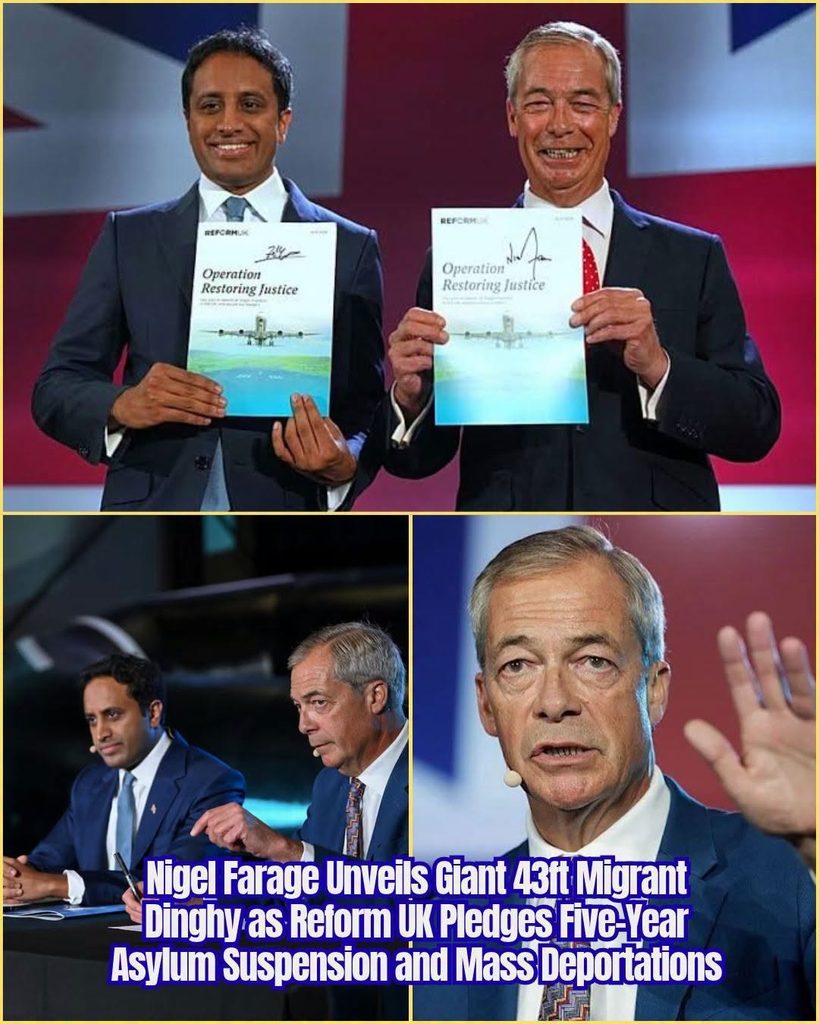
Nigel Farage has unveiled one of Reform UK’s most far-reaching immigration proposals yet, pledging to suspend Britain’s asylum system for up to five years while standing beside a giant replica migrant dinghy at a press conference in Kent.
The Reform UK leader made the announcement on Monday, October 12, presenting a series of measures he said would restore control over Britain’s borders if his party formed the next government.
At the centre of the event stood a 43-foot inflatable boat replica, which Reform said represented the vessel used to carry 230 people across the English Channel during a single crossing in August.
Farage used the display to argue that the scale of Channel crossings demanded a fundamental change in government policy.

Under the proposals, a Reform administration would suspend new asylum claims for up to five years and automatically reject approximately 90,000 outstanding applications and appeals.
Those affected would face removal from Britain, including families with children.
The party also intends to close most legal refugee resettlement routes, although it would retain an exception for Ukrainians who fled Russia’s full-scale invasion in 2022.
Another major element involves reviewing asylum approvals granted since 2024.
People whose countries of origin were subsequently classified as safe could face having their protection withdrawn.
Farage also outlined plans to increase pressure on governments that refused to accept the return of their nationals.
Potential measures would include visa restrictions, tariffs, asset-related sanctions and limits on airline access to British airspace.
Countries mentioned in discussions surrounding the proposals included Pakistan, Somalia, Eritrea, Afghanistan and Syria.
The Reform leader argued that the measures were necessary to address what he described as a national security emergency.
He also reiterated his ambition to stop small-boat crossings within the first 100 days of a Reform government.
However, the announcement immediately drew criticism from refugee organisations and political opponents.

Critics warned that automatically rejecting asylum applications could prevent people fleeing persecution from receiving individual assessments of their circumstances.
They also raised concerns about the compatibility of the proposals with Britain’s international refugee obligations and the practical difficulties involved in arranging large-scale deportations.
The government has defended its own approach, pointing to efforts to reduce Channel crossings while reforming the asylum and appeals system.
The latest proposals highlight the widening differences between the main political parties over immigration enforcement, humanitarian protection and border security.
For Reform UK, the announcement represents a commitment to replacing much of the existing asylum framework with a significantly more restrictive system.
For opponents, it raises questions about legal safeguards and the consequences for vulnerable people seeking protection.
The policies remain proposals rather than enacted measures and would depend on Reform UK entering government and overcoming potential legal and operational challenges.
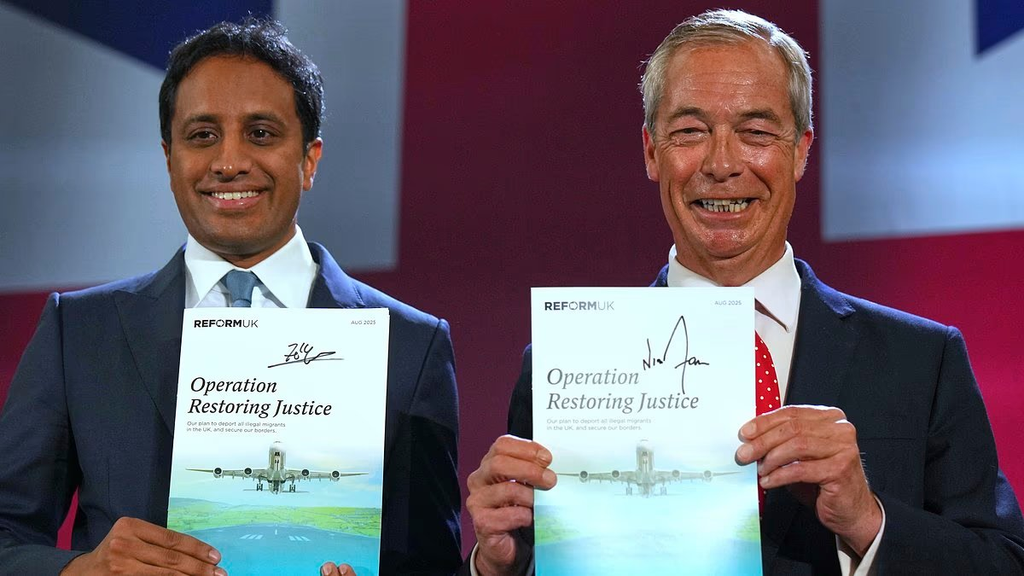
With immigration continuing to dominate Britain’s political debate, Farage’s giant boat display has ensured that his latest announcement attracts considerable attention.
The central question now is whether the party can demonstrate how such sweeping changes would operate in practice.
Nigel Farage Unveils Giant 43ft Migrant Dinghy as Reform UK Pledges Five-Year Asylum Suspension and Mass Deportations
Nigel Farage has brought the issue of small-boat migration back into the centre of Britain’s political debate, with Reform UK promoting a hard-line approach that includes a proposed five-year suspension of asylum claims and large-scale deportations. The unveiling of a giant 43-foot migrant dinghy has provided a striking visual focus for the party’s message, highlighting the scale of the challenge that irregular Channel crossings have come to represent in British politics.
The proposal raises fundamental questions about border security, the future of Britain’s asylum system and the legal limits of immigration enforcement. It also places renewed attention on the differences between political promises and the practical steps required to turn them into government policy.
For Farage and Reform UK, immigration is not simply one issue among many. It is a central part of the party’s argument that successive governments have failed to maintain public confidence in the country’s borders. The latest proposals seek to present a decisive alternative, although their implementation would involve substantial legal, diplomatic and administrative challenges.
A Giant Dinghy Becomes a Political Statement
The unveiling of a 43-foot migrant dinghy offers a powerful visual representation of the small-boat crossings that have become a familiar feature of Britain’s immigration debate.
Images of inflatable vessels carrying passengers across the English Channel have repeatedly appeared in news coverage, prompting discussions about the dangers of the journey and the responsibilities of the British government. For critics of current policy, the boats symbolise a border-control system that has struggled to prevent irregular arrivals.
Reform UK’s use of a large dinghy as a political centrepiece is intended to focus attention on the physical reality of the crossings rather than the technical language often used in policy discussions.
The vessel also illustrates the risks associated with the journeys. The Channel is a busy maritime route, and inflatable boats may be overcrowded, poorly equipped or unsuitable for the conditions. Passengers can face changing weather, strong currents and the possibility of mechanical failure.
Supporters of tougher immigration controls argue that these dangers demonstrate the need to prevent people from making the journey in the first place. They maintain that criminal smuggling networks should not be allowed to profit from people taking such risks.
However, the presence of a large dinghy at a political event does not, by itself, establish how many crossings a particular policy could prevent. The effectiveness of any proposal would need to be assessed through evidence about departures, arrivals, smuggling activity and the safety of maritime operations.
Reform UK’s Proposed Five-Year Asylum Suspension
One of the most controversial elements of Reform UK’s approach is the proposed suspension of asylum claims for a five-year period.
Such a policy would represent a fundamental change to the way Britain handles people who arrive and seek international protection. Its precise legal meaning would depend on the detailed proposals, including whether the party intended to suspend the acceptance of claims, change eligibility rules, restrict access to procedures or pursue another model.
These distinctions are important because asylum is governed by domestic legislation and international obligations. The United Kingdom is subject to legal requirements concerning refugees, human rights and the treatment of people who may face persecution or serious harm if returned to another country.
A government cannot assume that a blanket political declaration would automatically override those obligations. Any proposed suspension would need to be examined against the relevant legal framework and could face significant legal challenges.
Reform UK supporters may argue that exceptional measures are needed because the existing system has failed to deter dangerous crossings. They contend that stronger restrictions could reduce the incentive to travel to Britain through irregular routes.
Critics, however, question whether a blanket suspension would be lawful, workable or effective. They argue that it could leave vulnerable people without a clear route to have protection claims considered and create additional disputes over detention, removal and access to legal procedures.
The central question is therefore not simply whether a five-year suspension sounds decisive. It is whether the policy could be implemented in practice, what safeguards would remain in place and what consequences it would have for Britain’s legal responsibilities.
The Promise of Mass Deportations
The proposed expansion of deportations is another major component of Reform UK’s immigration agenda.
The party has argued for removing people who have no legal right to remain in Britain and for taking stronger action against irregular migration. For voters concerned about enforcement, the ability to carry out final removal decisions is an important measure of whether the immigration system is functioning effectively.
But large-scale deportations require a complex administrative structure. Authorities must establish identities, determine legal status, assess any relevant protection claims and secure the cooperation of countries that are expected to receive returnees.
Some individuals may have exhausted their legal options and be eligible for removal. Others may have pending claims, successful appeals or circumstances that prevent immediate return. Each case must be considered according to the applicable rules.
There are also practical limitations. Some countries may refuse to accept people whose nationality or identity has not been established. Others may require travel documents or additional diplomatic arrangements before returns can proceed.
Expanding removals would therefore require more than announcing a target. It would involve staffing, detention capacity where lawful, case management, transport arrangements, international agreements and procedures for reviewing decisions.
The financial implications would also need to be assessed. A programme operating on a substantially larger scale could require considerable upfront expenditure, even if its supporters argue that stronger enforcement would reduce longer-term costs.
Whether the proposal could deliver the results Reform UK promises would depend on how these obstacles were addressed.
Why Small-Boat Migration Has Become Such a Major Issue
Small-boat arrivals have become a prominent symbol of wider concerns about immigration and government competence.
For some members of the public, repeated crossings create the impression that the country is unable to control entry across its borders. They may also be concerned about the cost of accommodation, delays in processing asylum applications and the difficulty of removing people whose claims have been rejected.
These concerns have placed pressure on successive governments to demonstrate that their policies can produce measurable results.
Other observers emphasise that asylum seekers are not a single, uniform group. People arriving by boat may have different nationalities, personal histories and reasons for leaving their countries. Some may qualify for international protection, while others may not meet the relevant legal requirements.
This distinction matters because the method of arrival does not, on its own, determine whether an asylum claim is valid. Decisions generally require consideration of an individual’s circumstances and the applicable legal criteria.
The challenge for policymakers is to maintain effective border controls while ensuring that claims are processed properly and that people who have no legal basis to remain can be removed where the law permits.
The Role of People-Smuggling Networks
Behind many irregular Channel crossings are organised networks that arrange transport, recruit passengers and collect payments. These operations can expose migrants to serious risks while generating income for those facilitating the journeys.
Reform UK’s proposals focus heavily on deterrence and removal. However, disrupting the networks themselves is also an important part of any strategy to reduce crossings.
Investigations may involve intelligence-sharing, financial inquiries, surveillance and cooperation between British and French authorities. Identifying organisers and dismantling the businesses behind the crossings can be more complex than intercepting a vessel after it has departed.
Smugglers may also adapt when enforcement changes. They can alter departure points, use different vessels or change their methods in response to increased patrols. This means that a successful long-term strategy would need to anticipate changes rather than rely on a single intervention.
There is also a maritime safety dimension. Preventing dangerous departures and responding to vessels in distress are related but distinct responsibilities. Any new enforcement system would need clear procedures for handling emergencies and protecting life at sea.
A policy that reduces the number of arrivals but creates additional risks during interceptions would require careful reassessment.
The Legal and Diplomatic Challenges
Reform UK’s proposals would also have implications for Britain’s relationships with other countries.
Large-scale removals depend on the ability to return people to destinations that will accept them. This can require agreements on identity verification, travel documentation and the practical arrangements for receiving returnees.
Where a person claims they would face persecution or serious harm if returned, authorities must also consider the relevant legal protections. A policy cannot be evaluated solely by counting the number of people removed without examining whether decisions were lawful and whether safeguards were respected.
The proposed asylum suspension would raise further questions about the UK’s international commitments and the procedures available to people seeking protection.
If the policy were challenged in court, its implementation could depend on the outcome of legal proceedings. That uncertainty would matter when calculating costs, setting operational targets and deciding how the system would function during any transition.
Diplomatic cooperation would be equally important. Other governments may have their own legal requirements and political considerations when agreeing to receive returnees. Britain would need arrangements that work in practice rather than relying solely on announcements made at home.
These factors do not prevent a government from pursuing stricter immigration controls. They do mean that any plan must be developed with careful attention to legal authority, administrative capacity and international cooperation.
How the Proposals Could Shape British Politics
The unveiling of the giant dinghy and the pledge of tougher asylum measures underline Reform UK’s attempt to keep immigration at the centre of the national conversation.
The issue provides the party with an opportunity to challenge the established parties over their records and to argue that more fundamental changes are required. Its proposals are aimed at voters who want a more restrictive approach and who believe existing arrangements have not delivered sufficient control.
Other political parties face pressure to explain how their own policies would reduce dangerous crossings, improve the processing of asylum applications and ensure that final removal decisions are carried out.
However, the debate is not confined to competing promises. Voters may also ask how the proposals would be funded, what legal changes would be required and what safeguards would prevent mistakes or unlawful removals.
The answers matter because immigration policy affects not only national borders but also public spending, local authorities, the courts, employers and the people directly involved in the asylum system.
A proposal can attract attention through striking imagery and ambitious targets, but its lasting significance depends on whether it can deliver results under real-world conditions.
What Would Success Look Like?
Assessing the proposals would require clear measures of performance.
A government seeking to reduce irregular migration could examine the number of attempted crossings, successful arrivals, disrupted smuggling operations and people returned following final decisions. It would also need to monitor the speed and accuracy of asylum decisions, the costs of enforcement and the safety of operations at sea.
A reduction in arrivals alone would not necessarily reveal the full picture. Crossings could shift to different routes or periods, while enforcement costs could rise. Similarly, a higher number of removals would need to be considered alongside the legality of decisions and the resources required to achieve them.
Transparent reporting would help Parliament and the public judge whether the policy was meeting its objectives.
It would also make it possible to compare promised outcomes with actual results rather than relying on political claims from any party.
A Major Proposal With Major Questions
Nigel Farage’s presentation of a giant 43-foot migrant dinghy, alongside Reform UK’s proposed five-year asylum suspension and mass deportations, places immigration enforcement firmly back in the political spotlight.
The proposals reflect a demand among some voters for a more restrictive approach to irregular migration. They also raise serious questions about legality, administrative capacity, international cooperation, cost and the protection of people who may qualify for asylum.
A lasting reduction in dangerous Channel crossings would require more than a dramatic political announcement. It would depend on disrupting smuggling networks, improving the operation of the asylum system, carrying out lawful returns and coordinating effectively with international partners.
The decisive test will be whether the proposals can be translated into workable measures that produce measurable improvements without creating greater legal or humanitarian problems.
As the immigration debate continues, the public will have to look beyond the size of the dinghy and the scale of the promises. The more important questions concern what the proposed policies would actually do, whether they could operate within the law and whether they would deliver the results that Reform UK says Britain needs.