
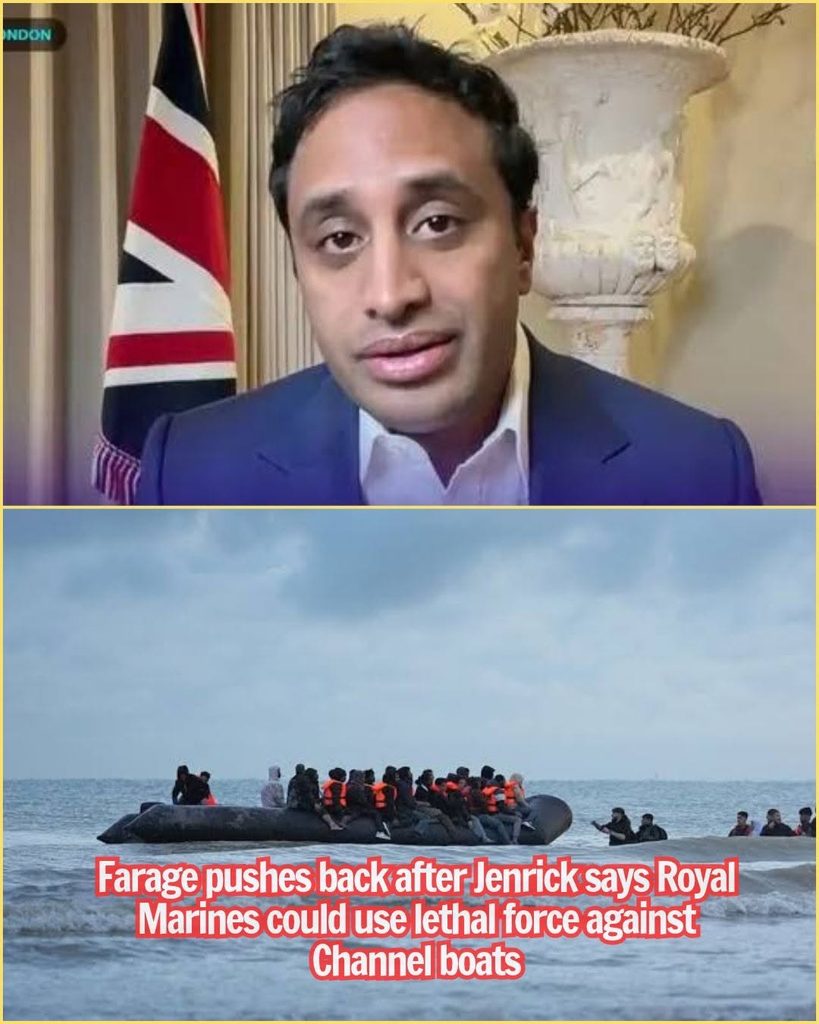
Nigel Farage has moved to deny that a Reform UK government would authorise the use of lethal force against small boat crossings in the Channel, intervening just hours after one of his MPs argued that troops should be allowed to open fire.
The Reform UK leader overruled Robert Jenrick, a prominent MP who defected from the Conservatives, after Jenrick suggested during a broadcast interview that the party would deploy the military to turn vessels back towards France. The public disagreement comes amid visible strain inside the party, on the same day an opinion poll suggested Reform had slipped into third place behind the Conservatives.

Speaking on LBC, Farage insisted that a Reform administration would not authorise any routine use of force against crossing boats, asserting that Jenrick was being “utterly misconstrued”.
Farage maintained that British forces would be permitted to use force only if they were fired at first, describing such action as a defensive response rather than a general policy of shooting at dinghies.
“Anybody wearing British military uniform who gets fired at has the right to respond. That’s what he was saying,” Farage told the station. Farage linked the situation to criminal operations operating around northern French camps, saying: “Remember, in these camps, every week there are shootings, there are stabbings. We are dealing here with very, very serious international criminal organisations, and what we’re saying is, we will, if we win the next election, pick these people up and take them back to France.”
Farage conceded that such interceptions could provoke confrontation, but predicted that robust action would quickly halt crossings altogether. “There is a possibility that initially that might be met with some force.
If it is, force will be met with force. But I tell you something: within two weeks of boats being taken back to France, the boats will stop coming,” he said.

The controversy was ignited when Jenrick claimed during an appearance on TalkTV that Reform was the only political party willing to use force against people making the crossing. “What we are going to do, and we’re the only political party that has the courage to say this, is deploy the Royal Marines into the Channel. If they need to use lethal force, then they’ll be able to do so,” Jenrick said.
Jenrick suggested that authorising the use of force would bring the crossings to an end “in just a few days”.
While he stated that using force was “obviously not what we want to see happen”, he added: “We want to see these individuals picked up off the boats in a sensible and reasonable way, and taken straight back to France.”
The remarks prompted sharp condemnation from the government. Defence minister Luke Pollard described the comments as “disgusting and illegal”, warning that members of the British armed forces are barred under military rules from following an unlawful command.

“We do not shoot unarmed civilians. We do not take military action against civilians,” Pollard told Times Radio. “The idea of this is a soundbite designed by Reform to distract from their sleaze and their scandal … it’s abhorrent to military values, it’s abhorrent to British values. I don’t think anyone should give this any truck.
We can all see what this is: an attempt to distract from Reform’s internal woes.”
The party’s position was further complicated when Reform UK chair Zia Yusuf also walked back earlier hardline rhetoric. Yusuf, who had previously promised that lethal force would be deployed to stop migrant boats reaching Britain, told BBC Breakfast that such measures would apply only “in extremely limited circumstances where it is necessary to protect innocent life.” Yusuf argued that personnel had to be prepared to act if they encountered individuals carrying weapons or threatening the lives of passengers on board.
Yusuf also highlighted internal divisions with former Conservative figures who joined Reform, including Jenrick and former home secretary Suella Braverman.
Asked on Sky News about a past social media post where he had referred to them as “quislings” for their roles in the previous government, Yusuf insisted that ministers in that administration bore collective responsibility for failing to deliver promised reductions in immigration numbers.
Yusuf additionally diverged from Braverman over controversial comments she had made suggesting her South Asian heritage prevented her from being considered English. Yusuf rejected that stance, referencing celebrated sporting figures such as Ashley Cole, Bukayo Saka, Rio Ferdinand and Nasser Hussain to illustrate that such an argument did not hold water with him. The widening public debate arrives alongside a Times poll indicating Reform had dropped to third place behind Labour and the Conservatives, giving Kemi Badenoch’s party its strongest showing since she became Tory leader.
Farage Pushes Back After Jenrick Says Royal Marines Could Use Lethal Force Against Channel Boats
A fresh debate over how Britain should respond to small boats crossing the English Channel has emerged after Robert Jenrick reportedly raised the possibility that Royal Marines could use lethal force against boats involved in illegal crossings. Nigel Farage has pushed back against the suggestion, bringing renewed attention to the legal, practical and humanitarian questions surrounding proposals to stop migrant vessels before they reach British shores.
The dispute highlights a difficult question facing British politicians: how far should the government go to prevent dangerous Channel crossings, and what measures can realistically be used without putting lives at greater risk?
For years, small-boat arrivals have been one of the most contentious issues in British politics. Successive governments have promised to strengthen border controls, disrupt smuggling networks and reduce the number of people making the dangerous journey from northern France. Yet the issue remains politically sensitive, with disagreements over enforcement methods, international cooperation and the future of the UK’s asylum system.
Farage Challenges the Use of Lethal Force
Nigel Farage has made immigration control a central part of Reform UK’s political platform. His approach has frequently focused on stronger border enforcement, removing people who have no legal right to remain in Britain and changing the arrangements that allow asylum claims to be processed.
However, the suggestion that Royal Marines could use lethal force against Channel boats raises a separate question from whether border enforcement should be tougher. It concerns the circumstances in which military personnel could lawfully use potentially fatal force against vessels carrying people, including children and individuals seeking asylum.
Farage’s reported pushback places him within a wider debate about the distinction between stopping illegal crossings and adopting measures that could endanger those on board. Stronger enforcement does not necessarily mean that every proposed tactic would be lawful, effective or proportionate.
The precise wording of the politicians’ statements, the circumstances in which the proposal was discussed and the details of Farage’s response are important. Without a verified account of those remarks, it would be premature to attribute a specific legal argument or detailed alternative plan to either politician.
Nevertheless, the disagreement illustrates how quickly the immigration debate can move beyond general promises of tougher action and into questions about what enforcement should actually involve.
Why the Channel Crisis Remains Politically Sensitive
The English Channel is one of the world’s busiest shipping routes. Small inflatable boats attempting to cross it face strong currents, changing weather, commercial traffic and the risk of overcrowding. Passengers may have little experience at sea, while the vessels used by smugglers are not always designed for a journey in such conditions.
These dangers create a difficult operational environment for authorities. Intercepting a boat can itself create risks if the vessel is unstable, overcrowded or already taking on water. An aggressive intervention may cause passengers to panic, destabilise the boat or make a rescue more complicated.
At the same time, British governments face pressure from communities and voters who believe that the current arrangements do not adequately deter unauthorised arrivals. Critics argue that smugglers continue to exploit gaps in enforcement and that repeated political promises have not produced a sufficiently lasting solution.
The resulting tension is central to the debate. Authorities are expected to prevent dangerous crossings, but they must also respond to emergencies and protect human life. Any proposal involving military personnel must account for both responsibilities.
The Role of the Royal Marines
The Royal Marines are trained for demanding military operations, but using military personnel in a domestic border-enforcement role would raise questions that go beyond their ability to operate at sea.
A proposal to deploy them against small boats would require a clear operational framework, including command arrangements, rules of engagement, coordination with maritime authorities and procedures for dealing with people rescued or intercepted during an operation.
The use of lethal force would raise the most serious questions. It cannot simply be treated as an ordinary tool for preventing an unauthorised crossing. The applicable legal framework, the immediate circumstances and the necessity of any use of force would all matter.
International human rights obligations, maritime law and domestic law may impose constraints on operations involving people at sea. The presence of suspected smugglers or individuals attempting an unlawful crossing would not, by itself, establish a justification for shooting at a vessel.
There is also a practical distinction between confronting an immediate threat to life and attempting to enforce an immigration policy. A response to an imminent threat may be assessed differently from the use of force intended merely to turn a boat away.
These considerations mean that any proposal involving lethal force would need far more than a political declaration. It would require detailed legal scrutiny, operational planning and clear accountability.
The Humanitarian Risks
Every Channel crossing carries risks, even when the weather appears relatively calm. Inflatable boats can become unstable, passengers may be unable to swim, and emergency situations can develop quickly.
The possibility of lethal force would therefore raise serious humanitarian concerns. A gunshot or other violent intervention could injure passengers, damage a vessel or trigger panic in an already dangerous environment. If a boat capsized, rescuers could face a far more complex emergency.
Those concerns do not remove the responsibility to enforce immigration laws. Rather, they underline the need to distinguish between effective border control and tactics that may increase the danger to everyone involved.
The people aboard these vessels are not all in the same position. Some may be suspected of organising or facilitating smuggling operations, while others may be passengers who have paid to cross. Some may qualify for international protection; others may not meet the requirements for asylum. Their individual circumstances can only be assessed through appropriate procedures.
A policy that treats every person aboard a small boat as an identical security threat risks overlooking these important distinctions.
The Government’s Wider Border Challenge
The argument between Farage and Jenrick also reflects the broader difficulty facing any government seeking to reduce small-boat arrivals.
Enforcement at sea is only one part of the problem. The UK must also consider cooperation with France, intelligence-sharing against criminal networks, the processing of asylum applications, returns where legally permitted and the conditions that encourage people to undertake the journey.
Smuggling organisations adapt to changes in enforcement. If one route becomes more difficult, they may alter departure points, change tactics or attempt crossings under different conditions. This makes long-term cooperation and intelligence-led operations important alongside patrols.
The processing system matters too. Where decisions take too long, accommodation costs and uncertainty can increase. Where people receive final decisions but removal arrangements cannot be completed, public confidence may suffer. A government seeking durable results must therefore address both the border itself and what happens after an arrival.
Farage and other critics have argued for more forceful action on immigration. Supporters of tougher enforcement say that visible consequences for illegal entry are necessary to discourage future crossings and weaken the business model of smugglers.
Opponents of the most aggressive proposals, however, argue that deterrence cannot be the only measure of success. They emphasise the need to comply with legal obligations, protect people in distress and avoid measures that could result in preventable deaths.
The central policy challenge is to design an approach that can withstand both operational reality and legal scrutiny.
Political Pressure and Public Confidence
Immigration remains an issue capable of shaping public attitudes towards the major political parties. For Reform UK, the subject offers an opportunity to challenge the established parties over their handling of border control. For Conservatives and Labour, it creates pressure to demonstrate that their policies can deliver measurable results.
A dispute over lethal force is particularly sensitive because it shifts the debate from broad promises about reducing arrivals to the methods that might be used to achieve that objective.
Voters may agree that dangerous crossings should be reduced while disagreeing sharply about how authorities should intervene. Some may prioritise deterrence and believe that stronger action is necessary. Others may support strict enforcement but reject measures that could place passengers’ lives at unnecessary risk.
Politicians therefore face a challenge in explaining not only what they want to achieve but how their proposals would work in practice.
A credible plan would need to clarify who would make operational decisions, what powers personnel would possess, how emergencies would be handled and how compliance with the law would be monitored. It would also need to explain how the policy would affect rescue operations and cooperation with French authorities.
Without those details, dramatic language risks obscuring the practical questions that determine whether a proposal could be implemented.
Could Tougher Tactics Stop the Crossings?
The effectiveness of any new approach would depend on more than the severity of the language used to announce it.
A policy might appear uncompromising but fail to reduce crossings if smugglers quickly adapted or if enforcement operations created new logistical problems. Conversely, measures involving better intelligence, coordinated policing and faster lawful decision-making could potentially disrupt criminal networks without relying on extreme tactics.
Evaluating success would require clear evidence, including changes in attempted crossings, the number of people intercepted, the disruption of smuggling organisations, the safety of maritime operations and the cost of enforcement.
It would also be necessary to distinguish between reducing departures and simply moving them to different locations or times. A fall in arrivals during one period would not, by itself, prove that a particular measure had delivered a lasting result.
Any proposal to involve the Royal Marines would need to be assessed against these practical considerations as well as its legal and humanitarian implications.
A Debate Far From Resolved
The reported disagreement between Nigel Farage and Robert Jenrick brings an important distinction into focus: demanding stronger border controls is not the same as establishing that every proposed enforcement method is justified.
Britain’s small-boats problem involves criminal smuggling, dangerous maritime journeys, contested asylum claims and persistent public concern about the government’s ability to control its borders. No single measure can resolve all those issues, and any serious strategy must explain how its different parts would work together.
If lethal force has been raised as a possible tactic, the question is not simply whether politicians want to appear tougher. It is whether such a proposal has a lawful basis, whether it could be implemented safely and whether it would achieve its stated objective.
For now, the broader argument over the Channel continues to expose the competing pressures facing British policymakers. They must demonstrate that borders are being enforced, address the networks profiting from dangerous crossings and maintain the legal safeguards that govern the use of force.
The political dispute may generate strong headlines, but the lasting test will be whether any proposed policy produces measurable results while protecting life and remaining within the law.