
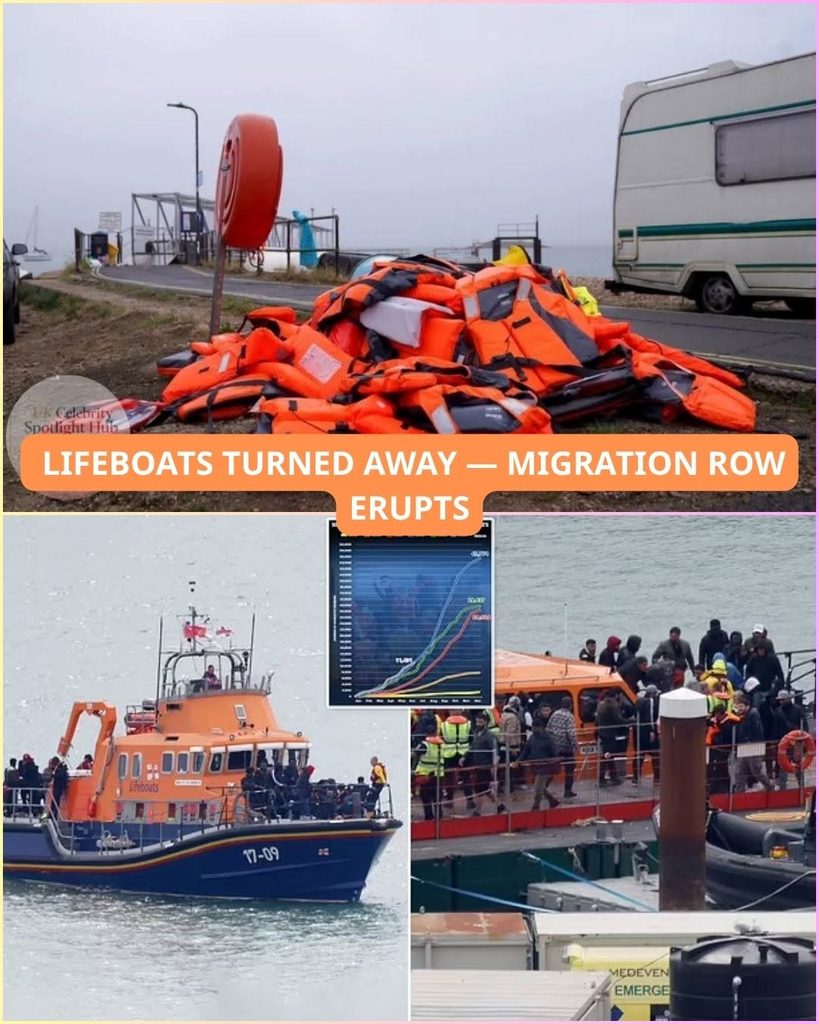
Two RNLI lifeboats carrying around 140 migrants were reportedly refused entry to ports in Southampton and Portsmouth before eventually bringing those rescued ashore at Eastney, according to newly revealed marine communications.
The incident has become the latest flashpoint in Britain’s increasingly heated debate over small-boat crossings and the role of the RNLI in responding to people in distress at sea.
On Sunday, two lifeboats operated by the charity picked up around 140 people from a single inflatable vessel in the Solent.
On Sunday, two lifeboats operated by the charity picked up 140 migrants from a single migrant vessel
PICTURED: Piles of lifejackets left by illegal migrants in Eastney after being dumped on the beaches of Hampshire
The boat is believed to have travelled from the Normandy coast, making it an unusually long Channel journey compared with the more common routes towards Kent.
Before the group was brought ashore at Eastney in Hampshire, the RNLI crews were reportedly denied access to both Southampton and Portsmouth.
According to the report, open marine VHF radio communications indicated that Southampton Vessel Traffic Service and the King’s Harbour Master Portsmouth would not allow the lifeboats into the ports.
Associated British Ports later confirmed that access to Southampton had been declined.
A spokesman said the port did not have suitable reception facilities available at the time.
The company added that Southampton would have responded differently if there had been an immediate safety-of-life emergency, if it had been the closest available port or if authorities had formally instructed the port to accept the vessels.
Hundreds of furious locals poured onto the streets in protest following the illegal migrants’ arrival
| PA
It said none of those conditions applied in this case.
After being unable to enter the two ports, the RNLI boats headed to Eastney.
Their arrival was followed by angry protests as hundreds of people gathered near the RNLI Portsmouth Lifeboat Station.
Some demonstrators blocked the road while police wearing riot gear formed lines in an attempt to control the situation.
Downing Street later condemned behaviour it described as intimidating and thuggish, while stressing that peaceful protest remained legitimate.
The Home Office said everyone brought ashore had subsequently left the landing area and was being transported for normal asylum processing.
The RNLI expressed frustration at the way the situation had been handled.
A spokesman said the charity was working with the relevant authorities to understand why access had been refused and said it was disappointed by the manner in which crews had been spoken to.
The organisation stressed that its volunteers give their time to save lives at sea.
The episode has nevertheless intensified political criticism of the RNLI from some opponents of current migration policy.
Reform MP Suella Braverman argued that ports should refuse entry to lifeboats carrying migrants and accused the Government of losing control of Britain’s borders.
She also used the controversial description of the RNLI as a “taxi service”, language the charity strongly rejects.
The RNLI maintains that its role is strictly humanitarian.
It says small boats attempting to cross the Channel are treated as being in distress and that its purpose is to respond when called upon to save lives.
Former RNLI volunteer David Wimble, now a Reform councillor, also defended crews despite his political opposition to small-boat crossings.
He said the charity itself was neutral and existed solely to rescue people in danger.
RNLI chief executive Peter Sparkes has meanwhile warned that staff and volunteers have faced growing abuse because of misinformation surrounding their Channel operations.
He said some volunteers had been targeted online and, in the worst cases, physically abused.
Sparkes argued that criticism of immigration policy should not be directed at crews responding to emergencies at sea.
The weekend’s events have therefore exposed a growing divide.
For critics, the repeated arrival of migrants rescued at sea has become symbolic of what they see as a failure of border policy.
For the RNLI, however, the issue is much simpler: when people are in danger on the water, its crews respond regardless of nationality, immigration status or politics.
The decision to deny the lifeboats access to Southampton and Portsmouth is now likely to fuel further debate over what should happen after migrants are rescued — and which ports should be responsible for receiving them.
What is clear is that the controversy surrounding Sunday’s rescue did not end when the passengers reached land.
Instead, it has become another major political battle over the Channel crossings, local protest and the responsibilities of one of Britain’s best-known lifesaving charities.
RNLI Migrant Rescue Boats Blocked from Two English Ports Before 140 People Are Brought Ashore at Eastney
The arrival of around 140 people at Eastney following a reported disruption involving RNLI rescue boats at two English ports has brought renewed attention to the challenges surrounding small-boat crossings in the English Channel. The incident raises important questions about maritime rescue operations, public opposition to migration, the responsibilities of local authorities and the continuing political dispute over Britain’s borders.
The Royal National Lifeboat Institution (RNLI) plays a significant role in maritime safety around the United Kingdom. Its lifeboat crews respond to emergencies at sea, often in difficult weather and under considerable pressure. When people encounter trouble in the Channel, the priority for rescue teams is to protect life and bring those in danger to safety.
However, the issue of migrant crossings has become increasingly contentious. While some people regard rescue operations as an essential humanitarian responsibility, others are frustrated by the continued arrival of small boats and question whether existing government policies are effective. When these competing concerns meet at ports and coastal communities, tensions can rise quickly.
The reported disruption at two English ports, followed by the arrival of 140 people at Eastney, illustrates the complexity of managing maritime emergencies amid an intensely politicised debate.
Questions Over the Reported Port Disruption
Reports that RNLI migrant rescue boats were blocked from operating at two English ports have raised questions about what happened, who was responsible and how the disruption affected rescue arrangements.
The precise circumstances require careful verification. It is important to establish whether the boats were physically prevented from entering or leaving, whether access was temporarily restricted, and whether any operational or safety considerations played a role. Without confirmed details, it would be premature to attribute responsibility or draw conclusions about the motives of those involved.
Nevertheless, any obstruction that interferes with an emergency response could have serious consequences. Lifeboat crews must be able to respond when people are in danger, regardless of the political arguments surrounding an incident.
Ports are important parts of the UK’s maritime safety network. They provide access for rescue vessels, allow crews to prepare for operations and support the movement of people who need assistance. Disruption can complicate coordination between emergency services, harbour authorities and other agencies.
If a port confrontation delays a rescue, the consequences could extend beyond the immediate dispute. The English Channel is a busy waterway where conditions can change rapidly, and small vessels carrying large numbers of people may be particularly vulnerable.
For that reason, any allegations of interference with rescue operations should be investigated using reliable evidence and clear accounts from the organisations involved.
Why Eastney Has Become Part of the Debate
The reported arrival of approximately 140 people at Eastney has placed the location at the centre of renewed attention surrounding Channel migration.
Bringing people ashore after a maritime operation is only one stage in a much larger process. Depending on the circumstances, those arriving may require medical assessments, safeguarding checks, identification procedures and decisions about their legal status. Different public bodies may be responsible for different stages of that process.
For residents, repeated reports of arrivals can raise questions about local resources, accommodation and the demands placed on public services. Some may feel that communities are expected to absorb the consequences of national policy without receiving sufficient information about the arrangements being made.
Others stress that people brought ashore after a rescue should not automatically be treated as having committed an offence. Their circumstances must be assessed individually, and any asylum claim must be considered under the applicable legal framework.
These positions reflect a broader disagreement over how Britain should manage migration. There is a legitimate debate about the level of immigration, the operation of the asylum system and the resources required to enforce the law. At the same time, people in danger at sea require assistance irrespective of the outcome of any later immigration decision.
The challenge for authorities is to maintain public confidence while ensuring that emergency responses are not undermined by political disputes.
The RNLI’s Role in Maritime Safety
The RNLI is a charity dedicated to saving lives at sea. Its lifeboat crews respond to a wide range of emergencies, including incidents involving recreational boaters, commercial vessels and people in distress.
Rescue work involving migrant boats can attract particular controversy because it is closely associated with the wider debate over border control. Critics sometimes argue that rescue operations are connected to a system that encourages further crossings. Supporters of the RNLI’s approach emphasise that saving lives at sea is a matter of maritime safety rather than an endorsement of immigration policy.
These arguments concern different questions. Whether the government has an effective strategy for preventing dangerous crossings is a matter of immigration and border policy. Whether a lifeboat crew should assist people facing immediate danger is a question of emergency response and maritime safety.
Keeping those responsibilities distinct is important. Rescue crews are not responsible for deciding asylum claims or determining who has the right to remain in Britain. Those decisions belong to the relevant public authorities and legal processes.
The RNLI’s operational decisions in any specific incident should be assessed against the available evidence and the circumstances faced by its crews. If a disruption occurred, the organisation’s account, alongside information from harbour authorities and other agencies, would help establish what happened.
Public Frustration Over Small-Boat Crossings
Small-boat migration has remained a major subject of political debate in the United Kingdom. The issue brings together concerns about national sovereignty, the enforcement of immigration rules, the cost of accommodation, pressure on public services and the effectiveness of international cooperation.
For some voters, the continued arrival of boats represents evidence that the government has not established sufficient control over the border. They want faster asylum decisions, stronger action against smuggling networks and the removal of people who have no legal right to remain when removal is lawful and practicable.
Others focus on the dangers faced by those attempting the crossing. They argue that criminal smuggling networks exploit people who may have few safe options, placing them aboard unsuitable vessels and charging substantial sums for journeys that can end in tragedy.
These concerns are not necessarily mutually exclusive. A country can enforce immigration law while maintaining an effective maritime rescue system. It can investigate smuggling networks, process asylum claims and carry out lawful removals while ensuring that emergencies at sea are handled safely.
The central policy challenge is to make the system work consistently enough that public frustration does not deepen and dangerous journeys become less attractive.
Why Obstructing Rescue Operations Can Create Risks
If rescue boats are prevented from reaching the water or returning to an appropriate landing point, the implications could extend beyond the immediate inconvenience.
Lifeboat crews operate within a system that depends on communication, coordination and access to suitable facilities. Delays may affect the availability of vessels for subsequent emergencies, while uncertainty over access can complicate planning.
The seriousness of any disruption depends on its duration, location and effect on operational readiness. A brief disagreement that does not affect safety is different from an obstruction that prevents crews from responding to a distress call. Establishing that distinction requires evidence rather than assumptions.
Peaceful protest and criticism of immigration policy remain part of democratic debate. However, protest should not put people at risk or interfere unlawfully with emergency services. Anyone concerned about migrant crossings can raise questions with elected representatives, support lawful campaigns or demand greater transparency from the government without creating hazards at a port.
Authorities should communicate clearly about any verified disruption and explain what measures are being taken to ensure that emergency services can continue their work.
The Government Faces Pressure to Deliver Results
The reported events come against a wider backdrop of demands for a more effective approach to small-boat crossings. Governments are judged not only on their promises but also on whether policies deliver measurable results.
A comprehensive response involves several separate tasks. Authorities must identify and disrupt smuggling networks, improve the speed and quality of asylum decisions, maintain appropriate accommodation and enforce decisions in accordance with the law. International cooperation may also be necessary where countries of origin or transit are involved.
No single announcement can resolve every aspect of the problem. Border enforcement requires operational capacity, functioning administrative systems and arrangements that can be implemented in practice.
The government must also explain how it intends to balance security, legal obligations and humanitarian considerations. If the public receives incomplete information or sees repeated delays without a convincing explanation, confidence in the system may deteriorate.
At the same time, claims about individual incidents should not be used as substitutes for broader evidence about whether a policy is succeeding. The number of crossings, the outcomes of asylum applications, the effectiveness of enforcement measures and the disruption of smuggling networks all provide different pieces of the picture.
Local Communities Want Clear Answers
Coastal communities can find themselves at the centre of a national argument despite having limited influence over the policies that shape it. Residents may want to know which services are involved when people arrive, how public money is being spent and what arrangements exist to manage the consequences.
Providing clear information can help prevent rumours from filling the gap. Authorities should explain what is known about an incident, which details remain unconfirmed and which organisations are responsible for responding.
This is particularly important when claims circulate rapidly on social media. A report that boats were blocked, for example, does not by itself establish who blocked them, whether the action was deliberate or whether rescue operations were delayed. Those questions need answers grounded in evidence.
The same principle applies to the reported arrival of 140 people at Eastney. Accurate information about the timing, circumstances and official response would help the public understand the event without relying on speculation.
Transparency does not require officials to disclose sensitive operational information. It does require them to distinguish established facts from allegations and to provide meaningful explanations when public safety or the use of public resources is at issue.
A Difficult Balance Between Border Control and Saving Lives
The dispute surrounding migrant crossings reflects a fundamental tension in British politics. Many people want stronger control over who enters the country, while emergency services must respond when lives are threatened.
These responsibilities should not be confused. Rescuing a person from danger does not automatically determine their immigration status, just as enforcing immigration rules does not remove the need for an appropriate emergency response.
A credible system needs both effective enforcement and reliable maritime safety arrangements. It must also treat allegations of obstruction seriously where evidence suggests that rescue operations were endangered.
The reported incident involving RNLI boats and the subsequent arrival of 140 people at Eastney therefore raises questions that go beyond one day’s events. It highlights the importance of establishing what happened, protecting the ability of rescue services to operate and addressing public concerns through workable policy.
Ultimately, Britain’s approach to small-boat migration will be judged by whether it reduces dangerous crossings, deals with asylum claims fairly and efficiently, disrupts criminal smuggling and maintains public confidence. Achieving those aims requires more than confrontation at ports or political arguments over rescue boats.
It requires reliable evidence, effective institutions and clear responsibilities. Until the details of the reported disruption are established, the public should be cautious about assigning blame. What remains clear is that maritime safety and border policy must be handled with seriousness, transparency and respect for the law.