
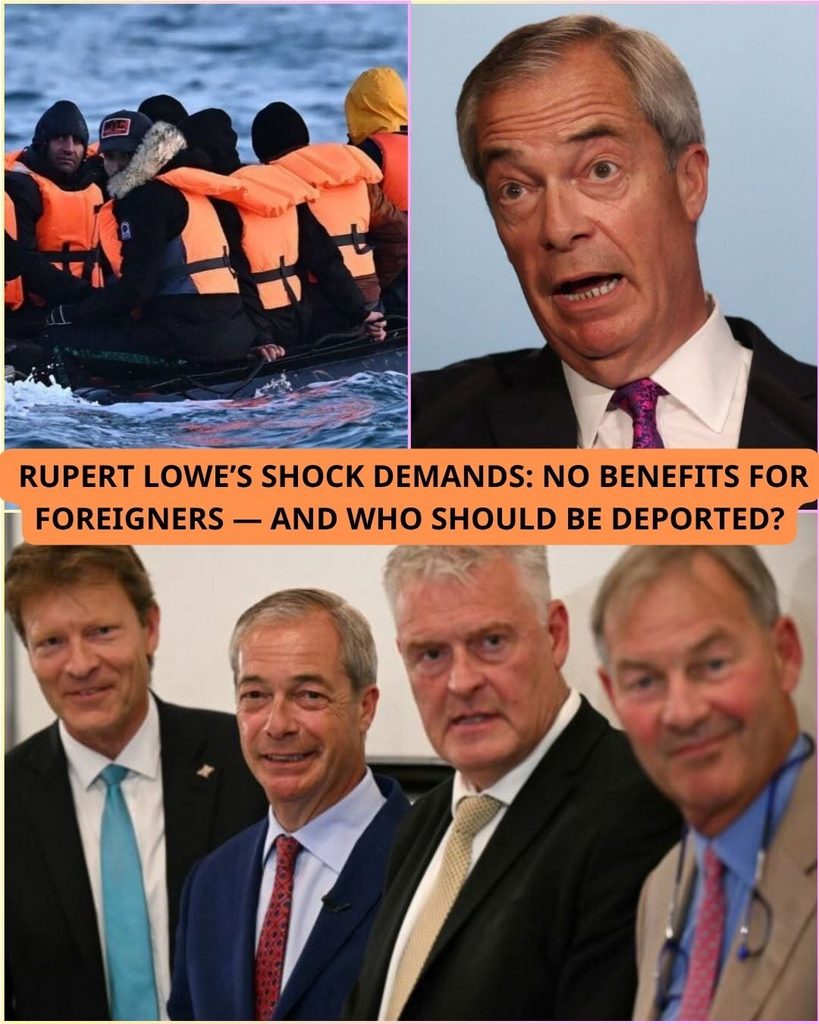

Rupert Lowe Calls for Tougher Restrictions on Benefits for Foreign Nationals, Igniting Westminster Row
WESTMINSTER — British MP Rupert Lowe has reignited one of the country’s most contentious political debates after reportedly calling for sweeping restrictions on state benefits for foreign nationals and arguing that people without a right to remain or the ability to support themselves should face removal from the United Kingdom.
The intervention has been promoted online as a demand for a “complete ban on foreign benefits” and “immediate deportations,” language that has generated strong reactions from both supporters and critics.
Yet the precise scope of Lowe’s proposal is important.
Britain’s immigration and welfare systems contain numerous legal categories, and the term “foreigner” can include people in dramatically different circumstances — from temporary visitors and overseas workers to refugees, permanent residents and people who have lived legally in Britain for decades.
Without a complete transcript of Lowe’s remarks, it would be premature to assume that every person without British citizenship was intended to fall under exactly the same policy.
Nevertheless, his reported intervention raises a politically potent question: to what extent should access to Britain’s welfare state depend on citizenship and financial self-sufficiency?
The Argument: Come to Britain, Support Yourself
At the heart of the position attributed to Lowe is a straightforward principle.
People moving to Britain, supporters argue, should generally be capable of supporting themselves rather than relying on taxpayers.
For advocates of tougher immigration controls, this is both an economic and moral argument.
They contend that Britain’s welfare state was created through contributions from people living and working in the country and that immigration policy should not create additional demands on already stretched public finances.
That message has particular political force at a time when households face pressure from housing costs, taxation and the cost of living.
If British citizens are struggling to obtain housing or access public services, critics of the current system ask why taxpayers should finance people who have arrived from overseas.
It is an argument likely to resonate with voters who believe the immigration system has become disconnected from the country’s economic capacity.
But translating the slogan into legislation is considerably more complicated.
Many Migrants Already Face Benefit Restrictions
One of the biggest misconceptions surrounding the debate is that every foreign national living in Britain automatically has full access to welfare.
That is not the case.
Many people entering the UK under immigration routes are subject to restrictions on access to public funds. Their ability to claim particular benefits depends on immigration status, residency requirements and the rules governing individual payments.
That means any proposal for a blanket prohibition would need to explain what additional restrictions it intends to introduce.
Would it apply to somebody who had legally worked and paid taxes in Britain for many years but had not obtained citizenship?
Would refugees be included?
What about spouses of British citizens?
Would permanent residents lose entitlements despite having contributed through taxation and National Insurance?
Those distinctions are essential if the proposal is to become something more than a political slogan.
Citizenship Versus Contribution
A particularly difficult question concerns whether citizenship should be the decisive test.
Imagine two workers living side by side.
Both have worked in Britain for many years. Both have paid taxes. Both lose their jobs unexpectedly.
One is a British citizen; the other is a foreign national with lawful long-term residence.
Should only one receive temporary support?
Supporters of a citizenship-based system may argue yes: citizenship carries rights that temporary or foreign residence does not.
Critics would argue that someone who has contributed to the system should not automatically be excluded simply because of nationality.
That disagreement goes to the heart of what the welfare state represents.
Is it principally a benefit of citizenship?
Or is it partly an insurance system connected to lawful residence and economic contribution?
Lowe’s reported intervention forces that philosophical question into the political spotlight.
Deportation Is a Separate Legal Question
The second part of the controversy concerns removal.
The claim that foreigners unable to support themselves should simply be “booted out” may sound straightforward, but deportation and immigration removal are governed by legal processes.
A person cannot necessarily be removed merely because they become unemployed or experience financial hardship.
Their immigration status matters.
Some individuals have permanent rights to remain. Others may have protection because returning them to another country would expose them to persecution or other serious risks. Family circumstances can also create legal considerations.
At the other end of the spectrum, people whose visas have expired or whose claims to remain have been finally rejected may already be liable for removal.
The political debate is therefore partly about whether existing rules should be changed and partly about whether existing removal decisions are being enforced effectively.
Those are different problems.
Supporters See a Question of Fairness
For Lowe’s supporters, the broader principle is likely to matter more than the technicalities.
They argue that a country has the right to decide who can settle within its borders and under what conditions.
If migration is intended to benefit Britain economically, they say, newcomers should normally contribute more than they require from the state.
Supporters may also argue that stricter welfare rules could reduce incentives for economically unsustainable migration and restore confidence among voters who believe governments have lost control of both immigration and public spending.
From that perspective, restricting benefits is not necessarily hostility toward migrants.
It is presented as a condition of admission: those choosing to move to Britain should be financially independent.
Critics Warn Against Oversimplification
Opponents are likely to argue that such proposals risk treating millions of people with vastly different circumstances as one group.
A foreign-born doctor working for the NHS is not in the same situation as somebody with no legal right to remain.
A recognized refugee is different from an economic migrant.
A permanent resident who has paid British taxes for 20 years is different from a newly arrived temporary worker.
Critics may also question whether sweeping restrictions would actually save as much money as supporters expect.
The financial impact depends on how many people currently receive the benefits targeted, how much they receive and whether restrictions would create costs elsewhere.
For example, removing support from families unable to meet basic needs could create additional pressures on councils, charities or emergency services.
The Political Appeal Is Obvious
Whatever the practical obstacles, Lowe’s argument taps into a powerful political theme.
Immigration is increasingly being discussed not simply in terms of border numbers but through housing, wages, welfare, healthcare and public spending.
That shift changes the debate.
The question becomes not only “How many people should Britain admit?” but also “What rights should people receive after they arrive?”
Those questions are likely to become increasingly important as parties compete for voters demanding tighter migration controls.
A proposal to reserve more welfare support for citizens can therefore be politically attractive even if converting it into workable law proves difficult.
From Parliamentary Clash to Policy
The most important test will be what comes next.
A dramatic parliamentary exchange can generate headlines, but serious policy requires detail.
Lowe or supporters of similar proposals would need to define precisely which benefits would be restricted, which immigration categories would be affected, what exemptions would exist and how removal would operate.
They would also need credible estimates of how much taxpayers would save.
Opponents, meanwhile, would need to do more than simply condemn the rhetoric. If they believe existing rules are appropriate, they must explain why — and demonstrate that the welfare and immigration systems are being administered fairly.
A Debate Britain Is Unlikely to Escape
The controversy ultimately reflects a larger struggle over the meaning of citizenship, contribution and national responsibility.
Most voters may agree with the general proposition that people entering Britain should, where possible, support themselves.
The disagreement begins when circumstances change.
What happens when a lawful migrant loses a job?
What happens after years of paying taxes?
What protection should refugees receive?
And when does temporary residence become sufficiently permanent that access to the welfare system should resemble that of a citizen?
Those questions cannot be resolved by the words “foreigners” or “deportation” alone.
Rupert Lowe’s reported intervention may have delivered a politically powerful message, but the real test of any such proposal lies in the details.
Bombshell in Parliament: British MP Demands Complete Ban on Foreign Benefits and Immediate Deportations!
Introduction
British politics has become increasingly heated as immigration, welfare spending, and national security continue to dominate public debate. In this tense political environment, demands for a complete ban on benefits for foreign nationals and the immediate deportation of certain migrants have attracted considerable attention. Such proposals reflect growing frustration among some politicians and members of the public who believe that the immigration system must become stricter and that public resources should primarily support British citizens. At the same time, these demands have raised serious questions about human rights, economic responsibility, and the principles of fairness that underpin British society. Although the idea of completely banning benefits for foreign nationals may appeal to voters concerned about government expenditure, implementing such a policy would involve significant legal and practical challenges. The debate therefore represents more than a disagreement about welfare payments; it highlights deeper divisions over national identity, immigration control, and the responsibilities of the modern British state.
A Controversial Demand in Parliament
The British Parliament has long been a place where disagreements over immigration policy generate passionate arguments. Politicians from different parties hold contrasting views about how the government should manage migration, protect public services, and enforce immigration laws. Some argue that stricter measures are necessary to restore confidence in the system, while others emphasize the importance of humanitarian protection and equal treatment under the law.
A proposal to ban foreign nationals from receiving benefits altogether would represent a particularly sweeping approach. Supporters of tougher restrictions might argue that access to certain welfare payments should depend on citizenship, permanent residence, employment history, or the number of years an individual has legally lived in the United Kingdom. They may believe that taxpayers deserve greater assurance that public funds are being used responsibly.
However, it is important to distinguish between a political demand and an established government policy. A dramatic parliamentary speech does not automatically change British law. Any proposal of this kind would require careful examination of existing legislation, immigration rules, eligibility requirements, and the United Kingdom’s legal obligations.
The controversy demonstrates how immigration has become a defining issue in national politics. It also shows how politicians may use strong language to communicate dissatisfaction with the current system and attract the attention of voters seeking decisive action.
Why Welfare Benefits Have Become a Political Flashpoint
Public spending is a major concern for many British households. Rising housing costs, pressure on healthcare services, expensive energy bills, and the general cost of living have left some people worried about their financial security. Against this background, questions about who should qualify for government assistance have become increasingly sensitive.
Supporters of stricter welfare rules argue that public benefits should prioritize citizens and people who have established a clear, lawful connection to the country. They believe that limiting eligibility could reduce pressure on government budgets and strengthen public confidence in the welfare system. Some also argue that a stricter approach could discourage individuals from moving to Britain primarily to access public assistance.
Nevertheless, these arguments require evidence rather than assumptions. The fiscal impact of immigration depends on several factors, including employment rates, income levels, taxes paid, age, family circumstances, and access to public services. Many foreign nationals work in essential industries and contribute to public finances through income tax, National Insurance contributions, and other taxes.
Furthermore, Britain already restricts access to many public benefits according to immigration status and specific eligibility rules. Certain migrants are subject to a condition known as “no recourse to public funds,” which prevents them from claiming a range of specified benefits. Other groups may qualify under different rules, depending on their immigration status and individual circumstances.
Consequently, the real policy debate is not simply whether foreign nationals should receive benefits. It is also about how existing restrictions operate, whether they are enforced effectively, and how the government can protect public finances without creating unnecessary hardship or violating legal obligations.
Immediate Deportations: A Demand for Stronger Border Control
Alongside welfare restrictions, calls for immediate deportations have become another controversial feature of Britain’s immigration debate. Supporters of tougher enforcement argue that people who have no legal right to remain in the country should be removed promptly and that the government must demonstrate that immigration decisions have meaningful consequences.
These arguments are often linked to concerns about irregular migration, unauthorized employment, and the credibility of border controls. Critics of the current system may point to delays in processing asylum applications, difficulties in removing people whose claims have been rejected, and the costs associated with prolonged immigration procedures.
From this perspective, faster decisions and more effective enforcement could reduce administrative expenses and strengthen confidence in the rule of law. Supporters may also argue that a system that cannot enforce its own decisions risks encouraging further non-compliance.
However, the phrase “immediate deportations” oversimplifies a complicated legal process. Not every foreign national is subject to removal, and not everyone whose immigration status is uncertain can lawfully be deported at once. Individuals may have valid visas, pending applications, family rights, or other legal grounds for remaining in Britain.
Asylum seekers also have the right to have protection claims assessed according to applicable law. Where a person faces a genuine risk of persecution, torture, or other serious harm, the government must consider its obligations before carrying out removal.
An effective deportation policy must therefore distinguish between people who have no lawful basis to remain and those whose cases require further examination. Speed and efficiency are important, but they must operate alongside due process, accurate decision-making, and appropriate safeguards.
The Economic Consequences of Restrictive Policies
A complete ban on benefits for foreign nationals could have consequences extending beyond government spending. Britain’s economy depends partly on international workers in sectors such as healthcare, social care, construction, hospitality, agriculture, and higher education. These workers contribute to economic activity and help fill vacancies that domestic recruitment alone may not always meet.
If welfare restrictions were introduced without careful consideration, some people could face severe financial difficulties even when they are legally employed or have other legitimate reasons for remaining in the country. Depending on the policy’s scope, vulnerable families and children could be affected, potentially increasing pressure on local authorities and charitable organizations.
At the same time, governments have a responsibility to ensure that welfare expenditure remains sustainable. Public assistance should be administered transparently, eligibility rules should be clear, and fraudulent claims should be investigated appropriately.
A balanced approach would evaluate the actual costs and benefits of different immigration categories rather than treating all foreign nationals as a single group. It would also consider the relationship between employment, tax contributions, benefit eligibility, and long-term economic growth.
Ultimately, sound immigration policy must be judged by measurable results. A policy that appears politically attractive may not necessarily reduce public expenditure if it creates additional administrative costs or shifts financial pressure to other public services.
Human Rights and Britain’s International Responsibilities
The demand for immediate deportations also raises questions about human rights and the UK’s international responsibilities. Britain has its own immigration laws, but those laws operate within a broader legal framework that includes protections against torture, persecution, and certain forms of unlawful removal.
The principle of due process is particularly important because immigration decisions can have profound consequences for individuals and their families. Removing someone without properly examining relevant evidence could expose that person to serious harm or result in an unlawful decision.
Similarly, welfare policy must account for the different legal positions of citizens, permanent residents, temporary workers, refugees, and other migrant groups. Their rights and eligibility requirements are not identical, and a single blanket rule may fail to reflect those differences.
Supporters of stricter immigration controls may argue that humanitarian protections should not become an excuse for indefinite delays. Critics, meanwhile, warn that overly aggressive enforcement could undermine fundamental rights and damage Britain’s international reputation.
These concerns are not necessarily impossible to reconcile. The government can seek faster asylum decisions, improve the accuracy of initial assessments, strengthen enforcement against unlawful employment, and remove individuals who have exhausted their legal avenues and are lawfully removable. The challenge is to achieve these goals without abandoning fairness or legal accountability.
Political Reactions and the Future of Immigration Policy
A demand for a complete welfare ban and immediate deportations would likely intensify political disagreements between parties that favor restrictive immigration policies and those that emphasize a more balanced or humanitarian approach.
Politicians advocating tougher measures may gain support from voters who believe that successive governments have lost control of immigration. They may present strict enforcement as evidence that elected representatives are responding to public concerns about national sovereignty, public spending, and border security.
Opponents may argue that sweeping restrictions risk stigmatizing migrants, overlooking their economic contributions, and creating unnecessary suffering. They may also question whether such proposals are legally workable or financially effective.
For the government, the challenge is to develop policies that are both enforceable and proportionate. This could involve improving administrative efficiency, publishing clearer information about benefit eligibility, ensuring that immigration decisions are made promptly, and strengthening cooperation with relevant authorities.
Public trust will depend not only on the toughness of the government’s rhetoric but also on the effectiveness of its actions. Voters will want to know whether policies reduce unlawful migration, improve the management of asylum cases, protect public services, and deliver value for taxpayers.
Conclusion
The demand for a complete ban on foreign benefits and immediate deportations captures the intensity of Britain’s ongoing immigration debate. It reflects genuine public concerns about government expenditure, border security, and whether immigration rules are being enforced effectively. However, sweeping political demands must be examined carefully before they become public policy.
A successful approach must distinguish between different immigration statuses, recognize the contributions of lawful migrant workers, protect vulnerable individuals, and ensure that public money is used responsibly. It must also maintain effective border controls and enforce lawful removal decisions without compromising due process.
Britain faces a difficult but important task: developing an immigration system that is firm, efficient, fair, and economically sustainable. Strong enforcement and respect for human rights do not have to be mutually exclusive. With clear legislation, reliable evidence, and accountable administration, the government can address public concerns while upholding the legal principles that define a democratic society.
Ultimately, the future of British immigration policy should not be determined by dramatic parliamentary headlines alone. It should be shaped by careful debate, practical solutions, and a commitment to protecting both the public interest and the rule of law.