The Westminster political class has ignored these crises for years, hiding behind corporate lobbyists and regulators who lack the teeth to bite.
Reform UK is here to change the rules of the game. It is time to put the British people first, take back control of our essential utilities and restore common sense to our country.
Nigel Farage Declares War on Britain’s Water Industry
Nigel Farage has placed the water crisis at the centre of Reform UK’s political agenda, arguing that the privatisation of essential utilities has failed to deliver the accountability and improvements promised to the public.
In an article published on 21 October 2026, Farage criticised the structure of Britain’s water industry, arguing that households effectively depend on a monopoly because there is only one water network supplying their homes. Unlike many consumer markets, customers cannot simply choose a different supplier when their water company performs poorly.
His proposal is to give serious consideration to taking a 50% stake in South West Water, the company serving parts of south-west England. Farage presented the proposal as a way to increase public influence over a utility that provides an essential service. <Cite refs={[“turn600376search0″,”turn600376search1”]}/>
The announcement followed recent contamination concerns in Plymouth, where reports of problems with water supplies caused anxiety among residents. Such incidents can undermine public confidence even when the wider drinking-water system continues to meet national standards.
Farage’s argument is that the water industry requires fundamental reform rather than another series of limited regulatory adjustments. However, the practical consequences of acquiring a 50% stake would depend on the terms of the investment, the company’s existing financial obligations and the extent of control the government could exercise.
A partial public stake would not automatically amount to complete nationalisation. Nor would it guarantee an immediate improvement in water quality. The proposal would need to explain how investment, operational decisions and accountability would change in practice.
Sewage Pollution and the Right to Swim Safely
Drinking-water quality is only one part of Britain’s wider water problem. Pollution in rivers and coastal waters has become a major concern for swimmers, anglers, environmental organisations and communities that depend on clean waterways for tourism and recreation.
Sewage discharges can introduce harmful microorganisms into rivers and coastal waters. Agricultural runoff, urban drainage and other sources of contamination can also affect water quality.
According to the Department for Environment, Food and Rural Affairs, 87.3% of designated bathing waters in England received good or excellent ratings in 2025. Nevertheless, the government identified 54 bathing waters that were rated poor or considered at risk of being poor following the 2025 bathing season. Sewage was a significant contributor to contamination at many of these locations. <Cite refs={[“turn600376search6”]}/>
These figures illustrate why the situation requires a balanced assessment. It would be inaccurate to claim that people cannot safely swim anywhere in Britain. Equally, national averages do not eliminate the risks faced by people visiting particular rivers, beaches or bathing sites affected by pollution.
For swimmers, the most important information is local and current. Water conditions can change after heavy rainfall, sewage overflows or the appearance of harmful algal blooms. A site that generally receives a favourable rating may still be subject to a temporary warning.
The Environment Agency’s Swimfo service provides information about designated bathing waters in England, including classifications and current advice. Checking local guidance before swimming is therefore more useful than assuming every location is either safe or unsafe.
Can Reform UK Deliver Its Promise?
Farage’s proposal raises an important question: would greater public ownership make Britain’s water industry more accountable?
Supporters of public intervention argue that water companies should be judged primarily by the quality and reliability of the service they provide. They believe stronger public control could make it easier to direct investment towards infrastructure, reduce pollution and ensure that essential services serve the wider public interest.
Critics may question whether government ownership alone would resolve the industry’s problems. Water infrastructure requires substantial long-term investment, and changing the ownership structure does not automatically provide the money needed to upgrade treatment works, repair pipes or modernise drainage systems.
A 50% stake would also raise questions about governance. Who would appoint directors? How would investment decisions be made? What responsibilities would remain with private shareholders? And how would the government ensure that taxpayers were not left carrying disproportionate financial risks?
Reform UK would need to answer these questions before voters could assess the proposal fully.
The party would also need to explain whether its approach would extend beyond South West Water. Pollution and infrastructure problems affect different regions, and a plan focused on one company would not necessarily address every problem in the national water system.
What the Government Is Already Proposing
Reform UK is not the only political organisation proposing changes to the water industry. The government published its A New Vision for Water white paper in January 2026, setting out plans to improve water security, environmental protection and outcomes for customers and investors. <Cite refs={[“turn600376search2″,”turn600376search3”]}/>
The government’s approach includes stronger oversight and measures intended to hold water companies accountable for poor performance. The Water (Special Measures) Act 2025 also introduced powers to strengthen enforcement, including measures targeting bonuses for water-company executives when serious failures occur.
The central disagreement is therefore not whether Britain’s water system faces challenges. It concerns which combination of regulation, investment, public ownership and enforcement can address them most effectively.
Farage advocates a more direct public role in South West Water. The government’s wider reform programme focuses on changes to the regulatory and operational framework. Both approaches would ultimately need to demonstrate that they improve water quality, protect customers and deliver value for money.
Neither political promises nor changes in ownership are sufficient on their own. Results would need to be measured through reliable drinking-water compliance, fewer pollution incidents, better bathing-water quality and transparent reporting of investment.
Conclusion: Clean Water Must Be More Than a Political Promise
Farage’s declaration that Reform UK will fix Britain’s water problems speaks to a genuine public concern. Recent contamination scares, sewage pollution and continuing questions about infrastructure have damaged confidence in parts of the water industry.
His proposal to consider a 50% public stake in South West Water represents a significant intervention in the debate over ownership and accountability. However, it remains a proposal, and its effectiveness would depend on the details of implementation, the funding available and the powers attached to public ownership.
The evidence also shows why the debate needs precision. Most public drinking-water supplies in England meet national standards, and most designated bathing waters receive favourable ratings. Yet serious local failures remain, and people affected by contamination deserve clear information, effective enforcement and a credible plan for improvement.
For Reform UK, the challenge is to turn its promise into a practical programme that explains the costs, identifies the responsibilities of government and water companies, and sets measurable targets for progress.
For the government and regulators, the priority is to ensure that existing and proposed reforms lead to cleaner rivers, safer bathing waters and reliable drinking supplies.
Ultimately, access to safe drinking water should not depend on political slogans or the ownership structure of a particular company. It requires effective infrastructure, responsible management, transparent monitoring and enforcement that protects public health.
Britain’s water crisis cannot be solved overnight, but the public has a legitimate expectation that essential services will be managed responsibly. The real test for Reform UK—and for every other party promising reform—will be whether its proposals deliver measurable improvements for households, communities and the natural environment.



Britain is broken. Look at our national infrastructure and you will be reminded of this truth, nowhere more so than with our water industry.
For decades, the British people were sold a bare-faced lie.
We were told that privatisation of our utilities would bring the magic of the free market into our homes. That it would lower prices, improve customer service and inspire relentless innovation driven by the fierce winds of competition.
It all sounded so wonderful on paper.
But the grim reality was it turned out you can’t have a free market when there is only one pipe coming into your house.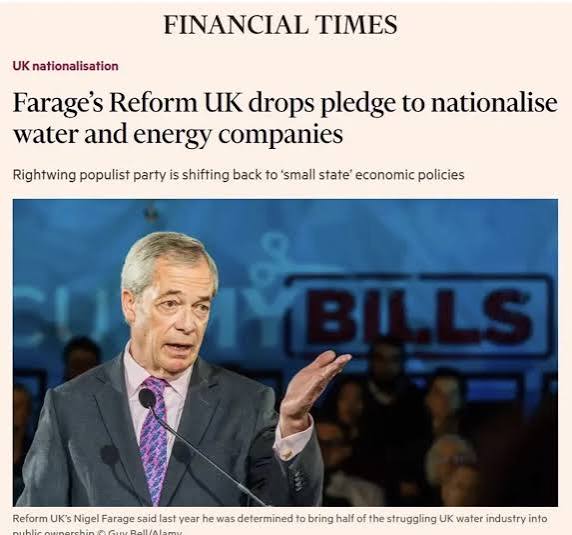
In the end, all we did was take a bloated, unaccountable state monopoly and hand it over to a fat-cat private monopoly, one which was insulated from the consequences of its own failure while everyday punters were left to foot the bill.
Look at what has happened down in the South West. On Monday, I spent the day in Plymouth. It’s one of the most stunning parts of our country, surrounded by a magnificent coastline that should be the pride of the nation.
Instead, following recent contamination scares, people there are genuinely nervous to turn on their taps to drink a glass of water. This is Britain in 2026.
This is our water supply, for crying out loud. We are an island nation, not a land-locked desert. If we can’t get basic things like this right, we are doing something very, very wrong.
Worse still, sewage spills are happening on a regular basis. Families are terrified to let their kids swim in the sea. It’s revolting. And, frankly, it’s a national disgrace.
And how do the bosses of South West Water respond to this environmental disaster? Do they roll up their sleeves, forfeit their bonuses and pump every penny back into fixing their leaky, crumbling Victorian pipes?
Of course not. Incredibly, despite failing so dismally, the shareholders of South West Water have been handed a staggering £200m in dividends over the last two years alone.
Meanwhile this summer, as the heavens refused to open and severe droughts were declared across Cornwall and beyond, South West Water’s customers were told to cut back while the system haemorrhaged water through what appears to be sheer neglect. It makes your blood boil.
This situation simply cannot go on. We need a fundamental shake-up. That is why I announced in Plymouth on Monday that a Reform UK government would give serious consideration to taking a 50 per cent stake in South West Water.
Now, the establishment will clutch their pearls at the very mention of state intervention. The usual suspects in Westminster and the City will cry foul, warning that we are scaring off international investors.
But let me be entirely clear. If you run a critical national infrastructure asset into the ground, load it with debt, poison our coastal waters and bleed the company dry to line your own pockets while the tap water isn’t safe to drink, you forfeit your right to protection.
Yes, the bondholders and shareholders would lose money under our plan. But given the astronomical dividends they have already pocketed off the backs of the British public, that wouldn’t be terribly unfair, would it? I say it is time to realign risk and reward.
Taking a 50 per cent stake allows us to get the government back into the business of protecting its citizens. It gives us a commanding voice in the boardroom to steer the company back to doing what it desperately needs to do which is providing safe, clean drinking water and cleaning up our seas so people can actually use them again, without fear of falling ill.
This follows our bold commitment on Thames Water, where we pledged to step in, buy the failing giant for a pound and place it into special administration.
We are also going to slash the suffocating red tape that has choked our infrastructure for decades by designating new reservoirs as nationally significant infrastructure, getting them built faster to secure our water supply for generations.
It’s funny, isn’t it? We almost seem to have everything on its head. The things that government is supposed to be there for – for defence, for national security, for core national infrastructure, for economic stability – it’s as if they’ve completely left the playing field.
Successive governments. The lot of them. Totally uninterested.
More from Nigel Farage
The Westminster political class has ignored these crises for years, hiding behind corporate lobbyists and regulators who lack the teeth to bite.
Reform UK is here to change the rules of the game. It is time to put the British people first, take back control of our essential utilities and restore common sense to our country.
Nigel Farage Declares War on Britain’s Water Industry
Nigel Farage has placed the water crisis at the centre of Reform UK’s political agenda, arguing that the privatisation of essential utilities has failed to deliver the accountability and improvements promised to the public.
In an article published on 21 October 2026, Farage criticised the structure of Britain’s water industry, arguing that households effectively depend on a monopoly because there is only one water network supplying their homes. Unlike many consumer markets, customers cannot simply choose a different supplier when their water company performs poorly.
His proposal is to give serious consideration to taking a 50% stake in South West Water, the company serving parts of south-west England. Farage presented the proposal as a way to increase public influence over a utility that provides an essential service. <Cite refs={[“turn600376search0″,”turn600376search1”]}/>
The announcement followed recent contamination concerns in Plymouth, where reports of problems with water supplies caused anxiety among residents. Such incidents can undermine public confidence even when the wider drinking-water system continues to meet national standards.
Farage’s argument is that the water industry requires fundamental reform rather than another series of limited regulatory adjustments. However, the practical consequences of acquiring a 50% stake would depend on the terms of the investment, the company’s existing financial obligations and the extent of control the government could exercise.
A partial public stake would not automatically amount to complete nationalisation. Nor would it guarantee an immediate improvement in water quality. The proposal would need to explain how investment, operational decisions and accountability would change in practice.
Sewage Pollution and the Right to Swim Safely
Drinking-water quality is only one part of Britain’s wider water problem. Pollution in rivers and coastal waters has become a major concern for swimmers, anglers, environmental organisations and communities that depend on clean waterways for tourism and recreation.
Sewage discharges can introduce harmful microorganisms into rivers and coastal waters. Agricultural runoff, urban drainage and other sources of contamination can also affect water quality.
According to the Department for Environment, Food and Rural Affairs, 87.3% of designated bathing waters in England received good or excellent ratings in 2025. Nevertheless, the government identified 54 bathing waters that were rated poor or considered at risk of being poor following the 2025 bathing season. Sewage was a significant contributor to contamination at many of these locations. <Cite refs={[“turn600376search6”]}/>
These figures illustrate why the situation requires a balanced assessment. It would be inaccurate to claim that people cannot safely swim anywhere in Britain. Equally, national averages do not eliminate the risks faced by people visiting particular rivers, beaches or bathing sites affected by pollution.
For swimmers, the most important information is local and current. Water conditions can change after heavy rainfall, sewage overflows or the appearance of harmful algal blooms. A site that generally receives a favourable rating may still be subject to a temporary warning.
The Environment Agency’s Swimfo service provides information about designated bathing waters in England, including classifications and current advice. Checking local guidance before swimming is therefore more useful than assuming every location is either safe or unsafe.
Can Reform UK Deliver Its Promise?
Farage’s proposal raises an important question: would greater public ownership make Britain’s water industry more accountable?
Supporters of public intervention argue that water companies should be judged primarily by the quality and reliability of the service they provide. They believe stronger public control could make it easier to direct investment towards infrastructure, reduce pollution and ensure that essential services serve the wider public interest.
Critics may question whether government ownership alone would resolve the industry’s problems. Water infrastructure requires substantial long-term investment, and changing the ownership structure does not automatically provide the money needed to upgrade treatment works, repair pipes or modernise drainage systems.
A 50% stake would also raise questions about governance. Who would appoint directors? How would investment decisions be made? What responsibilities would remain with private shareholders? And how would the government ensure that taxpayers were not left carrying disproportionate financial risks?
Reform UK would need to answer these questions before voters could assess the proposal fully.
The party would also need to explain whether its approach would extend beyond South West Water. Pollution and infrastructure problems affect different regions, and a plan focused on one company would not necessarily address every problem in the national water system.
What the Government Is Already Proposing
Reform UK is not the only political organisation proposing changes to the water industry. The government published its A New Vision for Water white paper in January 2026, setting out plans to improve water security, environmental protection and outcomes for customers and investors. <Cite refs={[“turn600376search2″,”turn600376search3”]}/>
The government’s approach includes stronger oversight and measures intended to hold water companies accountable for poor performance. The Water (Special Measures) Act 2025 also introduced powers to strengthen enforcement, including measures targeting bonuses for water-company executives when serious failures occur.
The central disagreement is therefore not whether Britain’s water system faces challenges. It concerns which combination of regulation, investment, public ownership and enforcement can address them most effectively.
Farage advocates a more direct public role in South West Water. The government’s wider reform programme focuses on changes to the regulatory and operational framework. Both approaches would ultimately need to demonstrate that they improve water quality, protect customers and deliver value for money.
Neither political promises nor changes in ownership are sufficient on their own. Results would need to be measured through reliable drinking-water compliance, fewer pollution incidents, better bathing-water quality and transparent reporting of investment.
Conclusion: Clean Water Must Be More Than a Political Promise
Farage’s declaration that Reform UK will fix Britain’s water problems speaks to a genuine public concern. Recent contamination scares, sewage pollution and continuing questions about infrastructure have damaged confidence in parts of the water industry.
His proposal to consider a 50% public stake in South West Water represents a significant intervention in the debate over ownership and accountability. However, it remains a proposal, and its effectiveness would depend on the details of implementation, the funding available and the powers attached to public ownership.
The evidence also shows why the debate needs precision. Most public drinking-water supplies in England meet national standards, and most designated bathing waters receive favourable ratings. Yet serious local failures remain, and people affected by contamination deserve clear information, effective enforcement and a credible plan for improvement.
For Reform UK, the challenge is to turn its promise into a practical programme that explains the costs, identifies the responsibilities of government and water companies, and sets measurable targets for progress.
For the government and regulators, the priority is to ensure that existing and proposed reforms lead to cleaner rivers, safer bathing waters and reliable drinking supplies.
Ultimately, access to safe drinking water should not depend on political slogans or the ownership structure of a particular company. It requires effective infrastructure, responsible management, transparent monitoring and enforcement that protects public health.
Britain’s water crisis cannot be solved overnight, but the public has a legitimate expectation that essential services will be managed responsibly. The real test for Reform UK—and for every other party promising reform—will be whether its proposals deliver measurable improvements for households, communities and the natural environment.