
Muslim leaders have condemned Nigel Farage’s call to ban public prayer by Muslims in the UK as bigoted and warned of a “growing tide of hate” after the Conservative leader, Kemi Badenoch, questioned whether the events fitted “within the norms of British culture”.
Farage was speaking at the launch of Reform UK’s manifesto for the forthcoming Scottish parliament elections when he made the remarks.
He described as “a wake up call and a warning to everybody” an event in Trafalgar Square earlier this week where hundreds of Muslims and people of other faiths prayed together, before the celebration of Eid.
He said the event, organised by the Ramadan Tent Project and attended by Sadiq Khan, London’s mayor, was “an open, deliberate, wilful attempt, not at the private observance of a different religion, but the attempt to overtake, intimidate and dominate our way of life”.
The event has happened in the historic square in central London five times before without incident or previous controversy.
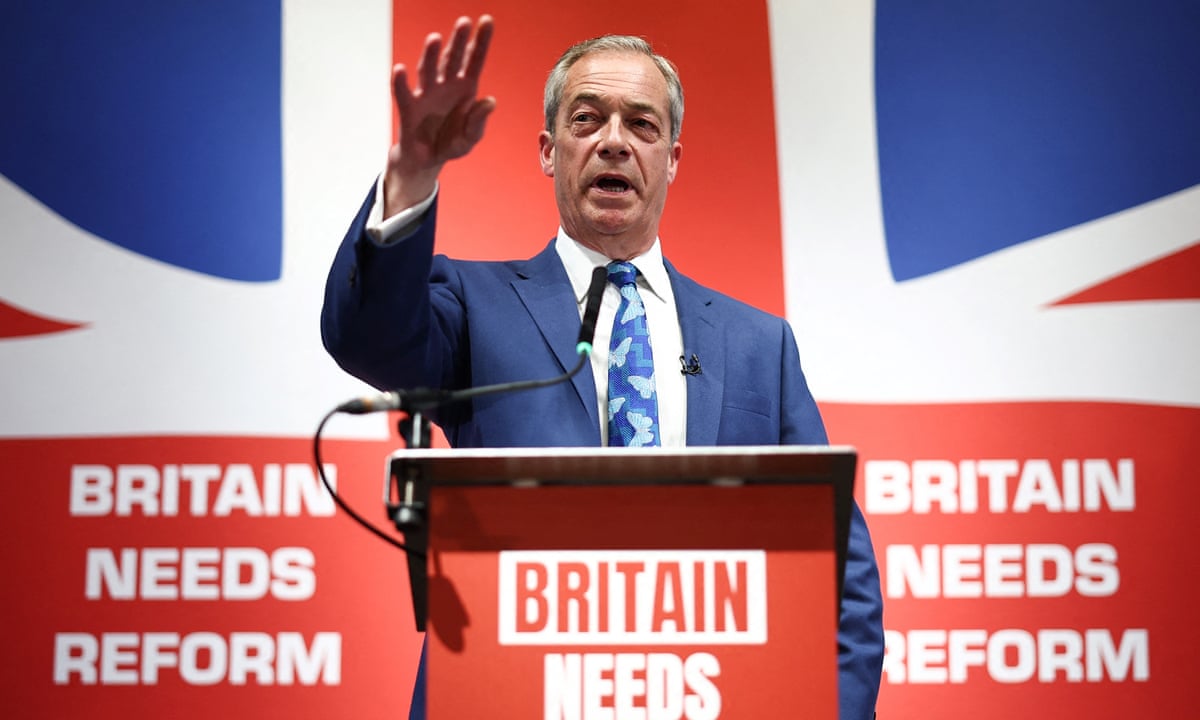
Asked by a reporter if he would like to see such events banned in future, he replied: “We wouldn’t want to stop individuals praying but mass prayer is banned in many Muslim countries in the Middle East itself. So, yes, we have to stop this kind of mass demonstration, provocative demonstration, in historic British sites.”
Such restrictions vary from country to country, and could be related to political or religious tensions or public safety.
The former first minister and SNP MSP Humza Yousaf said: “Nigel Farage seems to have no issues with Christian prayer, Hannukah, Vaisakhi or Diwali all being celebrated in Trafalgar Square. He only has a problem with Muslims praying. There is a word for that, bigotry.”
Yousaf, the UK’s first Muslim first minister, added: “While I have come to expect nothing less from a charlatan like Nigel Farage, I am angry and disappointed that such rhetoric has been mainstreamed from the likes of Nick Timothy MP, a member of His Majesty’s opposition.”
Badenoch backed Timothy, her shadow justice secretary, after he claimed that Islamic prayers taking place in public were intimidating and unBritish, with Labour saying the Conservatives had embraced the “gutter” politics of prejudice.
Asked if she agreed with Timothy, or with arguments from other Tories that the main worry about the event was about prayers being separated for women and men, Badenoch said: “This debate which Nick is having is not about freedom of religion. It is about how religion is expressed in a shared public space, and whether those expressions fit within the norms of a British culture.”
The Scottish Labour leader, Anas Sarwar, said Farage’s remarks exemplified his “toxic, poisonous politics”. “The Farage circus came to town, and once again, he demonstrated that he is a cynical chancer who wants to divide us. Reform are just failed Tories and offer Scotland nothing.”
Recent opinion polls have put Reform neck and neck or ahead of Scottish Labour, but a Ipsos Scottish Political Pulse survey on Thursday suggested their popularity was slipping.
Shaista Gohir, a crossbench peer and leader of the Muslim Women’s Network UK, said: “When these gatherings are conducted responsibly – without obstructing roads, causing disruption, and with proper safety measures – why then do some politicians seek to ban them?”
“The answer is simple: they object to the sight of them. This reflects a deep-seated hatred toward Muslims. No other faith communities face comparable scrutiny or antagonism from these politicians in the way Muslims do”.
Akeela Ahmed, the chief executive of the British Muslim Trust, warned that British Muslims “must not become a political football”.
“Words have consequences – and those who genuinely believe in the British values of tolerance, equality under the law and freedom of religion must not allow those values to be cast aside in attempt to marginalise British muslims”.
Farage was speaking to a rowdy audience of about 500 supporters at a country club near Glasgow alongside his party’s Scotland leader, Malcolm Offord, as they introduced candidates for the Holyrood elections in May, where Reform UK will stand candidates in all seats.
Launching a manifesto that pledged Reform UK will “make Scotland the most successful part of the UK”, Offord said Scots were “being forced to pay the highest taxes anywhere in the UK” and repeated the promise to scrap Scotland’s six-band income tax system – in which higher earners pay significantly more.
Offord said that concerns about social cohesion in Glasgow, the UK’s biggest asylum dispersal area after London, were “not something we are making up”, and the manifesto pledged to restrict who can apply for homelessness support in the city.
The manifesto also pledged to scrap all the SNP government’s net zero related targets, subsidies and quangos
Nigel Farage Condemned Over Call to Ban Public Prayer for Muslims in the UK
Nigel Farage has faced fierce criticism after calling for a ban on mass public religious observances, including Muslim prayers, in a controversy that has reignited debate over religious freedom, British identity and the role of faith in public life.
The Reform UK leader made the comments in March 2026 following a Ramadan gathering in London’s Trafalgar Square, where Muslims assembled for an open iftar event during the holy month. The gathering became a political flashpoint after critics argued that public Muslim prayer was an attempt to challenge British culture. Farage subsequently backed calls to stop what he described as provocative mass demonstrations at historic British sites. His remarks prompted objections from Muslim leaders, politicians and supporters of religious freedom. <Cite refs={[“turn338848search0″,”turn338848search1”]} />
The controversy raises a fundamental question for Britain: should public religious gatherings be treated as an ordinary expression of freedom of worship, or should authorities impose restrictions on certain events because of concerns about their location, size or perceived cultural significance?
For Farage, the issue is closely connected to his wider political message about immigration, national identity and the preservation of British traditions. For his critics, however, singling out Muslim prayer risks undermining the principle that people of different faiths should enjoy equal protection under the law.
What Did Nigel Farage Say?
Farage’s comments followed a public Ramadan event in Trafalgar Square organised by the Ramadan Tent Project. The gathering brought Muslims together to pray and break their fast, with London’s mayor, Sadiq Khan, among those attending.
The event was part of a broader programme intended to bring people together during Ramadan. Public iftars can include prayer, food and opportunities for people from different backgrounds to learn about Muslim traditions.
However, the gathering attracted criticism from Conservative figures, including shadow justice secretary Nick Timothy, who described mass prayer in public spaces as an act of domination. Conservative leader Kemi Badenoch also raised concerns about the nature of the event, while maintaining that public prayer should be permitted for people of all faiths.
Farage went further by arguing that mass Muslim prayer in prominent public places should be stopped. He said that he did not want to prevent individuals from praying, but opposed large public religious demonstrations that he regarded as provocative.
That distinction is central to understanding the dispute. The debate is not simply about whether individuals should be allowed to practise their religion. It concerns whether large organised gatherings should be subject to restrictions and, if so, whether those restrictions would apply equally to every faith.
Critics argue that a policy specifically targeting Muslim prayer would risk treating one religious community differently from others. Supporters of restrictions, meanwhile, may argue that public authorities should be able to regulate large gatherings when there are concerns about access, security or the use of historic public spaces.
The challenge is determining where legitimate regulation ends and religious discrimination begins.
Political Backlash Over Religious Freedom
Farage’s intervention drew criticism from politicians who argued that public worship is a normal feature of a democratic and religiously diverse society.
The government rejected calls to ban mass religious observances, with Scotland Office minister Kirsty McNeill emphasising that Britain has freedom of worship and religious diversity. The response reflected the government’s position that public religious gatherings should not be prohibited simply because they involve a particular faith. <Cite refs={[“turn338848search2”]} />
Attorney General Richard Hermer also challenged the criticism of the Trafalgar Square gathering. He questioned whether the same objections would be raised if Jewish worshippers gathered to pray in a public space.
That question struck at the centre of the controversy: are opponents concerned about the general principle of large religious gatherings, or are they particularly concerned when the gathering is organised by Muslims?
The distinction matters because equality before the law requires public authorities to consider comparable situations consistently. Rules governing demonstrations, public assemblies, noise, safety and access should be based on clear and lawful criteria rather than hostility towards a religious identity.
At the same time, disagreement over the use of public spaces does not automatically amount to religious discrimination. People can debate where events should take place, how they should be organised and whether local rules have been followed. The important issue is whether restrictions are proportionate and applied fairly.
The controversy has therefore become about more than one event in central London. It has raised questions about how Britain balances the freedom to express religious beliefs with the rights of others to use shared public spaces.
Trafalgar Square and Britain’s Changing Public Life
Trafalgar Square is one of London’s best-known public landmarks. It has hosted celebrations, demonstrations, cultural events and gatherings associated with different communities.
The decision to hold a Ramadan event there was significant because the location is closely associated with national ceremonies and Britain’s public identity. Supporters of the gathering saw its presence in the square as an opportunity to make Muslim traditions more visible and encourage interaction between communities.
Critics viewed the event differently, arguing that large religious ceremonies should take place in appropriate religious venues rather than prominent civic spaces.
Yet public spaces in Britain have long accommodated a variety of religious and cultural activities. Events connected with Christianity, Hinduism, Sikhism and Judaism have also taken place in prominent locations, including public celebrations and processions.
This does not mean every event must automatically be approved. Organisers may need permission, safety arrangements and compliance with local regulations. But the existence of those requirements does not necessarily justify a blanket ban on public worship.
The question is whether the same standards should apply to all groups. If a public event creates a genuine safety concern, authorities can assess that concern. If a gathering obstructs access or breaches a lawful condition, action may be justified. If the objection is simply that the participants are Muslims praying in public, the issue becomes much more difficult to reconcile with religious equality.
Is Public Prayer an Attempt to Dominate British Culture?
One of the most contentious aspects of the dispute is the suggestion that visible Muslim worship represents an attempt to dominate or replace British traditions.
For many Muslims, public prayer is an expression of faith rather than a political statement. Ramadan gatherings can provide an opportunity to worship collectively, share a meal and meet people outside their immediate community.
A public religious event may also be intended to demonstrate that people from different backgrounds can participate in national life without abandoning their beliefs. Supporters of the Trafalgar Square event argued that such gatherings could encourage understanding rather than division.
Farage and other critics, however, have argued that the scale and location of certain events can carry a wider cultural message. Their concerns reflect a broader political argument about integration, national identity and the visibility of religious practices in public institutions.
These interpretations should not be treated as interchangeable facts. The presence of worshippers in a public square does not, by itself, establish an intention to dominate society. Equally, the fact that an event is religious does not mean questions about its organisation or location are automatically illegitimate.
A serious discussion requires evidence about the event itself, rather than assumptions about the intentions of an entire religious community.
It also requires recognising that British identity is not experienced in exactly the same way by every citizen. Some people place particular emphasis on the country’s Christian heritage, while others see religious pluralism as part of modern British life. Many people hold both views to some degree, believing that historic traditions can be respected while citizens of different faiths enjoy equal rights.
The Legal Questions Behind a Proposed Ban
Any attempt to prohibit public Muslim prayer would raise difficult legal questions.
The United Kingdom protects freedom of religion through domestic law and its obligations under the European Convention on Human Rights. Article 9 protects freedom of thought, conscience and religion, including the freedom to manifest religious beliefs, subject to certain lawful and proportionate restrictions.
The right is not unlimited in every circumstance. Authorities may impose restrictions that are necessary for legitimate purposes, such as public safety or the protection of other people’s rights. Public gatherings may also be subject to rules governing permissions, crowd management and access.
However, a blanket prohibition on Muslim prayer in public places would raise a different question from a neutral rule governing the size, timing or location of all religious gatherings. A measure directed specifically at Muslims would face serious questions about equality and discrimination.
The details would matter. A rule applying equally to comparable events, supported by evidence and designed to address a legitimate practical problem, would need to be assessed differently from a measure intended to prevent one religious group from worshipping publicly.
This is why the distinction between regulating an event and banning a religious practice is so important. Political slogans can make a proposal sound straightforward, but putting it into law would require careful consideration of existing rights and legal obligations.
The Wider Debate Over Immigration and Integration
The argument over public prayer also sits within a wider political debate about immigration and integration.
Reform UK has built much of its political identity around tighter immigration controls, national sovereignty and concerns about the pace of social change. Farage’s remarks about public Muslim prayer connect those themes to questions of religion and cultural identity.
Supporters of his position may see restrictions as a way to reinforce a shared national culture and prevent public spaces from becoming sites of cultural confrontation.
Opponents argue that integration should not require people to conceal their religion or abandon peaceful expressions of faith. They contend that citizens can share common laws, institutions and civic responsibilities while maintaining different religious traditions.
There is also a distinction between discussing integration challenges and treating a whole community as responsible for them. Muslims in Britain are not a single political or cultural group. They differ in their backgrounds, beliefs, occupations, political views and relationships with religious practice.
A debate that overlooks this diversity risks turning a question about public policy into a judgement about millions of individuals.
The government, meanwhile, faces the challenge of maintaining confidence in the country’s institutions while protecting the rights of religious communities. That requires consistent rules, clear explanations and a willingness to address practical concerns without encouraging hostility towards people because of their faith.
What Happens Next?
The dispute is likely to remain part of the wider conversation about religious freedom and national identity. It also presents political parties with difficult questions about how they would govern a country in which people hold different beliefs and expectations about public life.
For Farage, the controversy reinforces his argument that Britain should be more assertive in defining the limits of public religious expression. For his critics, it illustrates the risks of turning religious practice into a test of whether someone belongs in the national community.
The practical questions are equally important. Should public authorities establish clearer rules for large religious gatherings? How should they assess competing demands on prominent public spaces? What safeguards are necessary to ensure that permissions and restrictions are applied consistently?
Those questions can be debated without assuming that one religious group is inherently threatening or that every criticism of an event is discriminatory.
Ultimately, the controversy over Muslim prayer in Trafalgar Square is a test of how Britain handles disagreement in a plural society. A democratic country can debate its traditions, regulate public events and discuss integration. It must also consider the rights of people whose beliefs differ from those of the majority.
Whether Farage’s proposals gain wider political support or encounter continued opposition, the underlying issue will remain: how can Britain preserve its historic identity while ensuring that freedom of religion and equal treatment apply to everyone?
The answer will depend not on rhetoric alone, but on the principles used to make decisions, the evidence supporting restrictions and the consistency with which the law is applied.