

Reform UK has hailed victory in the backyard of Plaid Cymru’s leader, saying the overnight by-election result is a great sign ahead of the May local elections. The party stormed to a win in the Ynys Gybi council by-election, a large constituency comprising over half of Holy Island off Anglesey.
Reform took 43.9% of the vote from a standing start, after having not fielded a candidate in 2022. Plaid Cymru won just 25%, down 3.7 points, despite the party’s leader, Run ap Iorwerth, representing Anglesey in the Welsh Parliament since 2013.
Labour lost 11 points, collapsing to just 12.5% of the vote, while the Tories also shed 13.1 points, down to 8.2%.
Get the latest politics news – straight from our team in Westminster and more
Invalid email
You agree you are 18 or over. We use your sign-up to provide content in ways you’ve consented to and to improve our understanding of you. This may include adverts from us and third parties based on our knowledge of you. You can unsubscribe at any time. More Info.

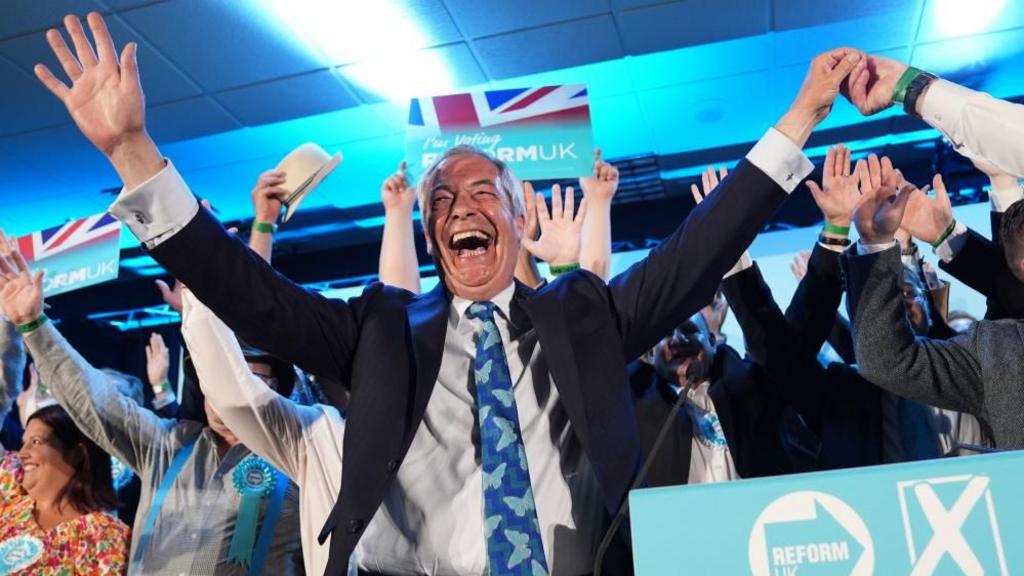
Nigel Farage is delighting in the result (Image: Getty)

The ward is within the Plaid Cymru leader’s Senedd constituency. (Image: Getty)
Reform benefited from no independent candidate standing, who won 26.3% of the vote the last time an election was held in the ward four years ago.
Reacting to the win, Reform’s new leader in Wales Dan Thomas said: “This is a sensational victory for Reform, and it shows that we can win absolutely anywhere here in Wales.
“From the former Labour heartlands to the former Plaid heartlands, we are fighting for every single vote so we can deliver the change Wales desperately needs.”
Mr Thomas was unveiled as Reform’s leader in a press conference yesterday, with Nigel Farage saying: “I think we deserve Reform UK, here in Wales, to be led by somebody who’s been battle hardened, who’s been there before.”
He said Mr Thomas would “keep a calm head through the good and bad, because you’re always going to get both in a campaign”.

Nigel Farage announced Reform’s new leader in Wales yesterday (Image: Getty)
Meanwhile, Reform was deprived of a second council by-election win overnight in North Somerset as they fell just 1.3 points shy of taking Clevedon South from Labour.
Many Reform supporters online accused the Tories of handing Labour the win, as the Conservatives took 18.6% of the vote, which would have seen Reform comfortably beat Labour.
The party’s deputy, Richard Tice, said: “Vote Tory get Labour… vote Reform get Reform.”
Reform Hails Huge By-Election Victory in Backyard of Plaid Cymru Leader
Reform UK has celebrated a significant by-election victory in Wales after securing the Ynys Gybi ward on the Isle of Anglesey, an area closely associated with Plaid Cymru leader and Welsh First Minister Rhun ap Iorwerth.
The result gave Reform its first-ever councillor on Ynys Môn and provided the party with an opportunity to argue that its support is extending beyond areas traditionally associated with its political message. Reform candidate Celfyn Furlong won 603 votes, representing 43.9 per cent of the vote. Plaid Cymru candidate Bethan Jones finished second with 343 votes, or 25 per cent. Labour received 171 votes, while the Green Party and Conservatives also contested the seat.
For Reform, the geographical context made the result particularly notable. Ynys Gybi covers much of Holy Island, which is connected to Anglesey and sits within the wider political territory represented by Rhun ap Iorwerth. The Plaid Cymru leader has represented Anglesey in the Senedd since 2013 and became First Minister of Wales following Plaid Cymru’s strong performance in the 2026 Senedd election.
Reform’s Welsh leadership quickly presented the result as evidence that the party can compete in places where Plaid Cymru has traditionally had an important presence.
Dan Thomas, who had recently become Reform UK’s leader in Wales, described the victory as a major breakthrough and argued that the party could win votes across different parts of Wales. His comments reflected a wider Reform strategy of presenting the party as capable of competing not only in former Labour strongholds but also in areas where Plaid Cymru has historically been influential.
However, the numbers also require some context.
The by-election was triggered by the death of Trefor Lloyd Hughes, a long-serving councillor and former president of the Football Association of Wales. In the 2022 local election, Hughes had been elected for Plaid Cymru in the ward. His death created the vacancy that led to the February 2026 contest.
The circumstances were therefore different from a normal full council election. A well-known incumbent was no longer on the ballot, while an independent candidate who had previously attracted a substantial share of the vote also did not stand this time. Reform entered the contest despite not having fielded a candidate in the ward in 2022.
That makes the 43.9 per cent vote share particularly noticeable, but it also means the result should not automatically be interpreted as a direct measure of how every party would perform in a future nationwide or Senedd election.
According to the published result, Reform won with 603 votes, while Plaid Cymru received 343. Labour finished on 171, the Greens on 118 and the Conservatives on 112. Turnout was 33.3 per cent.
The result nevertheless represents an important development for Reform in Anglesey.
Before the February contest, Reform had no councillor on the Isle of Anglesey County Council. The victory therefore gave the party its first representative on the authority. Plaid Cymru remained the largest group on the council, but the Reform gain demonstrated that the party could make progress even in parts of Wales where nationalist politics have a strong local identity.
The political significance is also connected to the broader transformation of Welsh politics during 2026.
Plaid Cymru made major gains in the Senedd election, ending Labour’s long period as the dominant governing party in Wales. Rhun ap Iorwerth subsequently became First Minister after being elected by the Senedd. Plaid Cymru emerged as the largest party, while Reform UK also secured a substantial number of seats and became the main opposition party.
That wider contest has created a more complicated political landscape in Wales.
For decades, Welsh politics was largely shaped by competition involving Labour, Plaid Cymru and the Conservatives. The growth of Reform has added another major force, particularly in debates surrounding immigration, taxation, public services, national identity and the relationship between Wales and the wider United Kingdom.
The Ynys Gybi result fits into that changing landscape.
It also followed another by-election on Ynys Môn in July, when Plaid Cymru successfully defended the Bro’r Llynnoedd ward against a Reform challenge. Plaid candidate Jon Paul Taylor won 551 votes, equivalent to 48.5 per cent, while Reform’s Richard John Jones received 446 votes, or 39.3 per cent.
The contrasting results illustrate how quickly individual local contests can produce different outcomes.
In July, Plaid Cymru held its seat despite a strong Reform challenge. Several months earlier, however, Reform had taken Ynys Gybi from Plaid Cymru. The two contests occurred in different wards and under different circumstances, meaning that neither result alone can establish a broader electoral trend across Anglesey.
For Plaid Cymru, the Ynys Gybi defeat therefore represents a local setback within a much larger period of electoral growth.
The party’s position in Wales changed substantially in the 2026 Senedd election. It became the largest party in the expanded Senedd and formed the Welsh government, while Reform won 34 seats and Labour fell to nine.
Rhun ap Iorwerth’s own political background makes the Ynys Gybi result especially interesting.
He grew up on Ynys Môn and entered politics through a Senedd by-election in 2013. He later became leader of Plaid Cymru in 2023. His political identity is closely connected to Welsh nationalism and the island where he was raised.
That does not mean the result represents a direct personal rejection of the First Minister. Local elections are influenced by individual candidates, turnout, local issues, vacancies and the presence or absence of independent candidates. The evidence from one council ward cannot establish the motivations of every voter.
Nevertheless, Reform has used the result to emphasize a broader argument: that its appeal is not limited to former Labour areas.
The party has increasingly sought to establish itself across Wales, where political competition has become more fragmented. Reform’s Welsh campaign has emphasized issues including immigration, the economy, public services and the constitutional future of the United Kingdom, while Plaid Cymru has focused heavily on Welsh national identity, devolved powers and its vision for Wales.
The competition between the two parties is therefore likely to remain significant.
There is also a wider question about what the Anglesey result means for the traditional political map.
The 2026 Senedd election already demonstrated that the old pattern of Welsh politics had changed considerably. A party that previously had only a limited presence in Wales became a major force, while Plaid Cymru moved into government and Labour suffered a dramatic reduction in representation.
At the same time, Plaid Cymru has demonstrated that Reform can be challenged successfully. Its July victory in Bro’r Llynnoedd showed that a strong local campaign could hold a seat even against a significant Reform challenge.
The political picture on Anglesey is therefore more competitive than a single by-election result might suggest.
For Reform UK, however, winning Ynys Gybi gives the party a concrete local foothold. It provides a councillor, increases its organisational presence on the island and gives party activists a result that can be used in future campaigning.
For Plaid Cymru, the result highlights the challenge of defending individual wards while governing at the national level. The party now has responsibility for running the Welsh government while also competing with Reform, Labour, Conservatives and other parties across local communities.
Ultimately, the Ynys Gybi by-election was one local contest, but its political symbolism extends beyond the ward itself.
Reform can point to a 43.9 per cent vote share and its first council seat on Ynys Môn. Plaid Cymru can point to its much broader success in the 2026 Senedd election and its continued ability to win other Anglesey contests. The contrast illustrates the increasingly competitive and fragmented nature of Welsh politics.
The result does not by itself determine what will happen at the next Senedd or Westminster election. What it does show is that political competition in Wales is no longer confined to the parties that dominated the country for much of the previous generation.
In a ward closely connected with Plaid Cymru’s leader, Reform has secured a visible local victory. The significance of that victory will depend on whether the party can translate a successful by-election campaign into sustained support across other Welsh communities.