
Shabana Mahmood has branded the anti-asylum activist who is behind the masked anti-migrant group Patriot Platform as “a far-right and outright racist”.
Article continues below
The Home Secretary said Danny “Tommo” Thomas will feel “the full force of the law” if his balaclava-clad followers commit crimes near asylum sites such as Piddington.
Article continues below
Residents in the Oxfordshire village earlier this week voted overwhelmingly to become an independent state in a symbolic “referendum”. They staged the protest vote after ministers announced plans to house 1,256 male asylum seekers at a nearby former military base.
Thomas has said thousands of his followers could surround the area “for days” to try to stop migrants being brought to the site.
Ms Mahmood sought to reassure the around 300 people living in Piddington that the plans would not “put pressure” on local resources because they would be given “self-contained facilities”. She said she wanted to differentiate between those who have genuine concerns and those who were “hijacking” the situation.
“I understand the anxiety of local people when they’re about to see a change to their community. But it is important to distinguish that anxiety, where reasonable people can have a conversation, and the far right and outright racists like Danny Thomas walking into town, hijacking an issue and then using that to divide our communities,” she told The Guardian.
“Their behaviour is completely unacceptable. And where they break the law, they will face the full force of the law.”
The Mirror last weekend revealed that Thomas, whose protestors brought chaos to both Dover and Portsmouth this month, has suggested he wants followers to camp outside asylum centres for days to stop officials transporting migrants. Under Thomas’ plans, the protesters would operate 24/7 blockades, with members from around the UK maintaining the barricade in shifts.
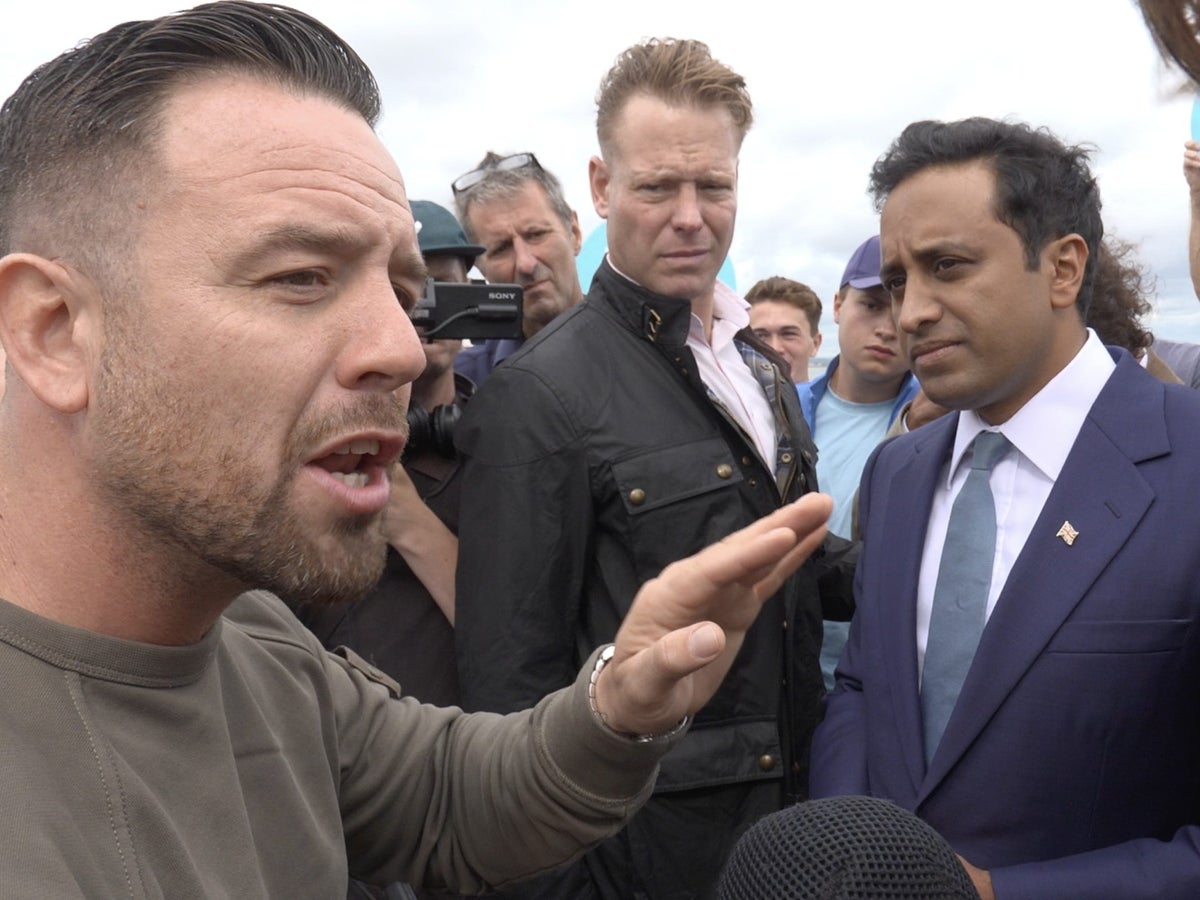
Thomas revealed the plot in an interview with fellow rabble rouser Tommy Robinson, real name Stephen Yaxley-Lennon. The convicted attempted kidnapper said: “I predict in the next six months, the Patriot Platform, with one message through a secure app, will be able to bring five to 10,000 people to a location within a matter of hours.”
He said one target could be Piddington, Oxfordshire, saying: “A prime example, Piddington, where the migrants are about to to go in. How powerful would it be if 5,000 men, when they know the MO, because we’ve proven who we are, what how our conduct is, that we surround that camp, we take tents, we sit there for days and we don’t let them get in till they can’t bring them in.”
On Wednesday, 285 people in Piddington backed “independence” from the UK, with a turnout of nearly 92%. Just 26 residents voted against the motion, with one spoiled ballot recorded.
Asked how she would respond to residents after the vote, Ms Mahmood said: “I want to reassure the residents of Piddington that actually our experience from other large sites where we already have, asylum seekers accommodated, whether that’s in Wethersfield or Crowborough, is that putting all facilities on to one site is actually the best way to manage pressures for local communities.
“Our experience of other large sites where we are housing asylum seekers is that we’re able to put on that site more of the facilities that asylum seekers need. It’s a relatively self-contained facility, and the knock-on pressure to those local areas, I don’t think we’re going to see.”
She also said there is “misinformation” online about the plans, adding: “I do understand the anxiety that people feel, when they’re about to see a change in their community or they are reading misinformation on the internet, or when they’re just concerned that a village is about to have a facility nearby that maybe they think may pose them some challenges.”
The Cabinet minister also said that concerns also existed in inner-city areas, such as her community in Birmingham, where there are large numbers of HMOs (houses of multiple occupation).
In response to the Piddington vote, Andy Burnham on Wednesday said ending use of asylum hotels requires difficult decisions as he defended plans to house migrants in a former military base instead.
Labour has vowed to end the use of asylum hotels and tackle the backlog. The number of asylum seekers being housed in hotels has halved in a year, official stats showed last month. Some 16,021 were accommodated in hotels at the end of June – down from 32,041 a year earlier.
Article continues below
Shabana Mahmood Brands Danny ‘Tommo’ Thomas ‘a Far-Right and Outright Racist’
Home Secretary Shabana Mahmood has sharply condemned anti-migrant activist Daniel “Danny Tommo” Thomas, describing him as “far-right and outright racist” and warning that he and members of his organisation will face the full force of the law if they commit offences during protests at asylum accommodation sites.
Mahmood’s intervention comes amid growing tensions over the government’s plans to accommodate asylum seekers in communities across England. The dispute has become particularly intense in Piddington, Oxfordshire, where the government intends to use a former military site to house male asylum seekers while their claims are processed.
Thomas, a co-founder of the Patriot Platform, has said that thousands of supporters could travel to the village to oppose the plans. Mahmood’s response was to draw a distinction between residents who have genuine concerns about changes to their community and organised groups she believes are attempting to exploit those concerns.
Her comments underline the increasingly confrontational atmosphere surrounding Britain’s asylum debate, with ministers facing pressure over migration while police forces are preparing for further demonstrations.
Mahmood’s Warning
Mahmood made her remarks during an interview in Birmingham after being asked about Thomas and his activities.
The Home Secretary said she understood why residents might be anxious about plans that could significantly change their local area. However, she argued that such concerns should not be confused with what she described as far-right activism.
She specifically named Thomas, accusing him of entering communities, “hijacking” local concerns and using the issue to divide residents.
Mahmood also issued a direct warning about potential criminal behaviour. She said that if Thomas or his supporters broke the law, they would face the full force of the law.
The distinction is significant. The government has repeatedly said that peaceful protest is protected, but ministers have also made clear that intimidation, violence, obstruction and other criminal conduct will be dealt with by police.
The Home Secretary’s comments therefore place the focus not simply on opposition to asylum accommodation, but on how demonstrations are organised and conducted.
Who Is Danny Tommo?
Daniel Thomas, widely known as Danny Tommo, has emerged as one of the prominent figures associated with recent anti-migration protests in southern England.
He is a co-founder of the Patriot Platform, a movement that has been involved in demonstrations concerning asylum seekers and small-boat arrivals.
Thomas has previously attracted attention because of his criminal record. According to reports by The Independent, he was sentenced to two years in prison in 2016 after pleading guilty to attempting to kidnap a man at knifepoint.
His recent activities have placed him increasingly at the centre of Britain’s migration debate.
Thomas has appeared alongside or spoken with other prominent anti-migration activists and has used social media and online interviews to promote his views. He has also encouraged supporters to become involved in protests around locations where asylum accommodation is planned.
That activity has attracted significant criticism from ministers and others who argue that organised demonstrations can intensify tensions in communities already dealing with uncertainty.
The Piddington Dispute
The immediate dispute concerns plans to accommodate approximately 1,256 male asylum seekers at a former military site near Piddington.
The proposed accommodation has generated opposition among some local residents, who have raised concerns about the potential impact on the village and surrounding communities.
Earlier in September, residents held a symbolic referendum in which voters overwhelmingly supported a proposal to declare Piddington an independent state. The vote had no legal effect but was intended to demonstrate the strength of local opposition to the government’s plans.
Thomas subsequently visited the village and spoke with residents.
He has presented his involvement as support for people who believe their concerns have not been adequately addressed by the government.
However, his proposed methods have generated a very different response from ministers.
In an interview with Tommy Robinson, Thomas discussed the possibility of mobilising thousands of men around the proposed accommodation site. He suggested that supporters could establish tents and remain at the location for days in an attempt to prevent asylum seekers from entering.
Such a blockade would raise obvious questions about public order, access and potential criminal offences if it obstructed lawful activity or emergency services.
Mahmood’s warning appears to have been directed partly at preventing such a confrontation from developing.
Separating Local Concerns From Extremism
One of the central themes in Mahmood’s comments was the need to distinguish between residents’ concerns and the activities of extremist groups.
The distinction is politically important because not everyone who opposes an asylum centre necessarily shares the ideology of far-right organisations.
Some residents may have concerns about housing, public services, policing, transport or the management of asylum accommodation. Those concerns can be expressed through consultations, petitions, demonstrations and political campaigning.
Mahmood did not argue that residents should be prevented from expressing such views. Instead, she said that legitimate anxiety should not be exploited by groups attempting to create confrontation.
This distinction has also featured in wider government discussions about recent protests.
The Home Secretary has urged police forces to make full use of their existing powers when criminal behaviour occurs at demonstrations while maintaining the right to lawful protest.
A Broader Wave of Anti-Migrant Protests
The confrontation involving Thomas comes after several highly visible demonstrations in southern England.
Protests in Dover and Portsmouth earlier in September involved groups of men dressed in black, with some wearing balaclavas. Police said the demonstrations created significant disruption, while the government expressed concern about the intimidation associated with masked groups.
Mahmood had already urged senior police officers to make greater use of intelligence and available public-order powers following the disturbances.
She argued that the appearance of large groups of masked men created fear among local residents and required a strong policing response.
The Guardian reported that Patriot Platform was among the groups involved in organising or promoting the protests.
The demonstrations also had consequences for organisations involved in the humanitarian response to Channel crossings.
The Royal National Lifeboat Institution faced abuse after volunteers helped people rescued from the Channel. The charity subsequently introduced additional security measures, illustrating how the migration debate has extended beyond politicians and protesters to emergency workers.
The Police Response
Police forces now face a complicated challenge.
They must protect the right to peaceful protest while also preventing criminal behaviour, intimidation and disorder.
Mahmood has encouraged forces to use tools including body-worn video, CCTV, automatic number plate recognition and other forms of evidence to identify people suspected of offences.
Newer powers concerning face coverings at protests can also be used in designated circumstances, although police must follow legal requirements when imposing such restrictions.
The government argues that stronger enforcement is necessary because some recent protests have involved tactics designed to make identification more difficult.
Civil liberties concerns remain relevant, however. Any restrictions on demonstrations must operate within the legal framework protecting freedom of expression and assembly.
The balance between those rights and public safety is likely to remain an important part of the debate as further protests are organised.
Thomas’s Challenge to the Government
Thomas has continued to present himself as an activist opposing the government’s immigration policies.
His supporters argue that politicians have failed to address concerns about illegal migration and the use of hotels and other facilities to accommodate asylum seekers.
The government’s position is that asylum accommodation is necessary while claims are processed and that protests cannot be allowed to interfere with lawful arrangements.
Thomas’s rhetoric about mobilising large numbers of supporters has therefore brought the two sides into direct conflict.
For Mahmood, the issue is no longer simply a political argument about immigration policy. She has framed the potential use of intimidation or unlawful blockades as a matter for police enforcement.
A Divisive National Debate
The dispute reflects a much wider disagreement in Britain over immigration.
Small-boat crossings, asylum accommodation and border control have become major political issues. Different parties and campaign groups have proposed sharply different approaches to managing migration.
For communities selected to host asylum accommodation, the issue can also become intensely local.
Residents may worry about how a large accommodation facility will affect their community, while asylum seekers themselves are dependent on the government for housing and support while their applications are considered.
The challenge for authorities is to manage those competing pressures without allowing political disagreement to turn into threats or disorder.
Mahmood’s comments represent one of the government’s clearest attempts to draw that line.
What Happens Next?
The immediate focus is likely to remain on Piddington and whether further protests develop around the proposed asylum accommodation site.
If Thomas and his supporters organise demonstrations, police will have to determine whether planned activity remains within the boundaries of lawful protest or crosses into criminal conduct.
The government has made clear that it will support police action where offences are committed.
At the same time, the underlying concerns about immigration will not disappear simply because protests are restricted. Questions about the number of asylum seekers, the speed of processing claims, accommodation arrangements and Britain’s wider migration system will continue to generate political debate.
Mahmood’s remarks therefore represent both a warning and an attempt to establish a boundary.
She has acknowledged that local people can have genuine concerns about major changes to their communities, while arguing that organised extremist groups should not be allowed to exploit those concerns.
For Danny Thomas and the Patriot Platform, the coming weeks will test how far their campaign can go without crossing legal boundaries.
For the government and police, the challenge will be to maintain public order while respecting lawful political expression.
And for residents of places such as Piddington, the central question remains how decisions about asylum accommodation will affect their communities.
The controversy surrounding Thomas demonstrates how Britain’s immigration debate has moved beyond Parliament and into towns and villages across the country. As tensions continue, the distinction between peaceful political disagreement and unlawful intimidation is likely to remain at the heart of the national conversation.