

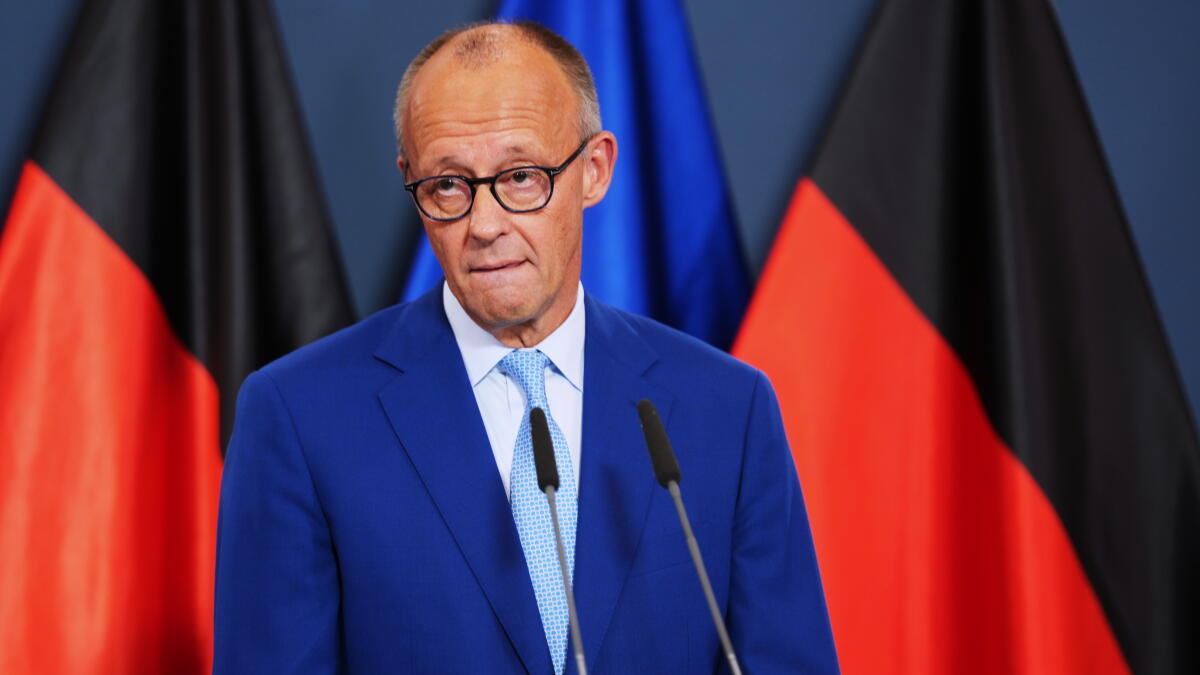
Friedrich Merz is set to suffer a “disastrous” double defeat in key elections as support for the right-wing Alternative for Germany (AfD) is expected to surge in a historic vote.
Two state elections took place today in Mecklenburg-Western Pomerania and Berlin as exit polls painted a bleak picture for the Christian Democrat Union (CDU).
But the polls were much rosier for the AfD, led by Alice Weidel and Tino Chrupalla, after being forecast to win 37 per cent of the vote in the rural state of Mecklenburg-Western Pomerania.
The projection was closely followed by the centre left Social Democrats (SPD) with 35.5 per cent.
Meanwhile, the Chancellor’s party is set to receive a set of damaging results, and is predicted to take home a measly 5.5 per cent of the vote.
If the exit poll if correct, the result would be the party’s worst result in the region since the Second World War.
The threshold to enter state parliament, the Bundestag, is five per cent.
Branding the outcome a “disaster”, Mr Merz said: “The reforms have to come. I am taking on this responsibility, because I want to move our country forward.”

Friedrich Merz vowed to stay in post
|
GETTY
Meanwhile, in Berlin, support for the AfD is projected to be on the uptick as the CDU is set to come in second place with 20 per cent.
In the capital, the left wing party Linke is said to win 24.5 per cent, while the AfD is set to take home 16 per cent.
Despite the AfD’s surge in support, it will prove challenging for the right party to strike a deal with other parties, given its competitors turning up their noses at the prospect of working with them.
On September 7, the AfD edged closer to power in the eatern state of Saxony-Anhalt after a state win there with 43.8 per cent of the vote.
The AfD was close to winning an outright majority in a state election at the start of September
At the time, Beatrix von Storch, the party’s deputy leader, called on other parties to consider working alongside them.
She said: “You cannot say, I do not accept the vote of the people.”
Ms von Storch said the results “were on the table and now democrats have to talk to [one] another”, adding: “This is what democracy demands.”
Without teamwork, she said that “we might end up in severe chaos”, triggering another election.
Meanwhile, the CDU had received a sledgehammer to its support in the region, where it saw its vote almost halve.
Mr Merz said the state election’s outcome was “seismic… not just in the country but also in my own political party and I take that very seriously”.
The results for today’s state elections are expected to trickle in overnight.
A full outcome is expected on Monday morning.
Germany State Elections: Friedrich Merz Suffers ‘Disastrous’ Double Defeat in Key Election as AfD Support Surges in Historic Vote
German Chancellor Friedrich Merz is facing renewed political pressure after his Christian Democratic Union suffered major setbacks in two state elections, while the Alternative for Germany, or AfD, recorded another strong result.
The elections in Berlin and Mecklenburg-Western Pomerania on Sunday produced results that have intensified questions about the direction of Germany’s governing coalition and the future of Merz’s reform programme.
The most dramatic result came in Mecklenburg-Western Pomerania, where the AfD emerged as the strongest party with 38.2 per cent of the vote. The Social Democratic Party (SPD), led in the state by popular governor Manuela Schwesig, finished second with 35.5 per cent.
For the CDU, the result was historic for a very different reason. The party received just 4.9 per cent and fell below Germany’s five-per-cent threshold for representation in the state parliament. It was the first time since the creation of the Federal Republic in 1949 that the CDU had failed to clear the threshold at a state, federal or European election.
Merz himself described the result as a “disaster” shortly after the projections were released.
Yet the Chancellor immediately rejected suggestions that he should abandon his position. He said he intended to remain CDU leader and Chancellor and insisted that his Government would continue with its reform programme.
“What needs to be done now requires backbone, steadfastness, and patience,” Merz said after the results. He argued that Germany could not postpone structural reforms simply because they were politically difficult.
A historic setback for the CDU
The Mecklenburg-Western Pomerania result represents a particularly severe setback because the CDU’s vote collapsed despite the party being part of Germany’s national governing coalition.
According to Germany’s public broadcaster ARD, the CDU’s 4.89 per cent result was its weakest result in any state, federal or European election since 1949. The party therefore lost its parliamentary representation in the state.
At the same time, the AfD more than doubled its previous result in the state. In 2021, the party received 16.7 per cent; in the latest election, it reached 38.2 per cent. It also won 22 of the state’s 36 directly elected constituencies and finished ahead of its competitors in hundreds of municipalities.
The outcome illustrates how dramatically Germany’s eastern political landscape has changed.
The AfD has now established itself as a major electoral force in several eastern states. Its latest success follows its first-place finish in Saxony-Anhalt earlier this month, where it received 43.8 per cent.
That does not automatically translate into governmental power. Germany’s mainstream parties have continued to reject coalition cooperation with the AfD, maintaining what is commonly described as a political “firewall”.
The Mecklenburg-Western Pomerania result nevertheless creates a complicated situation. The AfD won the election, but the SPD’s strong second-place performance means that Schwesig could potentially continue governing with other left-leaning parties.
Berlin delivers another blow
The second election took place in Berlin, Germany’s capital, where the political picture was different but again difficult for Merz’s CDU.
The Left Party, Die Linke, finished first with 25.7 per cent. The CDU came second with 18.8 per cent, followed by the AfD on 16.3 per cent, the Greens on 14.3 per cent and the SPD on just 12.1 per cent.
The result ended the CDU-SPD coalition’s majority in the Berlin state parliament.
The Berlin result was particularly damaging for the SPD, which has been one of the capital’s dominant political forces for decades. Its 12.1 per cent represented a historic low.
For the CDU, however, the Berlin result was less dramatic than Mecklenburg-Western Pomerania. Party figures argued that the capital’s result was comparatively respectable, even though the party lost its previous position as the strongest force in the governing coalition.
The two elections therefore cannot simply be treated as identical defeats.
In Mecklenburg-Western Pomerania, the CDU was pushed completely out of parliament. In Berlin, it remained the second-largest party.
Nevertheless, the combined results have created an uncomfortable national picture for Merz.
The AfD’s growing support
The biggest common factor between the two elections was the continued strength of the AfD.
In Mecklenburg-Western Pomerania, it finished first. In Berlin, it finished third but still recorded 16.3 per cent in a city that has historically been more difficult territory for the party.
Reuters reported that the AfD’s campaign focused on issues including immigration, energy policy and opposition to Germany’s support for Ukraine. Economic pressures also played an important role, with voters raising concerns about high living costs, energy prices and employment.
The party’s success has prompted renewed discussion about why voters are moving away from Germany’s traditional mainstream parties.
There is no single explanation.
Some voters have expressed dissatisfaction with immigration policy. Others have criticised the Government’s economic programme, energy costs or support for Ukraine. In Mecklenburg-Western Pomerania, opposition to military and financial support for Ukraine was identified by state Premier Manuela Schwesig as one factor behind the AfD’s appeal.
The AfD has also sought to position itself against the political establishment, presenting itself as an alternative to the traditional parties.
Its continued growth has created a strategic problem for the CDU and other mainstream parties: they must respond to voters attracted to the AfD while maintaining their existing political alliances and positions.
Merz refuses to abandon his reform agenda
Despite the electoral setbacks, Merz has not signalled a change of direction.
Instead, he has argued that Germany’s economic difficulties make reform more necessary rather than less.
The Chancellor came to office promising to revive economic growth and address structural problems in Europe’s largest economy. His Government has since faced disputes over pensions, healthcare, taxation and other reforms.
Some of these measures have proved unpopular, while disagreements within the governing coalition have complicated the Government’s ability to present a united message.
The election results have therefore generated questions about whether Merz can continue pushing through controversial reforms while his party is suffering electoral losses.
Reuters quoted economist Marcel Fratzscher, president of the German Institute for Economic Research, as warning that the election results could make it more difficult for the federal Government to build political support for fundamental reforms.
Merz, however, has argued that delaying reform would not solve Germany’s problems.
He has presented economic renewal as a long-term project that will inevitably involve difficult decisions and temporary political costs.
Pressure inside the CDU
The results are also likely to increase discussion within the CDU about political strategy.
There has been speculation over Merz’s leadership following the poor election results, particularly after the earlier defeat in Saxony-Anhalt.
However, there is currently no formal leadership challenge.
The Associated Press reported that no challenger had emerged following Sunday’s results and that Merz had reaffirmed his intention to remain in office.
That does not mean internal concerns have disappeared.
The CDU now has to consider how it can rebuild support in eastern Germany, where the AfD has become exceptionally strong.
At the same time, the party must decide how aggressively it should respond to AfD policies without abandoning the positions that distinguish it from the far right.
This is particularly difficult because the AfD’s growth has occurred alongside declining support for several established parties.
A fragmented political landscape
The elections also demonstrate how fragmented German politics has become.
In Berlin, five parties received enough support to gain significant parliamentary representation. In Mecklenburg-Western Pomerania, the AfD and SPD dominated the vote while smaller parties struggled.
Such fragmentation can make coalition negotiations more complicated.
In Berlin, the Left Party emerged as the largest force, but governing will require cooperation with other parties. The CDU and SPD lost their previous majority, meaning that a new coalition arrangement will have to be negotiated.
In Mecklenburg-Western Pomerania, the SPD can potentially remain in power despite finishing second because the AfD is isolated from coalition negotiations.
This illustrates an important feature of Germany’s political system: winning the largest share of votes does not necessarily mean a party will form the government.
Coalition arithmetic remains crucial.
What happens next?
For Merz, the immediate challenge is to prevent regional electoral defeats from becoming a broader crisis for his Government.
The next stage will involve both political and economic decisions.
His coalition must attempt to deliver reforms while addressing voters’ concerns about living costs, jobs, pensions and public services. At the same time, the CDU will need to respond to the AfD’s expanding support, particularly in eastern Germany.
The September elections do not determine the outcome of the next federal election, which is scheduled for 2029. Nor do they establish that the AfD will enter government at the national level.
They do, however, provide a clear snapshot of Germany’s current political landscape.
The AfD has demonstrated that it can win major state elections. The CDU has suffered one of its most severe electoral setbacks since the foundation of modern Germany. The SPD has faced particularly weak results in Berlin, while the Left Party has made a significant breakthrough in the capital.
For Merz, the message is therefore complicated.
He remains Chancellor and has no immediate leadership challenger, but his party’s latest results show the political difficulties facing the Government.
The Chancellor has chosen to respond by insisting that Germany needs reform and that difficult decisions cannot simply be postponed.
Whether that strategy can restore support for the CDU will depend on how voters respond to the Government’s economic policies over the coming years.
For now, the September elections have made one fact difficult to ignore: Germany’s traditional political balance is under significant pressure, and the AfD’s rise has become one of the defining features of the country’s current political debate.