
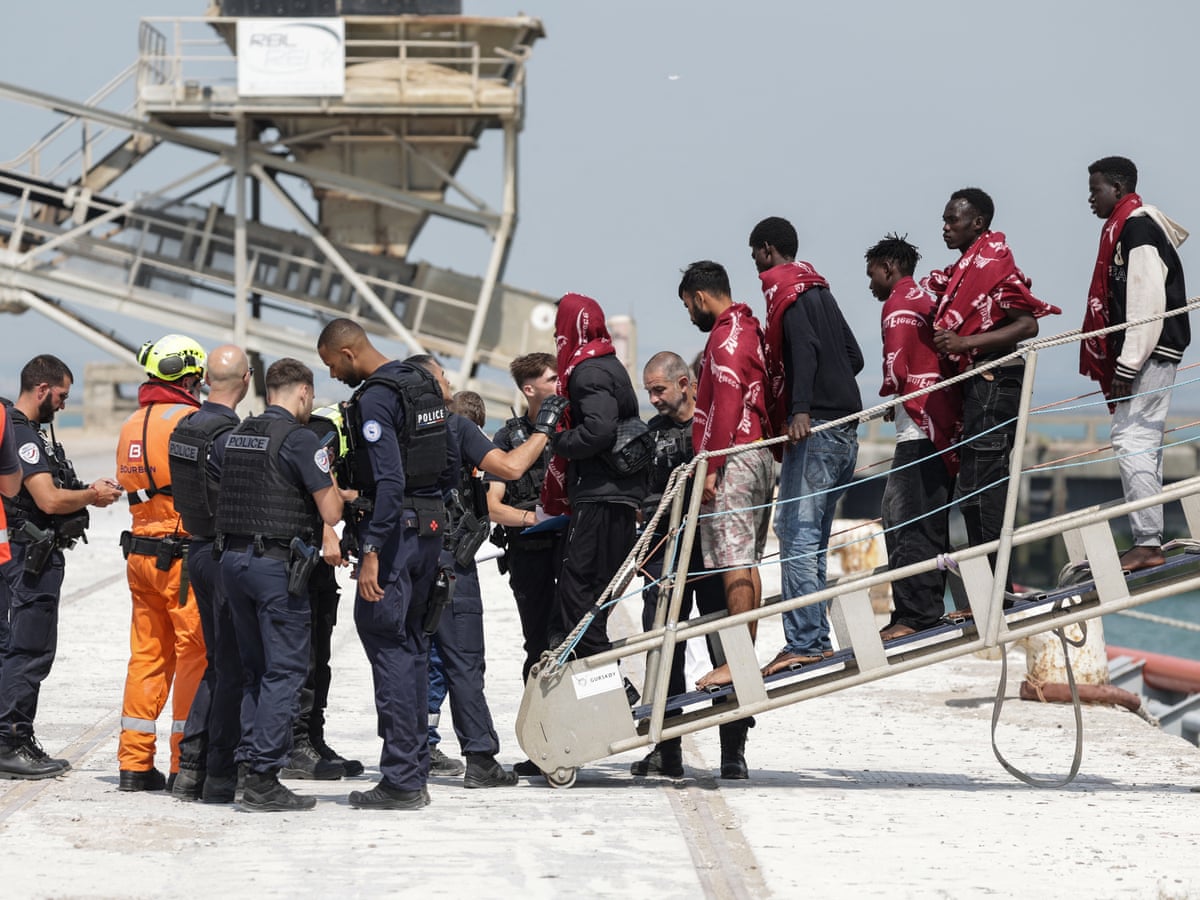
The dramatic rescue operation off the coast of Boulogne-sur-Mer was a stark reminder of the risks involved in Channel crossings, after an overcrowded migrant boat caught fire and its passengers were forced into the water.
The incident happened on August 4, 2026, as the vessel attempted to travel from the French coast towards Britain. French authorities initially reported that 157 people were rescued, while other reports subsequently put the number aboard at 173. The difference appears to reflect the difficulty of establishing an exact passenger count during a rapidly developing maritime emergency.
What is not in dispute is the scale of the rescue.
The boat’s engine caught fire while it was in the French search-and-rescue region, causing the vessel to break apart and eventually capsize. People entered the water and were picked up by French rescue vessels, British Border Security Command boats and an RNLI lifeboat.
According to ITV, 54 people were taken to France aboard the British vessels, while French vessels rescued the remainder. Those rescued were transported towards Boulogne-sur-Mer, where they could receive assistance and medical attention.
The operation also demonstrated the importance of cooperation between British and French authorities.
The two countries have frequently disagreed over immigration policy, but maritime emergencies create an immediate operational obligation. When a vessel is on fire or people are in the water, rescue services must concentrate on preventing deaths and injuries rather than on the political arguments surrounding why the crossing occurred.
French officials said there were no serious injuries reported after the rescue, although some people suffered burns, grazes or bruises. That outcome was significant given the number of people involved and the condition of the boat.
A boat carrying an extraordinary number of people
The incident also highlighted a development that has increasingly concerned maritime authorities: the emergence of extremely large migrant boats, sometimes described in media coverage as “mega-dinghies”.
The French maritime prefecture has reported that the average number of passengers per migrant boat has increased substantially in recent years. According to figures cited by TF1, the average rose from around 26 people in 2021 to approximately 65 during the first part of 2026.
A boat carrying more than 150 people represents an even more extreme situation.
Inflatable vessels of this type are not comparable with commercial passenger boats designed to carry large numbers of people. Their construction, stability and propulsion systems can be unsuitable for the demands placed upon them during a Channel crossing.
That creates a particular problem for rescuers.
If a small inflatable vessel begins to sink, catches fire or becomes unstable, hundreds of passengers may have very little room to move. Any sudden shift in weight can potentially make the vessel less stable.
An engine fire is especially dangerous because the engine and fuel system are central to the operation of the boat. Once propulsion is lost, passengers can quickly become dependent on rescue services.
The passengers initially declined assistance
Another unusual element of the incident was the response of people aboard the boat before the emergency became critical.
French authorities said that five people initially required assistance, while the rest of those aboard declined offers from French patrol boats and continued attempting to reach Britain. The authorities explained that passengers on such vessels can be reluctant to accept assistance because they remain determined to continue towards the UK.
That creates a difficult dilemma for rescue services.
Intervening too aggressively on a structurally fragile overcrowded inflatable can itself create danger. A sudden movement by dozens of passengers could cause the vessel to overturn.
But waiting carries its own risks.
In this case, the situation changed when the engine caught fire.
The emergency then developed into a mass rescue operation involving vessels from both countries.
Why the Channel remains so dangerous
The English Channel is one of the world’s busiest maritime areas.
Large commercial vessels, ferries, fishing boats and other shipping traffic operate through the same waters used by small migrant boats. A small inflatable craft can be difficult to see, particularly in poor weather, at night or when it is surrounded by larger vessels.
There are also strong currents and changing weather conditions.
A crossing that begins in relatively calm conditions can therefore deteriorate quickly.
The fire in this case illustrated precisely how rapidly the circumstances can change.
Passengers who had been attempting a journey towards Britain were suddenly in the water and dependent on professional rescuers.
The incident therefore became not simply a migration story but a maritime emergency.
The political debate over small boats
The rescue has also fed into Britain’s continuing political debate over Channel crossings.
The Government has made cooperation with France a central element of its strategy. In September, Prime Minister Andy Burnham said cooperation with French President Emmanuel Macron was helping reduce crossings and that operational teams were making progress in tackling the issue. The two governments agreed that the work should be expanded across Europe.
The Government has also highlighted French enforcement activity.
According to figures published by the Home Office in August, French authorities prevented 185 small-boat crossing events between April 27 and August 2 under the new UK-France agreement. The Government said this represented 61% of the crossing events recorded during that period.
Specialist French units have also been deployed under the agreement, with the British Government saying 125 specialist officers and reservists were involved in efforts to disrupt launches, pursue smugglers and prevent crossings.
The Government’s argument is that preventing boats from launching is safer and more effective than dealing with them once they are already at sea.
The August rescue demonstrates why.
Once an overcrowded vessel is in the Channel, the authorities may have to mount a large-scale operation involving multiple ships and rescue crews.
The humanitarian dimension
At the same time, the incident illustrates the humanitarian dimension of the migration debate.
Regardless of the legal status of the journey or the government’s immigration policy, people in immediate danger at sea must be rescued.
The successful outcome of the operation meant that the incident did not become another mass-fatality disaster.
That is particularly significant given the history of Channel crossings.
In November 2021, more than 30 people died after an overcrowded migrant boat sank in the Channel. The tragedy remains the deadliest known disaster involving a migrant crossing in the area, and alleged smugglers are currently on trial in Paris in connection with the deaths.
The memory of that disaster continues to influence discussions about maritime rescue procedures.
It also explains why authorities treat large overcrowded boats as potentially serious emergencies even before a vessel begins to sink.
Smuggling networks remain a central issue
British officials have repeatedly focused on organised criminal groups that arrange Channel crossings.
The basic economics of the smuggling trade create an incentive to maximise the number of passengers on each boat. If one vessel carries substantially more people, smugglers can potentially generate more revenue from a single launch.
But that economic model transfers much of the risk to the passengers and rescue services.
The August incident demonstrates the consequences.
A single mechanical failure affected more than 150 people at once.
Rather than rescuers dealing with a handful of passengers, multiple French and British vessels were required to respond to a mass emergency.
That is one reason the UK-France agreement focuses not only on intercepting boats but also on targeting the criminal networks behind the crossings.
Britain and France face the same operational problem
The political relationship between Britain and France can sometimes be contentious, particularly over migration.
Yet the rescue showed that the two countries remain dependent on one another when dealing with emergencies in the Channel.
The vessel was in French waters when the fire occurred, but British vessels and the RNLI also took part in the response.
The UK Maritime and Coastguard Agency confirmed that British vessels and a lifeboat were assisting after the vessel caught fire in French waters.
The cooperation is likely to remain important as long as small-boat crossings continue.
Recent Home Office figures show that crossings have not disappeared despite increased enforcement. For the week ending September 6, provisional figures recorded 625 arrivals in eight boats, while 282 people were prevented from crossing in 10 events.
For the following seven-day period, the Home Office recorded 144 arrivals on September 14 and another 55 on September 15. The figures are provisional and subject to revision.
These numbers show why the issue remains politically significant.
A difficult balance for the Government
The Government faces several competing objectives.
It wants to reduce irregular migration and disrupt people-smuggling organisations.
It also wants to prevent people from being placed in danger during crossings.
At the same time, British and French maritime authorities have an obligation to respond when lives are threatened.
Those objectives do not necessarily conflict, but they require different tools.
Border enforcement can prevent departures.
Police investigations can target smugglers.
International agreements can attempt to reduce incentives for crossings.
And search-and-rescue services are required when prevention fails and people find themselves in danger.
The August fire demonstrated how all four elements can intersect within a single incident.
The significance of the rescue
The most important fact is that the operation ended without a reported mass loss of life.
More than 150 people were recovered after their boat caught fire and capsized.
French and British rescue teams worked together.
The passengers were brought to safety and taken towards Boulogne-sur-Mer.
But the incident also demonstrated how close a large crossing can come to becoming a major maritime disaster.
An overcrowded vessel, an engine fire and hundreds of people in a confined space created a situation that could have developed very differently.
For British policymakers, the incident therefore provides another illustration of the challenge they face.
The Government can point to increased cooperation with France and the number of attempted crossings prevented before departure. Critics can point to the continued use of increasingly large boats and argue that the underlying problem has not been resolved.
Neither the rescue operation nor the political debate provides an immediate solution.
What the incident does provide is a clear picture of the risks involved.
A journey that began with more than 150 people attempting to reach Britain ended with passengers in the Channel and rescue vessels from two countries rushing to their aid.
The episode underlines why the future of Channel migration cannot be considered solely as an immigration-policy question.
It is also a question of maritime safety, organised crime, international cooperation and humanitarian responsibility.
And while the passengers in this case were brought to safety, the next overcrowded boat may face a different set of circumstances.
That possibility remains one of the strongest arguments for continued efforts to prevent dangerous crossings from taking place in the first place.
Migrant Dinghy Carrying 160 People Catches Fire in Channel, Sparking Huge Rescue Operation
A major search-and-rescue operation was launched in the English Channel after an overcrowded migrant dinghy caught fire while attempting to cross from France to Britain, with British and French rescue teams rushing to assist dozens of people trapped aboard the stricken vessel.
The incident unfolded on the morning of Tuesday, August 4, 2026, after the boat’s engine caught fire in French waters near Boulogne-sur-Mer.
Initial reports said the vessel was carrying around 160 people.
French authorities later confirmed that the number was even higher: 173 people had initially been aboard the dinghy, making it the largest migrant boat reported to have attempted the Channel crossing at that point.
The emergency triggered a coordinated response involving French rescue vessels, a French Navy helicopter, medical teams, Britain’s Border Force and an RNLI lifeboat from Eastbourne.
The incident once again highlighted the extreme dangers faced by people attempting to cross one of the world’s busiest shipping routes in small and heavily overloaded inflatable boats.
Engine Bursts Into Flames
The rescue operation began at approximately 6am after the dinghy’s engine reportedly burst into flames.
The vessel was still inside the French search-and-rescue region when the emergency began.
A UK Coastguard spokesperson confirmed that a vessel had caught fire and that British vessels and a lifeboat were assisting the French authorities.
The RNLI confirmed that Eastbourne’s all-weather lifeboat had launched at around 6am to assist with the operation.
The situation rapidly became dangerous.
The dinghy was severely overcrowded and began to break apart after the fire.
People were eventually forced into the water as the vessel became increasingly unstable.
For rescuers, the incident presented an extremely difficult challenge.
A large number of people were concentrated on a fragile inflatable boat that was already suffering from mechanical failure and fire.
Any sudden movement could potentially have caused further instability.
French and British Teams Join Forces
The emergency required cooperation between French and British authorities.
French maritime authorities deployed two rescue ships, a Navy helicopter and specialist medical personnel.
The British response included an RNLI lifeboat and Border Force vessels.
The rescue operation ultimately brought 157 people to safety during the main operation.
French vessels rescued 103 people, while British vessels rescued 54.
All those rescued were taken to Boulogne-sur-Mer in northern France for medical assessment and assistance.
The fact that the British vessels transported those rescued to France was significant.
The incident occurred inside French search-and-rescue waters, meaning French authorities were coordinating the operation.
The UK government subsequently stressed that those involved would be safely returned to France.
Eleven People Injured
Although there were no reported fatalities, the incident resulted in injuries.
French authorities said 11 people suffered minor injuries.
Three of those injured were taken to hospital in Boulogne-sur-Mer for further treatment.
The outcome could have been considerably worse.
The English Channel is subject to strong currents, changing weather and heavy commercial shipping.
An overcrowded inflatable boat losing power or catching fire creates a potentially life-threatening situation within minutes.
The successful rescue therefore depended on the rapid arrival of multiple emergency teams.
Five People Had Already Been Taken Ashore
The circumstances of the crossing had begun to attract the attention of French authorities before the fire.
The dinghy had reportedly departed from the Normandy coast on Monday evening.
French rescue services had been monitoring the vessel.
During the night, five people aboard the boat required assistance and were taken back to Boulogne-sur-Mer.
The remaining passengers initially declined assistance and continued their journey.
French maritime authorities explained that migrants attempting Channel crossings sometimes refuse rescue unless there is an immediate danger.
Rescuers do not necessarily force people off a vessel because attempting to remove large numbers of passengers from an overcrowded inflatable can itself cause the boat to capsize.
That consideration became especially important given the enormous number of people aboard the vessel.
A Record-Breaking Dinghy
The size of the boat’s passenger load attracted particular attention.
The 173 people initially aboard exceeded the previous reported record of 165 passengers on a single small boat.
That earlier crossing took place on July 23.
The growing size of these vessels has become a major concern for rescue services.
An inflatable boat carrying more than 150 people presents a fundamentally different challenge from the small groups that historically attempted Channel crossings.
The vessels are often designed for far fewer passengers and may be poorly equipped for long journeys at sea.
The additional weight can affect stability, while a mechanical failure can leave hundreds of people exposed to the elements.
Why the Channel Is So Dangerous
The English Channel is one of the busiest maritime areas in the world.
Commercial ships, ferries and smaller vessels operate continuously between Britain and continental Europe.
For people travelling in an inflatable dinghy, the risks are substantial.
The boats can be difficult for larger vessels to detect, particularly in poor visibility.
Their engines may fail.
Fuel can run out.
The boats can lose air or become unstable under the weight of too many passengers.
Even relatively calm weather can change rapidly.
Once a boat begins to take on water or loses power, passengers may have little protection from cold water.
The August rescue demonstrated how quickly a crossing can turn into an emergency.
A Growing Political Issue
The fire occurred against the background of an increasingly heated political debate in Britain and France over Channel migration.
The British government has made reducing small-boat crossings one of its major priorities.
It has worked with France on measures designed to prevent departures and disrupt people-smuggling networks.
The two countries have also increased cooperation on surveillance and policing.
The latest incident provided another reminder of why governments are concerned about the crossings.
A journey that begins as an attempt to reach Britain can rapidly become a major international rescue operation.
Government Response
Following the incident, the UK government emphasised the dangers of attempting the crossing in small boats.
A government spokesperson said the incident demonstrated the “terrible dangers” associated with such journeys.
The government said it continued to work with France and other international partners to prevent people from making the crossings.
The emphasis was on stopping people from entering the sea in dangerous vessels rather than relying solely on rescue operations once boats became distressed.
That distinction is important to Britain’s wider migration strategy.
Prevention focuses on stopping departures.
Search and rescue, by contrast, deals with an immediate humanitarian emergency once people are already at sea.
The Role of the RNLI
The involvement of the RNLI has also become politically sensitive.
The Royal National Lifeboat Institution is a charity whose crews respond to people in danger at sea.
Its volunteers do not decide Britain’s immigration policy.
Nor do they determine whether people rescued from the Channel are allowed to enter or remain in Britain.
Their role is to assist people facing maritime emergencies when tasked as part of the search-and-rescue system.
The Eastbourne lifeboat’s deployment therefore reflected its traditional lifesaving role.
The crew was sent to help people whose vessel was on fire and breaking apart.
The political circumstances surrounding the crossing did not change the immediate danger facing those aboard.
Concerns Over Overcrowding
The incident has renewed concerns about the number of passengers being placed aboard individual dinghies.
A vessel carrying 173 people is exceptionally crowded.
Every additional passenger adds weight and reduces the amount of space available for movement.
It can also make evacuation more difficult.
If a fire breaks out, passengers may struggle to move away from the source of the flames.
If the vessel begins to capsize, hundreds of people could enter the water almost simultaneously.
The rescue operation therefore illustrates the potentially catastrophic consequences of overcrowding.
Smuggling Networks Under Scrutiny
The size of the boat also raises questions about the role of people-smuggling networks.
Small-boat crossings are frequently organised by criminal networks that arrange transport and collect money from passengers.
The British government has repeatedly said it wants to target the gangs behind the crossings rather than focusing only on people arriving in Britain.
International cooperation coastline, while British agencies have focused on intelligence and is central to that strategy.
French authorities have attempted to disrupt departures along the northern French coastline, while British agencies have focused on intelligence and criminal investigations.
The fire demonstrates why authorities regard the business operated by smuggling networks as a serious security and humanitarian concern.
The Human Dimension
Behind the political argument are more than 170 individual people who found themselves aboard a vessel that suddenly caught fire.
The reasons people attempt dangerous journeys vary.
Some are seeking asylum or protection.
Others may be motivated by family circumstances, economic conditions or the belief that they will have better opportunities in Britain.
Regardless of their individual circumstances, everyone aboard the dinghy faced the immediate physical danger created by the fire.
The rescue operation was therefore fundamentally about preserving life.
Medical teams were prepared to assess those brought ashore, while emergency services dealt with the consequences of the incident.
A Warning for Future Crossings
The incident serves as another warning about the risks associated with Channel crossings.
The journey can appear relatively short on a map.
But the Channel is not a sheltered stretch of water.
Weather, currents, shipping traffic and mechanical failures can transform the situation rapidly.
The fire showed that danger does not necessarily begin when a boat reaches the middle of the Channel.
An emergency can develop close to the French coast.
For rescue authorities, that means maintaining readiness throughout the day and night.
A Major Test of International Cooperation
The successful rescue also demonstrated the importance of cooperation between Britain and France.
Although the incident occurred in French search-and-rescue waters, British crews were able to assist.
French vessels handled a large proportion of the passengers, while British vessels rescued dozens more.
The operation required coordination between maritime authorities, coastguards, lifeboat crews, Border Force, medical personnel and other emergency services.
Such cooperation is essential when large numbers of people are suddenly placed in danger.
The Bigger Numbers Behind the Incident
The fire occurred during a period in which Channel crossings remained a major political issue.
Recent British figures showed that thousands of people had crossed from France during 2026, although provisional totals were below the corresponding level in 2025.
The government has pointed to those figures when discussing its efforts to reduce irregular migration.
Opposition politicians and campaigners, meanwhile, continue to debate whether existing measures are sufficient.
The rescue therefore became part of a much wider discussion about border security, asylum policy and Britain’s relationship with France.
What Happens Next?
For the people rescued from the burning dinghy, the immediate priority was medical care and safety in France.
For the authorities, the incident will provide further evidence of the risks created by increasingly overcrowded small boats.
The UK and France are likely to continue focusing on preventing departures, disrupting smuggling networks and improving cooperation along the Channel.
But the need for rescue services will remain as long as people continue attempting the crossing.
The incident also demonstrates why rescue capacity must remain available even while governments seek to reduce the number of crossings.
A Dramatic Reminder of the Risks
The Channel fire was a dramatic reminder of how quickly a migrant crossing can become a mass-casualty emergency.
A boat carrying 173 people suffered an engine fire, began breaking apart and forced passengers into the water.
British and French rescue teams responded rapidly.
A total of 157 people were rescued in the main operation, with 103 taken aboard French vessels and 54 rescued by British vessels. Eleven people suffered minor injuries and three required hospital treatment.
There were no reported fatalities.
But the outcome could have been very different.
The incident reinforces the central dilemma facing Britain, France and maritime rescue organisations.
Governments want to prevent dangerous small-boat crossings.
Rescue services, meanwhile, must be prepared to save lives when those crossings go wrong.
For the RNLI and other emergency crews, the immediate priority remains the same regardless of the political debate: finding people in danger, bringing them to safety and ensuring that those who survive receive the help they need.
The burning dinghy off the French coast has therefore become more than another episode in Britain’s migration debate.
It is also a stark illustration of the human and operational risks created when hundreds of people attempt one of Europe’s busiest sea crossings in vessels that may not be capable of carrying them safely.