

Police Issue Update as Nigel Farage Heckler ‘Hit with Walking Stick’ at Reform Conference
West Midlands Police have issued an update after footage appeared to show a female protester being grabbed by the hair and struck with a walking stick during Nigel Farage’s speech at the Reform UK conference in Birmingham.
The incident, which took place at the National Exhibition Centre, quickly became one of the most contentious moments of Reform UK’s annual conference. Police said they had not received a direct complaint from the woman involved but asked her to come forward so officers could investigate the incident further.
The footage has prompted competing reactions from Reform figures, opposition politicians and the protest group involved.
Police ask protester to come forward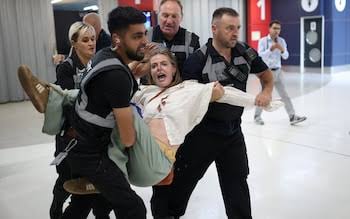
West Midlands Police said they were aware of a video circulating online showing an incident involving a protester at the conference.
The force said: “We haven’t received a complaint but would ask the woman involved to come forward and contact us so we can carry out enquiries.”
Police also appealed for anyone with information to contact them, quoting log number 924 of September 5, 2026.
The request means that, at the time of the police statement, investigators had not received a formal complaint from the woman shown in the footage.
The appeal nevertheless demonstrates that officers considered the circulating footage sufficiently relevant to ask those involved to make contact.
Police investigations will be expected to establish what happened before, during and after the confrontation rather than relying solely on short clips shared online.
What the footage appears to show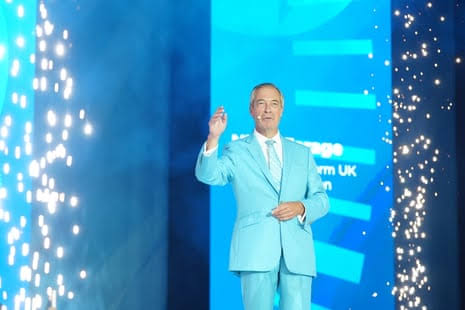
Several protesters disrupted Farage’s keynote speech during the Reform conference.
Video footage subsequently circulated appeared to show one woman being removed from the conference hall while members of the audience reached towards her.
The footage appeared to show people grabbing her hair and head. A man in the audience was also seen striking her with what reports described as a walking stick or crutch.
Security personnel were already attempting to remove the protester when the confrontation occurred.
The incident has become particularly controversial because the physical confrontation involved people who were not apparently part of the official security operation.
That distinction is important. Removing a protester from a private political conference and physically assaulting someone are separate questions, and whether any criminal offence occurred is ultimately a matter for police investigation and, if necessary, the courts.
Protesters disrupted Farage’s speech
The incident occurred during a series of disruptions at the Reform conference.
Demonstrators interrupted Farage’s keynote address several times. According to reports, protesters were removed from the main conference hall on four occasions.
The disruptions followed another protest during deputy leader Richard Tice’s speech, when a banner was displayed on stage referring to controversy surrounding political donations.
Climate Resistance, an activist group, claimed responsibility for the protest.
The group subsequently said it was “horrified at the violence” directed towards the woman and indicated that she was considering whether to contact police.
The organisation’s involvement helps explain why the confrontation took place, but it does not by itself establish precisely what happened during the physical altercation.
That is one of the issues police will need to determine.
Farage’s reaction
Farage himself reacted to the disruption while speaking on stage.
As the protest took place, he described the woman as a “screamer” and later said she appeared to be at risk of injuring herself.
He also criticised the wider reaction to the incident, arguing that coverage of confrontations involving Reform was one-sided.
Speaking to broadcasters, Farage pointed to previous incidents in which he had faced physical disruption during public appearances.
He argued that his party was entitled to remove people who entered its conference with the intention of disrupting proceedings.
His position was therefore focused primarily on the right of the conference organisers to deal with protesters.
The separate question of whether individual audience members went beyond what was appropriate is now being examined in the context of the police appeal.
Divided reaction inside Reform
The response from Reform figures has not been entirely uniform.
Zia Yusuf, the party’s home affairs spokesperson, was asked about footage showing audience members apparently grabbing the protester’s hair.
He said that he condemned people punching others.
His comments contrasted with those of Reform chairman Lee Anderson.
Anderson referred to an older man seen carrying a walking stick and said the party could hold a “whip round” to buy him a replacement.
The comments added another layer to the controversy because they appeared to treat the confrontation very differently from Yusuf’s condemnation of physical violence.
The different responses have subsequently become part of the wider political argument surrounding the incident.
Robert Jenrick’s comments
Reform’s Treasury spokesperson Robert Jenrick also faced criticism over his response.
Speaking about the incident, Jenrick said he had “zero sympathy” for the protester.
He argued that she had deliberately entered a political conference, interrupted the leader’s speech and should have expected a strong reaction.
When shown the footage, he dismissed the criticism by saying “boohoo”, according to reports.
Jenrick’s comments have themselves become a significant part of the story because they raise a question about the distinction between condemning disruptive protest and responding to it physically.
A person can oppose a protest while still arguing that members of the audience should not physically attack a demonstrator.
That distinction is now at the centre of much of the public debate.
The issue of political protest
Political conferences are private events, but they also occupy an important place in Britain’s democratic culture.
Parties have the right to organise conferences and establish rules governing attendance and conduct.
Protesters, meanwhile, have rights to express political opinions, subject to the law and restrictions governing the venue and circumstances.
When protesters interrupt a speech, organisers may remove them.
The difficult question begins when a confrontation occurs between protesters and members of the audience.
The law does not simply depend on whether someone was unpopular or disruptive.
Evidence about what happened, who initiated physical contact, what force was used and the circumstances surrounding it would all be relevant to any police investigation.
Why the police investigation matters
The police appeal provides an opportunity to move the discussion away from competing political narratives and towards evidence.
Video footage can be important, but individual clips do not necessarily provide the complete context of an incident.
Investigators can potentially examine longer recordings, speak to witnesses and establish the identities of those involved.
They may also need to determine whether the woman suffered injuries and whether anyone else was involved in the confrontation.
At present, police have said that they have not received a direct complaint from the protester.
That means it would be premature to describe anyone as having been formally charged or found guilty of an offence.
The wording used by police is therefore significant: they are asking the woman to come forward so that enquiries can be carried out.
A conference already under pressure
The confrontation came during a difficult conference for Reform UK.
The party was dealing with protests, disruption and controversy surrounding allegations about political donations.
The conference also attracted significant attention because Reform has positioned itself as a major force in British politics, making its public events closely watched.
Farage used his closing speech to acknowledge that the party would sometimes make mistakes and face criticism, while arguing that supporters would continue with its political programme.
Against that background, the confrontation involving the protester became another major story surrounding the conference.
What happens next?
The immediate next step is for the police to gather evidence.
West Midlands Police have specifically asked the woman involved to contact them. Anyone who witnessed the incident or possesses relevant information has also been asked to contact the force.
Until those enquiries are completed, claims about exactly what happened should remain carefully qualified.
The available footage appears to show physical contact between audience members and the protester, including an apparent strike with a walking stick. But determining whether that amounted to a criminal offence requires a fuller investigation.
The political arguments surrounding the incident are likely to continue.
Reform supporters have emphasised the disruption caused by protesters and the right of a political party to protect its conference. Critics have focused on the apparent treatment of the woman after she interrupted Farage’s speech.
Both issues can be examined separately.
The wider question
The incident highlights the tension that can arise when political protest meets a highly charged party event.
Protesters can disrupt political meetings. Political organisations can remove people who breach conference rules. But physical confrontation introduces a separate set of questions about individual conduct and the law.
For now, the most concrete development is the police appeal.
West Midlands Police have asked the woman involved to come forward and are seeking information about what happened at the NEC.
Until that process produces further findings, the video will remain the principal focus of public discussion — but the footage itself should not be treated as a substitute for a full investigation.
The controversy surrounding Nigel Farage’s conference therefore continues, with the police now seeking to establish what happened during the confrontation and whether further action is required.