


RNLI HITS OUT AT ‘MIGRANT TAXI SERVICE’ ACCUSATIONS
The Royal National Lifeboat Institution (RNLI) has once again found itself at the centre of Britain’s increasingly heated debate over small-boat crossings, after the charity was accused of operating what protesters described as a “migrant taxi service”.
The accusations have intensified following recent Channel rescue operations and demonstrations on the south coast, with some activists arguing that the lifeboat charity should not be involved in bringing people who cross the Channel in small boats to safety.
The RNLI strongly rejects that characterization.
The charity says its role is simple: when people are in danger at sea and HM Coastguard asks its crews to respond, its volunteers rescue them regardless of nationality, immigration status or the circumstances that brought them into danger.
The controversy has become particularly intense following events in Portsmouth and Dorset, where protests have targeted the RNLI and its volunteers.
Why is the RNLI involved?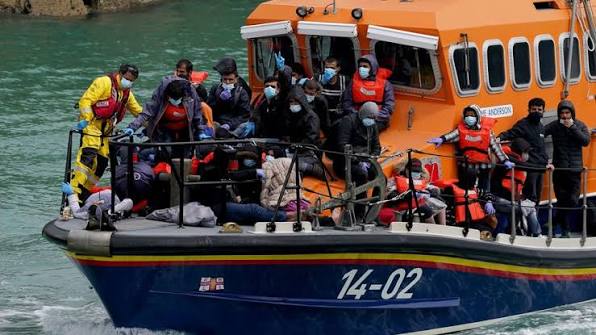
The RNLI is a search-and-rescue charity rather than an immigration enforcement organisation.
Its official explanation is straightforward. HM Coastguard coordinates maritime search-and-rescue operations around the UK, and RNLI lifeboats are among the organisations that can be tasked to assist people in difficulty.
The RNLI says its crews do not decide whether someone has a legitimate immigration claim.
They do not determine whether a person should be allowed to enter Britain.
They do not process asylum applications.
Instead, their responsibility is to respond when people are at risk of drowning.
Once those rescued reach safety, responsibility is transferred to the appropriate authorities, which can include the police, ambulance services or Border Force.
That distinction lies at the heart of the charity’s response to the “migrant taxi” accusation.
The accusation is not new
The phrase has been used for years.
In 2021, then-Brexit campaigner Nigel Farage described the RNLI’s rescue operations involving Channel migrants as a “migrant taxi service”.
The RNLI rejected the accusation, saying its crews had a moral and legal duty to rescue people whose lives were at risk at sea.
The dispute has periodically returned as the number of small-boat Channel crossings has increased.
The argument is politically sensitive because it sits at the intersection of two very different issues.
The first is immigration enforcement and border control.
The second is maritime search and rescue.
The RNLI maintains that these responsibilities must not be confused.
What happened in Portsmouth?
The latest controversy escalated after an incident in Portsmouth in September 2026.
Two RNLI crews helped bring around 120 asylum seekers ashore at Eastney after a Channel crossing.
The operation was followed by protests and a blockade, and the RNLI subsequently temporarily closed its Portsmouth lifeboat station because of concerns for the safety of its volunteers and staff.
The charity has faced further demonstrations and abuse connected to the incident.
According to reporting from the Guardian, protesters accused the RNLI of being involved in facilitating an “invasion” and called for people to stop donating to the charity.
For the RNLI, however, the incident was a search-and-rescue operation.
The charity said that people in the water were at serious risk and that its crews were responding to a maritime emergency.
One RNLI crew member described rescuing a person who had almost no strength left to hold on to the lifeboat.
Such accounts underline why the organisation says its volunteers cannot simply decide not to rescue someone because of their immigration status.
The numbers behind the controversy
The RNLI itself says that its involvement in Channel small-boat incidents is much smaller than some public discussion suggests.
According to the charity, there were 109 RNLI launches to small boats in the Channel during 2025, representing around 1.2 per cent of all RNLI launches that year.
The charity also says that of the 41,472 people recorded as crossing the Channel in small boats during 2025, 94.3 per cent were assisted by other agencies, such as Border Force, rather than the RNLI.
These figures are important because they provide context for the argument.
The RNLI is certainly involved in some Channel rescues.
But the charity’s own figures show that it is not responsible for handling the majority of small-boat arrivals.
Its primary activity remains wider maritime search and rescue around the UK’s coastline.
Why protesters remain angry
Critics nevertheless argue that the RNLI’s involvement has consequences beyond the immediate rescue.
Their argument is that rescuing people in small boats may encourage others to attempt the dangerous crossing because they know they can be rescued if something goes wrong.
This is essentially a deterrence argument.
If people believe that they will be intercepted or rescued before drowning, critics argue, the perceived risk of crossing may be reduced.
The RNLI rejects the idea that it should withhold rescue assistance as a way of influencing migration.
Its position is that maritime rescue cannot be conditional on immigration policy.
That puts the charity in an unusual position.
It is operating in an area where humanitarian rescue and a highly contentious political issue have become closely connected.
The danger of the Channel
The English Channel is one of the world’s busiest shipping lanes.
Small inflatable boats attempting the crossing face obvious dangers, including strong currents, cold water, changing weather and large commercial vessels.
The condition of some boats can also deteriorate rapidly.
RNLI crews have previously described rescuing people from overcrowded or damaged vessels and people who were exhausted after spending hours at sea.
The charity argues that these circumstances constitute genuine maritime emergencies.
In its own words, its volunteers respond to people at risk of drowning regardless of where they come from or their immigration status.
Where does Border Force fit in?
Another source of confusion is the distinction between rescue and immigration enforcement.
Border Force is responsible for border-control functions.
The RNLI is not.
When lifeboat crews rescue people from the sea, they do not determine the individual’s immigration status.
Instead, they hand responsibility over to the relevant authorities after the immediate danger has passed.
This means that rescuing somebody from a sinking vessel does not itself determine whether that person has a legal right to remain in Britain.
The asylum system subsequently considers individual claims under the relevant immigration rules.
That separation of responsibilities is central to the RNLI’s defence.
A charity caught in a political argument
The controversy presents a difficult situation for the RNLI.
The charity describes itself as politically independent and focused on saving lives.
But the small-boat crisis has become one of the most politically divisive issues in Britain.
As a result, the actions of individual volunteers can become the subject of political arguments over immigration.
Recent protests have demonstrated how intense those feelings have become.
The Portsmouth station closure was particularly significant because it showed that the dispute had moved beyond online criticism and demonstrations into concerns about the physical safety of volunteers and staff.
The RNLI has warned that its volunteers should not be placed in danger because of their rescue work.
The human side of the debate
Behind the political arguments are people facing very different circumstances.
For protesters, the central issue is Britain’s ability to control its borders and prevent dangerous or unauthorised crossings.
For the RNLI, the immediate issue is whether someone is in danger of drowning.
For migrants and asylum seekers, the Channel crossing can be part of a much longer journey involving war, persecution, poverty, displacement or attempts to find safety.
These perspectives often collide.
But a lifeboat crew arriving at a sinking vessel has very little time to debate immigration policy.
The immediate question is whether people can be kept alive.
Does rescuing migrants make the RNLI a “taxi service”?
The evidence does not support treating the phrase as a literal description of the RNLI’s role.
The RNLI does not transport people across the Channel as a commercial passenger service.
It does not decide who should cross the border.
It does not determine asylum claims.
It responds to maritime emergencies when tasked by HM Coastguard.
The charity’s official position is therefore that describing its rescue work as a “taxi service” fundamentally misunderstands what its crews are doing.
Critics may continue to argue that the wider system creates incentives for people to attempt crossings.
That is a legitimate policy question for governments and policymakers to debate.
But it is separate from the operational question facing a lifeboat crew when someone is in the water.
A debate unlikely to disappear
Britain’s small-boat crisis is unlikely to be resolved simply by arguing over the RNLI.
The underlying issues involve border enforcement, asylum processing, international cooperation, criminal smuggling networks and the conditions that drive people to attempt dangerous journeys.
The RNLI occupies a much narrower role.
Its crews are there to respond when people are in danger at sea.
The latest controversy nevertheless demonstrates how difficult it has become to separate humanitarian rescue from Britain’s wider immigration debate.
The charity says its volunteers will continue responding to people who are at risk of drowning.
Critics argue that the government must find better ways to prevent dangerous Channel crossings in the first place.
Those positions are not necessarily mutually exclusive.
A government can seek stronger border controls while a lifeboat charity continues to rescue people whose lives are immediately threatened.
For the volunteers on the water, however, the principle remains straightforward.
When someone is drowning, the first responsibility is to save them.
The political questions come afterwards.
And that distinction explains why the RNLI continues to reject the “migrant taxi service” accusation — even as Britain’s wider argument over immigration becomes increasingly heated.