
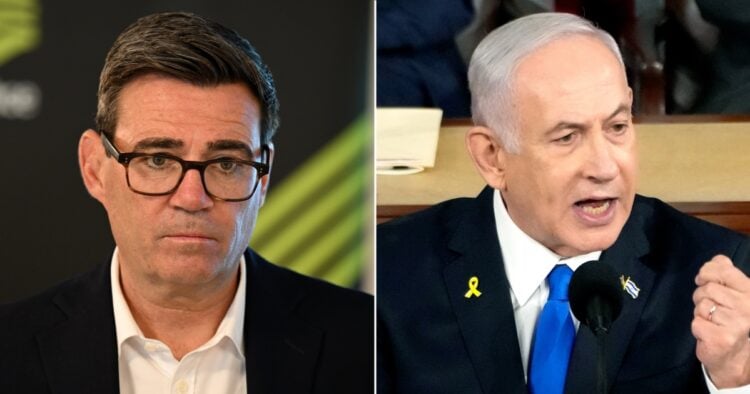
Andy Burnham’s decision to join international allies in condemning Israel’s settlement plans in the West Bank has placed the British government at the centre of a growing diplomatic dispute over the future of the region. The move reflects a significant political position on one of the most sensitive issues in international affairs and highlights the increasing concern among Western governments that continued settlement expansion could make a negotiated peace between Israelis and Palestinians more difficult.
The immediate issue is Israel’s proposed expansion of settlements in the E1 area of the occupied West Bank, east of Jerusalem. The plans involve thousands of new homes and have attracted strong international criticism because of the geographical importance of the area. E1 lies between Jerusalem and the major Israeli settlement of Ma’ale Adumim, and construction there is widely regarded by opponents as potentially creating a physical barrier between Palestinian communities in the northern and southern parts of the West Bank.
For Burnham, joining the condemnation represents a clear statement that Britain does not regard settlement expansion as an ordinary housing or planning issue. Instead, his government is treating it as an international and diplomatic matter with potential consequences for regional stability and the possibility of establishing a viable Palestinian state.
The West Bank has long been at the heart of the Israeli-Palestinian conflict. After Israel captured the territory in 1967, Israeli settlements began to expand across parts of the area. Palestinians claim the West Bank as a central part of a future independent state, alongside Gaza and East Jerusalem. Israel, meanwhile, has maintained control over large parts of the territory and has continued to support or permit settlement development in various areas.
The international community has overwhelmingly regarded Israeli settlements in the occupied West Bank as contrary to international law. Israel disputes some aspects of the international legal interpretation and argues that the territory has a complicated historical and political status. The dispute over settlements has therefore remained unresolved for decades.
What makes the latest controversy particularly important is the location of the proposed development. E1 is not simply another area where homes could be constructed. Its position makes it strategically important for the geographical continuity of the West Bank. Critics argue that large-scale development there could divide Palestinian population centres and make the creation of a contiguous Palestinian state considerably more difficult.
The idea of a two-state solution has been central to international diplomacy for many years. Under this framework, Israel and a future Palestinian state would exist alongside each other, with negotiations determining borders, security arrangements, Jerusalem, refugees, settlements, and other unresolved issues. Although the two-state solution has repeatedly been supported by international governments, the physical and political realities on the ground have made it increasingly difficult to achieve.
Settlement expansion is one of the major reasons for this difficulty. As settlements grow, the territory potentially available for a Palestinian state becomes more fragmented. Roads, military zones, infrastructure, and settlement blocs can create additional complications. From the perspective of critics of settlement expansion, every new development can make a future territorial agreement more difficult to implement.
Burnham’s decision to join other international leaders therefore represents more than a symbolic expression of concern. It reflects an attempt to reinforce a diplomatic position that Britain has increasingly adopted: that settlement expansion should stop and that actions threatening the possibility of a negotiated peace should have consequences.
The British position is particularly significant because the United Kingdom has historically maintained close relations with Israel. Britain regards Israel as an important partner in areas including trade, security, technology, intelligence, and diplomacy. At the same time, British governments have traditionally supported the establishment of a Palestinian state alongside Israel and have expressed opposition to policies that they believe undermine that objective.
Balancing these two positions is extremely difficult. A British government can maintain a relationship with Israel while criticising specific policies, but increasingly strong criticism can inevitably affect diplomatic relations. Burnham’s tougher position therefore carries political consequences as well as moral and legal implications.
Supporters of his approach argue that criticism is necessary precisely because Britain has influence as an international partner. If countries that maintain close relationships with Israel refuse to challenge settlement expansion, critics argue, there is little incentive for Israeli leaders to change course. Diplomatic pressure, sanctions, restrictions on settlement-related trade, and other measures may therefore be considered tools for influencing behaviour.
There is also a growing argument that condemnation alone is insufficient. Statements expressing concern about settlement expansion have been made repeatedly by governments around the world for many years. Yet settlements have continued to expand. For critics of the international response, this demonstrates that diplomatic language without practical consequences has failed to prevent the development of new settlements.
This is why Burnham’s position has become particularly important. His government is reportedly considering stronger measures against goods and economic activity connected to Israeli settlements. Such measures would represent a move beyond verbal condemnation and towards using Britain’s economic relationship as a means of applying pressure.
However, sanctions and trade restrictions are politically and practically complicated. Supporters argue that settlement-related sanctions can target activities connected specifically to the occupied territories without necessarily becoming a blanket economic boycott of Israel. Critics, however, warn that separating settlement activity from the wider Israeli economy may be difficult in practice.
Businesses may also face uncertainty about which goods are covered by restrictions, where products originate, and how supply chains should be monitored. Companies operating legitimately could find themselves facing additional administrative costs. There is also the possibility that economic restrictions could affect Palestinian businesses that depend on cross-border trade.
These concerns do not necessarily invalidate the case for sanctions, but they demonstrate why any policy would need to be carefully designed. A government seeking to influence Israeli policy must balance political objectives with practical enforcement and the potential consequences for businesses and civilians.
The domestic political dimension is equally important. Burnham has built his political identity around public services, social justice, and a strong connection with communities that have often felt neglected by Westminster. His position on Israel and Palestine is therefore likely to be closely watched by Labour supporters and other voters who regard the conflict as a major moral issue.
Within the Labour movement, opinions on Israel have been deeply divided. Some members believe Britain should maintain strong support for Israel while criticising particular government policies. Others argue that Britain should impose much stronger measures in response to settlement expansion and the wider treatment of Palestinians.
Burnham’s decision to take a harder line could therefore strengthen his support among voters who believe the previous government was too cautious. At the same time, it could create tensions with politicians and organisations that fear that stronger measures against Israel could damage Britain’s diplomatic relationship with a long-standing ally.
The situation also illustrates how foreign policy can influence domestic politics. For many voters, the conflict in the Middle East is not a distant issue. British communities include people with family, cultural, religious, and personal connections to both Israelis and Palestinians. Demonstrations, political campaigns, university debates, and community discussions have made the conflict an increasingly visible issue in British public life.
A prime minister must therefore consider not only Britain’s international relationships but also the effect of foreign policy decisions on social cohesion at home. Strong statements can be welcomed by one group while causing anger or fear among another. Responsible political leadership requires the ability to recognise these competing concerns without allowing disagreement to become hostility between communities.
Another important issue is the distinction between criticism of the Israeli government and hostility towards Jewish people. These are fundamentally different. A government can be criticised for its policies without that criticism being directed at an entire ethnic or religious community. Equally, opposition to Israeli government policies should never be used as a justification for antisemitism. Maintaining this distinction is essential for any serious political discussion.
The same principle applies to Palestinians. Criticism of particular political organisations or actions should not be used to treat Palestinians as collectively responsible for violence or political decisions. Ordinary civilians should not be reduced to the actions of governments or armed groups.
The humanitarian dimension makes the issue even more urgent. Palestinians living in the West Bank have experienced increasing pressure from settlement expansion, restrictions, displacement, and violence. Israeli civilians living in settlements also face security concerns and political uncertainty. Any lasting solution will have to address the rights and security of both populations.
Burnham’s condemnation can therefore be understood as part of a wider argument about whether the current trajectory can lead to peace. If settlement expansion continues, opponents argue, the possibility of creating a viable Palestinian state will become increasingly remote. If the two-state solution becomes impossible, the international community will face an even more difficult question about what political framework could replace it.
This is why the E1 development has generated such strong international reaction. Its significance extends beyond the number of homes involved. It represents a decision about land that could shape the geography of a future political settlement. Once large communities and infrastructure are established, reversing them becomes politically and practically much more difficult.
The debate also reveals the limits of international diplomacy. Governments can issue statements, pass resolutions, impose sanctions, or apply political pressure, but they cannot easily determine the decisions of another sovereign state. Israel has its own government, political system, security concerns, and domestic constituencies. International pressure may influence decisions, but it cannot guarantee a particular outcome.
Ultimately, the question is whether Britain and its allies are prepared to translate their condemnation into meaningful action. If settlement expansion is considered unacceptable, what consequences should follow? If sanctions are introduced, how should they be designed? If diplomatic pressure fails, what additional measures could be considered? These questions will determine whether the latest statements become another expression of international concern or the beginning of a more substantial policy shift.
For Burnham, the issue also presents a test of political leadership. Taking a position on such a controversial subject carries risks. A leader can face criticism from supporters, opponents, foreign governments, businesses, and community organisations. Remaining silent can also carry political and moral consequences when a government believes that international law or the prospects for peace are being undermined.
His decision to join international allies suggests that his government is prepared to accept some of those risks. Whether the approach ultimately succeeds will depend on what Britain does next.
Condemning settlement expansion is relatively straightforward. Creating diplomatic and economic policies capable of influencing events is much harder. Britain will need to balance its relationship with Israel, its commitment to international law, its support for Palestinian self-determination, its economic interests, and its broader objective of contributing to peace.
The issue also demonstrates why the Israeli-Palestinian conflict remains so difficult to resolve. It is not simply a dispute over borders. It involves competing historical narratives, security concerns, national identities, religion, international law, displacement, settlements, political power, and the basic question of who has the right to determine the future of the land.
Andy Burnham’s condemnation of Israel’s settlement plan places Britain firmly within one side of an increasingly urgent international debate. His government is arguing that settlement expansion threatens the possibility of peace and risks making a future Palestinian state impossible to establish as a viable and geographically connected entity.
Whether stronger British action can change the situation remains uncertain. But the decision to speak more forcefully reflects a growing recognition that statements of concern have limited value if they are not followed by meaningful policy. The future of the West Bank may ultimately depend not only on what governments say, but on what they are willing to do.
For Britain, the challenge will be to turn its principles into a coherent foreign policy. Supporting Israel’s security, defending Palestinian rights, opposing settlement expansion, promoting international law, and preserving the possibility of a peaceful political settlement are difficult objectives to balance. Yet they are not necessarily incompatible.
The most important goal should remain the creation of conditions in which Israelis and Palestinians can live with security, dignity, political rights, and lasting peace. Burnham’s decision to condemn the settlement plan is one part of that much larger struggle. Its significance will ultimately be judged not by the strength of the words used, but by whether Britain and its international partners can help prevent further division and keep alive the possibility of a just and sustainable peace.