

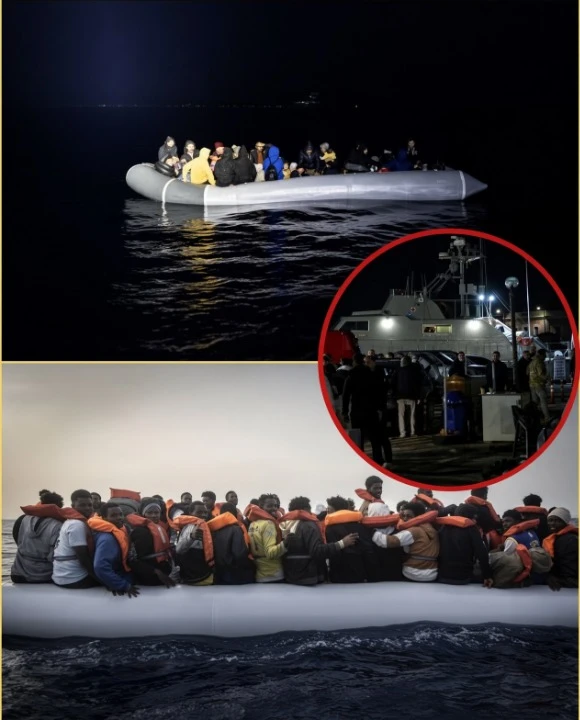
A devastating maritime disaster in the Mediterranean has left at least 14 migrants dead after the small vessel carrying them collided with a coast guard boat during an attempted interception, triggering renewed scrutiny over the dangers faced by migrants at sea and the methods authorities use when pursuing suspected smuggling vessels. The incident has circulated rapidly online, with some posts describing it as involving the “UK Coast Guard.” However, available reporting indicates that the collision occurred off the coast of Turkey, involving the Turkish Coast Guard, rather than British authorities. The distinction matters, particularly as governments across Europe face growing political pressure to prevent irregular migration while simultaneously protecting human life at sea.
According to reporting on the incident, the migrant boat was travelling off Turkey’s Mediterranean coastline near Demre, in Antalya province, when Turkish coast guard personnel attempted to stop it. Authorities said the vessel failed to comply with warnings and instead continued moving, with the encounter developing into what was described as a high-speed pursuit. During that sequence, the migrant craft and a coast guard vessel collided. The consequences were catastrophic. At least 14 people drowned, while survivors were pulled from the water or reached the shoreline. Turkish authorities subsequently launched judicial and administrative investigations into exactly how the collision occurred and whether established procedures had been followed.
The tragedy immediately raises one of the most difficult questions confronting governments responsible for maritime borders: how should officers stop a vessel suspected of carrying irregular migrants when attempting to intercept it may itself create an additional danger? Coast guard crews are expected to enforce national borders, combat smuggling networks and respond when vessels refuse instructions. Yet migrant boats are frequently overcrowded, poorly maintained, inadequately equipped and operated by people who may have little maritime experience. At high speed, even a relatively minor manoeuvre can have fatal consequences. When two vessels come dangerously close together, the risks multiply almost instantly.
Investigators will therefore need to reconstruct the final moments before impact with extraordinary care. They will likely examine the speed and direction of both boats, weather and visibility, communications between coast guard personnel and the migrant vessel, warnings given before the collision, and whether either craft made a sudden change of course. Witness testimony, maritime tracking information, onboard recordings and physical damage to the vessels could all become important evidence. Without those findings, it would be premature to conclude whether responsibility belonged to the migrant boat’s operator, the coast guard crew, a combination of decisions made by both sides, or circumstances that developed too rapidly to control.
What is already beyond dispute is the human cost. Fourteen people embarked on a journey that ended with their deaths in the water. The passengers were reportedly Afghan migrants. Seven people were rescued from the sea and received medical assistance, while another 14 who reached land were detained, according to reports citing Turkish authorities. Search-and-rescue operations were launched using maritime, aerial and land resources as authorities sought to determine whether anyone else remained missing.
For the families of those who died, the political arguments surrounding immigration will inevitably feel distant compared with the immediate reality of losing relatives at sea. Migrant routes through the Mediterranean and surrounding waters have repeatedly produced tragedies because the boats used for irregular crossings are often fundamentally unsuitable for the journeys they attempt. People may travel without proper life jackets, navigation equipment, radios or sufficient fuel. A sudden storm, mechanical problem, overcrowding incident or collision can turn an already dangerous voyage into a mass-casualty event within minutes.
Yet the circumstances of this particular disaster make the debate more complicated than a straightforward shipwreck. This was not simply a boat overwhelmed by weather or mechanical failure. It happened during interaction with a government enforcement vessel. That inevitably creates questions about proportionality, pursuit tactics and whether stopping a suspected smuggling operation immediately was worth the additional navigational danger created by a high-speed encounter. Those questions do not automatically imply misconduct by the coast guard. They do, however, make a transparent investigation essential.
One possible lesson is that maritime interceptions involving heavily crowded boats cannot be approached in exactly the same manner as pursuits involving ordinary criminal vessels. A speedboat carrying professional smugglers may be capable of sharp manoeuvres and sustained high-speed travel. A migrant craft carrying dozens of frightened passengers may behave very differently. Weight distribution can be unstable, passengers may panic and inexperienced operators may make unpredictable turns. Authorities confronting such vessels must therefore balance enforcement objectives against the possibility that aggressive pursuit could unintentionally increase the danger.
At the same time, abandoning enforcement altogether carries its own serious consequences. Smuggling networks frequently exploit precisely this dilemma. Criminal organisations understand that governments are legally and morally obligated to protect life, and they may place migrants aboard dangerously overloaded boats believing authorities will eventually be forced to rescue them. That creates an extraordinarily difficult operational environment for coast guard personnel. Officers may be required simultaneously to stop suspected smugglers, prevent an illegal crossing and ensure that dozens of passengers are not killed because of the intervention itself.
This is why the question “How could this tragedy have been prevented?” does not have one simple answer. Prevention begins long before a coast guard vessel encounters a migrant boat at sea. Authorities can target smuggling networks on land, disrupt recruitment operations, seize vessels before departure, trace payments and prosecute organisers who profit from dangerous crossings. International intelligence sharing can also identify trafficking routes and facilitators before passengers are placed aboard boats. Once a vulnerable craft is already travelling at sea, the available options become considerably more dangerous and limited.
Clear interception protocols are another critical safeguard. Maritime agencies need detailed rules governing how closely enforcement vessels may approach fragile migrant boats, when high-speed pursuit should be abandoned, what warning procedures must be followed, and when rescue operations should take priority over immediate detention. Officers also require specialised training for crowded-vessel incidents because the behaviour of a migrant boat can change suddenly if passengers move toward one side, panic or attempt to reach an approaching rescue craft.
Technology could potentially reduce some of these risks as well. Drones, aircraft, radar and long-range surveillance systems can allow authorities to track suspicious vessels without remaining physically alongside them throughout a dangerous pursuit. Instead of maintaining extremely close contact at high speed, coast guard agencies may sometimes be able to monitor a vessel from a safer distance while coordinating interception points ahead. Such strategies will not work in every situation, particularly where there is an immediate threat to life, but they could reduce the number of confrontations in which two boats are manoeuvring dangerously near each other.
The role of smugglers must also remain central to the investigation. If evidence confirms that the migrant vessel deliberately ignored instructions and performed evasive manoeuvres, the person controlling the boat may have exposed every passenger onboard to extraordinary danger. Smuggling operations often depend on desperation, misinformation and enormous financial payments from migrants hoping to reach another country. Those responsible can disappear long before authorities encounter the vessel, leaving passengers and low-level boat operators to face the consequences.
But blaming smugglers cannot substitute for examining government conduct. Democratic states grant coast guards and border agencies significant authority precisely because these organisations operate in environments where ordinary civilians possess little control. With that authority comes an obligation to investigate deaths independently and disclose enough evidence for the public to understand what happened. If operational mistakes contributed to the collision, they should be identified and corrected. If the coast guard vessel acted appropriately and the collision resulted primarily from dangerous evasive manoeuvres by the migrant craft, the evidence should make that clear as well.
The disaster also illustrates the dangers of misinformation during rapidly developing migration stories. Viral versions of the incident have described the vessel as colliding with the “UK Coast Guard,” potentially leading audiences to believe that British forces were directly responsible. Current reporting does not support that description. Britain undoubtedly faces its own intense debate over Channel crossings and border security, and official UK figures continue to document substantial numbers of people arriving in small boats. But the fatal collision involving at least 14 migrants described here occurred near Turkey, not in the English Channel.
The distinction is particularly important because the UK’s small-boat crisis already generates enormous public anger, and inaccurate information can easily become incorporated into an unrelated political argument. British authorities continue to face questions about border enforcement, asylum processing, organised smuggling and the safety of Channel crossings. Official data show that hundreds of migrants can arrive during individual periods of favourable weather, demonstrating that the underlying challenge remains substantial. But criticism of British policy should be based on events that actually involve British authorities rather than tragedies occurring thousands of kilometres away.
Britain has experienced genuine fatalities connected to small-boat crossings. The UK Marine Accident Investigation Branch, for example, has documented investigations involving migrant boats in the Dover Strait, including a June 2026 incident in which an unconscious person was discovered aboard an inflatable vessel and died. Such cases demonstrate that the Channel presents real dangers without needing unrelated foreign incidents to be incorrectly attributed to Britain.
More broadly, governments across Europe are confronting the same uncomfortable reality: maritime border enforcement involves objectives that can sometimes pull in opposite directions. Politicians promise tougher borders and stronger action against smugglers. Maritime law and basic humanitarian obligations demand protection of people in distress. Coast guard commanders must translate those political objectives into decisions made at sea, often at night, in rough conditions and within seconds. A policy that sounds simple at a press conference can become extremely complicated when dozens of lives are concentrated on an unstable inflatable boat.
This is why accountability after incidents like this matters beyond a single country. Investigators should determine not merely who technically caused the collision but whether procedures can be improved so that similar confrontations are less likely to become fatal. Could the pursuit have been conducted at lower speed? Could surveillance have continued from a greater distance? Were passengers already in imminent danger? Did the migrant vessel intentionally steer toward or away from the coast guard craft? Were warnings clearly understood? Did officers have alternatives available at the crucial moment? Those are practical questions capable of producing lessons rather than simply political accusations.
There is also a wider humanitarian issue that border enforcement alone cannot resolve. As long as people are willing to entrust their lives to smugglers and attempt dangerous maritime journeys, coast guards will continue encountering overloaded boats. Governments can reduce departures through enforcement, agreements with transit countries and stronger action against trafficking organisations, but economic instability, conflict and displacement continue pushing migrants toward irregular routes. Finding a sustainable response requires acknowledging both border security and human vulnerability rather than pretending one cancels out the other.
For supporters of stricter immigration control, the disaster may reinforce the argument that irregular maritime migration must be stopped before boats ever enter open water. From this perspective, preventing departures is not merely a border-security measure but a life-saving policy because every successful launch creates the possibility of drowning, mechanical failure or collision. Critics of aggressive enforcement, however, will argue that governments must ensure deterrence policies do not themselves increase the risk of death. Both concerns deserve examination because a credible border system must be capable of enforcement without treating preventable fatalities as an acceptable consequence.
Ultimately, fourteen deaths should not become ammunition for a misleading political narrative. They should prompt a factual examination of what happened and a serious effort to prevent another vessel from ending the same way. The evidence currently available points to a tragic collision involving migrants and the Turkish Coast Guard off Turkey’s Mediterranean coast, followed by rescue operations and official investigations. It does not establish that 14 migrants were killed during a chase involving the UK Coast Guard.
The answers may eventually reveal failures by individuals, shortcomings in interception procedures, reckless actions by smugglers or some combination of those factors. Until investigators complete their work, certainty about responsibility would be irresponsible. What is already clear is that maritime migration has once again produced an unbearable human toll. Fourteen people entered the water and never came back. Any serious response—whether focused on stronger borders, humanitarian protection or both—should begin with one objective on which governments of every political persuasion ought to agree: preventing the next crowded boat from becoming another list of names lost at sea.