
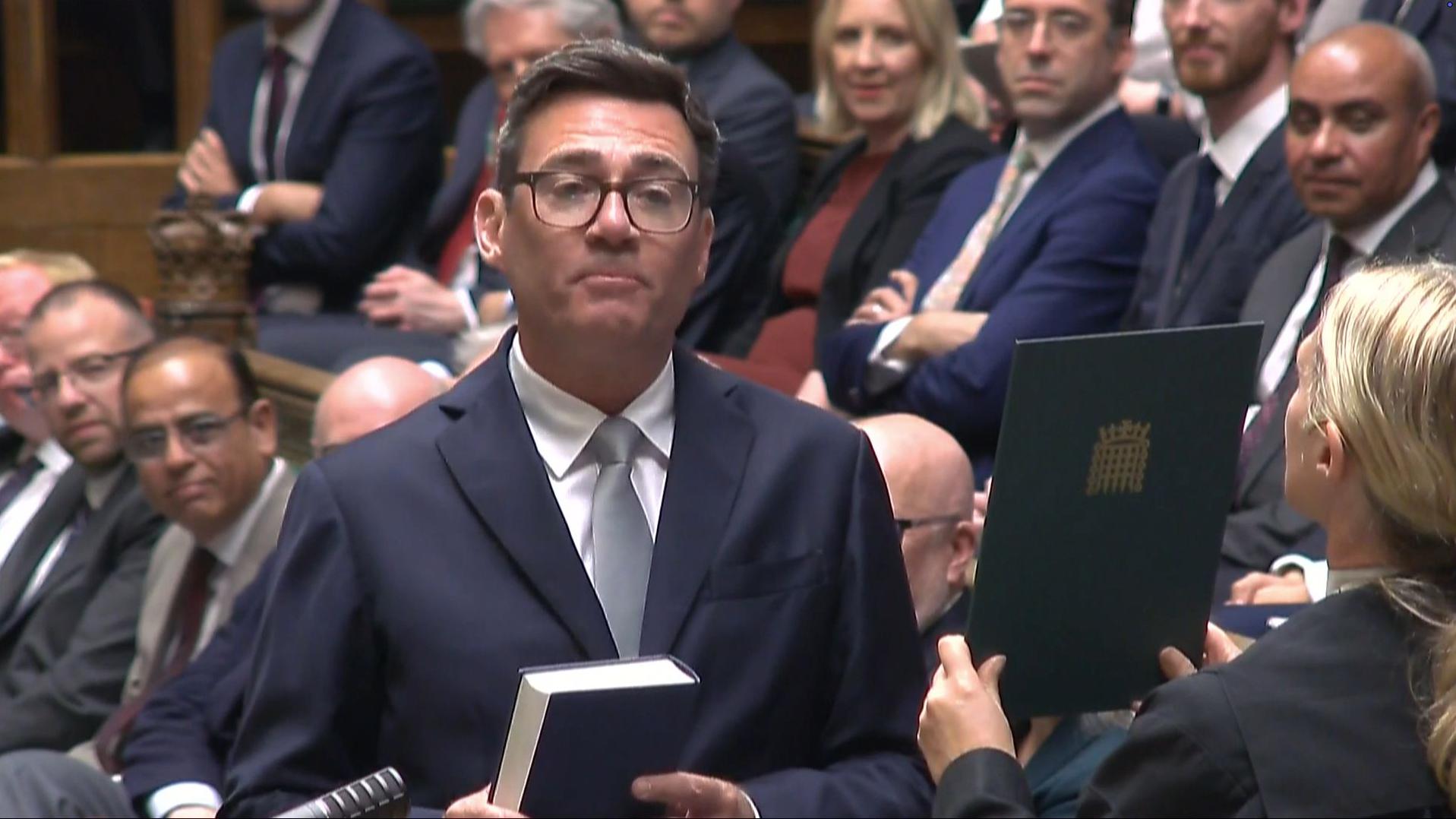
Andy Burnham “Acting Like He’s Already PM” as Snap Election Plans Send MPs Into Panic
Andy Burnham has found himself at the centre of a growing political storm after reports that his allies have been considering the possibility of a snap general election and preparing plans for a future government. To some Labour MPs, the speculation is evidence of a politician already thinking beyond the immediate task of governing. To others, it suggests that Burnham understands something fundamental about modern politics: power can disappear almost as quickly as it arrives.
The controversy is particularly striking because Burnham’s rise to Downing Street has been extraordinarily rapid. After returning to Westminster through the Makerfield by-election, he moved from the position of Greater Manchester mayor to Labour leader and then prime minister in a remarkably short period. His transition has left Westminster watching closely for signs of what his government will actually become.
Even before Burnham entered Downing Street, reports suggested that his allies were “wargaming” the possibility of an early general election. According to reports from May, Labour MPs were deeply uncomfortable with the idea because many had only recently secured their seats and feared that an early election could put them at risk. Burnham’s team denied the reports at the time.
Now, however, the issue has returned with renewed force.
The basic political calculation behind an early election is easy to understand. A new prime minister who has just taken power may want to seek a personal mandate from voters. If opinion polls are favourable, an early election can potentially transform a fragile parliamentary position into a stronger majority.
But the opposite is also true.
Calling an election is one of the greatest risks a prime minister can take. A leader may enter Downing Street believing that an election will strengthen his position and discover that voters have other ideas. Political momentum can disappear within weeks. A campaign can expose divisions, unpopular policies and weaknesses that had previously been hidden.
For Labour MPs, the risk is particularly personal.
Many members of Parliament have spent years building their political careers. Some have only recently won their constituencies. An early election could force them to defend seats before they have established themselves with local voters. That is why reports that MPs warned of “carnage” if Burnham called a snap election generated such anxiety.
From their perspective, the message is simple: let the government govern.
Burnham’s supporters could make a different argument. They could say that a prime minister should not be paralysed by the anxieties of individual MPs. If the country needs a fresh mandate and the political circumstances are favourable, waiting for years simply because MPs are nervous would not necessarily be responsible leadership.
This is where Burnham’s political instincts become important.
He has always presented himself as a politician willing to take risks when he believes the opportunity is worth taking. His decision to leave the relatively secure position of Greater Manchester mayor and return to Westminster was itself a major gamble. He entered a by-election in a constituency where Reform UK had performed strongly and successfully won the seat.
That decision demonstrated something about his character.
Burnham is not naturally a cautious politician.
At the same time, he has shown an unusual willingness to keep his plans private. Before becoming prime minister, his Cabinet strategy was described as being locked inside a “black box”, with even some Labour figures close to him uncertain about his final choices. The secrecy created intense speculation in Westminster about who would receive senior jobs.
That secrecy can be politically useful.
If potential ministers do not know whether they will receive a promotion, they cannot easily organise against the prime minister. If MPs do not know the government’s long-term plans, rumours and speculation fill the vacuum. Burnham retains control because everyone is waiting for him to reveal his next move.
But there is a danger.
A government cannot operate indefinitely as a private project controlled by a handful of people.
Once a politician becomes prime minister, the responsibility changes. A mayor can make bold promises about a city or region. A prime minister must balance the interests of an entire country, manage financial markets, deal with international crises, command a parliamentary party and make decisions affecting millions of people.
The question facing Burnham is whether his political style can adapt to that enormous responsibility.
His Cabinet choices provide an early indication of the answer.
When he entered Downing Street, Burnham rapidly assembled a government that included several significant Labour figures. John Healey became chancellor, Angela Rayner was appointed housing secretary, and Ed Miliband remained a senior figure. Several prominent figures associated with Keir Starmer’s government, including Rachel Reeves and David Lammy, were removed from government.
The choices demonstrated that Burnham was prepared to reshape the government around his own political priorities rather than simply preserve the existing structure.
That is not necessarily surprising.
Every new prime minister wants to put his stamp on government.
What is more unusual is the scale of the speculation that preceded the appointments. Before the Cabinet was formally announced, Westminster was already filled with predictions about who would receive which position. LabourList even conducted its own “fantasy Cabinet” exercise, with Ed Miliband, Angela Rayner and Wes Streeting among the most popular choices.
This fascination with Cabinet jobs reveals something important about Westminster politics.
Personnel matters.
A prime minister’s Cabinet is not simply a collection of talented individuals. It is a statement of political intent. Appointing someone to the Treasury signals something about economic policy. Choosing a particular Home Secretary sends a message about immigration and policing. Selecting a foreign secretary communicates how the government intends to position Britain internationally.
Burnham therefore has an opportunity to create a government that looks dramatically different from the one he inherited.
But the possibility of a snap election makes those decisions even more significant.
If Burnham were to call an election early, his Cabinet would have to defend his record almost immediately. Voters would judge whether his government had delivered meaningful change or merely changed the names above the ministerial doors.
His first announcements already suggest an attempt to demonstrate rapid action. On his first day in office, Burnham announced plans to scrap VAT on domestic electricity bills from October and pledged to tackle rough sleeping. He also promised a “new political model and a new economic model” aimed at addressing the cost-of-living crisis.
Those policies could become important campaign messages.
But they could also become vulnerabilities.
Every promise made by a new government creates expectations. If Burnham calls an election before those promises have had time to produce results, opponents can argue that he is asking voters to judge him on intentions rather than achievements.
That is precisely why many Labour MPs are likely to resist the idea of an early contest.
They do not necessarily oppose Burnham personally. They may simply want time.
Time to establish their constituencies.
Time for the government to implement its policies.
Time for the public to see whether Burnham’s political programme actually works.
And time for Labour’s opponents to make mistakes.
There is also a strategic reason why Burnham might be tempted to wait.
Reform UK and the Conservatives remain engaged in a struggle for voters on the political right. If those parties divide the anti-Labour vote, Labour could benefit under Britain’s first-past-the-post electoral system. A snap election might therefore offer Burnham an opportunity to secure a stronger parliamentary position before his opponents have fully recovered.
But that calculation is extremely dangerous.
Political parties can change rapidly. A poll advantage today may not exist tomorrow. A scandal, economic shock or controversial policy could completely alter the electoral landscape.
Burnham must therefore decide whether he believes the country is more likely to reward his government now than later.
That is not simply a political calculation.
It is a gamble with the careers of hundreds of MPs.
For that reason, the accusations that Burnham is “acting like he is already PM” should be treated carefully. There is a difference between preparing for possible political developments and behaving as though an outcome is guaranteed. Serious political leaders inevitably plan for different scenarios. A prime minister who never considers an election strategy would arguably be failing to do his job.
The real question is whether those preparations are distracting from governing.
If Burnham spends too much time thinking about the next election, voters may conclude that he is more interested in winning power than using it. If he spends too little time thinking about the political consequences of his decisions, he risks being outmanoeuvred by his opponents.
The balance is extraordinarily difficult.
For now, the most important test is performance.
Can Burnham reduce pressure on household finances?
Can he improve public services?
Can he address concerns about immigration without allowing the debate to become toxic?
Can he restore trust in politics?
Can he persuade voters outside Greater Manchester that his government represents them as much as it represents his political heartland?
These questions matter far more than speculation about a Cabinet spreadsheet.
Yet the political drama surrounding a potential snap election tells us something about Burnham’s new position.
He is no longer simply the ambitious mayor who wanted greater power for Greater Manchester.
He is now the person with the power to decide when Britain goes to the polls.
That changes everything.
A prime minister can spend months preparing for an election without ever calling one. But the fact that Labour MPs are already worrying about the possibility shows how quickly Burnham’s political centre of gravity has shifted.
The man who only recently had to persuade voters in one constituency to return him to Parliament now has the ability to ask the entire country for a mandate.
That is an extraordinary transformation.
And it explains why Westminster is nervous.
Burnham may insist that governing is his immediate priority. His supporters may argue that speculation about a snap election is premature. But politics is ultimately about anticipating what comes next.
If Burnham is already planning his next move, he is doing what successful politicians have always done.
The danger is that Britain may not be ready to move at the same speed.
And if the new prime minister chooses to gamble on a snap election, the people who have the most to lose may be the very Labour MPs who helped put him in Downing Street.