

Scottish First Minister John Swinney has come under fire over the reported cost of his trip to the FIFA World Cup, with critics accusing the SNP leader of spending taxpayers’ money on an expensive international journey at a time when public finances remain under intense pressure.
The controversy has quickly developed into another political battle over spending, priorities and accountability. While ministers have defended official overseas travel as an important part of promoting Scotland’s interests, opponents have questioned whether the expense can be justified when households across Scotland continue to face financial pressures.
The row has also prompted a blunt warning from Swinney’s critics: voters should “remember this” when the next election arrives.
For the SNP, the dispute is particularly uncomfortable because the party has traditionally presented itself as a champion of public services and careful stewardship of Scotland’s resources. Any suggestion that senior politicians are enjoying costly international trips at public expense risks feeding a broader narrative about political priorities.
Questions Over the Cost
The central issue is not necessarily whether Scotland’s First Minister should attend the World Cup.
International sporting events can provide governments with opportunities to promote tourism, business, investment and Scotland’s global profile. Major tournaments can also be useful occasions for politicians to meet business leaders, sporting organisations and international representatives.
The controversy instead concerns whether the benefits of the trip justify its overall cost to taxpayers.
Critics have demanded greater transparency over expenses, accommodation, travel arrangements and the purpose of the First Minister’s visit. They argue that members of the public have a right to know exactly how much was spent and what measurable benefits Scotland received in return.
That question becomes particularly important when public expenditure is under scrutiny.
Scotland, like other parts of the United Kingdom, faces difficult choices over healthcare, education, local government and infrastructure. Against that background, opponents argue that politicians should demonstrate exceptional restraint when spending public money.
The phrase “eye-watering cost” has become central to the criticism because it transforms what might otherwise be regarded as routine ministerial travel into a question of political judgment.
A Political Gift for Opponents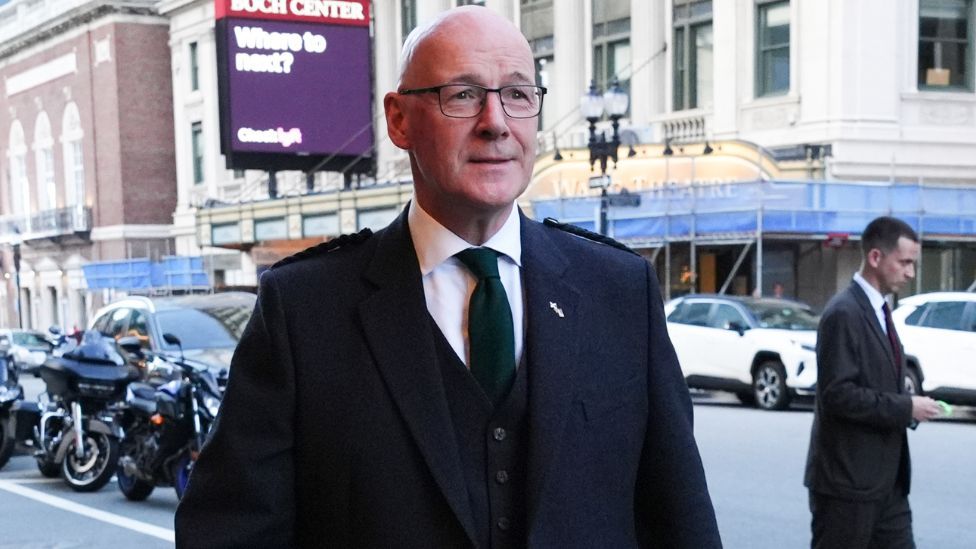
For opposition parties, the controversy offers an opportunity to portray the SNP government as out of touch.
The optics are straightforward: while families worry about household bills and public services face financial constraints, the country’s political leader is travelling overseas to attend one of the world’s biggest sporting events.
That contrast can be politically powerful even if the government can demonstrate that the trip had legitimate official purposes.
Politics is often shaped by perception as much as by spreadsheets.
An expenditure that might appear reasonable when viewed as part of a wider programme of diplomatic and economic engagement can look very different when reduced to a headline figure.
That is why critics have urged voters to remember the episode.
The message is essentially that taxpayers’ money should be spent according to priorities that ordinary people recognise as essential.
For Swinney, the challenge is therefore not simply to defend the trip but to explain its value.
Why Governments Attend Major Sporting Events
Governments around the world routinely send senior representatives to major sporting tournaments.
The World Cup attracts enormous international audiences, creating opportunities for countries and regions to promote themselves to visitors, investors and businesses. Government representatives can use such events to discuss trade, tourism, education, cultural links and future investment.
Scotland has a particularly strong international sporting identity, and its relationship with football extends well beyond the national team.
A First Minister attending a major international event could therefore reasonably argue that the trip represents official business rather than a personal holiday.
The distinction is crucial.
If Swinney’s schedule involved meetings with business organisations, sporting authorities, diplomats or representatives of the host country, those activities could provide a legitimate justification for the expenditure.
However, critics are likely to focus on the proportion of the trip devoted to formal duties compared with sporting entertainment.
The public may reasonably ask whether taxpayers would have been expected to fund the same level of expenditure if the event had not involved one of the world’s most prestigious football tournaments.
The SNP’s Broader Spending Record
The controversy comes against the background of wider arguments over the SNP’s management of Scotland’s public finances.
Opposition politicians have repeatedly accused the Scottish Government of failing to control spending while allowing taxes and government budgets to increase.
The SNP, for its part, argues that many of Scotland’s financial constraints are rooted in decisions made at Westminster and that the Scottish Government must operate within the limits of its devolved budget.
That long-running dispute provides the backdrop to every controversy involving government expenditure.
When an individual spending decision becomes controversial, it can quickly be presented as evidence of a much broader governing philosophy.
Swinney therefore faces a familiar political dilemma.
If he dismisses criticism too aggressively, opponents can accuse him of failing to understand public concerns. If he apologises or concedes that the cost was excessive, he risks suggesting that taxpayers’ money was not handled appropriately.
The strongest defence would be evidence showing that the trip produced tangible economic or diplomatic benefits for Scotland.
“Remember This”
The warning to voters is perhaps the most politically significant element of the controversy.
Opposition parties frequently attempt to turn individual incidents into symbols of wider dissatisfaction. A costly trip can become a shorthand for a government accused of having the wrong priorities.
The phrase “Remember this” is designed to make the controversy last.
Rather than allowing the story to disappear after a few news cycles, critics want voters to associate the expenditure with the SNP when they eventually enter the polling booth.
That strategy is especially relevant in Scotland, where political loyalties have undergone significant change in recent years.
The SNP has dominated Scottish politics for much of the period since 2007, but its position has faced growing pressure from Labour, the Conservatives and other parties.
Every controversy therefore carries potential electoral consequences.
The opposition does not need to prove that one trip caused Scotland’s financial difficulties. It only needs to convince voters that the episode reflects a wider problem of political judgment.
Transparency Will Be Key
The simplest way for the Scottish Government to address the controversy is transparency.
Publishing a detailed breakdown of costs and explaining the official purpose of the visit would allow voters to judge whether the expenditure was proportionate.
That should include travel, accommodation, security, staffing and any other expenses charged to public funds.
It should also clarify the First Minister’s official programme.
How many meetings took place? Which organisations were involved? What agreements or investment opportunities emerged? Were there measurable commitments relating to Scottish businesses, tourism or international partnerships?
The more concrete the answers, the easier it will be for the government to demonstrate that the trip was an investment in Scotland rather than simply an expensive political outing.
If the answers are vague, critics will have more room to argue that the trip was unnecessary.
A Question of Priorities
The dispute ultimately comes down to a simple political question: what should taxpayers expect from their government?
Ministers are entitled to travel when there is a clear public purpose. International engagement can be an important part of government, particularly in a country that wants to attract investment and promote its economy abroad.
But public officials are also expected to exercise restraint.
The higher the cost, the stronger the justification needs to be.
That principle applies regardless of political party.
An SNP government cannot expect voters to accept every expenditure simply because it is described as official business. Equally, opposition parties cannot reasonably portray every overseas ministerial visit as an unnecessary luxury without examining what the trip actually achieved.
The facts matter.
If the World Cup visit generated significant opportunities for Scottish companies, tourism or international cooperation, Swinney can make a strong case that the expenditure served Scotland’s interests.
If the trip primarily amounted to attending football matches at significant public expense, the political criticism becomes much harder to dismiss.
The Bigger Battle Ahead
The argument over Swinney’s World Cup trip is unlikely to be remembered simply as a dispute over travel expenses.
It reflects a much larger debate about government spending and political priorities.
Scotland’s voters will ultimately judge the SNP on a wide range of issues, from the NHS and education to taxation, transport and the economy. But individual controversies can influence how voters interpret those larger questions.
A government that is perceived as careful with money can withstand criticism over an isolated expenditure.
A government already facing accusations of wastefulness may find even a single expensive trip politically damaging.
That is why the words “Remember this” matter.
They are not really about one journey. They are an attempt to turn an individual expense into a symbol of how the SNP governs.
For Swinney, the answer will need to be more than political rhetoric. He will have to show that the trip had a clear purpose, that the costs were proportionate and that Scotland gained something meaningful from his presence.
Until those questions are fully answered, the controversy will continue to provide ammunition for his opponents.
And as the next election approaches, voters may indeed remember the headline — not simply the cost of the World Cup trip, but what it appeared to say about the priorities of the government that paid for it.:::
Leave a Reply
You must be logged in to post a comment.