
NI Finance Minister Calls for Highest-Level Government Decision on Budget
Northern Ireland’s Finance Minister John O’Dowd has called for the UK Government to make a decision at the “highest level” on additional funding for public services, warning that Stormont cannot properly address the region’s financial pressures without a fair and sustainable budget settlement.
The demand comes as Northern Ireland’s Executive continues to face difficulties agreeing a budget for the current financial year. Departments have been operating on contingency arrangements since April, while ministers across the Executive have repeatedly argued that additional funding from Westminster is needed to protect essential public services.
O’Dowd has argued that the current funding settlement does not adequately reflect Northern Ireland’s needs. He says the situation is particularly damaging for services already under severe pressure, including healthcare. In his view, a multi-year budget is essential if ministers are to tackle long-term problems such as hospital waiting lists and the wider instability facing the health service.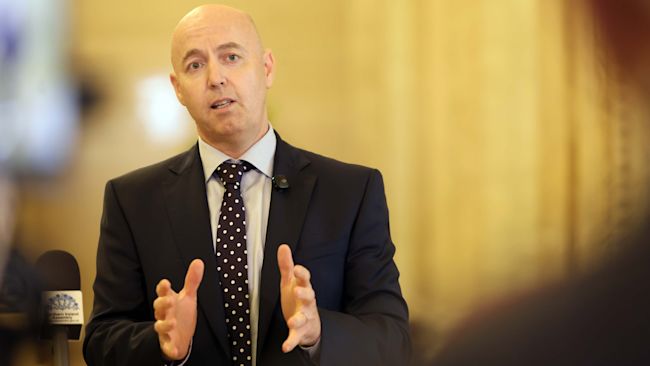
The Finance Minister has said discussions with Treasury officials have been taking place for months, but he believes those negotiations have now reached a point where political decisions must be made. He has written to Chancellor John Healey requesting an urgent meeting, arguing that responsibility ultimately rests with the Chancellor and the Prime Minister.
O’Dowd’s intervention highlights the complicated relationship between Stormont and Westminster when it comes to Northern Ireland’s finances. The Northern Ireland Executive has responsibility for many public services, but its ability to fund those services depends heavily on money provided by the UK Government.
This creates a difficult situation when the Executive believes that the funding available to it does not match the level of need. Ministers can attempt to make savings, increase efficiency or raise additional revenue locally, but there are limits to what can realistically be achieved without affecting public services or placing greater financial pressure on households.
The Finance Minister has strongly rejected the idea that Northern Ireland should solve the problem through additional charges on households. In particular, he has argued against introducing water charges, saying that asking hard-pressed families and workers to pay more is not the appropriate solution to what he sees as an unfair funding settlement.
O’Dowd has compared Northern Ireland’s financial position with that of Scotland and Wales. He argues that Scotland receives around £3 billion more than its assessed level of need, while Wales receives approximately £1 billion more, whereas Northern Ireland is funded below what its needs would suggest. He says this imbalance needs to be addressed by the UK Government.
The argument over funding is particularly important because Northern Ireland’s public services are already facing substantial demand. Healthcare waiting lists remain a major concern, while hospitals and other services are dealing with staffing pressures and financial uncertainty.
Health Minister Mike Nesbitt previously warned that the absence of an agreed budget was putting Northern Ireland’s health service in an increasingly difficult position. He said his department was unable to implement recommended pay awards for healthcare workers without a settled budget and warned that further industrial action could become more likely.
Pay is an important part of the wider dispute. Doctors, nurses and other healthcare professionals have faced pressure over wages and working conditions, while health departments must balance those demands against limited financial resources. Delays in implementing pay awards can contribute to dissatisfaction among staff and make recruitment and retention more difficult.
For patients, the consequences of financial uncertainty can be significant. A health service struggling to recruit staff and manage costs may find it harder to reduce waiting times or expand services. Long waits for diagnosis and treatment can affect people’s health, employment and quality of life.
The same principle applies across other government departments. Education, infrastructure, communities, justice and social services all depend on predictable budgets. Without certainty over funding, ministers can struggle to plan beyond the immediate financial year.
That is why O’Dowd is calling for a multi-year settlement rather than another short-term intervention. Long-term financial planning allows departments to make strategic decisions, invest in services and identify sustainable savings instead of repeatedly responding to annual crises.
A multi-year settlement could also help restore confidence within the Executive. Stormont ministers need to know what resources will be available before they can make difficult decisions about spending priorities. Without that certainty, every major policy decision becomes more difficult.
The dispute is not simply about the size of Northern Ireland’s budget. It is also about how the available money is distributed and whether the funding formula properly reflects the region’s circumstances.
Northern Ireland has particular social and economic challenges that can create additional pressure on public services. Ministers argue that these factors should be reflected in the amount of money made available by Westminster.
The UK Government, however, also faces financial constraints of its own. Increasing funding for Northern Ireland requires difficult choices within the wider UK budget. Ministers in London must balance demands from Northern Ireland with spending pressures in England, Scotland and Wales, as well as national commitments on taxation, debt and public services.
This makes the political dimension of the dispute unavoidable. O’Dowd believes the issue has reached the point where officials can no longer resolve it through technical discussions alone. He wants the Prime Minister and Chancellor to become directly involved.
The Finance Minister has questioned why Northern Ireland’s elected representatives should continue to be ignored if they believe the existing settlement is inadequate. His argument is that the UK Government has a responsibility to ensure that the devolved administration has sufficient resources to provide essential services.
The dispute also illustrates the challenges facing the restored power-sharing Executive. Northern Ireland’s major parties have frequently disagreed over policy, but on the issue of funding there has been a relatively broad recognition that the current situation is difficult.
First Minister Michelle O’Neill has previously described the budget situation as being at “breaking point” and called for a meeting with the Prime Minister. Deputy First Minister Emma Little-Pengelly has similarly argued that Northern Ireland cannot afford to wait for action from Westminster.
This cross-party pressure increases the political significance of O’Dowd’s latest intervention. If ministers from different parties continue to make the same argument, the UK Government will face growing pressure to respond.
At the same time, Stormont will need to demonstrate that any additional money it receives is used effectively. Westminster may be reluctant to provide substantially more funding without assurances about financial management, spending priorities and reforms within Northern Ireland’s public services.
That means the debate is likely to involve both sides of the funding equation. Northern Ireland’s Executive wants more resources, while the UK Government is likely to expect evidence that existing resources are being used efficiently.
Healthcare is perhaps the clearest example of this tension. The health service requires significant investment, but simply increasing spending does not automatically solve waiting lists or staffing shortages. Reform, improved productivity and better integration between health and social care may also be necessary.
The same applies to other departments. Additional funding can provide immediate relief, but long-term financial stability requires structural changes. Ministers will therefore need to demonstrate how extra resources would translate into better outcomes for the public.
For ordinary people in Northern Ireland, however, the argument can appear much simpler. They want reliable public services, reasonable waiting times, functioning infrastructure and support when they need it. They are unlikely to be interested in the technical details of funding formulas if they cannot access essential services.
The current budget dispute therefore has practical consequences far beyond Stormont’s political institutions. Decisions made by the Treasury and Northern Ireland Executive can influence whether hospitals can recruit staff, whether infrastructure projects move forward, and whether public services have enough resources to meet demand.
O’Dowd’s call for action at the highest level is an indication of how serious the situation has become. His argument is that continued negotiations between officials are no longer sufficient and that political leaders must now decide whether to provide Northern Ireland with a revised settlement.
The coming months will be important. If an agreement is reached, Stormont could gain the financial certainty needed to establish a proper multi-year plan. If negotiations remain unresolved, departments may continue operating under financial restrictions, increasing the pressure on already stretched services.
The challenge for the UK Government will be to balance Northern Ireland’s demands with the wider financial position of the United Kingdom. For Stormont, the challenge will be to demonstrate that additional funding would produce measurable improvements rather than simply delaying difficult decisions.
Ultimately, the dispute is about more than accounting figures. It is about the capacity of government to provide essential services and the confidence of people in Northern Ireland that their political institutions can meet their needs.
John O’Dowd believes the time for further delay has passed. By calling for a decision from the Prime Minister and Chancellor, he is placing the issue firmly at the centre of the relationship between Stormont and Westminster.
Whether that pressure produces a new funding package remains to be seen. But with departments operating under contingency arrangements and public services facing growing pressures, the argument that a decision is urgently required is becoming increasingly difficult to ignore.
For Northern Ireland, a sustainable budget could provide the stability needed to tackle long-standing problems. Without one, ministers may find themselves spending more time managing financial crises than improving the services on which the public depends.