

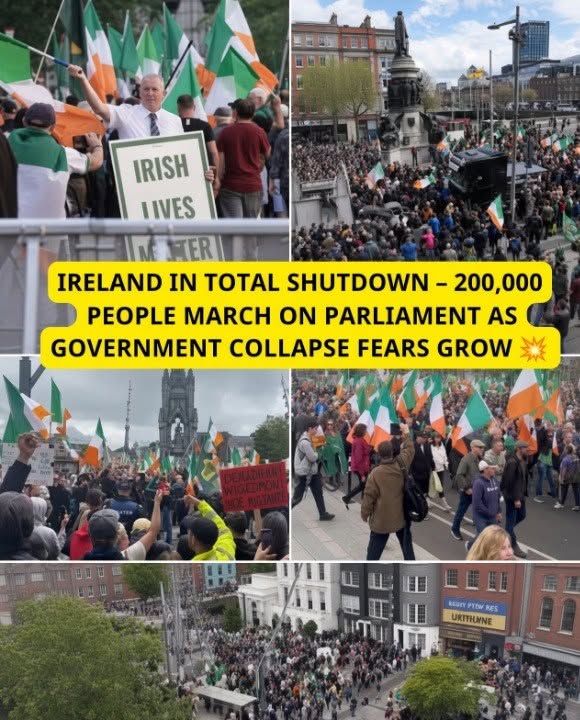
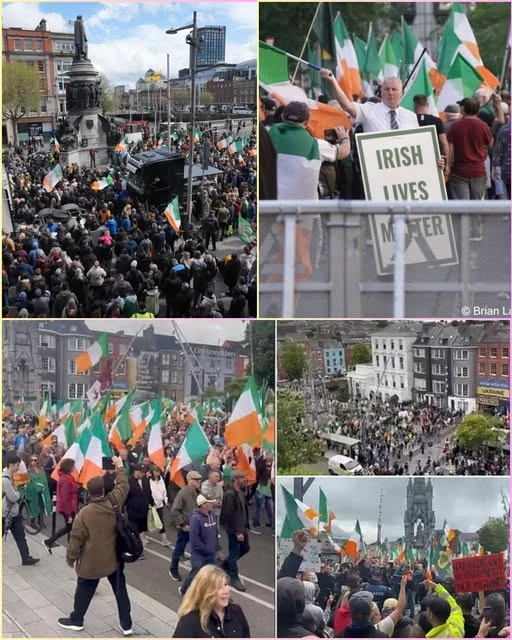
A DRAMATIC CLAIM OF 200,000 PEOPLE OUTSIDE PARLIAMENT HAS SET SOCIAL MEDIA ALIGHT — BUT THE VERIFIED PICTURE IS VERY DIFFERENT
Claims that as many as 200,000 people had flooded the streets outside Ireland’s parliament have spread with extraordinary speed, accompanied by warnings that the country is entering a period of unprecedented political instability. The imagery is powerful: a vast crowd surrounding Leinster House, public anger spilling into the heart of Dublin, and a government supposedly facing one of the largest demonstrations in modern Irish history. But there is a major problem with that dramatic version of events. Reliable Irish reporting does not currently support the claim that 200,000 demonstrators gathered outside parliament. Recent protests in Dublin have certainly been real, sometimes disruptive and politically significant, but the verified numbers have been far smaller. On June 10, 2026, RTÉ reported that several hundred people took part in an anti-immigration demonstration that marched from O’Connell Street to Leinster House, calling for a referendum on the EU Migration Pact. Later that month, another anti-immigration rally in Dublin attracted hundreds of participants. Ireland has also experienced other protests in 2026, including fuel-related demonstrations that disrupted traffic across the capital. The reality is therefore not a nation literally overwhelmed by a 200,000-person uprising outside parliament. Yet dismissing the headline entirely would also miss something important: Ireland is experiencing a period of unusually visible political frustration in which immigration, housing, living costs, sovereignty and distrust of institutions are increasingly converging on the streets.
THE STREET PROTESTS ARE REAL — AND THEY ARE BECOMING HARDER FOR THE POLITICAL ESTABLISHMENT TO IGNORE
Even without the sensational 200,000 figure, the fact that protesters are repeatedly taking their grievances directly into Dublin’s political and symbolic centre matters. The June 10 demonstration moved toward Leinster House, the seat of the Oireachtas, while participants called for a public vote on the EU Migration Pact. Roads were temporarily affected and Gardaí implemented rolling closures as the crowd moved through the city. On June 27, hundreds again gathered in Dublin for a rally described by organisers as a “national rally,” with demonstrators carrying Irish flags and banners opposing the Migration Pact. These events were not numerically equivalent to the huge mass demonstrations sometimes seen elsewhere in Europe, but their political importance cannot be measured solely by turnout. They reflect a growing willingness among groups dissatisfied with immigration policy to move from online anger to organized street politics. That transition matters because political movements often become more influential when they demonstrate that supporters are prepared to assemble physically, create disruption and force national media to cover their message.
IMMIGRATION HAS BECOME ONE OF THE MOST EMOTIONALLY CHARGED ISSUES IN MODERN IRISH POLITICS
Ireland’s transformation over the past several decades has been extraordinary. Once a country more associated with emigration than immigration, it has become one of Europe’s most dynamic economies and a destination for workers, students, refugees and asylum seekers from around the world. For many Irish people, that transformation has brought enormous benefits: a larger workforce, greater cultural diversity, international investment and a more globally connected society. But rapid change has also coincided with severe shortages of housing, rising rents, pressure on public services and growing concern about whether the state has sufficient infrastructure to absorb population growth. This overlap has made immigration politically combustible. Housing problems that predate recent migration can still become associated in the public mind with new arrivals because both groups are competing within the same constrained system. Government explanations that Ireland’s housing crisis is structurally complex may be economically accurate, but they can sound abstract to a household unable to find affordable accommodation. That gap between technical explanation and lived experience is where political anger grows.
THE EU MIGRATION PACT HAS BECOME A SYMBOL OF SOMETHING MUCH BIGGER THAN THE TEXT OF THE AGREEMENT ITSELF
The demonstrations targeting the EU Migration Pact reveal how immigration politics is increasingly intertwined with sovereignty. For opponents, the issue is not simply how asylum claims are processed. It is whether Ireland should surrender additional decision-making authority to European institutions on a politically sensitive issue involving borders and population movement. Protesters demanding a referendum are therefore making a broader democratic argument: if European migration rules could significantly affect Ireland’s future, voters should have a direct say. Supporters of the pact counter that migration is inherently cross-border and cannot be managed effectively by individual EU states acting alone. They argue that common European rules are necessary precisely because irregular migration affects external borders, asylum systems and secondary movement between countries. These two positions are difficult to reconcile because they begin from different understandings of sovereignty. One sees national control as essential to democracy. The other sees European cooperation as essential to effective control.
THE GOVERNMENT’S PROBLEM IS THAT IMMIGRATION ANGER IS MERGING WITH HOUSING ANGER
Ireland’s housing crisis has become one of the defining political issues of the era. Younger people struggle to buy homes, renters face high costs and emergency accommodation remains under pressure. Against that background, any announcement involving accommodation for migrants or asylum seekers can become politically explosive. Local residents may ask why facilities appear to be found for newcomers when existing citizens have waited years for housing. Government officials respond that the systems are not directly interchangeable and that humanitarian obligations must be met regardless of housing shortages. But politics is driven as much by perceived fairness as administrative structure. When citizens believe the state can mobilize resources rapidly for one emergency but not another, resentment can deepen. This does not mean that all opposition to migrant accommodation is anti-immigrant, nor does it mean every protest is driven purely by housing concerns. But the intersection of the two issues has created one of the most powerful sources of political frustration in Ireland.
THE GOVERNMENT ALSO FACES A TRUST PROBLEM
Perhaps more dangerous than disagreement over individual policies is the erosion of trust between sections of the public and state institutions. Protest movements frequently gain momentum when people believe conventional political channels no longer respond to them. Once that perception takes hold, official statements can paradoxically deepen suspicion. If authorities say a protest involved hundreds but activists insist thousands attended, supporters may accuse the media of deliberately minimizing the event. If government ministers say immigration is controlled, critics may point to visible accommodation centres or local demographic change and conclude that official statistics conceal reality. The resulting environment is extraordinarily fertile for misinformation. A claim that 200,000 people surrounded parliament can spread because it fits an existing emotional narrative even when reliable reporting provides no evidence for such a number. Political distrust therefore does not merely create protests; it changes the way people interpret information about the protests themselves.
SOCIAL MEDIA CAN TURN A HUNDREDS-STRONG PROTEST INTO A “NATIONAL UPRISING” WITHIN HOURS
The modern information environment rewards dramatic exaggeration. A headline saying “several hundred people protest in Dublin” may accurately describe an event, but it rarely travels as far as “Ireland erupts” or “200,000 storm parliament.” Images can further distort perception. A tightly framed photograph of a dense section of a crowd can make a gathering appear enormous, while an aerial image may reveal a much smaller turnout. Videos filmed from ground level provide intensity but often no reliable sense of scale. Once political accounts begin repeating a figure, repetition itself creates credibility. Users see the number in multiple posts and assume each post represents independent confirmation, when in reality they may all originate from the same unsupported claim. This is one reason crowd estimates should be treated with particular caution in politically polarized events.
THAT DOES NOT MEAN THE GOVERNMENT CAN SIMPLY DISMISS THE ANGER
Correcting an exaggerated crowd figure is not the same thing as answering the grievances that generated the protest. A government that focuses only on debunking numbers risks appearing evasive. The more important question is why immigration has become sufficiently contentious that people are repeatedly marching through Dublin. Protesters who believe immigration is too high want substantive answers about numbers, accommodation, border procedures and the government’s ability to deport people whose claims fail. People concerned about housing want to know when supply will finally catch up with demand. Others want greater transparency about how locations for asylum accommodation are selected. If these questions are ignored or answered solely through accusations of extremism, the political centre may lose even more ground.
AT THE SAME TIME, ANTI-IMMIGRATION POLITICS CAN EASILY CROSS INTO SOMETHING DARKER
There is an equally important warning in the opposite direction. Legitimate criticism of immigration policy is not automatically racist or extremist. Citizens have every right to argue that migration should be reduced, borders strengthened or European migration policy rejected. But protests can also attract individuals and groups whose agenda goes much further, including nationalist organizations promoting hostility toward migrants or minorities. The June 27 rally, for example, included National Party flags and slogans calling for migrants to be removed. Political movements are often coalitions containing people with very different motivations. Governments and journalists therefore face the difficult task of neither smearing every participant because of the most extreme attendees nor pretending that extremist elements are irrelevant when they are visibly present.
IRELAND’S PROTEST WAVE IS NOT ONLY ABOUT IMMIGRATION
The wider atmosphere of dissatisfaction can be seen in other demonstrations as well. In April 2026, rolling fuel protests caused serious disruption in central Dublin, blocking major roads and affecting public transport. Dublin City Council publicly warned that demonstrators could not be allowed to “hold Dublin to ransom,” while simultaneously recognizing the right to protest and the frustration caused by rising fuel costs. The protests illustrated an important pattern: anger in Ireland is not confined to a single ideological or policy issue. Cost-of-living pressures, fuel prices, housing, migration and distrust of government can reinforce one another even when the groups involved are different. When multiple grievances emerge simultaneously, the political atmosphere can feel much more unstable than the size of any single demonstration might suggest.
THIS IS WHY TALK OF “POLITICAL INSTABILITY” NEEDS BOTH CONTEXT AND ATTENTION
Ireland is not experiencing the collapse of democratic government. Elections continue, parliament functions, protests are policed and opposition movements operate openly. Describing the country as being on the verge of political breakdown would therefore be an exaggeration. But stability is not binary. A country does not have to be approaching revolution for political conditions to become more volatile. The growth of protests, the rise of anti-establishment rhetoric and the increased willingness of voters to challenge traditional parties can all indicate a political system under pressure. Ireland’s long period of politics dominated by familiar party structures has already been changing. Social media enables smaller movements to organize rapidly, while issues such as immigration can create new political divisions that do not fit neatly into traditional left-right categories. The danger for established parties is not necessarily that 200,000 people suddenly surround Leinster House. It is that dissatisfaction grows gradually until an election reveals that millions of quieter voters have moved.
THE GOVERNMENT FACES A DIFFICULT BALANCING ACT
On immigration, ministers must attempt to achieve several objectives that frequently pull in opposite directions. Ireland has humanitarian and international legal obligations toward people seeking protection. It also needs workers in parts of the economy and benefits substantially from international mobility. At the same time, the state must maintain public confidence that migration is controlled, that asylum decisions are made efficiently and that people without a lawful right to remain do not simply disappear into the system. Governments must also ensure local infrastructure can absorb population change. Fail on enforcement and voters may conclude the system is open-ended. Fail on humanity and Ireland risks violating legal obligations and values many citizens strongly support. Fail on housing and every migration dispute becomes more combustible.
OPPOSITION MOVEMENTS SEE AN OPPORTUNITY THE ESTABLISHMENT MAY HAVE UNDERESTIMATED
For populist, nationalist and anti-establishment groups, immigration provides an issue capable of connecting multiple grievances under one narrative. Housing shortages become evidence that government prioritizes newcomers. EU migration rules become evidence that sovereignty has been weakened. Asylum accommodation becomes evidence of secretive decision-making. Rising public spending becomes evidence that ordinary taxpayers are being ignored. Whether each link is economically or administratively justified matters less politically than whether voters find the overall story persuasive. A successful political movement does not need to prove that immigration caused every problem. It merely needs to persuade voters that government failed to control change.
MAINSTREAM POLITICIANS CANNOT WIN THIS DEBATE BY PRETENDING EVERY CONCERN IS IRRATIONAL
One lesson from political developments across Europe is that dismissing migration concerns often strengthens parties promising tougher policies. Voters who feel ignored rarely become less angry when told their concerns are illegitimate. Governments therefore need to distinguish clearly between hostility toward migrants and legitimate questions about migration levels, border management and public capacity. That requires transparent numbers, clear enforcement rules and honest acknowledgement of trade-offs. If politicians promise both unlimited humanitarian generosity and unlimited control, reality will eventually expose the contradiction. A credible policy must say how many people the country can reasonably accommodate, which routes are legitimate, what happens when asylum claims fail and how infrastructure will expand alongside population growth.
EQUALLY, THE OPPOSITION CANNOT SOLVE COMPLEX PROBLEMS WITH A SINGLE SLOGAN
The harder truth for protest movements is that controlling immigration is administratively complicated. Ireland is part of the European Union, participates in international refugee frameworks and has an economy that depends heavily on international workers and investment. Reducing migration dramatically could affect businesses, healthcare, universities and other sectors. Deportation requires legal procedures and cooperation from destination countries. Asylum systems cannot simply be abolished without significant legal and diplomatic consequences. Political slogans are powerful because they remove complexity. Governments eventually have to put complexity back in.
THE 200,000 CLAIM MAY BE WRONG — BUT THE MOOD BEHIND IT SHOULD NOT BE IGNORED
This is perhaps the most important conclusion from the controversy. There is no reliable evidence that 200,000 people recently gathered outside the Irish parliament in the event described by the viral headline. Verified anti-immigration demonstrations near Leinster House in June 2026 involved several hundred participants, not hundreds of thousands.
But the reason an extraordinary figure like 200,000 could spread so easily is itself politically revealing.
Many people are ready to believe that Ireland is on the verge of a mass uprising because they already perceive the country as deeply divided.
They see a housing system under severe pressure.
They see rapid social change.
They see heated arguments over immigration and the EU.
They see protests disrupting Dublin.
And they see declining confidence in institutions that once appeared far more secure.
The online exaggeration feeds on a genuine atmosphere of uncertainty.
IRELAND IS NOT “ERUPTING” IN THE LITERAL SENSE — BUT ITS POLITICAL LANDSCAPE IS CLEARLY SHIFTING
Ireland remains a stable democratic country, and nothing in the verified evidence suggests that a 200,000-person crowd has surrounded parliament or that the government is facing imminent collapse.
Yet something significant is happening.
Political anger is becoming more visible.
Street demonstrations are becoming an increasingly important part of political expression.
Immigration has moved from a secondary issue to a major national argument.
Housing frustration is intensifying every other political grievance.
And social media is creating an alternative political ecosystem where dramatic narratives can move faster than traditional journalism can correct them.
For the government, that combination presents a serious challenge.
It cannot simply govern by pointing to economic performance or institutional stability if sections of the electorate feel that fundamental questions about housing, migration and sovereignty remain unanswered.
For protesters, the challenge is different.
If they want to transform anger into lasting political influence, they will need more than dramatic online claims. They will need credible policies, accurate information and support broad enough to extend far beyond the hundreds currently attending individual rallies.
The difference between 200,000 people and several hundred is enormous.
But history repeatedly demonstrates that political movements do not always begin with enormous crowds.
They begin with unresolved grievances.
They grow when institutions fail to respond.
And they become dangerous to established parties when frustration that once seemed marginal becomes normal.
That is the real story Ireland’s political class should be watching.
Not a fictional 200,000-person siege of parliament.
But a much slower and potentially more consequential erosion of confidence taking place across parts of the country.
Whether that frustration fades, fractures into competing movements or eventually transforms Irish electoral politics will depend heavily on what happens next.
If housing remains scarce, migration stays politically contentious and voters continue to feel excluded from major decisions, demonstrations may continue.
If the government restores confidence through visible results, the temperature could fall.
But one thing is already clear.
Ireland’s current political argument is not simply happening inside Leinster House anymore.
It is happening on the streets, online, in communities and around kitchen tables across the country.
And while the viral numbers may be wildly exaggerated, the sense that something in Irish politics is changing is much harder to dismiss.