
Nigel Farage to Defeat ‘Desperate Tory-Labour Pact’ in Second Clacton By-Election, Data Suggests
Nigel Farage has once again turned Clacton into the centre of Britain’s political drama, with fresh data suggesting that the Reform UK leader could defeat attempts by his opponents to deny him another decisive mandate.
The latest contest has become far more than an ordinary by-election.
For Farage, it is a test of whether his political appeal remains powerful enough to withstand renewed scrutiny, criticism from Westminster and coordinated opposition from parties determined to prevent Reform from gaining further momentum.
For Labour and the Conservatives, meanwhile, Clacton represents an unusual strategic dilemma.
The two traditional parties have found themselves on the same side of a remarkable political contest: neither wants to hand Farage an easy victory, yet neither necessarily wants to give him the national platform that a conventional head-to-head election would create.
The result has been an extraordinary political battle in which Farage has attempted to frame the contest as a confrontation between Reform supporters and what he describes as the establishment.
Recent events have made the argument even more dramatic.
Farage triggered the by-election after resigning his seat amid scrutiny of his financial affairs, arguing that voters in Clacton should have the opportunity to judge him directly. The parliamentary investigation concerns an undeclared £5 million gift from cryptocurrency entrepreneur Christopher Harborne, an issue Farage has denied involved wrongdoing. The investigation has since resumed following his victory.
The strategy was obvious.
Farage wanted to transform a potentially damaging controversy into a political referendum.
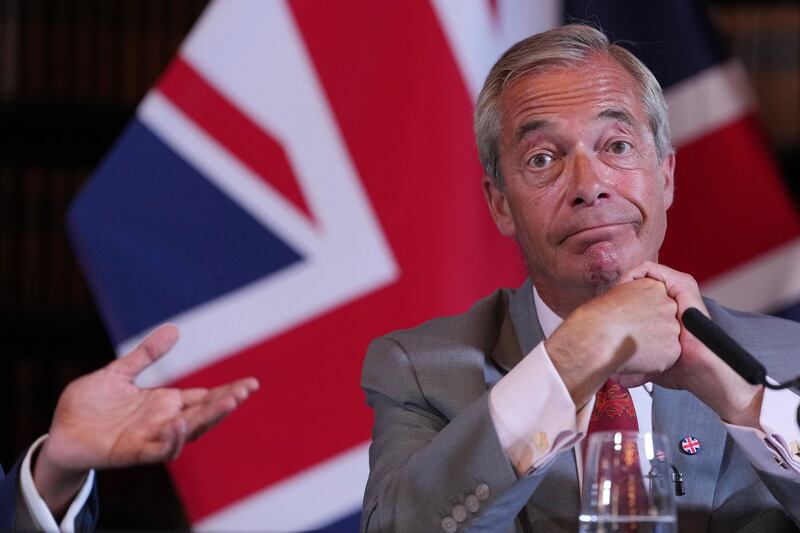
Instead of allowing the story to remain focused on financial questions, he sought to make the election about trust, political freedom and what he sees as an establishment determined to remove him from British politics.
That strategy has now produced another extraordinary chapter in the Clacton story.
Farage won the by-election with more than 22,000 votes, taking roughly 63 per cent of the vote. Count Binface, the satirical candidate, finished second with about 27 per cent. The major political parties did not field candidates.
On the surface, the result represents a commanding victory.
But politically, the numbers require a closer examination.
Turnout was considerably lower than at the 2024 general election. Farage nevertheless received more votes than he had secured in 2024, when he first won the constituency for Reform. That provides his supporters with a powerful argument that his personal base in Clacton remains substantial.
The political significance goes beyond the constituency itself.
Farage has spent decades arguing that Britain’s traditional political system is failing to represent millions of voters.
He has positioned himself as the challenger to Westminster consensus, particularly on immigration, national sovereignty, taxation and the role of government.
The Clacton result allows him to reinforce that narrative.
But the real question is whether the victory represents a broader political trend.
That is where the latest data becomes interesting.
If Reform continues to perform strongly in areas where Conservative and Labour voters are dissatisfied, the established parties could face an increasingly difficult electoral landscape.
The Conservatives have already lost significant support to Reform.
Labour, meanwhile, must consider whether some of its voters could also be attracted by Farage’s message, particularly those who feel disconnected from Westminster politics or frustrated by issues such as immigration and the cost of living.
This creates a complicated three-way contest.
Labour wants to prevent Reform from expanding its support.
The Conservatives want to recover voters who have moved toward Farage.
Reform wants to convince those same voters that they should never return to the traditional parties.
The battle for those voters could shape Britain’s next general election.
That is why Clacton matters.
Farage does not need to win every constituency to change British politics.
He needs to demonstrate that Reform can consistently attract enough support to make the major parties alter their strategies.
A party polling strongly can influence the policies of its competitors even before it wins large numbers of seats.
That is precisely what Reform has already achieved.
Immigration has become even more central to political debate.
Questions surrounding public spending, taxation and national identity have also become increasingly difficult for mainstream politicians to avoid.
Farage’s political strength lies in his ability to connect these issues into a single argument about political failure.
His message is that Britain has been governed by different versions of the same establishment for too long.
His opponents reject that interpretation.
But the fact that millions of voters are willing to listen demonstrates that the argument has political power.
The Clacton contest therefore becomes another test of whether that power can survive sustained scrutiny.
There are reasons for Farage to be confident.
His personal brand remains exceptionally strong among Reform supporters.
He has considerable experience campaigning.
He is highly effective at generating media attention.
And he has repeatedly demonstrated that political controversies do not necessarily destroy his support.
Indeed, controversy can sometimes strengthen his position among voters who already distrust established institutions.
Every criticism from Westminster can be presented as evidence that the establishment is threatened.
Every investigation can become another opportunity to argue that political insiders are targeting him.
That creates a powerful feedback loop.
His opponents attack.
Farage responds.
His supporters become more energised.
And the controversy generates another round of publicity.
However, there are also significant challenges.
The Clacton election was highly unusual because the major parties chose not to contest it. That means the result cannot be treated as a normal test of Reform against Labour or the Conservatives.
A by-election with dozens of candidates and an unusually low turnout is fundamentally different from a general election involving the full range of major parties.
That distinction matters.
A decisive victory in Clacton demonstrates Farage’s strength in Clacton.
It does not automatically prove that Reform would defeat Labour nationally.
Nor does it prove that Conservative voters would permanently abandon their former party.
This is where interpretation becomes crucial.
Farage will naturally present the result as evidence that the British public is moving toward Reform.
His opponents will point to the unusual circumstances and lower turnout.
Both arguments contain elements of truth.
The real test will come when Reform faces serious competition across a much wider range of constituencies.
That is where the party’s organisational strength will be tested.
Can it recruit credible candidates?
Can it maintain discipline?
Can it produce detailed policies?
Can it persuade voters that it is capable of governing rather than simply protesting?
Those questions will become increasingly important as Reform grows.
For Labour, the challenge is equally serious.
It cannot simply assume that criticising Farage will make his support disappear.
Political movements do not grow in a vacuum.
They grow because voters believe existing alternatives are inadequate.
If Labour wants to weaken Reform, it must address the issues that are driving voters toward it.
That may mean taking tougher positions on immigration.
It may mean demonstrating greater control over public spending.
It may mean rebuilding trust among voters who feel that politics has become disconnected from their everyday lives.
And it may require Labour to explain why its own vision for Britain is more convincing than Farage’s.
The Conservatives face a different but equally difficult problem.
They need to decide whether to compete directly with Reform or attempt to distinguish themselves from it.
If they move too far toward Farage, they risk losing their traditional identity.
If they ignore Reform, they risk losing even more voters.
That strategic dilemma is one reason Clacton has become such an important political symbol.
Farage has successfully forced his opponents to react to him.
And that may be one of his greatest strengths.
He wants politics to revolve around the questions he considers important.
He wants immigration and sovereignty at the centre of the debate.
He wants the public to question the authority of Westminster institutions.
And he wants Reform to be viewed not as a protest party, but as a government-in-waiting.
Whether that ambition can be achieved remains uncertain.
But dismissing it would be a mistake.
The political landscape is changing rapidly.
Voters are increasingly willing to switch parties.
Traditional loyalties are weakening.
Smaller parties can now receive enormous media attention.
And political campaigns are increasingly driven by personalities as much as policies.
Farage has mastered that environment.
The Clacton victory gives him another opportunity to claim that his political project remains alive.
His opponents may describe the contest as a stunt or an unusual political exercise.
They may question the turnout.
They may highlight the unusual field of candidates.
They may continue to scrutinise his finances.
But none of those arguments change the basic fact that Farage has secured another mandate from the voters of Clacton.
That gives him political breathing space.
More importantly, it allows him to return to Westminster with a renewed argument: his opponents may be able to challenge him, investigate him and criticise him, but they cannot easily remove him from the political conversation.
The next stage will be much harder.
Winning Clacton is one thing.
Turning that victory into a nationwide political movement is another.
Reform must now prove that its support can survive outside Farage’s strongest territory.
It must demonstrate that it can appeal to voters who are not already convinced.
And it must show that its policies can withstand the scrutiny that comes with serious political power.
For now, however, Farage has achieved what he wanted from the Clacton contest.
He has returned to Parliament.
He has strengthened his position within Reform.
And he has once again forced Britain’s political establishment to pay attention.
The argument over whether his movement has peaked is far from settled.
But one thing is becoming increasingly difficult for his opponents to deny.
Nigel Farage remains a formidable political force.
And if the latest data is pointing in the direction suggested by Reform supporters, the battle for Britain’s political future may be only beginning.