

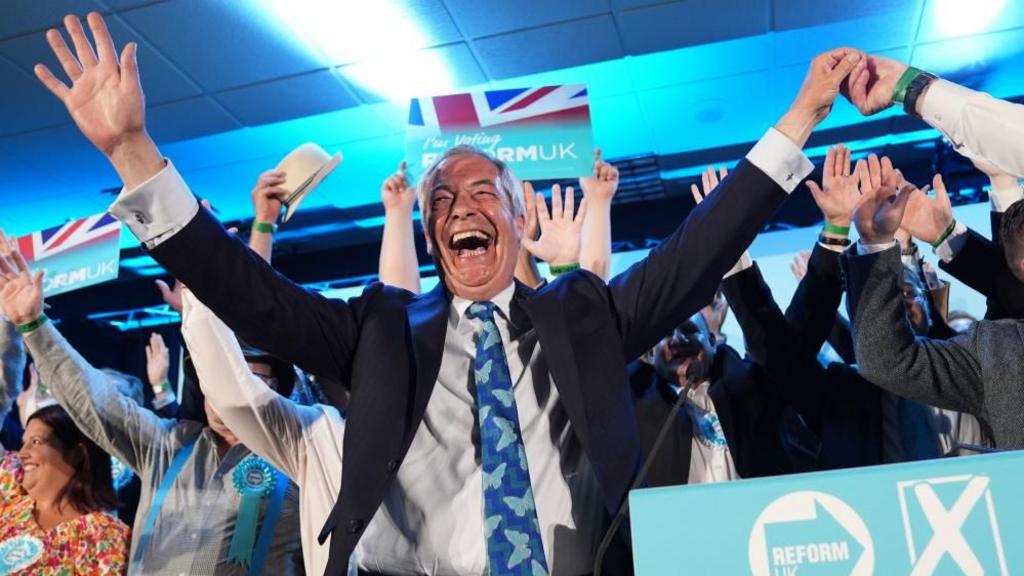
Reform UK Scores Another By-Election Victory as Nigel Farage Gains Momentum

Reform UK has secured another electoral victory, giving Nigel Farage fresh ammunition in his campaign to convince Britain that the political establishment is losing its grip on the electorate. The result comes at a particularly significant moment for the party, which has been seeking to turn growing dissatisfaction with Labour and the Conservatives into a sustained national movement.
For Farage, every successful contest offers an opportunity to make the same argument: that Reform UK is no longer simply a protest movement but a serious political force capable of winning votes across Britain.
The party’s recent electoral performance has certainly given that claim greater weight. Reform UK won seven council by-elections in one night in June, including victories in areas with very different political traditions. In St Helens Town Centre, the party secured almost 40% of the vote, while it also won Haydock with 33%. In Wilnecote, Tamworth, Reform took 46%, recording a dramatic increase in its vote share.
These results matter because they suggest that Reform’s appeal is not confined to one particular region or a single type of voter. The party has been making advances in former Labour heartlands as well as areas traditionally associated with the Conservatives. That creates a potentially serious problem for both established parties.
Reform’s success is particularly uncomfortable for the Conservatives. For years, the Conservative Party relied on voters who prioritised lower taxation, national sovereignty, immigration controls and scepticism towards European integration. Farage has increasingly attempted to persuade those voters that Reform, rather than the Conservatives, represents the political alternative they have been looking for.
But Labour faces its own challenge.
Reform’s ability to win votes in traditionally Labour areas demonstrates that its support cannot simply be dismissed as a Conservative split. Working-class voters who once regarded Labour as their natural political home have become increasingly willing to consider alternatives. Issues such as immigration, economic insecurity, public services and distrust of Westminster have created opportunities for Reform to build support well beyond its original base.
That is why every by-election result attracts disproportionate attention. A single local contest does not necessarily predict the outcome of a general election, but a pattern of results can reveal something important about changing political loyalties.
Farage understands the importance of that pattern.
His political career has been built on challenging assumptions about what British voters supposedly want. Brexit was the defining example. For years, the political establishment underestimated the strength of Eurosceptic sentiment, before the 2016 referendum produced a result that transformed British politics.
Today, Farage is attempting to repeat that disruption on a much larger scale.
His message is simple: Britain is broken, the established parties have failed, and voters should be prepared to consider a radical alternative. Reform UK has attempted to present itself as the party willing to tackle issues that mainstream politicians allegedly avoid, particularly immigration, national sovereignty and the size and effectiveness of government.
The danger for Reform is that electoral momentum can be easier to create than to sustain.
Winning council seats is one thing. Winning parliamentary constituencies at a general election is considerably harder. A national election involves different candidates, different local circumstances, tactical voting and much greater scrutiny. Voters may support Reform as a protest in a local contest without necessarily being ready to hand the party control of national government.
There is also an important distinction between opposition politics and government.
A party can gain enormous popularity by criticising its opponents. It can promise to reduce immigration, cut bureaucracy, reform public services and challenge political elites. But once voters consider Reform as a potential governing party, they will demand detailed answers about how those promises would actually be delivered.
That is the test Farage now faces.
His supporters believe the party is ready for it. They argue that Britain’s established political system has had decades to solve the country’s problems and has repeatedly failed. From their perspective, the rise of Reform is not a temporary protest but a political realignment.
The scale of recent local victories gives them reason for optimism.
In the May local elections, Reform UK claimed 1,451 council seats and took control of 14 councils, according to the party’s own account. Those figures demonstrate how quickly the party’s local presence has expanded and explain why Farage has been increasingly confident in demanding a general election.
Yet the party’s momentum has also produced intense scrutiny.
Farage recently resigned as MP for Clacton and triggered a by-election to seek a renewed mandate. He presented the contest as a battle between “the people” and the establishment. The election was unusual because Labour, the Conservatives, the Liberal Democrats and the Greens chose not to contest it, leaving Farage facing a field dominated by independents and fringe candidates. In total, 34 candidates appeared on the ballot.
Farage ultimately won the Clacton contest with about 63% of the vote, while satirical candidate Count Binface secured roughly 27%. However, the unusual circumstances mean the result should be interpreted carefully. Major parties had boycotted the election, and turnout was significantly lower than in the 2024 general election.
Nevertheless, Farage can legitimately point to the result as evidence that he retains a strong personal base in Clacton.
The wider question is whether that support can translate into a national breakthrough.
That is where the recent council results become particularly interesting. Unlike the Clacton contest, local elections have involved direct competition between Reform, Labour, Conservatives, Greens and Liberal Democrats. Reform’s ability to win seats in such contests provides a more meaningful indication that its support has spread across different parts of the electorate.
The party’s opponents will naturally argue that local elections are not general elections. They are right. Political parties have historically performed very differently at different levels of government.
But dismissing Reform’s gains would also be a mistake.
The most significant development is not necessarily the number of seats won. It is the psychological effect of repeated victories. Each result makes Reform appear more credible. Candidates become easier to recruit. Donors and activists become more enthusiastic. Media coverage increases. Voters who previously regarded the party as a protest option may begin to believe that it can genuinely win.
That creates a self-reinforcing cycle.
Political momentum can change perceptions before it changes parliamentary arithmetic. Once voters believe a party is capable of winning, they become more willing to vote for it. That can make previously impossible victories possible.
This is precisely why Labour and the Conservatives cannot afford to treat Reform simply as a temporary irritation.
The rise of Reform also reflects a deeper transformation in British politics. Traditional party loyalties have weakened. Voters are increasingly willing to change parties between elections, and issues that once divided politics into straightforward left-right categories no longer fit neatly into the old system.
Immigration, national identity, economic security and dissatisfaction with political institutions cut across traditional party boundaries.
Farage’s political skill has been his ability to turn those frustrations into a straightforward narrative. He tells voters that they have been ignored and that the established parties have failed to listen.
Whether that message is enough to build a governing majority remains uncertain.
Reform will need to demonstrate that it can offer credible policies as well as compelling criticism. It will need candidates who can withstand intense scrutiny and an organisation capable of functioning across hundreds of constituencies. Most importantly, it will need to convince voters that supporting Reform is not simply a way of expressing anger but a practical route towards changing the country.
For now, however, the direction of travel is difficult for Westminster to ignore.
Another electoral victory means another headline for Farage, another setback for established parties and another reminder that Britain’s political landscape is changing rapidly.
The crucial question is no longer whether Reform UK has momentum. Its recent results clearly suggest that it does.
The question is how far that momentum can carry it.
If Reform continues winning in areas where neither Labour nor the Conservatives expect to lose, Britain’s next general election could become a much more unpredictable contest than traditional political assumptions suggest. Farage has spent decades arguing that the old political order is vulnerable.
With every new victory, he gains another opportunity to prove it.