
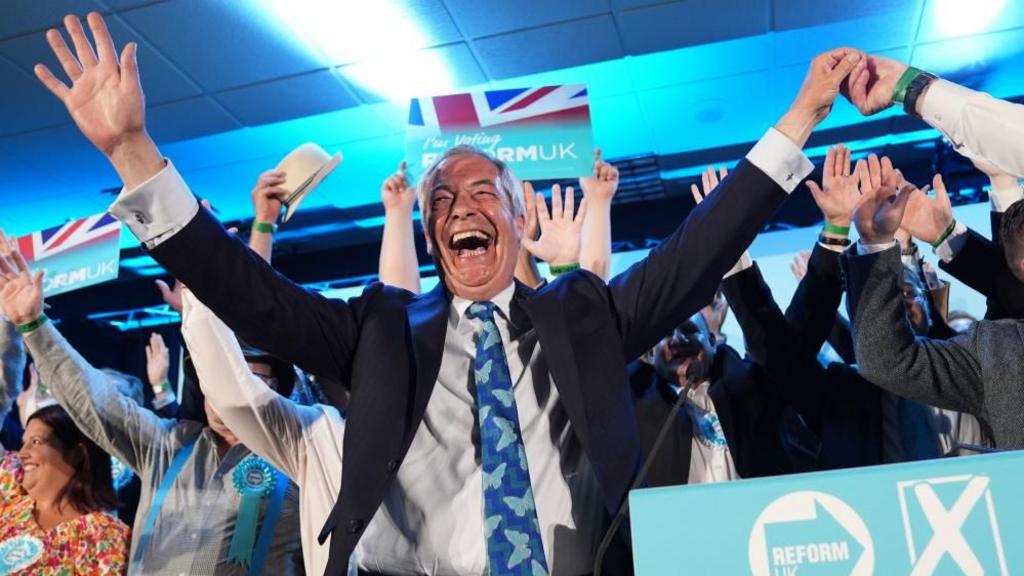
Farage Sparks Westminster Shock as Reform UK Pushes to Change Voting Rules and Insists Britain Should Be Governed by British Citizens
Westminster was thrown into a fresh political controversy as Nigel Farage and Reform UK intensified their campaign for changes to Britain’s electoral system, arguing that decisions about the country’s future should be placed firmly in the hands of British citizens. The intervention has reignited a fierce national debate about citizenship, voting rights, political representation, and what it means to govern in the interests of the British public.
Farage, one of the most recognisable figures in Britain’s modern political landscape, has repeatedly presented Reform UK as a movement prepared to challenge what it describes as an established political consensus. The party’s latest position has added another explosive issue to that agenda, raising questions about who should be entitled to participate in British elections and how the rules governing democratic representation should be determined.
The argument is politically sensitive because voting rights are at the heart of any democracy. Supporters of Reform UK’s approach say that those who determine Britain’s government should have a clear and direct connection to the country through citizenship. Critics, however, warn that changing electoral rules on the basis of nationality could create divisions between communities and undermine established principles concerning political participation.
The dispute comes at a time when immigration, national identity, and political sovereignty remain among the most emotionally charged subjects in British politics. Reform UK has built much of its support by arguing that successive governments have failed to respond adequately to concerns about immigration, public services, borders, and national independence.
For Farage, the issue is therefore about more than voting rules. It is part of a wider political argument over who Britain is for, who should make its laws, and whether the traditional parties have become disconnected from ordinary voters.
The language surrounding the proposal has generated particular attention. The insistence that Britain should be governed by British citizens appeals to voters who believe citizenship should carry special political significance. To supporters, the principle appears straightforward: if someone is going to help choose the government of the United Kingdom, they should have a formal stake in the country’s political future.
Yet the question becomes considerably more complicated when examined in practice.
Britain’s electoral arrangements have developed over many decades and differ depending on the type of election. Eligibility is not simply determined by whether someone happens to live in the United Kingdom. Different rules apply to different elections, and constitutional relationships between the UK and other countries also play a role.
Any attempt to fundamentally alter those arrangements would therefore require careful legal and political consideration.
Opposition parties are likely to argue that electoral reform should not be treated as a simple political slogan. Questions about voting rights involve constitutional principles, parliamentary legislation, historical agreements, and the treatment of different groups of residents. A major change could affect millions of people and would inevitably become the subject of intense parliamentary debate.
Reform UK, meanwhile, has an obvious political incentive to make the issue central to its identity. The party has positioned itself as an alternative to the established political parties, particularly on immigration and national sovereignty. By challenging existing assumptions about voting eligibility, Reform can reinforce its message that the political system itself needs to change.
The reaction from Westminster has therefore been closely watched.
Some politicians fear that the proposal could deepen an already polarised political environment. Britain has experienced increasingly heated arguments about immigration and national identity in recent years, and opponents of Reform UK worry that further emphasis on citizenship could make political debate more confrontational.
Supporters counter that difficult subjects should not be avoided simply because they are controversial. They argue that voters have a legitimate interest in discussing the relationship between citizenship and political power, particularly when immigration has become such an important part of national politics.
At the centre of the controversy is a basic democratic question: who should have a voice in choosing the people who govern the country?
There is no universally accepted answer to that question. Different democracies have developed different approaches to voting eligibility. Some place greater emphasis on citizenship, while others allow certain non-citizens who meet residency or other requirements to vote in particular elections.
Britain’s own system reflects its complicated constitutional history. The United Kingdom is not simply a single political community with identical electoral rules in every circumstance. Its relationship with the nations of the UK, the Commonwealth, Ireland, and other political entities has influenced the development of electoral rights.
Changing that system could therefore have consequences far beyond Reform UK’s immediate political objective.
There is also a practical question concerning British citizens living abroad. If citizenship becomes the central principle used to determine political participation, policymakers would have to consider how the rights of British citizens overseas should be treated. A citizen may have strong family, cultural, and financial connections to Britain while living thousands of miles away. At the same time, a non-citizen may have lived, worked, paid taxes, and raised a family in Britain for many years.
These complicated cases demonstrate why electoral reform cannot easily be reduced to a single sentence.
Nevertheless, the political message behind Farage’s intervention is clear. Reform UK wants to place citizenship and national sovereignty at the centre of the political debate.
The party argues that Britain needs a government willing to prioritise British interests and respond directly to the concerns of voters who feel ignored by the traditional political establishment. Its supporters often point to immigration, housing shortages, pressure on public services, and concerns about national identity as evidence that Britain requires a significant political change.
Critics see the situation differently. They argue that many of Britain’s social and economic problems cannot simply be attributed to immigration or the voting rights of non-British citizens. Housing shortages, NHS waiting lists, economic inequality, infrastructure problems, and public spending decisions have multiple causes. Reducing complex issues to questions of nationality, they say, risks distracting from deeper structural problems.
The debate also raises questions about the meaning of British citizenship itself.
Citizenship is not merely a legal status. For many people, it represents identity, belonging, responsibility, and participation in national life. Britain is also a diverse society containing people with different ethnic, cultural, and family backgrounds. Some citizens have lived in Britain for generations, while others became British citizens after moving to the country.
A modern political movement seeking to define who counts as part of the national political community therefore faces a difficult task. It must balance the desire for national sovereignty with the realities of a diverse population.
Farage has built his political career by entering precisely these contentious debates. From his opposition to the European Union to his campaigns on immigration, he has frequently challenged the boundaries of mainstream political discussion. His supporters see him as someone willing to address subjects that other politicians avoid. His critics regard his rhetoric as unnecessarily divisive.
The latest controversy fits that long-established pattern.
Whether Reform UK can turn the issue into a major electoral advantage remains uncertain. Political campaigns are shaped not only by individual policies but also by economic conditions, leadership, public services, local concerns, and the performance of rival parties.
Nevertheless, the debate itself could have lasting consequences.
If Reform UK succeeds in making voting eligibility and citizenship central political issues, established parties may be forced to clarify their own positions. Parliament could face renewed arguments over electoral law, residency, citizenship, and the rights of different groups. Voters, meanwhile, will have to decide whether such reforms represent a necessary restoration of democratic sovereignty or an unnecessary restriction on political participation.
What began as another Reform UK policy demand has therefore developed into a much broader national conversation.
At its heart lies an enduring question about democracy: who belongs to the political community, and who should have the power to decide its future?
Britain has confronted versions of that question throughout its history. As society changes, the rules of political participation inevitably come under pressure. The challenge for Westminster will be to debate those changes without allowing political disagreement to become hostility between different sections of the population.
For Reform UK, the message is uncompromising: Britain should put British citizens first.
For its opponents, the priority is protecting a democratic system that allows people who live and contribute to British society to have a meaningful political voice.
The argument is unlikely to disappear soon. Indeed, as Reform UK continues to challenge the established parties, questions surrounding citizenship, sovereignty, immigration, and democratic representation may become increasingly important.
Westminster may have been shocked by the latest intervention, but the underlying debate is much larger than one politician or one party.
It is a debate about Britain itself—and about who gets to decide what Britain becomes next.