

Clacton By-Election Results LIVE: Farage Wins but Count Binface Gets Over 9,000 Votes
Nigel Farage has won the Clacton by-election by a commanding margin, returning to Parliament with more than 22,000 votes. But while the Reform UK leader secured the result he wanted, the extraordinary performance of satirical candidate Count Binface ensured that the contest ended with an unexpected twist.
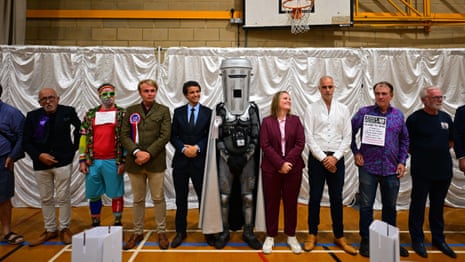
Farage received 22,239 votes, equivalent to 63.34 per cent of the vote. Count Binface finished second with 9,455 votes, taking 26.93 per cent. The result was remarkable not only because of Farage’s overwhelming victory, but because a novelty candidate wearing a distinctive bin-shaped helmet managed to secure more than 9,000 votes in a parliamentary election.
The Clacton contest was unlike almost any other modern British by-election. The main established political parties chose not to contest the seat, leaving Farage to face a huge field of independent, satirical and fringe candidates. In total, 34 candidates appeared on the ballot paper, producing an unusually long list and turning the election into a mixture of serious political confrontation and political theatre.
Despite the unusual circumstances, there was never much doubt that Farage would be the overwhelming favourite.
The Reform UK leader had already won Clacton at the 2024 general election, securing 21,225 votes and 46.2 per cent of the vote. His decision to trigger another by-election was therefore a calculated political gamble. Rather than waiting for another general election, Farage resigned his seat and asked voters to return him to Parliament immediately.
They did.
Indeed, Farage increased his absolute vote total compared with 2024 and substantially increased his share of the vote. For Reform UK, that provided an opportunity to portray the result as evidence that its support remains strong and that Farage’s personal political appeal has not disappeared.
The result also allowed Farage to frame the election as a confrontation between his movement and the political establishment.
His supporters argued that the decision by Labour, the Conservatives, the Liberal Democrats and other major parties not to contest the seat demonstrated their unwillingness to face Reform directly. The absence of mainstream opposition meant that the campaign became heavily focused on Farage himself.
That was precisely the kind of political contest in which Farage has traditionally performed well.
He has spent decades presenting himself as an outsider challenging the political establishment. His career has been built around campaigns against established institutions, first through the Eurosceptic movement, then through UKIP, the Brexit Party and finally Reform UK.
Clacton has now become another chapter in that story.
Yet the second-place finish of Count Binface added a surprising dimension to the result.
Count Binface is the satirical political persona of comedian Jonathan David Harvey. His campaigns deliberately mix political humour with genuine commentary about British politics. In Clacton, his manifesto included deliberately absurd proposals alongside messages aimed at Farage and the political system.
Nevertheless, the scale of his vote was far from a joke.
His 9,455 votes represented almost 27 per cent of all votes cast. It was vastly greater than his previous parliamentary performances and established the result as his strongest electoral showing to date. Reuters described the performance as a historic result for a comedic British political candidate.
For Count Binface, the result can therefore be interpreted as both comedy and political protest.
Some voters may have supported him because they genuinely enjoyed the satire. Others may have used their vote to express opposition to Farage. Still others may have been frustrated by the unusual nature of the election and the absence of mainstream candidates.
Whatever their motivations, the result demonstrated that a significant proportion of Clacton voters were willing to support an unconventional political alternative.
That makes the final result more complicated than Farage’s huge majority initially suggests.
On paper, the Reform leader won comfortably. But nearly 10,000 people chose the satirical challenger.
The turnout also provides important context. Approximately 44 per cent of eligible voters participated, significantly lower than the 58.7 per cent recorded at the 2024 general election.
That lower turnout means the result should not automatically be interpreted as a national referendum on Farage.
Clacton is a distinctive constituency, and the election was held under highly unusual circumstances. Major parties did not put forward candidates, while the ballot paper contained an unprecedented number of contenders.
For that reason, Farage’s 63 per cent share cannot simply be translated into an equivalent national level of support for Reform UK.
However, it would also be wrong to dismiss the victory.
Farage has once again demonstrated that he can mobilise a substantial electoral base. More importantly, he has returned to Parliament after deliberately putting his political future in the hands of Clacton voters.
The political significance of the result extends beyond the constituency.
Reform UK has been attempting to establish itself as a permanent force in British politics rather than merely a protest movement. Farage’s return gives the party another high-profile parliamentary platform from which to campaign on immigration, taxation, public spending, national sovereignty and dissatisfaction with the established parties.
The victory also gives Farage a powerful response to critics who have questioned his political future.
His resignation had been controversial because it came amid scrutiny of his financial affairs. The parliamentary investigation into a £5 million gift from cryptocurrency businessman Christopher Harborne has now resumed following the by-election. Farage has denied wrongdoing and has defended the circumstances surrounding the money.
The investigation therefore remains an important part of the political story.
Farage’s decision to resign and then seek re-election was presented by his supporters as a way of allowing the people of Clacton to make their own judgment. His critics, however, described the election as an unnecessary and expensive political stunt designed to distract from the controversy.
Now that Farage has won, both sides have fresh arguments.
Farage can point to the result and say that voters had the opportunity to reject him but instead returned him with an increased vote share.
His critics can point to the low turnout, the absence of mainstream parties and the unusually large number of fringe candidates.
The truth is likely to be somewhere between these interpretations.
The result is clearly significant for Farage personally, but its national implications should be treated with caution.
One of the most extraordinary moments came when Farage chose not to attend the official count.
The Reform leader said he had been warned about a potential attempt to embarrass him at the results ceremony and instead held a separate event known as “Farage Fest”. However, Essex Police reportedly said it had not advised him to avoid the count and that no relevant incident occurred.
His absence created an unusual scene.
Farage had won the election, but he was not present when the result was formally declared. Instead, Count Binface appeared at the declaration and became one of the most recognisable figures associated with the evening.
For critics, Farage’s absence was symbolic of the unusual character of the election. Supporters argued that he had legitimate security concerns and that he was entitled to make his own decision about where to appear.
Either way, the incident guaranteed further headlines.
The Clacton by-election was therefore never simply about numbers.
It became a contest involving political personalities, satire, media attention, party strategy and questions about public trust.
For Count Binface, the result is an extraordinary personal success. He has gone from receiving only a few hundred votes in previous parliamentary campaigns to winning more than 9,000 in Clacton.
His performance also raises an interesting question about the role of protest candidates in modern British democracy.
As trust in traditional political institutions declines, some voters may increasingly use elections to send messages rather than simply choose between conventional parties.
A vote for a satirical candidate can express dissatisfaction with politicians, political culture or the entire electoral process.
That does not necessarily mean those voters want a comedian in Parliament. It may instead indicate that they believe conventional politicians have failed to represent them.
Clacton provided an unusually clear example of this phenomenon.
The election featured 34 candidates, including several fringe and novelty figures. With the major parties absent, voters had a wide range of unconventional choices. Count Binface successfully turned that unusual situation into a major electoral breakthrough.
Yet Farage remains the clear winner.
His 22,239 votes were more than twice Binface’s total. He secured a majority of more than 12,000 votes and will return to Westminster as Clacton’s MP.
The victory gives him renewed confidence at a crucial moment.
Reform UK now has to decide how to build on it.
Winning a by-election dominated by one candidate is very different from winning dozens of constituencies at a general election. Reform needs a broader organisation, strong local candidates and policies capable of appealing to voters beyond Farage’s personal following.
That will be the real test.
Clacton has demonstrated that Farage remains capable of winning substantial support. It has not yet demonstrated that Reform UK can replicate the same success across Britain.
For Labour and the Conservatives, the result should therefore be studied carefully rather than simply celebrated or dismissed.
The established parties may be relieved that they avoided the contest, but Reform’s continued ability to attract attention means they cannot ignore Farage indefinitely.
At the same time, the Count Binface result should not be overlooked.
Almost 9,500 voters chose the satirical candidate, producing one of the most unusual second-place finishes in recent British electoral history. His success suggests that the Clacton electorate was not simply divided between support for Farage and traditional party politics.
There was also a significant appetite for protest and political humour.
That may be one of the most revealing aspects of the entire election.
British politics is changing. Traditional party loyalties are weakening, outsider candidates are attracting more attention and voters are increasingly prepared to use elections to express dissatisfaction.
Farage has built his career around precisely that political transformation.
His victory in Clacton confirms that he remains one of the most influential figures within it.
But Count Binface’s 9,455 votes provide a reminder that political protest does not belong exclusively to Reform UK.
The Clacton by-election has therefore produced two very different winners.
Farage won the parliamentary seat and returned to Westminster with a commanding majority.
Count Binface won something else: an extraordinary level of public attention and his strongest electoral performance ever.
For Farage, the immediate message is clear. He remains a formidable political force, and his supporters have once again demonstrated their willingness to back him.
For the wider political establishment, the lesson is more complicated.
The Clacton result cannot be treated as a straightforward national opinion poll. But neither can it be dismissed as an irrelevant curiosity.
It demonstrates that voters are willing to abandon conventional political choices, that Reform UK continues to possess a powerful electoral base and that political satire can unexpectedly become a serious electoral force.
As the dust settles, Farage will return to Parliament determined to use his victory as evidence that Reform UK is here to stay.
Count Binface, meanwhile, can celebrate a result that transformed a joke campaign into a genuine political phenomenon.
And Clacton will be left with one of the strangest election stories Britain has seen in years: a decisive victory for Nigel Farage, a stunning second place for a man in a bin helmet, and a by-election that once again exposed just how unpredictable British politics has become.