

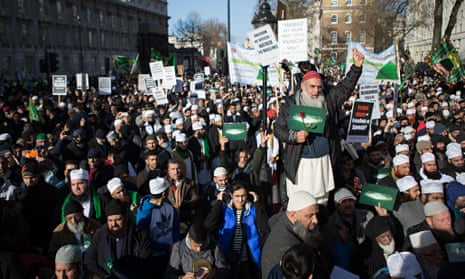
“MUSLIMS DEMAND SHARIA LAW IN THE U.K.” — THEN BRITAIN TOOK TO THE STREETS

Britain is once again facing a fierce argument over immigration, religion, national identity and the limits of political protest.
A sensational online video currently circulating uses the headline “Muslims DEMAND Sharia Law in U.K. Then Brits Stormed the London Streets!”
The headline is designed to suggest a dramatic confrontation between Muslims demanding the replacement of British law and ordinary Britons taking to the streets to stop them.
But the evidence does not establish that Muslims across Britain collectively demanded Sharia law, nor does it show that a recent London demonstration was a nationwide uprising against such a demand.
That does not mean Britain’s debate over Sharia, Islamism and religious influence is imaginary.
Far from it.
The United Kingdom has experienced genuine controversies involving extremist Islamist groups, public demonstrations and arguments about whether religious principles should play a role in British law. Some of the most controversial examples, however, date back years rather than representing a new nationwide attempt to replace British law.
One of the clearest historical examples involves Muslims Against Crusades, a banned extremist organization associated with Anjem Choudary. In 2011, members of the group publicly advocated replacing democracy with Sharia and proposed establishing areas governed by Islamic law. The British government subsequently proscribed the organization.
Those events were real.
But they should not be confused with the views of Britain’s entire Muslim population.
That distinction is essential.
BRITAIN DOES NOT HAVE A SECOND LEGAL SYSTEM
The idea that Britain could suddenly “switch” from British law to Sharia because Muslims demanded it misunderstands the country’s constitutional and legal structure.
Sharia councils do exist in Britain, but they do not possess the legal authority of British courts. Reuters previously fact-checked claims that London’s mayor had somehow allowed Sharia law to replace British law, noting that Sharia councils have no general legal jurisdiction in the United Kingdom.
A religious body can provide advice, mediation or religious guidance in certain circumstances.
It cannot simply declare that an Act of Parliament no longer applies.
It cannot create a parallel criminal justice system.
It cannot sentence British citizens under religious law.
And it cannot override the authority of British courts.
That distinction is often lost in emotionally charged political discussions.
For many Muslims, Sharia is primarily a religious framework governing personal faith and conduct. Praying five times a day, fasting during Ramadan, following halal dietary requirements or giving charitable donations are matters of religious observance.
They are not attempts to seize control of Britain’s courts.
The political question becomes different when an organization explicitly demands that religious law replace democratic law.
That position can and should be debated.
But it should be attributed to the organization or individuals advocating it—not automatically to millions of British Muslims.
THE REAL EXTREMIST HISTORY
Britain has had genuine Islamist extremist movements that openly rejected aspects of British democracy.
Muslims Against Crusades, for example, organized demonstrations in London in 2011 where participants called for democracy to be replaced by Sharia. The group was subsequently banned by the British government.
There were also controversial “Muslim patrols” in parts of East London during 2013–14. Members confronted people over alcohol consumption, clothing and other behavior, claiming Islamic authority. Several individuals were arrested and later convicted.
Those incidents provide legitimate grounds for discussing extremism and vigilantism.
But they also demonstrate something important.
When individuals attempted to impose religious rules on strangers through intimidation, British law enforcement intervened.
Britain did not surrender its legal system.
The state prosecuted people who committed offenses.
That is precisely how a constitutional democracy is supposed to respond.
THEN CAME THE STREET PROTESTS
The modern political environment is different but equally heated.
In May 2026, tens of thousands of people took part in separate demonstrations in central London, including a far-right rally organized by Tommy Robinson and a pro-Palestinian demonstration. Police deployed around 4,000 officers in one of the capital’s largest public-order operations in years.
Those demonstrations were connected to immigration, national identity, foreign policy and political grievances.
They were not, however, evidence that Britain had descended into a nationwide confrontation between Muslims demanding Sharia and Britons rejecting it.
That distinction matters because demonstrations can contain people with very different motivations.
Someone attending an anti-immigration march may want lower immigration.
Another participant may be angry about asylum policy.
Someone else may be concerned about national identity.
Another person may hold explicitly anti-Muslim views.
Those positions should not automatically be treated as identical.
The same applies to Muslim participants in demonstrations.
Some may be protesting British foreign policy.
Some may support Palestinian rights.
Some may oppose racism.
Some may be concerned about domestic policy.
Some may hold strong religious views.
There is no single political agenda shared by every Muslim demonstrator.
WHY THE WORD “SHARIA” IS SO POWERFUL
The word itself has become one of the most politically explosive terms in debates about Islam.
For some Britons, “Sharia” immediately evokes fears of religious courts, restrictions on women, punishments associated with certain historical interpretations of Islamic law and the rejection of liberal democratic values.
For many Muslims, however, the word can have a much broader religious meaning involving morality, worship, family life and personal behavior.
These interpretations are not identical.
That is why serious debate requires precision.
If an extremist organization says that British democracy should be abolished and replaced with Sharia, that statement should be confronted directly.
But if a Muslim family follows religious dietary rules or attends a mosque, describing that behavior as an attempt to impose Sharia on Britain is unreasonable.
The difference is between private religious observance and public political authority.
Britain can protect the first while rejecting the second.
WHAT SHOULD BRITAIN DO?
The answer does not require banning Islam.
Nor does it require ignoring genuine extremism.
The strongest position is to enforce one law equally.
If a person threatens another person, prosecute the threat.
If a group commits violence, investigate the group.
If someone attempts to establish an illegal vigilante force, intervene.
If an organization advocates terrorism or meets the legal criteria for proscription, use the relevant counterterrorism powers.
But if a Muslim citizen peacefully attends Friday prayers, observes Ramadan or participates in a lawful demonstration, those activities should not automatically be treated as extremist.
That approach protects everyone.
It also prevents extremist organizations from successfully claiming that Britain is at war with Islam itself.
THE DANGER OF COLLECTIVE BLAME
There is another side to this debate that cannot be ignored.
Britain’s Muslim population is enormous and diverse.
It includes people born in Britain as well as immigrants from dozens of countries.
It includes doctors, engineers, teachers, shopkeepers, university students, police officers, entrepreneurs and public servants.
It includes people who are deeply conservative, people who are politically progressive and people who have little interest in politics at all.
Treating all of them as though they share the objectives of an extremist organization would be both inaccurate and counterproductive.
Recent demonstrations have also highlighted the danger of inflammatory rhetoric.
Ahead of the May 2026 Unite the Kingdom rally, the Metropolitan Police warned organizers and speakers that unlawful hate speech would trigger police intervention. The force said it was preparing one of its largest public-order operations in recent years.
That approach reflects a fundamental principle.
Britain protects freedom of expression.
But freedom of expression does not mean every threat or act of incitement is automatically lawful.
At the same time, political disagreement is not itself extremism.
Someone can demand lower immigration without being racist.
Someone can criticize Islam without hating Muslims.
Someone can defend religious freedom without supporting Islamism.
Someone can oppose Islamist extremism without opposing Muslims.
These distinctions are what make a serious political debate possible.
THE BIGGER QUESTION: WHAT DOES IT MEAN TO BE BRITISH?
Behind all the shouting is a deeper question.
What kind of country does Britain want to be?
A country can have religious diversity while maintaining a single legal system.
It can allow Muslims, Christians, Jews, Hindus, Sikhs and people of no religion to practice their beliefs while requiring everyone to obey the same criminal and civil law.
That is not weakness.
It is the basic principle of equal citizenship.
The alternative would be a society in which different religious or ethnic groups received different legal rights and obligations.
That would be far more dangerous.
Britain’s challenge is therefore not to defeat a fictional “Muslim takeover.”
It is to maintain confidence in its own institutions.
British courts must remain British courts.
Parliament must remain sovereign within the constitutional framework.
Police must enforce the law without regard to religion.
Religious communities must be free to worship.
And extremist groups must not be allowed to intimidate others or replace lawful authority with private coercion.
That is a much stronger response than political panic.
THE TRUTH BEHIND THE VIRAL HEADLINE
The dramatic claim that “Muslims demanded Sharia law and then Brits stormed London’s streets” makes for an attention-grabbing video title.
But the documented evidence tells a more complicated story.
Britain has experienced genuine Islamist extremist movements that advocated Sharia as a replacement for democracy. Some were banned and their members prosecuted.
Britain has also experienced large demonstrations involving immigration, Islam, Palestine and national identity.
But those facts do not prove that British Muslims collectively demanded the abolition of British law.
Nor do they establish that London recently witnessed a nationwide revolt against such a demand.
The real battle is more subtle.
It is a battle over how Britain responds to extremism without demonizing an entire religion.
It is a battle over how immigration can be debated without turning neighbors into enemies.
And it is a battle over whether Britain’s political system can remain confident enough to protect religious freedom while insisting that no religious organization stands above the law.
That principle should be non-negotiable.
Britain does not need to choose between religious freedom and the rule of law.
It can have both.
And if the country wants to defeat genuine extremism, that may ultimately be its strongest weapon: one law, equal rights, and no collective guilt.