

CHAOS IN NORFOLK: Standoff Escalates Outside Asylum Housing as Angry Crowds Athena
Tensions erupted in Norfolk as a large crowd gathered outside accommodation being used to house asylum seekers, creating a tense standoff between protesters, residents, police officers, and supporters of the asylum system. What began as a local demonstration quickly developed into a highly charged confrontation, drawing national attention to one of Britain’s most divisive political issues.
The gathering reflected growing frustration among some local residents who believe their communities are being asked to shoulder an unfair share of the pressure created by the asylum system. Protesters expressed anger over the use of local accommodation, the cost of housing asylum seekers, and what they described as a lack of consultation with people living nearby.
On the other side, supporters of asylum seekers warned that demonstrations outside accommodation could intimidate vulnerable people who may already have experienced war, persecution, displacement, or serious hardship.
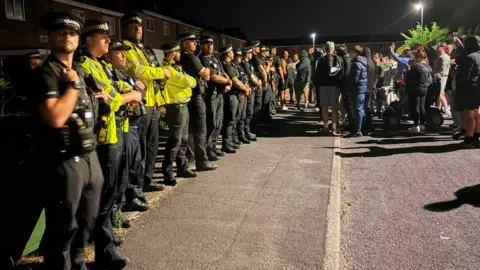
Police were deployed to manage the situation and prevent the confrontation from escalating. Officers attempted to maintain separation between opposing groups as emotions rose and people gathered around the entrance to the accommodation. The presence of police provided a visible barrier between protesters and those connected with the housing facility.
The atmosphere was tense, with shouting and competing chants reported as both sides attempted to make their voices heard. Images of the gathering spread rapidly online, where the incident became part of a much larger argument about immigration, asylum, public spending, and Britain’s ability to manage migration.
For many protesters, however, the issue was not simply about immigration in general. It was about what they believed was happening in their own neighborhood.
Some residents argued that local services were already under pressure. They pointed to concerns about housing availability, healthcare, education, policing, and other public services. They questioned why accommodation used for asylum seekers had been selected in their area and whether sufficient resources had been provided to the local community.
Those concerns deserve to be heard, particularly when major changes affect a neighborhood without residents feeling that they have been properly consulted. But critics of the protest emphasized that asylum seekers themselves do not decide where they are housed. Accommodation arrangements are generally determined by government contractors, authorities, or organizations working within the asylum system.
That distinction became increasingly important as the confrontation developed.
The people inside the accommodation were not necessarily responsible for the policies that had brought them there. Many asylum seekers are waiting for decisions on applications after arriving in Britain from countries experiencing conflict, political instability, persecution, or humanitarian crises. Their legal status and individual circumstances can vary considerably.
At the same time, public frustration over the asylum system has become increasingly intense across Britain.
The number of people seeking asylum, the cost of temporary accommodation, lengthy processing times, and political disagreements over immigration policy have all contributed to a deeply polarized national debate. Hotels and other buildings used for asylum accommodation have become flashpoints in several parts of the country.
Norfolk has not been immune to those tensions.
Local communities can find themselves caught between national policy and local consequences. Decisions about asylum accommodation may be made at a national or regional level, while residents experience the practical effects directly. This can create a sense that local people have little influence over decisions affecting their neighborhoods.
The confrontation outside the accommodation demonstrated how quickly those frustrations can become confrontational.
Police intervention was therefore crucial. Their primary responsibility was not to determine which side of the political argument was correct, but to maintain public order and protect people from violence, intimidation, or other unlawful behavior.
That distinction is particularly important during demonstrations involving immigration.
Peaceful protest is a fundamental democratic right. People must be able to criticize government immigration policies and express opposition to the use of local accommodation. But that right does not extend to assault, threats, criminal damage, harassment, or attempts to prevent vulnerable individuals from accessing essential services.
Similarly, people supporting asylum seekers have the right to demonstrate and defend the asylum system. They too must respect the rights of others to express opposing views.
The challenge for police is to protect both principles simultaneously.
As darkness approached, the gathering remained a focal point of public attention. Videos circulating online showed groups confronting one another verbally, while police officers attempted to keep the situation under control. However, individual social-media videos can provide only a partial picture. They may capture isolated moments without showing what happened before or after the recording.
That is why claims made online about arrests, injuries, criminal activity, or the identities of participants should be treated cautiously unless confirmed by reliable authorities.
The political reaction was predictable.
Those opposed to current asylum policies portrayed the confrontation as evidence that public patience is running out. They argued that the government must take stronger action to reduce the number of people entering the asylum system and accelerate decisions on applications.
Supporters of the asylum system responded that the incident demonstrated the dangers of inflammatory political rhetoric. They argued that migrants and asylum seekers should not become targets of anger over decisions made by politicians and government agencies.
Both arguments reflect genuine concerns, but neither provides an easy solution.
Britain faces a complicated asylum challenge involving international law, border enforcement, housing, immigration administration, local government, and humanitarian responsibilities. Reducing pressure on communities requires more than moving asylum seekers from one building to another. It requires efficient processing of applications, appropriate accommodation, effective border management, and adequate support for local areas affected by government decisions.
The incident in Norfolk therefore represents a much broader problem.
When people feel ignored, political frustration can spill into the streets. When vulnerable groups feel targeted, fear can spread quickly. And when opposing groups meet in an atmosphere of anger, even a peaceful demonstration can become difficult to control.
The responsibility for preventing such confrontations cannot rest entirely with police officers on the ground. National and local authorities also have a role to play in communicating clearly with residents, explaining why accommodation decisions are made, publishing relevant information, and providing channels through which communities can raise concerns.
Transparency matters because uncertainty creates a vacuum that rumors quickly fill.
Residents deserve accurate information about accommodation arrangements, local impacts, costs, and security measures. Asylum seekers deserve accurate information about their rights, responsibilities, and legal status. Police officers deserve clear operational guidance and sufficient resources to maintain public safety.
Most importantly, everyone involved must recognize that political disagreement does not require personal hostility.
The protesters outside the accommodation may strongly oppose Britain’s asylum policy. That does not automatically make them extremists. Likewise, people supporting asylum seekers are not necessarily indifferent to the concerns of local residents. The national debate becomes more constructive when disagreement is directed toward policies rather than individuals.
The Norfolk standoff should serve as a warning.
Britain’s asylum system is under enormous pressure, and local communities are increasingly becoming the places where national political disputes are played out. Without effective communication and credible policy, confrontations are likely to continue.
But anger alone cannot solve the problem.
The government must demonstrate that asylum applications are processed efficiently, that accommodation is managed responsibly, and that local communities are not simply expected to absorb the consequences of national decisions without support. At the same time, demonstrations must remain peaceful, and asylum seekers must not be treated as convenient targets for frustrations they did not create.
The events in Norfolk may eventually disappear from the headlines, but the underlying tensions will remain.
The real question is whether Britain can address those tensions through evidence, lawful protest, responsible government, and honest public debate—or whether increasingly polarized communities will continue to meet one another across police barriers.
For Norfolk, the immediate priority is calm. For Britain, the larger challenge is finding a sustainable asylum policy that protects vulnerable people while restoring public confidence.
That will require far more than slogans shouted across a police line.