

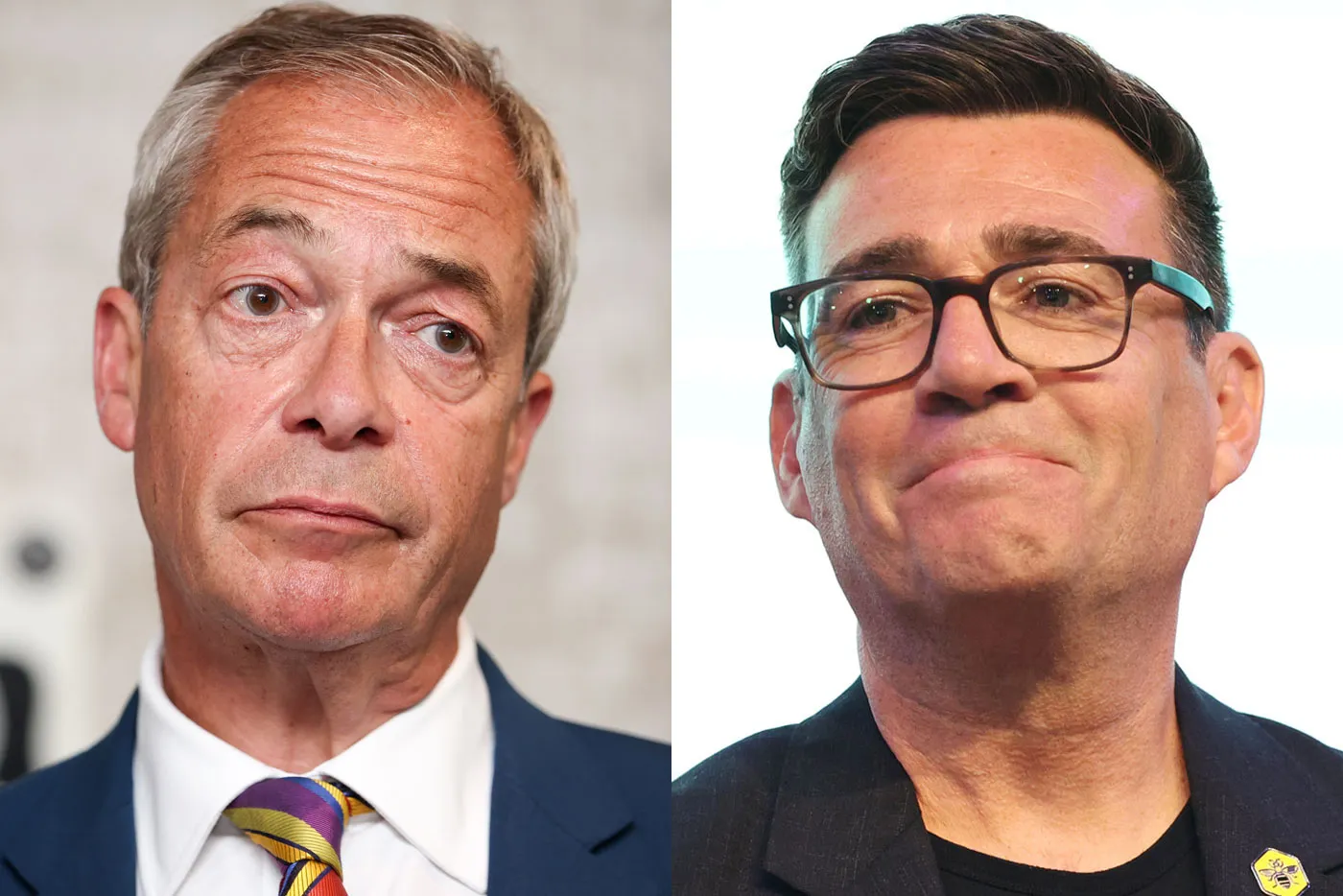
Bombshell New Poll Gives Andy Burnham a Major Boost — And Nigel Farage a Political Nightmare
A new wave of polling has delivered a striking boost for Andy Burnham while raising fresh questions about Nigel Farage and the future direction of Reform UK.
The latest figures suggest that Britain’s political landscape is changing rapidly following Burnham’s arrival at Downing Street. After months in which Reform appeared capable of challenging the traditional parties for first place, Labour has begun to recover ground.
Most significantly, voters appear to be responding positively to Burnham personally.
That could prove far more important than a single headline voting-intention figure.
A dramatic change in Labour’s fortunes
The latest YouGov polling found that 48% of Britons believe Andy Burnham would make a better Prime Minister than Nigel Farage, while only 22% preferred the Reform UK leader in the same head-to-head comparison.
That is an extraordinary 26-point advantage for Burnham.
It suggests that although Reform has built a substantial electoral following, Farage has not yet convinced a majority of voters that he is ready to lead the country.
And that distinction could become crucial.
A political party can perform strongly in voting-intention polls without its leader necessarily being regarded as the best person to occupy Downing Street.
Burnham appears to have established an advantage on that second question.
Labour has overtaken Reform
The movement is also visible in voting intentions.
A recent YouGov poll for The Times put Labour on 24%, two points ahead of Reform on 22%. The result marked Labour’s first lead over Reform in that poll for around 18 months.
Other polling has produced similar signals.
The Financial Times’ poll tracker recently placed Labour on 25%, narrowly ahead of Reform on 24%.
The margins remain extremely small, and polling should never be treated as an election result.
But the direction is difficult for Reform to ignore.
Only weeks ago, the party looked capable of becoming the dominant force in British politics.
Now Labour is beginning to regain the initiative.
The “Burnham bounce”
The obvious explanation is the change in Labour leadership.
Burnham inherited a party suffering from severe public dissatisfaction after Keir Starmer’s premiership.
The party’s support had fallen sharply, while Reform had benefited from voters abandoning Labour and the Conservatives.
Burnham’s arrival changed the political conversation almost immediately.
A Reuters analysis found that Labour’s support had risen significantly after Burnham became Prime Minister, with Survation putting Labour on 26% against Reform’s 24%, compared with Labour’s 19% before the leadership change.
Another More in Common poll gave Labour 28%, with Reform on 24%.
The pattern is clear.
Burnham has not magically solved Labour’s problems.
But he has given the party something it had been missing:
momentum.
Burnham’s personal advantage
The most damaging part of the latest polling for Farage may not actually be the party figures.
It is Burnham’s personal ratings.
Ipsos polling in June found that 35% thought Burnham would do a good job as Prime Minister, compared with 24% who thought he would do a bad job. His average score was therefore positive.
The same research found Burnham ahead of Farage on a range of personal characteristics.
For example, 44% said Burnham had a lot of personality, compared with 42% for Farage.
More importantly, 42% said Burnham was in touch with ordinary people, compared with 31% for Farage.
Forty per cent described Burnham as likeable, compared with 26% for Farage.
And 35% said Burnham acted with integrity, compared with only 23% for Farage.
Those figures should concern Reform.
Farage’s political brand has traditionally depended heavily on his claim to understand ordinary voters.
If voters increasingly believe that Burnham is more in touch with them, Labour is directly attacking one of Reform’s biggest advantages.
The Farage problem
Nigel Farage remains an extremely powerful political figure.
His ability to dominate political headlines should not be underestimated.
He has spent decades building a national profile.
He led the Brexit movement.
He helped transform Reform from a fringe political project into a serious electoral force.
And his personal following remains substantial.
But there is now a growing gap between Farage’s ability to attract attention and his ability to persuade voters that he should become Prime Minister.
The latest YouGov figures are particularly revealing.
Almost half of voters prefer Burnham in a direct contest, while only just over one in five choose Farage.
That is not an insurmountable problem.
But it is a major warning.
Reform’s summer of setbacks
The polling deterioration has arrived alongside a difficult period for Reform.
The party has experienced internal disputes, competition from Rupert Lowe’s Restore Britain and scrutiny surrounding financial matters involving Farage.
The Clacton by-election has also generated controversy.
Farage won the contest decisively, securing 22,239 votes, or roughly 63% of the vote.
But the election was unusual because the major political parties did not contest it.
His closest challenger was Count Binface, who received around 9,455 votes.
That makes it difficult for Reform to present the result as a straightforward demonstration of national momentum.
Farage won.
But he did not defeat Labour, the Conservatives or the Liberal Democrats.
The Clacton victory was therefore complicated
For Farage, winning his parliamentary seat again was undoubtedly important.
But the circumstances meant it could not deliver the national political boost he might have wanted.
The major parties effectively stayed out of the contest.
That allowed Farage to win comfortably, but it also removed the opportunity for Reform to demonstrate that it could defeat mainstream opponents in a competitive parliamentary election.
The Financial Times described the victory as coming with bigger tests still ahead.
Those tests will ultimately determine whether Reform’s rise is continuing or beginning to plateau.
Burnham has another advantage: timing
Burnham is benefiting from the fact that he is still relatively new to Downing Street.
New leaders often receive a period of goodwill.
Voters are willing to give them the benefit of the doubt.
They have not yet had enough time to become associated with every difficult government decision.
That gives Burnham a valuable political window.
He can use it to establish a narrative about what his government stands for before his opponents fully define him.
His early policies matter
Burnham has deliberately focused on measures designed to address the cost of living.
His government has moved on energy costs, bus fares and business rates, among other issues. Reuters noted that these measures helped Labour’s support rise after his appointment.
The strategy is politically clever.
Rather than beginning with abstract constitutional reform or ideological battles, Burnham has chosen issues that voters encounter in everyday life.
Energy bills.
Transport.
Pubs and businesses.
Household finances.
That allows Labour to make a very simple argument:
The new government is making life cheaper.
The danger for Burnham
But Burnham should not become complacent.
Polling leads can disappear quickly.
The public may currently like his political style, but governing Britain is considerably harder than campaigning for office.
The biggest tests are still ahead.
Inflation.
Public services.
Housing.
Migration.
Taxation.
The NHS.
Social care.
Crime.
The economy.
If Burnham cannot deliver improvements on those issues, today’s popularity could quickly turn into tomorrow’s disappointment.
Even polling that currently looks positive shows that voters are not overwhelmingly convinced that their lives will improve.
A recent Times analysis found that only 22% believed their lives would improve under Burnham, despite his stronger personal ratings.
That is an important warning.
Farage’s biggest threat may not be Burnham
Ironically, Reform’s greatest long-term problem may be the fragmentation of the political right.
Farage is facing competition not only from the Conservatives but also from Restore Britain.
Rupert Lowe’s new party is attempting to attract voters who believe Reform is not radical enough.
That creates a serious strategic problem.
If Reform moves further right, it risks losing moderate voters.
If it does not, Restore Britain can accuse it of abandoning its principles.
Either way, Farage faces pressure.
The Financial Times has described the division on the right as one of Farage’s biggest threats.
A divided right helps Labour
Britain’s first-past-the-post electoral system makes this particularly dangerous.
Imagine a constituency where:
- Labour receives 36%;
- Reform receives 31%;
- Restore Britain receives 12%;
- Conservatives receive 11%;
- Greens and others receive the remainder.
The anti-Labour vote would be much larger than Labour’s.
Yet Labour would still win the seat.
That is why Burnham has every reason to welcome divisions among his opponents.
The more fragmented the right becomes, the easier it becomes for Labour to win constituencies without necessarily winning a majority of votes.
Reform’s previous momentum is no guarantee
The party’s performance in the 2026 local elections demonstrated that Reform can be extraordinarily successful.
It made huge gains in areas that had historically been dominated by Labour.
But local elections and national elections are different.
A voter may support Reform for a council seat while choosing another party at Westminster.
And once Reform takes control of councils, it becomes responsible for delivering services.
That creates a new challenge.
The party can no longer simply criticise the establishment.
It must demonstrate that it can govern.
The “protest vote” problem
Farage’s political strategy has always benefited from voters who want to send a message.
But eventually a protest party has to become a governing party.
That requires a broader coalition.
Some voters may support Reform because they are angry about immigration.
Others because they dislike Labour.
Others because they distrust Conservatives.
Others because they want lower taxes.
But those groups do not necessarily agree on everything.
Keeping them together is extremely difficult.
Burnham, meanwhile, has an opportunity to bring some of those voters back by offering a Labour alternative that feels less like the Starmer-era party.
The Red Wall question
This is where the political battle becomes particularly important.
Labour historically relied on working-class voters across northern England and the Midlands.
Reform has made significant gains among those voters.
Burnham is now attempting to reverse that process.
His background as a former mayor of Greater Manchester gives him an obvious advantage.
He can present himself as someone who understands the concerns of communities outside Westminster.
That is exactly the territory Farage has tried to occupy.
The latest polling suggests Burnham may be succeeding.
Barnsley provides an early test
Barnsley is particularly revealing.
Reform performed extremely strongly there in the May local elections, winning 42 council seats compared with Labour’s 11.
Yet subsequent reporting has found signs that some Labour voters are reconsidering their position after Burnham became Prime Minister.
That does not mean Reform’s support has collapsed.
Many Barnsley voters remain firmly opposed to Labour, particularly over immigration.
But some appear willing to give Burnham a chance.
That is exactly what Labour needs.
Greater Manchester has also sent a message
The Greater Manchester mayoral by-election provided another boost for Labour.
Bev Craig won 47% of first-preference votes, rising to 66.3% after second preferences.
Reform finished well behind on 33.7%.
The result was particularly significant because Reform had made major gains across the region only months earlier.
The party had hoped to demonstrate that its local-election breakthrough was becoming permanent.
Instead, Labour regained ground.
That does not prove that Reform’s national challenge is over.
But it demonstrates how quickly political momentum can change.
Farage still has time
The most important point for Reform supporters is that the next general election is not necessarily imminent.
There is still considerable time for Farage to rebuild his political position.
He can adjust policy.
He can broaden Reform’s appeal.
He can attempt to settle internal disputes.
He can challenge Labour over the economy and immigration.
And he can use his parliamentary platform to attack Burnham’s government.
A few months of bad polling do not destroy a political movement.
But the direction matters
Politics is often about momentum.
When a party is rising, every poll reinforces the belief that it is heading towards victory.
When it begins falling, supporters start asking whether the peak has already passed.
That psychological change can be extremely damaging.
Candidates become less confident.
Donors become more cautious.
Activists lose enthusiasm.
Rivals become emboldened.
And voters who previously supported the leading challenger may begin returning to traditional parties.
This is precisely the danger facing Reform.
Burnham’s greatest opportunity
For Burnham, the current situation represents an extraordinary opportunity.
He inherited a Labour Party that appeared politically exhausted.
Within weeks, he has transformed its position.
Labour has moved from trailing Reform to narrowly leading it in several polls.
And Burnham himself is substantially more popular than Farage in head-to-head questions about who would make the better Prime Minister.
If that advantage survives difficult political decisions, Labour could rebuild a much stronger electoral coalition.
But Labour must not repeat its old mistakes
There is a warning here too.
The electorate has become highly volatile.
Voters who abandoned Labour for Reform can change their minds again.
But they can also abandon Labour for the Greens, Conservatives or another alternative.
Burnham therefore cannot assume that voters have permanently returned.
He needs to prove that his government can actually deliver.
The economy will decide much of this
Ultimately, political popularity will be tested by economic reality.
If household incomes rise, energy costs fall and public services improve, Burnham’s popularity could become more durable.
If taxes increase while living standards stagnate, the current polling advantage could disappear.
Farage will be waiting.
He can argue that Labour’s promises are too expensive and that the Government is failing to control spending.
That economic confrontation may become the defining battle between the two men.
Immigration remains another major battleground
No discussion of Farage’s political prospects can ignore immigration.
Reform has made migration one of its defining issues.
Even if Labour improves economically, it risks losing voters if they believe the Government is not controlling Britain’s borders.
Burnham therefore faces a difficult balancing act.
He must appeal to voters who want stronger immigration controls without alienating Labour’s traditional supporters.
Farage will attack him from the right regardless of what he does.
The Conservatives could become the wildcard
The Conservative Party has also shown signs of recovery.
The latest YouGov figures put the Conservatives at 21%, just one point behind Reform’s 22%.
That is potentially devastating for Farage.
If Reform falls while the Conservatives recover, Farage could find himself fighting on two fronts.
He would have to persuade former Conservative voters not to return to the Tories while simultaneously preventing Restore Britain from taking his most committed supporters.
That is a difficult electoral equation.
The real nightmare scenario for Farage
The worst possible scenario for Reform would therefore be:
Labour rises.
Conservatives recover.
Restore Britain expands.
Reform remains stuck in the low twenties.
Under that scenario, Farage’s dream of replacing the Conservatives as Britain’s dominant alternative to Labour becomes much harder.
He could still remain politically influential.
But becoming Prime Minister would be a much more distant prospect.
The best scenario for Burnham
Burnham’s ideal scenario is almost the mirror image.
Labour consolidates its lead.
Reform and Restore Britain fight each other.
The Conservatives recover enough to split the right further.
Burnham’s personal ratings remain strong.
And the Government delivers tangible improvements in living costs and public services.
If those things happen simultaneously, Labour could move from political survival to genuine electoral competitiveness.
But one poll does not win an election
This point should not be forgotten.
The latest figures are encouraging for Burnham, but Britain has experienced dramatic polling swings before.
A lead of two or four points is not remotely decisive.
Even a substantial personal-rating advantage can disappear after one major political crisis.
Burnham has only recently taken office.
Farage has spent years building his political movement.
The contest remains wide open.
Final verdict
The latest polling represents a genuine warning for Nigel Farage and an important boost for Andy Burnham.
Labour has moved ahead of Reform in several recent voting-intention surveys, while Burnham has established a striking advantage when voters are asked directly who would make the better Prime Minister.
The YouGov head-to-head figure is particularly damaging for Farage: 48% prefer Burnham compared with only 22% for the Reform leader.
But it would be premature to declare Reform finished.
Farage still commands a significant national following, Reform remains highly competitive in polling, and the next general election could be years away.
The real story is that the political landscape has changed.
For months, the question was whether Labour could survive Reform’s rise.
Now the question is whether Burnham can turn Labour’s revival into a sustained political comeback.
If he can, Nigel Farage faces perhaps his toughest challenge yet.
He must defeat not only Labour, but also the Conservatives and Restore Britain — while convincing voters that he, rather than Burnham, is the person capable of running Britain.
For the moment, the polling suggests that voters are not convinced.
And that is the real nightmare for Farage.
Reform may still have the loudest political voice in Britain — but Andy Burnham is beginning to look increasingly like the man voters would actually trust with the keys to Downing Street.