

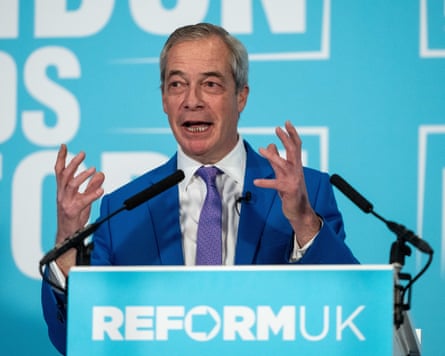
Nigel Farage Fires Back at Rachel Reeves in Explosive Benefits and Racism Row
Nigel Farage has launched a forceful response to Rachel Reeves after the Chancellor accused him of supporting a discriminatory approach to the two-child benefit cap. The confrontation has developed into one of the more heated arguments over welfare, immigration and national identity, with Reform UK insisting that Labour has deliberately distorted Farage’s position.
At the heart of the dispute is a deceptively simple question: should the state provide the same level of child-related welfare support regardless of a family’s nationality and place of birth?
For Labour, the answer is straightforward. Children should not be disadvantaged because of where their parents were born. Reeves has argued that Farage’s position would effectively mean different treatment for children based on their parents’ origins, and she has described his comments in strongly critical terms.
Farage, however, rejects the accusation and argues that Reform’s position is about immigration, welfare eligibility and the cost to taxpayers—not race.
The resulting clash illustrates the increasingly difficult political territory occupied by Britain’s welfare debate.
How the Row Began
The controversy centres on the two-child benefit cap, a policy that restricted certain welfare payments to the first two children in most families.
The Labour government moved to abolish the restriction, arguing that doing so would help reduce child poverty. Labour has claimed that removing the cap could benefit hundreds of thousands of children, making the policy an important part of its wider anti-poverty strategy.
Farage and Reform UK took a different view.
Although Farage had previously indicated support for removing the cap, Reform later reversed course. The party argued that the cost of abolishing the restriction was too high and that the policy could disproportionately benefit foreign-born families. Farage subsequently said Reform MPs would oppose the change and suggested that any relaxation should be restricted to particular British families.
That change in position gave Labour an opportunity to attack Reform.
Reeves argued that the proposal risked making children’s access to support dependent on their parents’ place of birth. She presented the issue as one of basic equality, asking what kind of country Britain would become if children received different treatment according to their background.
Farage’s response was effectively that Reeves had misrepresented the policy.
Farage’s Counterattack
For Farage, the central distinction is between race and nationality.
Reform argues that a policy differentiating between citizens and people who have recently arrived in Britain is not automatically racist. From its perspective, a government has the right to determine who qualifies for taxpayer-funded benefits and under what conditions.
This argument forms part of a much broader Reform philosophy.
The party has repeatedly promoted the principle of putting British citizens first when determining access to public resources. Its proposals have included restrictions on benefits for certain foreign nationals and changes to immigration-related charges and entitlements.
Farage therefore sees the benefits controversy as an extension of his wider argument that Britain must regain control over immigration and public spending.
His critics see something very different.
They argue that policies deliberately designed to give different treatment to families according to nationality or immigration background can create discriminatory outcomes, particularly when those policies affect children.
This is where the political argument becomes particularly difficult.
Is It About Race or Nationality?
The distinction between race and nationality is central to the dispute.
A person’s nationality and ethnic background are not the same thing. Britain contains millions of citizens from diverse ethnic backgrounds, while foreign-born people can be white, Black, Asian or from any other ethnic group.
Consequently, a policy based explicitly on citizenship or immigration status is not automatically a racial policy.
But critics can still argue that a nationality-based policy may have unequal effects on particular ethnic groups.
That distinction should be maintained in serious political debate.
Calling a policy racist is a substantial claim. It should be supported by an explanation of how the policy operates and why its criteria amount to racial discrimination.
Likewise, dismissing any criticism as a “racism smear” does not automatically settle the question.
The real issue is whether the proposed policy is fair, lawful and defensible.
The Human Cost of the Argument
Behind the political confrontation are families living under difficult economic conditions.
The two-child benefit cap has long been one of the most controversial welfare policies in Britain because its consequences are felt directly by children.
Supporters of abolishing the cap argue that children should not suffer financially because their parents have more than two children. They maintain that the policy contributes to child poverty and that the government has a responsibility to provide adequate support.
Opponents focus on affordability and incentives.
They argue that welfare policy cannot be separated from the country’s financial position. If government spending increases significantly, taxpayers must ultimately finance that expenditure through taxation or borrowing.
Reform’s argument therefore reflects a broader concern: whether Britain can afford a continually expanding welfare state while also dealing with pressure on public services, high taxation and the costs associated with immigration.
That is a legitimate economic question even when reasonable people disagree about the answer.
Why Farage Has Chosen to Fight Back
Farage has strong political reasons to challenge Reeves aggressively.
Reform UK has built its appeal around the idea that traditional politicians are unwilling to confront controversial issues. If Farage simply accepts Labour’s accusation, he risks allowing his opponents to define his position.
By fighting back, he can present himself as the politician willing to challenge what he regards as political double standards.
This is consistent with the broader political strategy that has characterised Farage’s career.
When critics accuse him of extremism, he argues that they are attacking legitimate public concerns. When they accuse him of inflammatory rhetoric, he presents himself as someone willing to discuss subjects that others avoid.
The strategy is particularly effective among voters who already believe that Westminster politicians are disconnected from ordinary life.
A confrontation with a senior Labour politician can reinforce that image.
The Problem of Policy Reversals
However, Farage’s position also faces a legitimate criticism: Reform previously supported the removal of the two-child cap before changing direction.
That makes it easier for opponents to question the consistency of the party’s welfare policy.
Reform’s explanation is that circumstances and calculations changed. The party has argued that the cost of the policy and its impact on immigration-related welfare spending justified a change in position.
Political parties are allowed to change their minds.
Indeed, changing policy after examining its consequences can be responsible.
But voters are also entitled to ask why a party changed its position and whether the new policy is based on principle or electoral calculation.
For Reform, that question will become increasingly important as it attempts to present itself as a credible alternative government rather than simply a protest movement.
Labour’s Strategic Challenge
For Reeves and Starmer, attacking Farage over welfare carries its own risks.
Labour wants to portray itself as the party protecting working families and reducing child poverty. The removal of the two-child cap provides a clear political dividing line between Labour and Reform.
But there is a danger in relying too heavily on moral condemnation.
If Labour focuses exclusively on accusing Reform of racism, it risks allowing Farage to shift the debate towards questions about immigration, public spending and the rights of taxpayers.
Those are issues on which Reform believes it has a significant electoral advantage.
Labour therefore needs to explain not merely why Farage’s proposal is morally wrong, but why its own welfare model is economically sustainable.
That is a much harder political argument.
The Wider Immigration Question
The benefits dispute cannot be separated from Britain’s immigration debate.
Over recent years, immigration has become one of the most politically important issues in the country. Reform has benefited substantially from public concern about the scale and management of immigration, while both Labour and the Conservatives have attempted to develop policies that address those concerns without embracing Reform’s broader agenda.
Farage’s position is that immigration and welfare are directly connected.
If the population increases rapidly through migration, he argues, the state must consider the impact on public finances, housing, healthcare and benefits.
Critics respond that migrants also work, pay taxes and contribute economically, meaning the relationship between immigration and public spending cannot be reduced to a simple calculation.
Both sides therefore need to provide evidence rather than slogans.
A Debate That Will Not Disappear
The argument between Farage and Reeves is unlikely to end with this particular dispute.
The underlying questions are too important.
Britain must decide how generous its welfare system should be, who should qualify for different forms of support and how the country balances obligations to citizens with its responsibilities towards people who legally live and work in Britain.
Those decisions will inevitably involve immigration.
They will also involve race and identity because immigration has transformed the demographic character of modern Britain.
But politicians should be careful.
The fact that immigration policy can have different effects on different ethnic communities does not mean every immigration policy is racist. Equally, a policy framed around nationality can still be examined for discriminatory consequences.
Precision matters.
Conclusion
Nigel Farage’s confrontation with Rachel Reeves is ultimately about much more than a single welfare policy.
It is a battle over the meaning of fairness.
Labour argues that children should receive support regardless of their parents’ birthplace and that restricting assistance according to national origin risks discrimination. Reform argues that taxpayers should have a greater say in who qualifies for welfare and that immigration must be taken into account when designing an affordable benefits system.
Farage’s aggressive response reflects his determination not to allow Labour to define Reform’s position as racist without a political fight.
Whether voters agree with him will depend largely on how they answer a much bigger question: should welfare entitlement be determined primarily by need, or should nationality, citizenship and contribution to the country play a greater role?
There is no easy answer.
But the debate deserves more than accusations from either side.
Britain needs a welfare system that protects vulnerable children, remains financially sustainable and commands the confidence of taxpayers. It also needs immigration policies that are clear, enforceable and consistent with the country’s legal obligations.
The confrontation between Farage and Reeves shows just how difficult achieving that balance will be.
And as Reform continues to challenge Labour from the right, the argument over benefits, immigration and national identity is likely to become one of the defining political battles of Britain’s next electoral era.