


Labour’s Migrant Crisis Exposed as Mega-Dinghy Chaos Raises Questions Over Border Control
Britain’s migrant crisis has entered a new and increasingly uncomfortable phase after a record-breaking Channel crossing involving a huge inflatable boat carrying around 230 people. The extraordinary scale of the vessel has reignited arguments over whether the Government is genuinely succeeding in restoring control of Britain’s borders, while opponents accuse Labour of failing to prevent criminal smuggling gangs from adapting to enforcement measures.
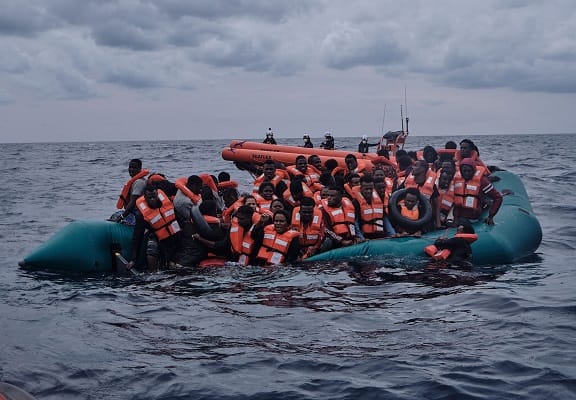
The incident is particularly politically damaging because it comes at a time when ministers have repeatedly insisted that action is being taken to reduce illegal Channel crossings. Government figures and ministers have pointed to improved cooperation with France and falling arrival numbers as evidence that the strategy is beginning to work. Yet the emergence of so-called “mega-dinghies” provides a dramatic reminder that smugglers remain capable of changing their methods.
According to recent reporting, around 230 people crossed the English Channel in a single vessel, making it one of the largest crossings recorded in recent years. The boat was vastly larger than the fragile inflatable dinghies traditionally associated with the crisis. Its size demonstrates how organised criminal networks have adapted to increased enforcement pressure along the French coast.
For critics of Labour, the symbolism is difficult to ignore.
The Government has promised to restore control over Britain’s borders, yet images of an enormous boat packed with hundreds of people making the journey across one of the world’s busiest shipping lanes create an impression of a system that remains vulnerable. The political argument is therefore no longer simply about how many people are arriving. It is about whether the Government is staying ahead of the criminal organisations facilitating the crossings.
The reality, however, is more complicated than the most dramatic headlines suggest.
Overall Channel crossings have reportedly fallen significantly compared with the previous year. The Guardian reported that crossings were down by more than 40 per cent, while the Government said July recorded the lowest number of crossings for that month since 2020. Increased French patrols, cooperation between British and European authorities and efforts to disrupt smuggling networks have all contributed to the reduction.
That means the latest mega-dinghy cannot, by itself, prove that the Government has completely lost control.
Nevertheless, it exposes a serious weakness in the current strategy.
When criminal gangs find that smaller boats are becoming more difficult to launch because of increased surveillance and enforcement, they have an incentive to change tactics. Larger vessels can transport substantially more people in a single journey, potentially allowing smugglers to maintain or even increase the number of passengers despite fewer individual crossings.
This is precisely why the latest incident matters.
A reduction in the number of boats does not necessarily mean an equivalent reduction in the number of people arriving. If one enormous vessel can replace several smaller ones, the Government’s statistics may improve in one category while the underlying criminal business remains resilient.
The issue is also becoming a major political weapon for Nigel Farage and Reform UK.
Farage has made immigration and border control central to his political identity. He has argued that the Government needs a much more aggressive response and has promoted proposals including the use of naval vessels to turn boats around. His criticism of Prime Minister Andy Burnham has intensified following the arrival of the record-sized dinghy, with Farage arguing that the Government lacks the determination required to stop the crossings.
For Labour, this creates a dangerous political situation.
The party cannot simply dismiss public concern as hostility towards migrants. Many voters who are worried about illegal immigration are not necessarily opposed to refugees or legal migration. Their concern is whether the Government can determine who enters the country, process asylum claims efficiently and remove people who have no legal right to remain.
That distinction is becoming increasingly important.
The Government therefore faces two different audiences. One expects Britain to uphold humanitarian responsibilities towards people seeking protection. The other expects ministers to demonstrate that the immigration system has firm and enforceable limits.
A successful policy must address both concerns.
The humanitarian dimension of the Channel crisis should not be forgotten. These crossings are extremely dangerous, and smugglers are willing to place enormous numbers of people onto vessels that may be unsuitable for the journey. The latest mega-dinghy was itself a warning about the potential for mass casualties if such a vessel capsizes or suffers mechanical problems.
The criminal gangs behind these journeys are not charities. They are businesses operating in a highly dangerous environment. Their incentive is financial profit, not the welfare of the passengers.
This is why the Government’s campaign against smuggling networks remains central to its strategy.
Ministers have emphasised cooperation with France and other European partners, including increased patrols and efforts to seize boats and engines before they can be used. British authorities have also sought to disrupt supply chains connected with the manufacture and distribution of equipment used by smuggling gangs. Recent reports indicate that more than 1,100 boats and engines have been seized since the last UK general election.
But enforcement creates an ongoing technological and tactical race.
When governments strengthen surveillance, criminal gangs look for alternative launch sites. When smaller boats become harder to use, larger vessels can be introduced. When authorities seize equipment, smugglers search for new suppliers.
The Government is therefore not confronting a static problem.
It is confronting an organised criminal market capable of adapting rapidly.
That makes the political language of “taking back control” particularly difficult to sustain. Control is not simply a matter of announcing tougher policies. It requires a permanent capacity to enforce those policies against organisations that are constantly searching for weaknesses.
The Labour Government must therefore answer several difficult questions.
Why were smugglers able to deploy such a large vessel? How was it prepared and launched? Were British and French authorities aware of the operation before it reached the Channel? Could the supply chain behind the boat have been disrupted earlier? And, most importantly, what measures will prevent similar vessels from being used again?
These questions matter because the public’s confidence depends not only on statistics but also on visible evidence of competence.
If the Government says crossings are falling, voters will want to understand why huge boats can nevertheless appear on the Channel. If ministers say cooperation with France is working, they will be asked why smugglers remain capable of organising such ambitious operations.
The Government’s response will therefore be crucial.
Andy Burnham has already acknowledged that changing tactics may be necessary as smuggling gangs become more sophisticated. His Government has also defended the importance of international cooperation, including a performance-based funding arrangement with France designed to increase enforcement activity.
That approach may eventually prove successful. But political patience is limited.
Immigration has become one of the defining issues of modern British politics precisely because voters have heard repeated promises from successive governments that the system will be brought under control. Conservative governments made such promises. Reform UK has built much of its support around the argument that those promises were never fulfilled. Labour now faces the same test.
The danger for Labour is that every spectacular crossing provides opponents with a powerful image that can overwhelm more complicated statistical arguments.
A fall of more than 40 per cent in crossings is significant. But a single boat carrying 230 people is visually and politically dramatic. For voters who already believe that the Government has lost control, the mega-dinghy appears to confirm their suspicions.
This is where Labour’s political challenge becomes particularly difficult.
Ministers need to communicate success without appearing complacent. They need to acknowledge continuing problems without creating the impression that their policies are failing. They need to reassure communities concerned about asylum accommodation while also explaining Britain’s legal and humanitarian obligations.
Most importantly, they need to demonstrate that their strategy is capable of adapting faster than the smugglers.
The emergence of mega-dinghies should therefore be treated as a warning rather than simply another political controversy. Falling numbers are encouraging, but they cannot be the only measure of success. The Government also needs to demonstrate that it can disrupt the criminal infrastructure behind the crossings.
Britain’s border debate is ultimately about more than boats.
It is about public confidence in the ability of the state to enforce its laws. It is about whether asylum decisions are made quickly and fairly. It is about whether rejected applicants can be removed effectively. It is about whether criminal gangs can be dismantled rather than merely displaced. And it is about whether communities believe that the Government understands the pressures created by the asylum system.
Labour has inherited a deeply entrenched problem, but voters will not accept that inheritance as a permanent excuse.
The Government may legitimately point to falling crossing numbers and stronger cooperation with France as evidence of progress. Yet the record mega-dinghy demonstrates that the crisis is evolving. The smugglers are changing their tactics, and Labour must change faster.
If ministers succeed, the latest incident may eventually be remembered as evidence of the final stages of a declining smuggling route.
If they fail, however, it could become a symbol of something far more damaging: a Government that promised to restore control, only to discover that the people running the Channel smuggling trade had already found a way around its strategy.
For Labour, that is the real danger.
The question is no longer simply whether fewer boats are crossing the Channel. The question is whether Britain can finally make the criminal business behind those boats unsustainable.
Until it can, claims that the border crisis is under control will continue to face a powerful challenge every time another mega-dinghy appears on the horizon.