
Nigel Farage Reveals What He Will Do With Foreign Criminals Serving Time in UK Jails
Nigel Farage has once again placed immigration and crime at the centre of Britain’s political debate with a proposal that is as controversial as it is ambitious.
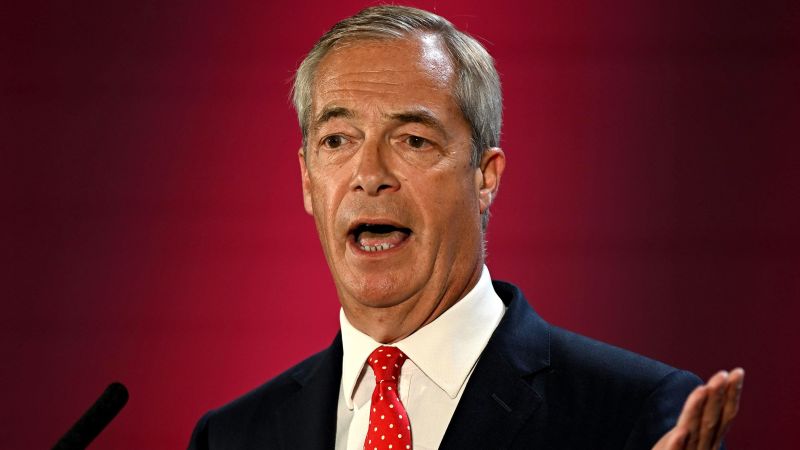
If Reform UK comes to power, Farage says foreign nationals serving prison sentences in Britain would no longer necessarily remain in British prisons. Instead, they would be deported to their home countries where possible, while those whose governments refuse to take them back could potentially be transferred to third countries.
Among the countries being considered is El Salvador.
The proposal has immediately attracted attention because it goes far beyond the usual political debate about deporting foreign offenders after they have completed their sentences. Farage is proposing a fundamental change to where some convicted foreign criminals actually serve those sentences. Reform says the policy could free around 10,000 prison places in Britain, helping to address the country’s chronic prison overcrowding problem.
It is an extraordinary proposal.
But it also raises a straightforward question: is this a radical solution to Britain’s prison crisis, or simply another example of Farage promising a dramatic answer to a deeply complicated problem?
The political attraction is obvious.
Britain’s prisons are under enormous pressure. Governments have repeatedly struggled to provide enough places for convicted criminals, while early-release schemes have become a politically explosive issue. Reform argues that British prison cells should primarily be available for people who need to be imprisoned in Britain, rather than foreign nationals who could, in principle, serve their sentences elsewhere.
Farage has therefore identified an issue that is easy for voters to understand.
If a foreign national commits a serious crime in Britain, why should British taxpayers necessarily have to pay for that person’s imprisonment in a British jail?
It is a powerful question.
Reform’s answer is equally straightforward: deport them.
Farage has said that all foreign nationals in British prisons should be removed from the UK. If their home countries will accept them, they would be returned there. If those governments refuse, Reform wants to explore agreements with third countries where prison accommodation could be rented. El Salvador and Kosovo have been mentioned as possible destinations.
The proposal would represent a significant departure from conventional British criminal-justice policy.
It is also important to distinguish between two different concepts.
The first is deportation.
Britain already has mechanisms for deporting foreign national offenders under certain circumstances. The question is often when deportation should occur and whether the individual must first serve part or all of their sentence in Britain.
The second is transferring the execution of a prison sentence abroad.
That is much more complicated.
A prisoner is not simply an unwanted passenger who can be placed on a plane. There are legal questions, diplomatic questions, security questions and practical questions about the standards under which a sentence is served.
There is also the issue of accountability.
If a British court sentences someone to prison, the British public has a legitimate interest in knowing that the sentence is being carried out under an appropriate legal framework. Any agreement to transfer prisoners abroad would therefore have to establish clear rules about supervision, access to lawyers, medical treatment, inspections and the rights of prisoners.
This is where Farage’s proposal will face its greatest scrutiny.
The political slogan is simple.
The implementation is not.
El Salvador has become central to the controversy because of its dramatic transformation under President Nayib Bukele. The country has constructed enormous prisons as part of a sweeping crackdown on organised crime, and its prison system has attracted international attention as well as serious criticism from human-rights organisations.
Reform’s interest in El Salvador is therefore not accidental.
It represents the kind of uncompromising approach to crime that Farage wants to associate with his own political movement.
But Britain cannot simply copy another country’s prison model.
The United Kingdom operates within a completely different constitutional and legal environment. British courts, Parliament and international obligations impose restrictions that cannot simply be ignored because a policy is politically popular.
That does not mean the idea should automatically be rejected.
It means it must be tested seriously.
If Britain can negotiate legally robust agreements under which foreign criminals are transferred to their countries of nationality or to carefully selected third countries, and if those agreements genuinely reduce pressure on British prisons while maintaining acceptable standards, there is a legitimate argument for examining them.
The current system is clearly not working perfectly.
Britain cannot continue treating prison capacity as an afterthought.
When prisons become overcrowded, governments are forced into unpleasant choices. They can build more prisons, reduce the number of people entering prison, change sentencing rules or release some offenders earlier.
Every option has consequences.
Building prisons costs money and takes time.
Reducing sentences can create public anger, particularly when victims believe offenders are being released too soon.
Keeping everyone in prison for longer requires more cells, more staff and more resources.
That is why Farage’s proposal has political significance.
It offers a fourth option: reduce the number of foreign prisoners occupying British cells by moving them elsewhere.
Reform says this could create approximately 10,000 additional places. It also proposes building around 12,000 additional modular “Nightingale” prison places, meaning the party claims its overall plan could generate roughly 22,000 additional places by 2031.
If those numbers could actually be delivered, the impact would be significant.
But voters should be cautious about treating political projections as guaranteed outcomes.
The first problem is cost.
Sending prisoners abroad is not necessarily cheap. Britain would have to negotiate agreements, transport prisoners, establish monitoring arrangements and potentially pay foreign governments for accommodation and services. If a third country is being paid to house prisoners, the British taxpayer is still paying for imprisonment — merely somewhere else.
The financial case therefore needs to be demonstrated rather than assumed.
The second problem is diplomacy.
What happens if a country refuses to take back its nationals?
That is already one of the biggest challenges facing immigration enforcement. A government can issue a deportation order, but deportation requires another country to accept the individual.
Farage’s proposed third-country model attempts to solve that problem.
But it creates another.
Why should El Salvador, Kosovo or another country accept prisoners who are not their citizens?
The answer would presumably be money and diplomatic agreements.
Yet that means Britain would need reliable partners willing to participate in the scheme for years, not merely during a political announcement.
The third problem is public confidence.
Farage has built much of his political appeal around the promise of restoring control. That means his policies will be judged by whether they actually work.
If a prisoner is transferred abroad and later escapes, is released early or becomes impossible to monitor, the political consequences could be enormous.
Reform would therefore need a system capable of guaranteeing that a sentence imposed by a British court remains meaningful after the prisoner leaves Britain.
There is, however, a broader argument in Farage’s favour.
Britain has spent years discussing the symptoms of its prison crisis without always confronting its structural causes.
The country needs more prison capacity.
It needs faster and more effective criminal justice.
It needs enough prison officers.
And it needs a clear policy towards foreign national offenders.
The idea that every foreign criminal must automatically serve their entire sentence in a British prison should not be treated as a sacred principle.
Nor should the opposite proposition — that every foreign prisoner can simply be sent abroad — be accepted without scrutiny.
The sensible approach lies somewhere between the two extremes.
Serious criminals should be punished.
Victims deserve justice.
British communities deserve protection.
And taxpayers deserve to know that the prison system is being managed responsibly.
Farage’s proposal is controversial because it forces politicians to confront all four questions simultaneously.
There is another political dimension that should not be overlooked.
Reform UK is increasingly presenting itself not merely as a protest movement but as a potential party of government. That means Farage’s promises are now being judged differently.
When he was an outsider, it was enough to identify what he believed was wrong with Britain.
Now he has to explain how he would actually run the country.
The foreign-prisoner proposal is therefore a test.
Can Reform turn a striking political idea into a functioning government policy?
Can it negotiate the necessary international agreements?
Can it guarantee legal safeguards?
Can it demonstrate that the policy represents value for money?
And can it do all this without creating new problems that are worse than the one it is trying to solve?
Those are the questions that matter.
Farage is right about one thing: Britain’s prison overcrowding problem cannot simply be ignored.
A justice system that repeatedly struggles to find space for convicted criminals is not functioning as effectively as it should. Nor is it sustainable to rely indefinitely on early release as a substitute for adequate prison capacity.
But dramatic policies require serious preparation.
If Reform wants to send foreign criminals abroad, it must publish the details. Which countries would participate? How much would Britain pay? What legal agreements would be required? What happens if a receiving country violates the terms? How would prisoners be monitored? What standards would apply? Who would inspect the facilities?
The British public deserves answers.
Because the real test of Nigel Farage’s proposal will not be whether it produces spectacular headlines.
It will be whether it produces safer streets, more prison capacity and better value for taxpayers.
That is a much harder test.
Farage has spent decades telling Britain that politicians are too cautious, too slow and too afraid to make difficult decisions.
Now he has the opportunity to prove that his own movement can do better.
Sending foreign criminals abroad may sound like a simple solution.
It is not.
But neither is Britain’s prison crisis.
If Reform can turn this controversial idea into a lawful, financially credible and genuinely effective programme, it could become one of the most consequential parts of Farage’s law-and-order agenda.
If it cannot, then the proposal risks becoming another headline-grabbing promise that collapses when confronted with the realities of government.
For now, the message from Farage is unmistakable.
Foreign criminals who have been convicted and imprisoned in Britain, he argues, should not necessarily remain in British jails.
They should serve their sentences elsewhere where possible — even, potentially, thousands of miles away.
Whether Britain is prepared to go that far remains one of the biggest questions facing Reform UK.
And perhaps that is exactly why Farage has chosen to make the proposal now.
He is no longer merely asking Britain to listen.
He is asking Britain to imagine what a Farage government would actually do.