
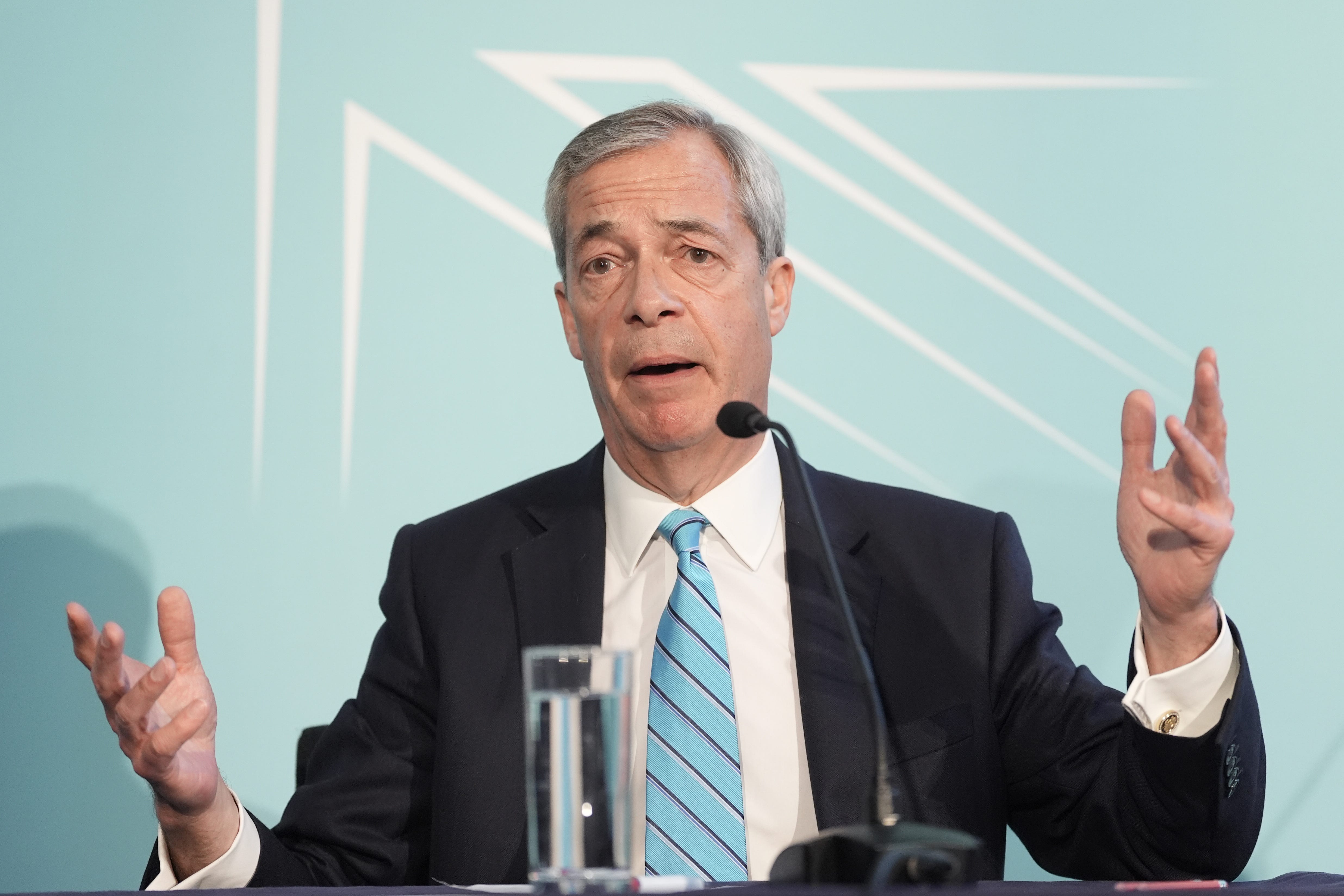
Britain may have hit ‘peak-Reform’ warns pollster while Farage slams ‘dishonest people’
Britain May Have Reached “Peak Reform” — But Nigel Farage Refuses to Accept the Warning
For more than a year, Nigel Farage has appeared to be riding one of the most extraordinary political waves in modern British history.
Reform UK has transformed itself from a protest movement into a serious electoral force. It has attracted former Conservative voters, disillusioned Labour supporters and millions of people who believe Westminster’s traditional parties have stopped listening to them.
But now a dangerous question is beginning to emerge.
Has Reform already reached its peak?
For Farage, the answer is an emphatic no.
The Reform leader has repeatedly dismissed suggestions that his party’s support has begun to weaken, accusing critics and pollsters of underestimating the scale of his movement.
But the warning cannot simply be ignored.
Recent polling has revealed a complicated picture. Reform remains capable of leading national voting-intention surveys, while Farage continues to dominate the political conversation. At the same time, there are signs that his personal reputation is considerably weaker than the strength of his party’s electoral support.
YouGov’s July 2026 figures found that 65 per cent of Britons viewed Farage unfavourably, compared with only 25 per cent who viewed him favourably. Just 16 per cent considered him trustworthy.
That creates a fascinating political paradox.
Millions of voters may be attracted to what Reform represents without necessarily trusting the man leading it.
And that could ultimately determine whether Reform’s rise continues — or whether Britain has already witnessed its “peak Reform” moment.
Farage versus the pollsters
The relationship between Nigel Farage and political pollsters has become increasingly hostile.
Farage has previously accused polling organisations of understating Reform’s support, particularly when surveys suggested that the party’s popularity was beginning to decline.
One of the most prominent disputes involved YouGov, with Farage attacking the way the company presented voting-intention data.
Polling expert Sir John Curtice, however, argued that there was “no doubt” Reform’s support was falling at one point during the spring, while Farage insisted that the party remained stronger than its critics claimed.
This disagreement illustrates a fundamental difference in political philosophy.
Farage believes political momentum can be measured by what he sees happening on the ground: crowds, activists, local election results and conversations with voters.
Pollsters rely on samples.
Farage sees a movement.
Pollsters see numbers.
And both can sometimes be right.
What does “peak Reform” actually mean?
The phrase sounds dramatic, but it needs to be understood carefully.
“Peak Reform” does not necessarily mean Reform is about to collapse.
It could simply mean that the party has reached the maximum level of support available under current political conditions.
A party can remain extremely powerful after reaching its peak.
Imagine Reform sitting at around a quarter of the national vote.
If it remains there for the next two years, it could still win a substantial number of parliamentary seats depending on how votes are distributed.
But if Reform’s support falls from the mid-twenties into the high teens, the electoral consequences could be significant.
The first-past-the-post system makes the situation particularly complicated.
Reform does not simply need supporters.
It needs concentrated support in the right constituencies.
That is why the party’s recent electoral performance matters just as much as national polling.
The strongest argument against the “peak” theory
There is a powerful case that Reform has not peaked.
The party has continued to attract attention across areas that were once dominated by Labour or the Conservatives.
Research from UCL Policy Lab and More in Common found that Reform was ahead of Labour on the question of which party respects people who work hard, with 43 per cent saying Reform respected such people compared with 30 per cent for Labour.
That is important.
Political parties do not win elections simply because voters agree with their policies.
They also win because voters believe the party understands them.
For decades, Labour benefited from its association with working-class communities.
Now Reform is attempting to occupy some of that political territory.
Its message is remarkably simple:
The political establishment does not respect you.
We do.
For voters who feel ignored, that can be incredibly powerful.
The Farage problem
But Reform’s greatest strength may also be its greatest weakness.
Nigel Farage.
There is little doubt that Farage remains the central figure in the party’s political identity.
YouGov found in February that 73 per cent of Britons thought Reform was either “very” or “fairly” reliant on Farage.
That creates a difficult strategic problem.
If Farage becomes more popular, Reform benefits.
If Farage becomes unpopular, Reform suffers.
There is little separation between the politician and the party.
That is why his personal ratings matter so much.
And they are not particularly strong.
According to YouGov’s July figures, Farage was seen as decisive by half of Britons, but majorities regarded him as incompetent, unprincipled or unlikeable.
Even more strikingly, only 16 per cent of the public regarded him as trustworthy.
That is an extraordinary weakness for a politician who wants to become Prime Minister.
The “dishonest people” accusation
Farage’s response has often been to attack the credibility of those questioning him.
He has accused critics, commentators and political opponents of dishonesty.
The language fits his political brand.
Farage has spent decades presenting himself as an outsider fighting an establishment that he believes protects its own interests.
When an establishment figure attacks him, he can portray that attack as evidence that the system is frightened.
That strategy worked spectacularly during the Brexit campaign.
But there is a danger.
Eventually, a politician who spends too much time accusing opponents of dishonesty must convince voters that he himself is completely trustworthy.
That is where the polling becomes uncomfortable.
Ipsos found in April that 51 per cent of Britons believed Farage tells the truth “not very often” or “never”, compared with 46 per cent saying the same about Keir Starmer.
This does not mean Farage cannot win.
It means his political ceiling may be lower than the size of his current movement suggests.
A fictional conversation in a British town
Imagine a fictional conversation in a pub in Essex.
One voter, Paul, says:
“Farage is the only politician who says what people are thinking.”
Another, Claire, disagrees.
“I agree with some of what Reform says,” she replies, “but I don’t trust Farage enough to give him the keys to Downing Street.”
Paul looks surprised.
“You don’t trust him?”
“No,” Claire says. “But I don’t trust Starmer either.”
That fictional exchange captures an important feature of modern British politics.
The choice may not be between politicians people love and politicians they hate.
It may be between politicians voters distrust to different degrees.
And that creates an unpredictable electoral environment.
The threat from the Conservatives
Farage’s biggest problem may eventually come from the Conservative Party.
Reform’s rise has been built partly on Conservative voters abandoning the Tories.
But those voters are not permanently owned by Reform.
If the Conservatives can persuade former supporters that Reform is too risky, too inexperienced or too divisive, some may return.
This is particularly important under Britain’s electoral system.
A small movement of Conservative voters back towards the Tories could potentially prevent Reform from winning marginal constituencies.
That means Reform could retain a large national vote share while losing dozens of seats it currently expects to win.
The battle between Farage and Kemi Badenoch could therefore become one of the defining contests of the next election.
And then there is the radical right
Reform also faces competition from its own ideological neighbourhood.
The emergence of Restore Britain has complicated the political landscape further.
If Reform loses supporters to an even more radical party, the consequences could be severe.
Farage cannot simply move further to the right indefinitely.
At some point, doing so risks alienating moderate voters who might otherwise support Reform.
This is the classic dilemma facing populist parties.
Move towards the centre and risk losing the base.
Move further towards the base and risk limiting the electoral ceiling.
The political “short blanket” problem is real.
There may simply not be enough room for everyone.
Could Reform still win the next election?
Absolutely.
That possibility should not be dismissed.
Even critics of Farage recognise that Reform has fundamentally changed Britain’s political landscape.
The party has demonstrated an ability to attract voters from both major parties.
It has forced immigration, national identity and political trust back towards the centre of political debate.
And its supporters are often highly motivated.
The challenge is converting political anger into a sustainable governing coalition.
That is much harder.
A protest voter can be angry.
A government voter needs confidence.
They need to believe the party can manage the economy, run public services, defend the country and deal with crises.
That is where Reform’s next phase becomes considerably more difficult.
The great test of leadership
Nigel Farage has spent much of his career telling voters that the establishment is wrong.
Now he faces the ultimate test.
Can he prove that his own political predictions are right?
If Reform continues to rise, Farage will argue that the pollsters were wrong.
If Reform stabilises, he will say the party has created a permanent political realignment.
But if support falls substantially, critics will return to the phrase that currently irritates him most:
“Peak Reform.”
That phrase would suggest that the extraordinary wave has already crested.
The party may still be large.
Farage may still dominate the headlines.
But the easy growth would be over.
Britain has not made up its mind
The most important fact about British politics is that voters remain extraordinarily volatile.
Ipsos found widespread distrust in the political system, with two-thirds of Britons saying they lacked confidence that the government was running the country with integrity or competence.
That distrust creates the conditions for Reform to succeed.
But it also creates the conditions for competitors to succeed.
A voter angry with Labour can choose Reform.
A voter worried about Reform can return to the Conservatives.
A voter dissatisfied with both can choose the Greens or Liberal Democrats.
The electorate is no longer a simple two-party battlefield.
That fragmentation makes predictions dangerous.
The final verdict
Has Britain reached peak Reform?
Nobody can know yet.
The evidence points in both directions.
Reform has demonstrated extraordinary political momentum and remains a major force.
But Farage’s personal ratings are significantly weaker than his party’s political position, and there are clear signs that his opponents are learning how to fight back.
That means the next stage of the Reform story will be very different from the first.
The party no longer needs to prove that people are angry.
Everyone knows they are.
It now needs to prove that anger can be converted into trust.
Nigel Farage can continue accusing his critics of being dishonest.
He can continue attacking pollsters.
He can continue telling supporters that the establishment underestimates Reform.
But eventually, Britain will ask a much harder question:
Not whether Reform can protest — but whether Reform can govern.
That is the question that will determine whether this really was the peak of Farage’s revolution, or merely the moment before it became something even bigger.