
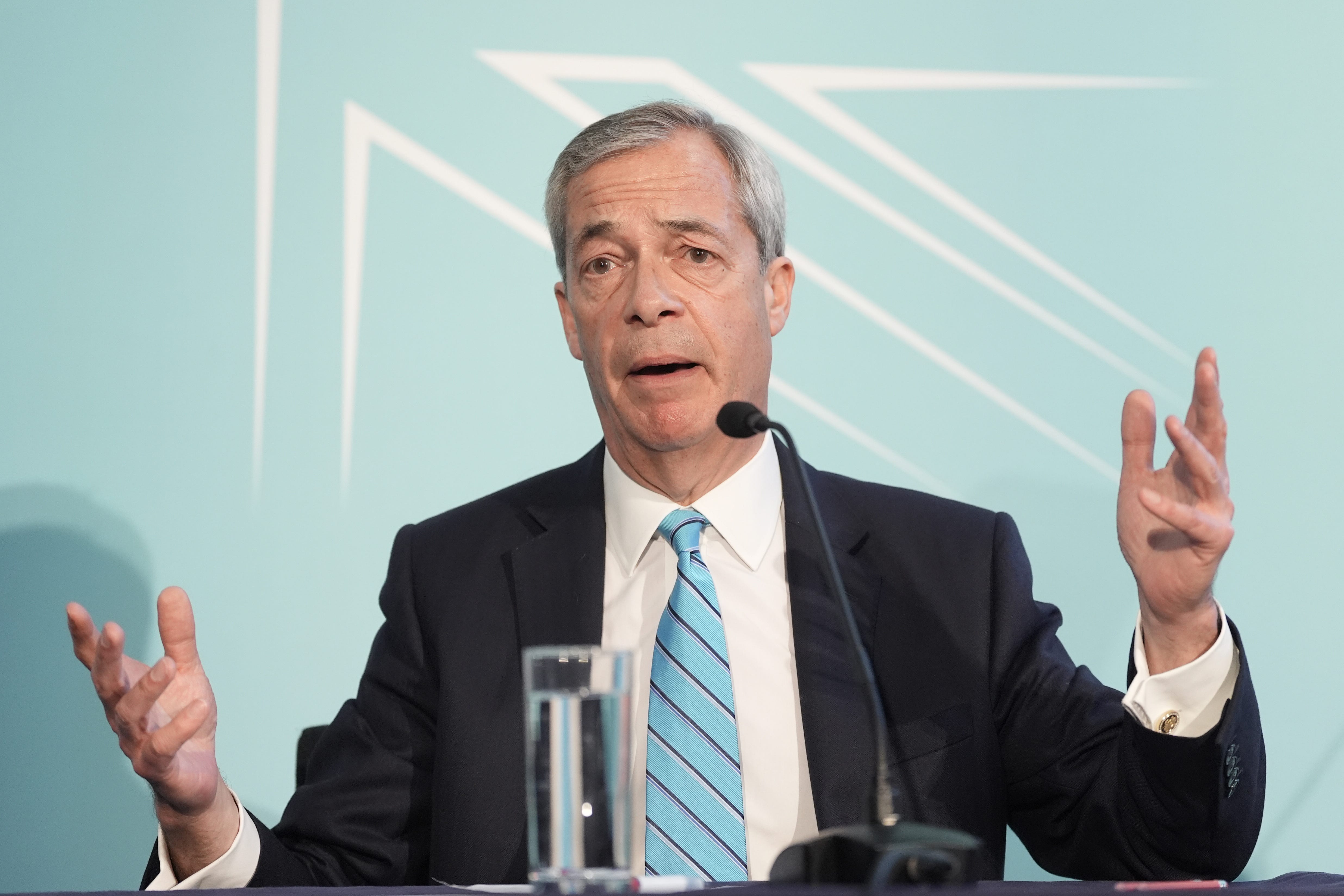
Nigel Farage’s Explosive Claim: Would Reform Really Have Won If Only British Citizens Voted?

Nigel Farage has once again opened one of the most explosive arguments in British politics: who should have the right to decide the future of Britain?
Following Reform UK’s defeat in the Gorton and Denton by-election, Farage insisted that his party’s candidate, Matt Goodwin, would have won if the election had been decided only by British citizens.
It was a remarkable claim.
The official result tells a very different story. Green Party candidate Hannah Spencer won with 14,980 votes, while Reform’s Matt Goodwin received 10,578 and Labour candidate Angeliki Stogia finished third with 9,364. Spencer therefore defeated Goodwin by 4,402 votes.
But Farage was not accepting the result as the end of the argument.
Instead, he shifted the discussion towards the composition of the electorate.
Speaking after the contest, the Reform leader said he was “absolutely convinced” that Goodwin had come first among British-born voters. He subsequently backed proposals to restrict voting in UK national elections to British citizens.
The intervention has produced a fierce political backlash.
Critics argue that Farage is attempting to explain away an election defeat by questioning who took part in the election.
Reform supporters see something completely different.
They believe Farage is asking a legitimate question about national sovereignty.
And that question could become much bigger than one by-election.
The election that changed the conversation
Gorton and Denton was already a politically important contest.
The seat had long been associated with Labour, but the by-election produced a dramatic result.
The Greens achieved their first Westminster by-election victory, while Reform surged into second place. Labour, which had previously held the constituency, fell to third. Official figures show that Labour’s vote collapsed to 9,364, while Reform secured 10,578.
For Reform, second place was both encouraging and frustrating.
The party could point to a substantial increase in its vote share.
But it had still lost.
And the Greens had not merely won. They had won by more than 4,000 votes.
Rather than accepting that result as a straightforward demonstration of voter preference, Farage immediately focused attention on immigration, citizenship and electoral eligibility.
That was the moment when a local by-election became part of Britain’s much wider culture war.
What Farage is actually arguing
At the heart of Farage’s argument is a simple proposition:
British national elections should be decided by British citizens.
Reform has proposed removing the voting rights currently available to certain Commonwealth citizens who meet existing eligibility requirements while living in Britain.
Farage’s supporters argue that this is not an extreme proposition.
They point to countries such as the United States and Japan, where citizenship is central to national voting rights.
Their argument is based on sovereignty.
If Parliament makes decisions for the entire United Kingdom, they say, then the people choosing Parliament should be citizens of the United Kingdom.
It is a coherent political argument.
But it is also highly controversial.
Britain’s current electoral arrangements reflect a long historical relationship with Commonwealth countries, and changing those rules would have significant consequences.
The issue is therefore not simply administrative.
It is constitutional.
But did Reform actually win?
This is where the controversy becomes particularly important.
Farage’s statement about British-born voters is a counterfactual claim.
There was no separate election in which only British-born voters participated.
The official result therefore cannot establish that Goodwin would have won under those circumstances.
What we know is what happened under the rules that actually applied.
Hannah Spencer won.
Matt Goodwin came second.
Labour came third.
Everything beyond that is speculation unless supported by detailed voter-level data that identifies citizenship and birthplace and legally links those characteristics to individual voting behaviour.
That does not necessarily mean Farage’s claim is impossible.
It means that it should be understood as a political assertion rather than an independently demonstrated election result.
This distinction matters because political parties can easily create alternative versions of an election.
If every defeated candidate could say, “We would have won if different people had voted,” the actual result would become almost meaningless.
But Farage’s supporters would answer that he is not disputing the legal result.
He is challenging the rules themselves.
A fictional conversation in Gorton
Imagine a fictional conversation outside a café in Gorton.
John, a lifelong British voter, says:
“I think national elections should be for citizens. That doesn’t seem unreasonable to me.”
Across the table, Sarah disagrees.
“If someone has lived here for twenty years, works here, pays taxes and is legally entitled to vote, why shouldn’t they have a say?”
John responds:
“Because citizenship means something.”
Sarah replies:
“Residence means something too.”
Neither fictional character is necessarily right or wrong.
Their disagreement illustrates why this argument is so difficult.
There are two competing definitions of democratic participation.
One emphasises citizenship.
The other emphasises residence and participation in the community.
Farage wants the first definition to become dominant.
His opponents want to defend the second.
The immigration question is never far away
There is another reason why the controversy has become so intense.
The voting debate cannot be separated from immigration.
Reform has built much of its political identity around reducing immigration, strengthening border controls and challenging what it sees as Britain’s excessively liberal settlement rules.
Critics therefore suspect that the proposal to restrict voting rights is part of a broader attempt to reshape the political influence of immigrant communities.
Reform rejects that interpretation.
Its response is that the rule would be based on citizenship, not ethnicity.
A British citizen would have the same voting rights regardless of their racial or religious background.
A non-British citizen would face the restriction regardless of where they came from.
That is the principle Reform wants voters to consider.
The question is whether the public accepts that distinction.
The political danger for Farage
Farage has always understood the power of controversy.
He knows that a provocative statement can dominate television coverage, social media and newspaper front pages.
But there is a danger.
The more Reform talks about who should be allowed to vote, the more opponents can portray the party as trying to narrow democracy.
That could alienate voters who might otherwise be attracted to Reform’s economic or immigration policies.
At the same time, backing away from the issue could anger Reform’s core supporters.
Farage therefore faces a familiar political dilemma.
The issues that energise his base are often the same issues that frighten his opponents.
That tension has defined his political career.
A new battle for the British right
The controversy also matters because Reform is no longer merely a protest movement.
The party wants to become a major governing force.
That means it must present a comprehensive vision of Britain.
Immigration is one part of that vision.
Taxation is another.
Public services, housing, energy, defence and constitutional reform are others.
Voting rights now appear to be joining that list.
If Reform succeeds in convincing millions of voters that Britain’s democratic system needs fundamental reform, Farage could turn another controversial issue into a powerful electoral weapon.
But if voters conclude that the party is simply refusing to accept an electoral defeat, the strategy could backfire.
The Green victory should not be forgotten
There is another element of the story that risks being overshadowed.
The Greens won.
Hannah Spencer received 14,980 votes — more than 4,000 ahead of Reform. Labour’s collapse was also significant, with the party receiving only 9,364 votes.
That result tells us something important about modern British politics.
Voters are not moving in one direction.
They are fragmenting.
Some traditional Labour voters are moving towards Reform.
Others are moving towards the Greens.
Conservative support has also weakened in many areas.
The old political map is becoming harder to read.
That makes by-elections particularly interesting because they can reveal political movements before they become visible nationally.
Gorton and Denton may therefore be less important for who won the seat than for what it revealed about the electorate.
Farage’s bigger argument
Ultimately, Farage is not simply arguing about Matt Goodwin.
He is arguing about Britain.
What does it mean to be a citizen?
Who belongs to the political nation?
Should living in Britain be enough to justify a vote in a parliamentary election?
Or should citizenship be the decisive qualification?
Those questions have no simple answers.
They involve history, constitutional law, immigration, national identity and democratic principles.
That is precisely why Farage’s intervention has attracted such attention.
A relatively ordinary by-election has become a battleground over the meaning of British democracy.
The next election could make the issue enormous
Imagine the issue appearing on the national campaign trail.
Farage stands before a crowd and declares:
“British elections should be decided by British citizens.”
His supporters cheer.
Labour responds that democracy should not be narrowed according to Farage’s political preferences.
The Greens accuse Reform of trying to rewrite the rules after losing.
Conservatives are forced to decide whether to support or oppose the proposal.
Suddenly, an electoral technicality becomes a central political dividing line.
That is the kind of political environment in which Nigel Farage thrives.
He has spent decades turning questions that were once regarded as peripheral into major national debates.
Brexit was the ultimate example.
Now he wants citizenship and voting rights to become another defining issue.
Whether that strategy succeeds remains uncertain.
But one thing is clear.
The Gorton and Denton result cannot simply be rewritten.
The Green Party won.
Reform came second.
Labour came third.
Those are the facts recorded by the returning authorities.
What Farage has done is ask voters to imagine a different electorate — one in which only British citizens participate.
That imagined election may never be possible to prove.
But politically, it could become extremely real.
And if Reform continues to rise, the question of who gets to vote may become one of the fiercest battles in Britain’s next political revolution.