
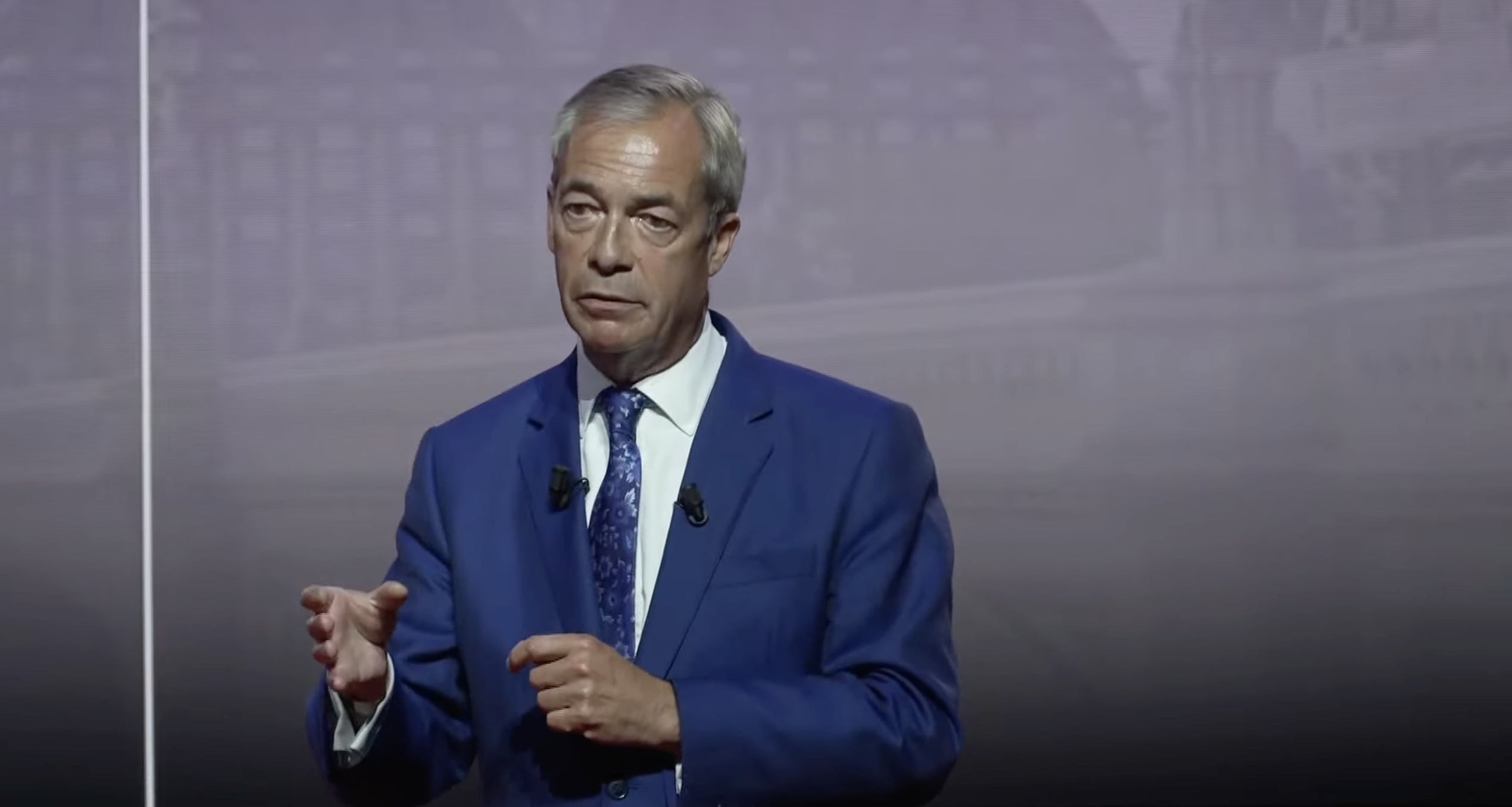
Speaking at the CPAC GB conference in London today, Farage accused Burnham of being “the great chameleon of British politics”, attempting to be “all things to all people”, and branded his acceptance speech “absolutely vacuous”.
“We will have our seventh prime minister in 10 years – and we used to laugh at the Italians”, Farage said.
Farage pointed out that Burnham looked down at his notes a whopping 266 times during his speech earlier today, when he accepted the Labour leadership.
Nigel Farage: Burnham Has “Literally No Mandate at All”
Reform UK leader Nigel Farage has launched a sharp attack on Greater Manchester Mayor Andy Burnham, declaring that Burnham has “literally no mandate at all” to speak on behalf of the British public beyond his regional office. The remarks come amid growing speculation about Burnham’s increasing influence within the Labour Party and his potential role in shaping its future direction.
Farage’s comments reflect the intensifying political rivalry between Reform UK and Labour as opinion polls suggest the two parties are running neck and neck nationally. While Burnham has become one of Labour’s most recognizable and popular politicians outside Westminster, Farage argues that the Greater Manchester mayor’s popularity should not be confused with a nationwide democratic mandate.
Speaking during a media appearance, Farage criticized Burnham for frequently commenting on national policy issues, including immigration, economic growth, transport, and regional investment. According to Farage, Burnham was elected to serve the people of Greater Manchester rather than to present himself as a national political figure.
“Andy Burnham was elected by the people of Greater Manchester,” Farage said. “He has literally no mandate at all to lecture the rest of the country or to set national policy.”
Farage argued that only Members of Parliament elected to the House of Commons—or a prime minister commanding the confidence of Parliament—possess the democratic authority to shape national policy. In his view, local and regional leaders should focus primarily on delivering services and representing the interests of their own communities.
The criticism comes at a time when Burnham’s national profile continues to rise. Since becoming Mayor of Greater Manchester in 2017, he has gained recognition for his work on public transport, housing, policing, and healthcare integration. His outspoken opposition to the UK government’s handling of regional COVID-19 restrictions significantly increased his popularity, with many supporters praising him for defending the interests of northern England.
Burnham has also become a prominent advocate for greater devolution, arguing that cities and regions should receive more powers over transport, housing, education, and economic development. Supporters believe his approach has helped transform Greater Manchester into one of England’s leading regional economies.
However, Farage remains deeply skeptical of Burnham’s expanding national influence. Reform UK has consistently argued that Britain’s political system has become too centralized while simultaneously criticizing what it describes as an unelected political establishment exercising excessive influence over national debates.
Farage contends that Burnham’s frequent appearances in national media blur the distinction between local government and national politics. He believes voters outside Greater Manchester never elected Burnham to represent their interests and should therefore be cautious about treating him as a national political authority.
Supporters of Burnham strongly reject that argument. They point out that directly elected mayors are chosen by hundreds of thousands of voters and are expected to contribute to national discussions, particularly on issues affecting cities and local government. They argue that Burnham’s experience managing one of the UK’s largest metropolitan regions gives him valuable practical insight into challenges such as housing shortages, transport infrastructure, public health, and economic inequality.
Political analysts note that Farage’s criticism is also strategically significant. As Reform UK seeks to expand its electoral support, Burnham represents one of Labour’s strongest public communicators outside the national leadership. Challenging Burnham’s legitimacy allows Farage to undermine a prominent Labour figure while reinforcing Reform’s message that national politics should be driven by directly accountable parliamentary representatives.
The dispute also reflects a broader constitutional debate over the role of England’s metro mayors. Since the introduction of directly elected mayors in several English city regions, figures such as Burnham, Steve Rotheram, Tracy Brabin, and others have become increasingly influential voices in public policy. While their formal powers remain limited compared with central government, their visibility and public profiles have grown substantially.
Some constitutional experts argue that this evolution is a natural consequence of devolution, with local leaders increasingly expected to influence national policy discussions. Others believe there remains uncertainty about where the boundary lies between regional leadership and national political advocacy.
Despite Farage’s criticism, Burnham has repeatedly stated that his priority remains serving Greater Manchester. Nevertheless, he continues to comment regularly on national issues, arguing that decisions made in Westminster directly affect local communities and that regional leaders have both the right and the responsibility to contribute to those debates.
The exchange between Farage and Burnham highlights the increasingly competitive nature of British politics. Reform UK continues to position itself as an anti-establishment movement challenging both Labour and the Conservatives, while Labour seeks to demonstrate that experienced regional leaders can contribute meaningfully to national policymaking.
Ultimately, whether Burnham possesses a broader political mandate depends largely on one’s interpretation of democratic representation. Legally, his electoral mandate extends only to Greater Manchester. Politically, however, his growing popularity has made him an influential national voice whose opinions attract attention far beyond the region he governs. As Reform UK and Labour continue to compete for public support, clashes between figures such as Nigel Farage and Andy Burnham are likely to become an increasingly prominent feature of the UK’s political landscape.
“Any leader who is incapable of standing before an audience and stringing a couple of sentences together might be doing the job more out of personal ambition than out of conviction and belief in the country,” Farage said.
He also warned that “the only certainty with Burnham is that we are going to get more of the same”, predicting higher taxes and continued refusal to leave the European Court of Human Rights.
“He has literally no mandate for this at all”, Farage said. “The British public have had enough of this game of musical chairs taking place in Downing Street.”
He concluded: “The only good, decent and right thing to do i