
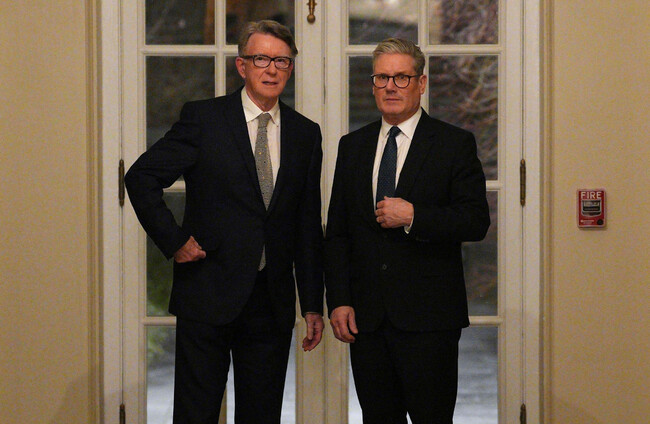
BRITISH PRIME MINISTER Keir Starmer has survived more calls to step down as Labour leader and maintained that he was not informed that Peter Mandelson failed his vetting.
Details emerged last week that Mandelson did not pass the initial vetting process before his appointment as UK ambassador to Washington at the beginning of last year.
Speaking in the House of Commons today Starmer told MPs it was “staggering” that he was not told Mandelson had failed vetting checks and acknowledged Parliament should have known about it “a long time ago”.
Back when the disgraced former Lord was appointed, security officials recommended that he should not be granted high level clearance, a decision which the Foreign Office overturned.
Starmer maintained the afternoon that he was only informed of this on Tuesday last week just before the story was broken by The Guardian: “This is information I should have had a long time ago, and it is information that the House should have had a long time ago.”
Subsequently, the Prime Minister effectively fired Foreign Office top civil servant Olly Robbins.
Starmer said he took responsibility for Mandelson’s appointment this afternoon: “I take responsibility for that decision, and I apologise again to the victims of the paedophile Jeffrey Epstein, who were clearly failed by my decision.”
How did this come out?
Last Thursday, The Guardian revealed that the UK’s Foreign Office overturned the initial decision to bar Mandelson from the appointment after security officials conducted the in-depth background check.
By the time, the security officials had failed Mandelson, Starmer had already made his appointment to the position public.
After these details emerged last week, the Foreign Office’s top civil servant, Olly Robbins, subsequently resigned.
What is Downing Street saying?
The UK government has said that Starmer was not aware that the former Labour grandee was granted developed vetting against the advice of UK Security Vetting until last week.
This afternoon Starmer is set to face more questions in parliament over the Mandelson scandal with the Conservative opposition once again calling for his resignation.
He’s facing allegations that he knowingly misled parliament after repeatedly telling MPs that ”full due process” was followed in Mandelson’s appointment.
What has Downing Street said?
A statement issued by No 10 on Sunday night said that although civil servants rather than ministers make decisions on vetting and clearance, there was nothing in the law to prevent ministers being told.
“There is nothing in the guidance which prevented information being shared in this scenario, in a proportionate and necessary way and subject to the appropriate procedural steps,” the statement on the Constitutional Reform and Governance Act said.
Who’s calling for him to go?
Conservative leader Kemi Badenoch has again called for Starmer’s resignation saying: “If the Prime Minister doesn’t know what’s happening in his own office, he shouldn’t be in charge of our country. He should go.”
The Green Party and Reform UK have also called for Starmer to resign.
Starmer also has critics within the Labour party who have questioned his leadership and who already fear an electoral bloodbath for the party in May’s contests in English councils and the Scottish and Welsh parliaments.
What’s the background again?
Mandelson was fired from his role as ambassador to Washington last September after further details emerged about his relationship with paedophile financier Jeffrey Epstein, who died in 2019.
Starmer was aware Mandelson’s dealings with Epstein continued after the financier’s conviction for child sex offences.
Questions over his judgment intensified after the first batch of documents related to the decision published last month showed that he was warned before announcing Mandelson’s ambassadorship of a “general reputational risk” over his association with Epstein.
That warning stemmed from the first part of the checks, carried out by the Cabinet Office, which was based on information in the public domain at the time.
The second was the highly confidential background vetting by security officials, which followed the announcement but came before Mandelson took up his role in February 2025.
Starmer’s Irish-born chief of staff Morgan McSweeney stepped down from his role in February taking “full responsibility” for Mandelson’s appointment and calling for vetting processes to be “fundamentally overhauled”.
Starmer Insists He Was Never Told Mandelson Failed Security Vetting as Pressure Mounts (Again)
Political scandals often become dangerous for governments not only because of the original mistake, but because of questions about who knew what, when they knew it, and whether the truth was fully disclosed. The headline “Starmer Insists He Was Never Told Mandelson Failed Security Vetting as Pressure Mounts (Again)” captures a moment of intense political pressure surrounding Keir Starmer’s government, as questions continue over the appointment of Peter Mandelson and the handling of security clearance concerns.
The controversy has created a difficult situation for the prime minister. Starmer has insisted that he was not informed that Mandelson had failed the initial security vetting process before being appointed to a major diplomatic role. He has argued that this information should have been provided to him and that ministers should have been aware of the issue before the appointment was confirmed.
For any government, security vetting is a highly sensitive matter. It exists to ensure that individuals given access to important government positions meet necessary standards of trust, reliability, and responsibility. When questions emerge about whether proper procedures were followed, the issue quickly becomes not only an administrative problem but also a political crisis.
The Mandelson controversy has placed Starmer under renewed scrutiny because the appointment involved a senior public figure with a long political history. Critics argue that a decision involving such an important role should have involved complete transparency and careful consideration of all available information.
Starmer’s defence has focused on the claim that he was unaware of the failed vetting result. He has described the situation as unacceptable and argued that information was withheld from him. According to reports, Starmer said he was “staggered” that he had not been informed and maintained that Parliament should have known about the issue earlier.
However, political opponents have questioned whether the prime minister should ultimately accept responsibility regardless of who failed to communicate the information. In government, ministers are often held accountable for decisions made by their departments, even when they were not personally involved in every detail.
This creates a familiar dilemma for political leaders. A prime minister cannot personally oversee every government decision, but the public expects the leader to ensure that systems are working properly. When something goes wrong, the question becomes whether the problem was an individual failure or a wider failure of leadership.
The controversy has also raised questions about the relationship between ministers and senior civil servants. Civil servants are responsible for providing professional advice and supporting government operations, while elected politicians make final decisions. When communication breaks down between the two groups, serious problems can occur.
Reports suggested that senior Foreign Office official Olly Robbins became central to the dispute after questions emerged over how the vetting decision was handled. Starmer’s allies argued that officials should have informed ministers about the failed security assessment, while critics questioned whether responsibility was being shifted away from political leadership.
The dispute highlights a wider issue in British government: the balance between political accountability and administrative responsibility. Ministers often argue that they can only make decisions based on the information provided to them. Critics respond that leaders must create systems that ensure they receive all relevant information.
For Starmer, the political consequences are significant because the controversy comes during an already difficult period for his leadership. Before this issue emerged, he was already facing criticism over government performance, public dissatisfaction, and questions about Labour’s political direction.
A scandal involving trust and transparency is particularly damaging because credibility is one of the most important assets for any government. Voters may forgive unpopular decisions if they believe leaders are honest and competent. However, uncertainty over whether information was hidden or mishandled can weaken public confidence.
Opposition parties have used the controversy to attack Starmer’s leadership. They argue that the prime minister must take responsibility for the appointment process and explain clearly what happened. For opposition leaders, scandals involving government procedures provide an opportunity to question whether the administration is capable of effective leadership.
Labour supporters, however, argue that Starmer has acted appropriately by demanding answers and addressing the issue publicly. They maintain that the prime minister cannot be blamed for information that was allegedly not provided to him.
The controversy also demonstrates the difficulties of governing in the modern media environment. Political stories now develop rapidly, with every statement, leaked document, and parliamentary exchange receiving immediate attention. Governments must respond quickly while ensuring that investigations and reviews are thorough.
The role of Parliament is another important part of the debate. MPs have a responsibility to question government decisions and hold ministers accountable. Parliamentary scrutiny allows democratic institutions to examine whether mistakes occurred and whether changes are needed to prevent similar problems in the future.
For Starmer, appearing open and transparent will be crucial. Leaders facing scandals often attempt to demonstrate that they are taking action, learning lessons, and improving procedures. The challenge is convincing the public that these actions represent genuine accountability rather than political damage control.
The wider issue is also about public trust in government institutions. Security systems, diplomatic appointments, and senior government decisions all depend on citizens believing that proper procedures are being followed. If people lose confidence in these processes, the damage can extend beyond one individual or one administration.
The controversy surrounding Mandelson’s appointment may therefore have consequences beyond the immediate political argument. It raises broader questions about how government appointments are made, how security information is communicated, and who should be responsible when systems fail.
Political scandals often develop in stages. Initial revelations may lead to further questions, investigations, parliamentary debates, and calls for accountability. Whether a leader survives depends not only on the original issue but also on how effectively they respond.
Starmer’s political future will depend on whether he can convince colleagues and voters that he remains in control. If the public accepts his explanation that he was not informed, the controversy may eventually fade. If doubts continue about leadership and transparency, pressure could increase.
The situation also reflects the broader challenges facing modern prime ministers. Governments must manage complex organisations involving thousands of officials, multiple departments, and sensitive information. Mistakes can happen, but leaders are judged on whether they respond effectively.
In conclusion, “Starmer Insists He Was Never Told Mandelson Failed Security Vetting as Pressure Mounts (Again)” represents a major test of Keir Starmer’s leadership and credibility. The dispute is not only about one appointment but about wider questions of responsibility, transparency, and trust in government.
Starmer’s defence rests on his claim that he was not informed about the failed vetting decision. His critics argue that, as prime minister, he must take responsibility for ensuring that government systems work properly.
Ultimately, the political impact of the controversy will depend on whether Starmer can restore confidence and demonstrate that lessons have been learned. In politics, trust is difficult to build and easy to lose. For the Labour government, the challenge is proving that accountability exists at the highest levels of power.