

THE FALL OF Keir Starmer and rise of Andy Burnham dominates the front pages across the water after yet another big day in British politics.
As ever, the tabloids lead the way in their attempts to crack jokes out of yesterday’s proceedings, with The Sun fitting in a suitably timed World Cup nod in their headline.
“HE THINKS IT’S ALL OVER,” the paper blasts regarding Burnham’s likely coronation as prime minister, before adding: “… And it definitely is for Starmer.”
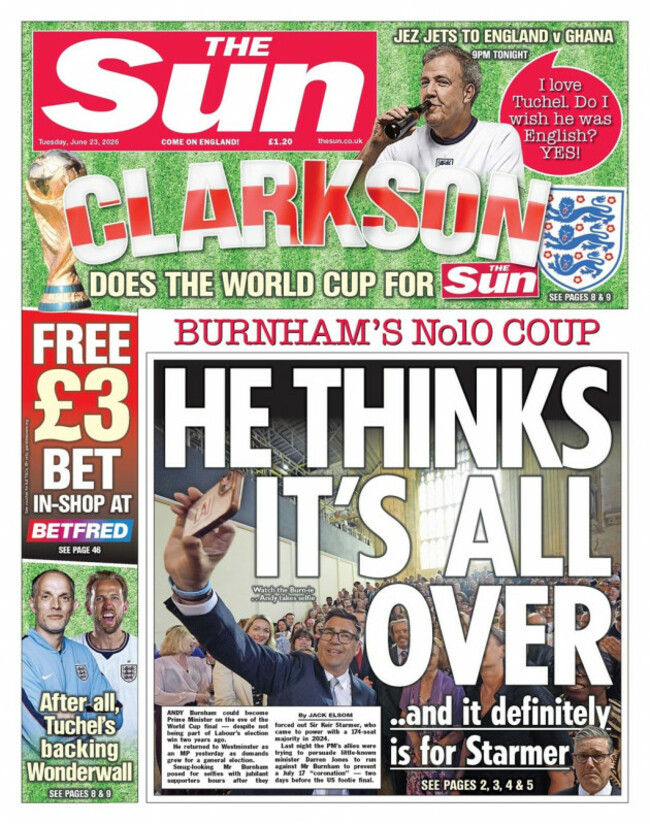
The man on the way out doesn’t feature all that much, squeezed out on the papers as in political life by the former mayor of Manchester.
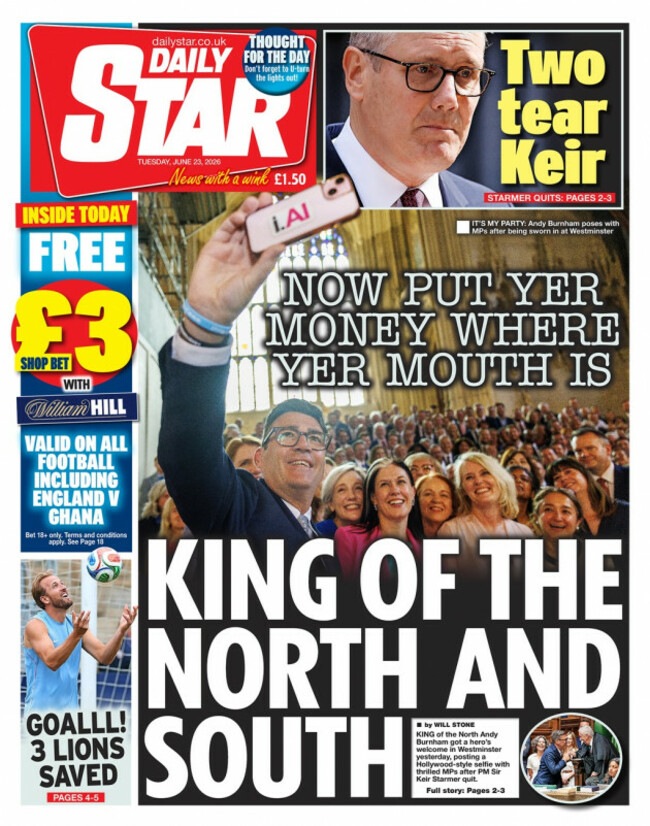
The Star includes Starmer on the top corner of its paper “Two tear Keir”, a reference to his emotional departure speech and trillionaire Elon Musk’s attacks on the outgoing prime minister for policing in the UK.
The same paper calls Burnham king not just of the north but also the south.
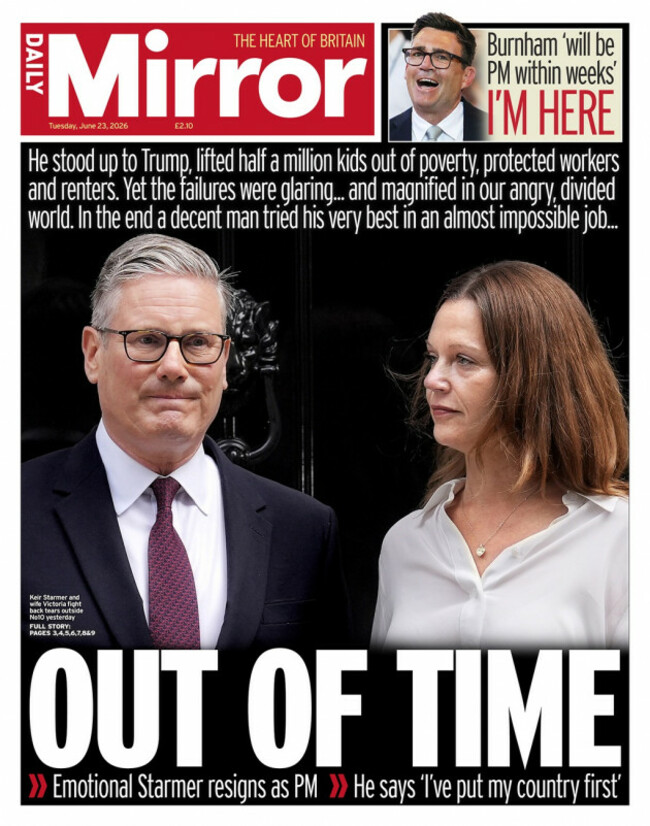
The best reception for Starmer comes from the Labour friendly Daily Mirror, which calls him a “decent man” who tried his “very best in an impossible job”. Nonetheless, it says that Starmer’s failures were “glaring” as leader of the country.
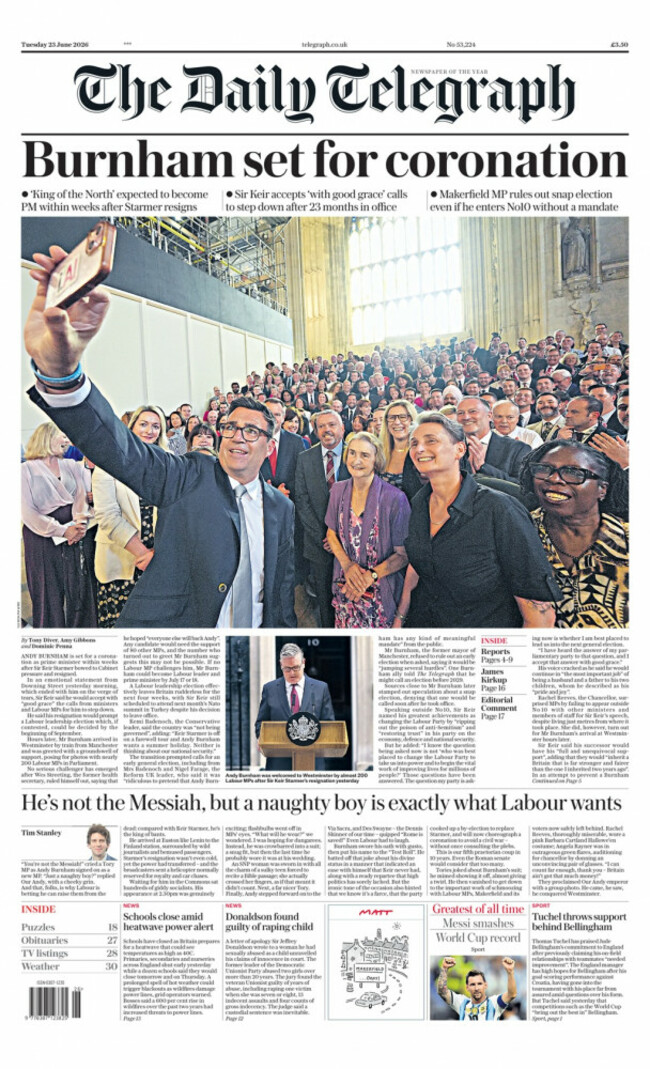
A selfie took with Labour’s hundreds of MPs after his arrival at Westminster is across the Telegraph and the Times, which both take a more sober attitude to the day’s events.
Burnham’s local paper from where he rebuilt his political career as mayor of Greater Manchester framed its front page around the likely new PM’s journey to London via the train.

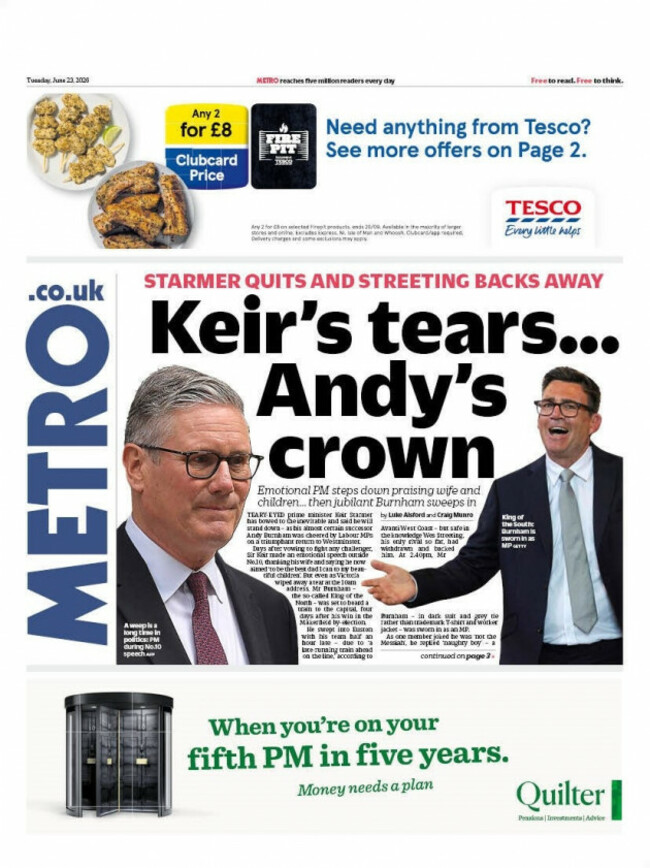
And it’s not the story on the front of the Metro that catches the eye, but the ad at the bottom of the paper by wealth management firm Quilter.
“When you’re on your fifth PM in five years, money needs a plan,” it reads.
‘He Thinks It’s All Over’: UK Papers Spotlight the Rise of Andy Burnham (and Slag Off Starmer)
Political change is often accompanied by a battle over the national narrative. When a leader rises and another begins to lose influence, newspapers play a powerful role in shaping how the public understands that transition. The headline “‘He Thinks It’s All Over’: UK Papers Spotlight the Rise of Andy Burnham (and Slag Off Starmer)” captures a moment when political attention shifts dramatically from one figure to another, highlighting not only the ambitions of Andy Burnham but also the growing criticism directed towards Keir Starmer.
In British politics, newspaper coverage has always played an important role in influencing public debate. Front pages often attempt to summarise complex political developments through memorable headlines, jokes, criticism, or dramatic language. The reaction to Burnham’s rise demonstrates how quickly the political conversation can change when voters, politicians, and commentators begin to focus on a potential new leader. Several newspapers highlighted Burnham’s growing influence while portraying Starmer’s position as increasingly weakened.
The phrase “He thinks it’s all over” carries a strong sense of political theatre. It suggests that one era may be ending while another begins. The wording creates the impression of a changing political landscape, where Starmer’s leadership is being questioned and Burnham is being presented as the figure ready to take centre stage.
However, newspaper headlines are not simply descriptions of events; they are also political interpretations. Different newspapers approach political stories with different perspectives and priorities. Some may focus on leadership failures, others on political opportunities, and others on the personalities involved. Understanding media coverage requires recognising that headlines often reflect a particular viewpoint.
Andy Burnham’s rise has attracted attention because his political career has followed a different path from many Westminster politicians. After serving in national government, Burnham established himself as Mayor of Greater Manchester, where he developed a reputation for regional leadership and local campaigning. His supporters argue that this experience gives him a practical understanding of how government decisions affect communities outside London.
One of Burnham’s strongest political messages has been the importance of regional equality. He has often argued that power and investment should be spread more evenly across the country. Supporters believe this approach connects with voters who feel that national politics has focused too heavily on London and other major centres.
This regional identity has become increasingly important in British politics. Many voters have expressed frustration about economic inequality, declining public services, and a sense that politicians do not understand their everyday concerns. Burnham’s supporters believe his experience working directly with local communities allows him to present himself as a politician who understands these issues.
The comparison with Keir Starmer is therefore not only about personality but also about political style. Starmer has often been described as a cautious, professional, and highly structured politician. His background as a lawyer shaped an image of careful decision-making and attention to detail. Supporters viewed these qualities as strengths, particularly after years of political instability.
However, critics have argued that Starmer struggled to create a strong emotional connection with voters. Modern politics often rewards leaders who can communicate a clear story about the future. While competence and experience are important, many voters also look for inspiration, personality, and a sense of direction.
This difference in political style has contributed to the contrast between the two figures. Burnham is often presented as a more openly political communicator, someone who emphasises personal connection and local identity. Starmer, meanwhile, has been portrayed by critics as more technocratic and managerial.
The media focus on Burnham’s rise also reflects wider questions about Labour’s future direction. Political parties constantly debate how they can win elections and maintain public support. Labour has faced the challenge of balancing traditional supporters with voters who have changed political allegiance in recent years.
For supporters of Burnham, his appeal lies in his ability to reconnect Labour with communities that feel disconnected from Westminster politics. They argue that issues such as housing, transport, public services, and economic opportunity should be at the centre of political decision-making.
Critics, however, may question whether a change in leadership alone can solve deeper problems. Governments and political parties face complex challenges that cannot be solved simply by changing personalities. Economic pressures, international events, and public expectations all create difficulties for any leader.
The criticism of Starmer in newspaper coverage reflects a common pattern in British politics. Leaders who achieve major electoral success can quickly face pressure if public expectations are not met. The same media that celebrates political victories can later focus heavily on mistakes, controversies, or declining popularity.
Starmer’s supporters may argue that negative coverage can sometimes exaggerate political problems. They may point out that governing involves difficult decisions and that leaders are often judged harshly during periods of uncertainty. They may also argue that criticism does not necessarily reflect the views of all voters.
On the other hand, critics argue that political leaders must accept responsibility for public dissatisfaction. They believe that governments must communicate effectively and demonstrate clear achievements if they want to maintain public confidence.
The rise of Burnham also raises questions about the role of personality in modern politics. Elections and leadership contests are increasingly influenced by perceptions of individuals rather than only policies. Voters often ask whether a politician appears trustworthy, capable, and connected to ordinary people.
Media coverage plays a major role in creating these impressions. A politician described as experienced and relatable may gain support, while another described as distant or ineffective may struggle. This does not mean newspapers completely determine political outcomes, but their influence on public discussion remains significant.
Another important issue is whether Burnham’s popularity can translate into national leadership. Being successful as a regional leader is different from governing an entire country. A prime minister must deal with international relations, national finances, defence, and a wide range of competing interests.
Supporters may argue that Burnham’s experience outside Westminster is exactly what modern politics needs. They believe that understanding local government and regional challenges can help create more effective national policies.
Sceptics may respond that national leadership requires different skills. A prime minister must manage a much larger political system and make decisions affecting the entire country. The transition from regional success to national leadership is never guaranteed.
The debate between Burnham and Starmer also reflects a broader discussion about what voters want from political leaders. Some people prefer stability, caution, and careful management. Others want stronger personalities who promise major change. Successful leaders must often combine both qualities.
Ultimately, the attention surrounding Burnham’s rise demonstrates how quickly political fortunes can change. A leader who appears secure one moment can become vulnerable when public opinion shifts. Likewise, a politician who has spent years building influence can suddenly become the centre of national attention.
In conclusion, “‘He Thinks It’s All Over’: UK Papers Spotlight the Rise of Andy Burnham (and Slag Off Starmer)” reflects a dramatic moment in political storytelling. The coverage highlights the contrast between Burnham’s growing reputation and Starmer’s struggles with criticism and changing expectations.
The story is not only about two politicians but about the changing nature of British politics itself. It demonstrates the importance of media narratives, public expectations, regional identity, and leadership style. Whether Burnham’s rise represents a lasting political transformation or simply a moment of intense attention will depend on what happens next.
Political careers are ultimately judged by results rather than headlines. Newspapers can influence the conversation, but voters decide which leaders succeed. For Burnham, the challenge would be turning public attention into lasting trust. For Starmer, the challenge would be defending his record and proving that his leadership still has public support.