
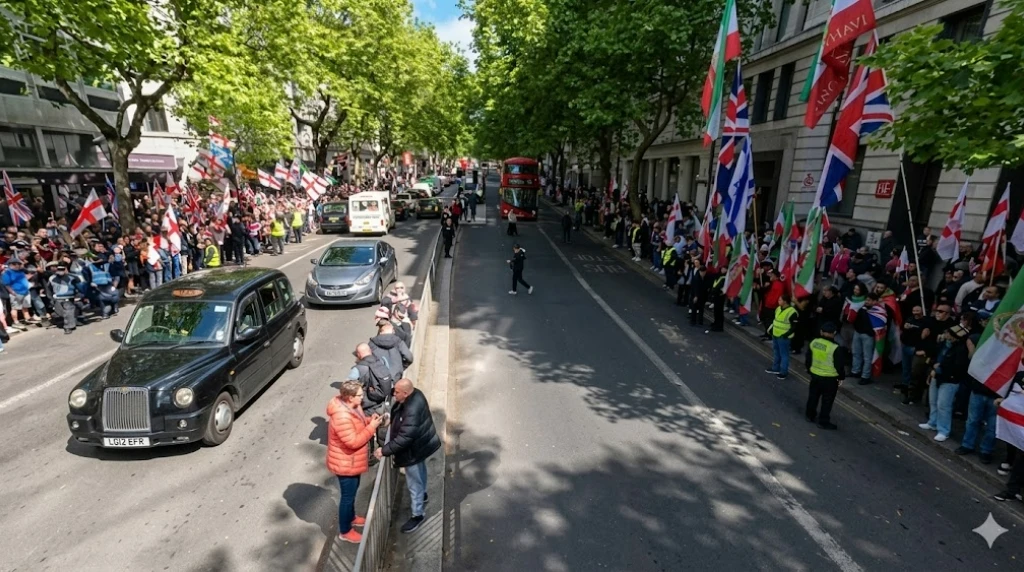
The “Unite the Kingdom” rally has officially erupted!  While PM Starmer doubles down, branding the massive crowds as “voices of division,” live footage shows something completely different.
London has seen an enormous influx of demonstrators this morning as the highly anticipated “Unite the Kingdom” rally gets underway. Video footage taken hours before the official start time shows streets packed with attendees, contradicting government narratives that the event is driven by violent extremists. Meanwhile, Prime Minister Keir Starmer has reiterated his condemnation of the march, sparking intense backlash from the event’s organizers and participants.
THOUSANDS GATHER EARLY IN LONDON Footage broadcast by the British Stand channel revealed significant crowds gathering in the capital as early as 10:00 AM, three and a half hours before the march was scheduled to begin. The video captured streets and junctions flooded with individuals and families carrying Union flags.
A prominent voice in the footage, purportedly an organizer, highlighted the demographic makeup of the crowd to counter the government’s narrative. “Look at all the flags… It’s all families, Starmer. All decent families coming, celebrating their country, their identity, and sending a message that they’re fed up,” the speaker stated .
The speaker emphasized the presence of “generations” of “decent people,” including children, asserting that these are the citizens the Prime Minister has labeled as “far-right agitators” and “racist, hateful people”. Organizers confidently predicted the gathering would be the “biggest in British history,” describing it as a movement of “nationalism” that will sweep the nation leading up to the 2029 elections .
PRIME MINISTER STARMER DOUBLES DOWN As the crowds swelled, Prime Minister Keir Starmer took to social media to double down on his harsh criticism of the rally. Following a video statement released the previous day, Starmer posted on LBC (London Broadcasting Company) this morning: “Today the voices of division will be loud. They don’t speak for the country I know, one that belongs to all of us. That’s our Britain, a Britain we’re fighting for.” .
Starmer’s comments reflect the government’s ongoing stance that the rally is a disruptive force fueled by extremism rather than legitimate political grievance. Commentators on the British Stand suggest that Starmer is intentionally trying to provoke chaos to distract from the severe internal crisis currently engulfing the Labour Party, specifically the rumors of a leadership challenge from Andy Burnham .
FIERCE REBUTTAL FROM ORGANIZERS The Prime Minister’s statements were met with immediate and aggressive pushback. Tommy Robinson, a central figure in the rally, directly replied to Starmer’s post with a blunt message: “The country belongs to us, the British people. Pack your bags, you commie wanker.” .
The British Stand host characterized Starmer’s rhetoric as “gaslighting,” arguing that the government is trying to paint “normal everyday people” representing the “heart of Britain” as thugs to invalidate their political concerns .
A CITY ON EDGE With the event now fully underway, the situation in London remains highly charged. The visual evidence of massive, early turnouts consisting largely of peaceful families poses a significant challenge to the government’s preemptive framing of the event as a dangerous, far-right riot. Authorities, including the Prime Minister and London Mayor Sadiq Khan, who were reportedly seen monitoring the situation from an operations room yesterday , are on high alert as the capital navigates one of the largest public demonstrations in recent history.
The rally has quickly become one of the most widely discussed political events in the United Kingdom, attracting attention from both domestic and international media. Supporters describe the demonstration as a peaceful expression of patriotism and national identity, arguing that it represents ordinary citizens who are dissatisfied with the government’s policies on immigration, the economy, public services, and freedom of expression. Many participants insist that they are exercising their democratic right to protest and reject accusations that the movement is motivated by hatred or political extremism.
At the same time, government officials and many political commentators have expressed concern that large demonstrations of this nature could be exploited by extremist groups seeking to inflame social tensions. They argue that while peaceful protest is a fundamental democratic right, public authorities have a responsibility to prevent violence, hate speech, and disorder. This difference in interpretation has further intensified the debate over the nature of the rally, with each side accusing the other of misrepresenting its intentions and actions.
The event also reflects deeper divisions within British society that have developed over the past decade. Since the Brexit referendum, the country has experienced increasing polarization over issues such as national identity, immigration, economic inequality, and the role of government. Rising living costs, pressure on public services, and concerns about economic growth have contributed to growing frustration among many voters. These challenges have created an environment in which large-scale demonstrations can attract significant public support while also generating substantial political controversy.
Political analysts suggest that the government’s response to the rally may have important consequences for public opinion. If the authorities are perceived as respecting the right to peaceful protest while maintaining public order, they may strengthen confidence in democratic institutions. Conversely, if either the protesters or the government are viewed as escalating tensions unnecessarily, the political divide could deepen further. As a result, the handling of the demonstration is likely to be closely scrutinized by opposition parties, civil society organizations, and the media in the days ahead.
The rally also comes at a sensitive moment for the governing Labour Party, which has been facing growing pressure over its economic agenda and declining approval ratings. Internal disagreements within the party, combined with persistent criticism from opposition leaders, have fueled speculation about Labour’s future direction. Although political leadership may change over time, the broader issues highlighted by the demonstration—including economic insecurity, immigration policy, social cohesion, and public trust in government—are likely to remain central topics in British politics for years to come.
Ultimately, the significance of the “Unite the Kingdom” rally will depend not only on the size of the crowds but also on its long-term political impact. Whether it leads to meaningful policy discussions, strengthens public engagement in the democratic process, or further polarizes political debate remains uncertain. What is clear, however, is that the demonstration has become a symbol of the competing visions for Britain’s future, illustrating the challenges faced by political leaders as they seek to balance national unity, freedom of expression, and public security in an increasingly divided political landscape.