
Reader discretion is strongly advised, as it discusses the horrors of the Holocaust and Nazi concentration camps.
In the annals of human depravity, few figures stand out as starkly as Karl-Otto Koch, a mid-level SS officer whose unbridled cruelty turned even his fellow Nazis against him. Born in 1897 in Darmstadt, Germany, Koch rose through the ranks of the Schutzstaffel (SS) not on merit alone, but on a foundation of sadistic zeal that made him a terror within the terror machine of the Third Reich. As the first commandant of Buchenwald concentration camp and later overseer of Majdanek, Koch didn’t just enforce the regime’s genocidal policies—he reveled in them, personally inflicting pain and death on thousands for sport. His excesses, which included flogging prisoners with whips, stomping on their bodies in fits of rage, and orchestrating unauthorized killings, horrified higher-ups in the SS, leading to his downfall not for moral reasons, but for corruption. Yet, Koch’s legacy endures as a chilling testament to the depths of Nazi inhumanity, one that was fully exposed in the postwar trials that sought justice amid unimaginable evil.

From Obscurity to the Heart of Darkness
Karl-Otto Koch’s path to infamy began far from the barbed wire and crematoria of the camps. Orphaned young after his father’s death in 1905, he drifted through odd jobs before enlisting in the German army during World War I, where he served as a paymaster sergeant. Postwar chaos drew him to the far-right fringes, and by 1931, he had joined the Nazi Party and the SS, climbing the ladder through loyalty and ruthlessness. His early postings in lesser-known camps like Esterwegen and Sachsenhausen honed his administrative cruelty, but it was in 1937, when Heinrich Himmler personally appointed him commandant of the newly established Buchenwald near Weimar, that Koch’s true monstrosity unfurled.
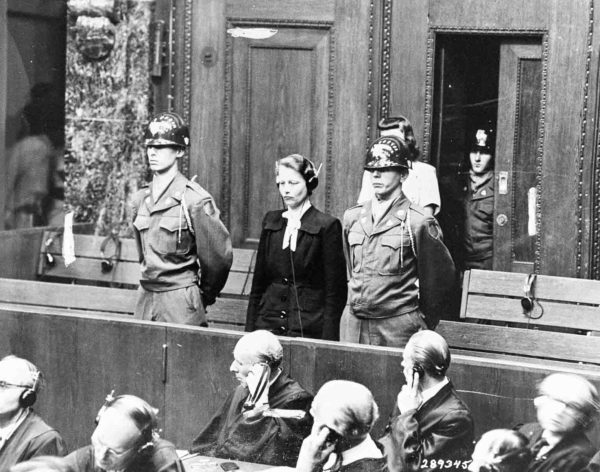
Buchenwald was no ordinary prison; it was a sprawling hellscape designed to break bodies and spirits, holding up to 56,000 inmates at its peak—Jews, political dissidents, Roma, and Soviet POWs among them. Under Koch’s command, it became a personal playground of torment. Witnesses from the 1947 Buchenwald Trial described him as a man who derived perverse pleasure from violence. He would roam the barracks at night, selecting prisoners at random for “entertainment,” forcing them to strip and endure beatings with a bullwhip he kept at his side. One survivor recounted how Koch, in a drunken rage, trampled a Jewish inmate to death under his boots, laughing as the man’s ribs cracked and blood pooled on the dirt floor. These weren’t isolated incidents; Koch’s sadism led to hundreds of extrajudicial murders, often disguised as “natural causes” to evade scrutiny. He even ordered the construction of a brothel within the camp, compelling female prisoners to service SS guards, further degrading the already shattered souls trapped there.
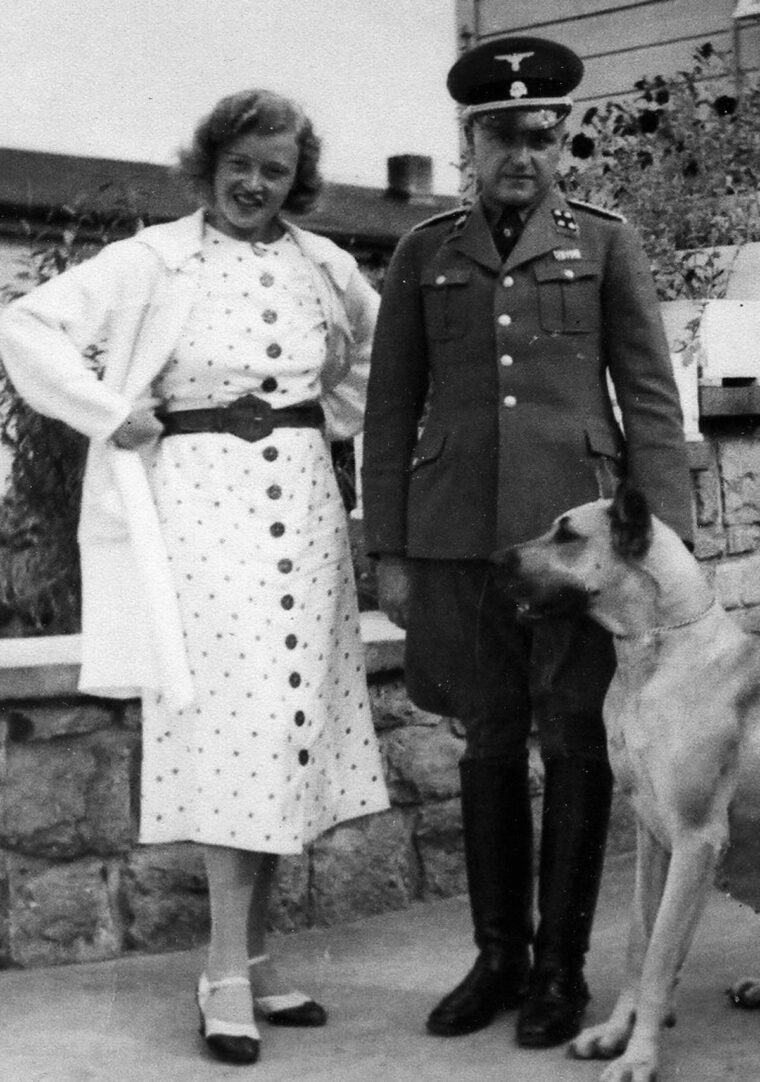
Koch’s wife, Ilse Koch—later dubbed the “Witch of Buchenwald”—mirrored and amplified his brutality. The couple hosted lavish parties in their villa overlooking the camp, where they would toss human ashes from the crematorium into the wind like confetti, or select tattooed skins from executed prisoners to fashion into lampshades and book covers—a gruesome hobby that became synonymous with Buchenwald’s horrors. Ilse herself wielded a riding crop with glee, flogging women until their backs were raw meat. Together, they embodied a domestic nightmare atop the industrial-scale genocide, their corruption extending beyond violence to embezzlement: Koch skimmed camp labor profits to fund his opulent lifestyle, pocketing gold teeth and jewelry stripped from the dead.
A Reign of Terror at Majdanek
By 1941, Koch’s reputation—equal parts efficiency and excess—earned him promotion to commandant of Majdanek, the blood-soaked extermination camp outside Lublin, Poland. Here, the machinery of death operated on an even grander scale, with gas chambers and mass graves claiming over 78,000 lives, including 59,000 Jews. Koch’s methods remained consistent: arbitrary executions, medical experiments disguised as “research,” and public spectacles of cruelty to cow the inmates into submission. He personally oversaw the gassing of transports, then rifled through the victims’ belongings for valuables. One SS officer, appalled by Koch’s habit of beating prisoners to death over minor infractions—like a dropped spoon—reported him to superiors, noting that even by Nazi standards, such “unnecessary” killings disrupted the camp’s “productivity.”
Majdanek’s horrors under Koch included the infamous “bathhouse” executions, where prisoners were herded into fake showers only to be asphyxiated with Zyklon B. His ledger of atrocities ballooned: forced labor in bone-crushing conditions, starvation rations that turned men into skeletons, and ritualistic whippings that left survivors maimed for life. Yet, Koch’s downfall loomed not from these crimes against humanity, but from his greed. Investigations revealed he had falsified records to siphon funds, bribed subordinates, and even murdered an inmate who threatened to expose him—all while the war turned against the Reich.
The SS’s Own Justice: A Firing Squad in Buchenwald
In late 1944, as Allied forces closed in, SS hardliner Josias Erbprinz zu Waldeck und Pyrmont launched a probe into Koch’s corruption. The trial, held in the very crematorium he had overseen, exposed not just financial malfeasance but a litany of abuses that shocked the SS elite. Witnesses testified to Koch’s “excessive cruelty,” including his role in shooting over 8,000 prisoners without authorization. Himmler, ever the pragmatist, ordered his execution to maintain discipline. On April 5, 1945—just weeks before Buchenwald’s liberation—Koch faced a firing squad in the camp’s stables. Blindfolded and defiant to the end, he was shot in the neck, his body cremated in the ovens he had once commanded. Ilse was arrested separately but survived the war, only to face her own reckonings.
Ironically, the SS’s “justice” spared the world from a full accounting of Koch’s crimes during his lifetime. It was left to the victors to unearth the truth.
A Legacy Etched in Ashes and Testimony
The Buchenwald and Majdanek trials, part of the broader Nuremberg proceedings, immortalized Koch as a symbol of unrepentant evil. Prosecutors presented diaries, ledgers, and survivor accounts detailing his hands-on sadism—floggings that peeled skin from bone, stomping sessions that crushed skulls, and killings tallied in the hundreds, if not thousands. Though he escaped human courts, his name became synonymous with the Holocaust’s visceral brutality, a reminder that monsters aren’t born in vacuums but forged in the fires of ideology.
Today, memorials at Buchenwald and Majdanek stand as silent indictments, their stones bearing the weight of Koch’s legacy. In a regime that normalized genocide, his excesses shocked even the perpetrators—a chilling irony that underscores the boundless capacity for human darkness. Karl-Otto Koch wasn’t just a cog in the Nazi machine; he was its most gleeful executioner, a monster among monsters whose story warns us that evil thrives not only in silence, but in spectacle.