

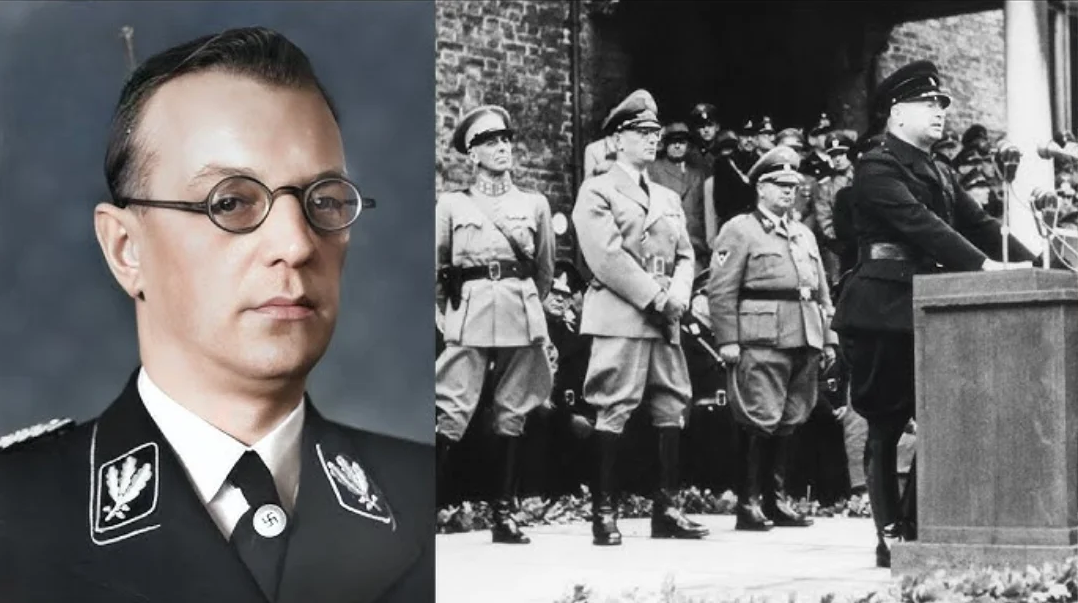
Content Warning: This article discusses the Holocaust, Nazi crimes, and postwar justice, and may be distressing. It is shared for historical and educational purposes to examine how persecution was implemented through state bureaucracy and why accountability matters for human rights.
Arthur Seyss-Inquart (1892–1946) was an Austrian Nazi lawyer who became Reichskommissar in the occupied Netherlands. Under his administration, anti-Jewish measures were enforced, the Dutch Jewish community was systematically deported, and large numbers were sent to camps where most did not survive. His government also imposed forced labor, restricted civil life, and repressed resistance through arrests and executions. After the war, he was tried at Nuremberg, convicted of major international crimes, and executed on October 16, 1946. This overview draws on court records and archival research to present an objective account of his career, his role in occupation policy, and the legal proceedings that followed.
Early Life and Rise in Austria
Born on July 22, 1892, in Stannern (in the Austro-Hungarian Empire; now in the Czech Republic), Seyss-Inquart later studied law and worked as a lawyer in Vienna. He served in World War I and, during the interwar years, aligned himself with pan-German nationalist politics that overlapped with Austrian Nazism.
In 1938, he played a decisive role in Austria’s political crisis leading to the Anschluss, the annexation of Austria by Nazi Germany. He briefly became chancellor during the transition and then held senior positions in the Nazi administration. In Austria, his government supported the exclusion of Jews from public and professional life and facilitated the transfer of property and institutions under Nazi control.
Role in Occupied Poland
From 1939, Seyss-Inquart served in the Nazi administration of occupied Poland under Governor-General Hans Frank. The General Government became a central site of mass persecution and killings. Within that system, Seyss-Inquart supported policies that targeted Jewish communities and other persecuted groups through segregation, deportations, and state violence.
Reichskommissar of the Netherlands
Appointed Reichskommissar on May 29, 1940, Seyss-Inquart became the top German civilian authority in the Netherlands. His administration dissolved democratic opposition, controlled cultural and civic institutions, and expanded policing structures to enforce Nazi rule. Strikes and resistance activities were met with harsh reprisals, including arrests, hostages, and executions.
Persecution of Jews and Forced Labor
Under Seyss-Inquart’s authority, anti-Jewish regulations were imposed, Jews were isolated from public life, and deportations were organized through a system of registration, restrictions, and transport. Tens of thousands were routed through transit sites such as Westerbork and sent to Nazi camps in the East, where the overwhelming majority were murdered. His administration also expanded forced-labor conscription, sending large numbers of Dutch civilians to work under coercive conditions, including in Germany.
Late-War Crisis and Aftermath
As the war turned against Germany, the Netherlands experienced deep hardship, particularly during the “Hunger Winter” of 1944–1945. While multiple military and logistical factors contributed to the crisis, the occupation authorities played a significant role in the conditions that worsened civilian suffering.
Nuremberg Trial and Execution
After Germany’s defeat, Seyss-Inquart was captured and indicted by the International Military Tribunal at Nuremberg. He was convicted of crimes against peace, war crimes, and crimes against humanity. He was executed by hanging on October 16, 1946.
Conclusion
Arthur Seyss-Inquart’s career illustrates how persecution and mass violence can be enabled by legal decrees, administrative structures, and bureaucratic obedience. Studying his actions and the postwar trials helps clarify the mechanisms of state-sponsored abuse and reinforces the importance of accountability, historical remembrance, and the protection of human rights.